

Last updated: October 14, 2026
Watch a dog trot alongside a horse in the pasture, or see the two touch noses over a fence, and it’s hard not to wonder if there’s some family connection there. They’re both social, both trainable, and both have lived alongside people for thousands of years. So are horses and dogs related, or is it just a coincidence that they seem so alike?
Below, I’ll show you where horses and dogs sit on the mammal family tree, why scientists still argue over exactly how they’re connected, why the two seem so similar, how they differ, and why they so often get along.
Table of Contents
Are Horses and Dogs Related?
Every living mammal is related if you go back far enough, so the real question is how close the relationship is. For horses and dogs, it’s closer than many people realize, but still very distant.
Scientists usually divide placental mammals into four big groups. Horses and dogs are in the same one, Laurasiatheria, along with cattle, pigs, whales, bats, cats, pangolins, and hedgehogs. Humans are in a different group with primates and rodents. That means a horse and a dog share a more recent common ancestor with each other than either one shares with you. Within that group, though, they’re on separate branches. A horse is an odd-toed ungulate, and its closest living relatives outside the horse family are rhinos and tapirs. A dog is a carnivoran, in the same order as cats, bears, and seals, and the domestic dog is a domesticated form of the gray wolf.
| Horse | Dog | |
|---|---|---|
| Superorder | Laurasiatheria | Laurasiatheria |
| Order | Perissodactyla (odd-toed ungulates) | Carnivora (carnivorans) |
| Family | Equidae | Canidae |
| Closest living relatives | Zebras and donkeys in the horse family; rhinos and tapirs in the same order | Gray wolves, then coyotes, jackals, and other canids |
| Domestication | Modern domestic lineage spread about 4,200 years ago | Earliest known dog dates to about 15,800 years ago |
So, are dogs related to horses? Yes, as distant cousins within Laurasiatheria. Scientists still debate the exact order in which horses, dogs, cattle, and the other groups branched apart, and that’s where the family tree gets messy.
Where Horses and Dogs Split on the Family Tree
You’d think scientists would have this settled by now, but they still disagree about some of the earliest branches of this part of the family tree. Different kinds of genetic evidence don’t always point to the same answer, which makes it hard to pin down which groups split off first.
In 2006, a team of Japanese researchers studied genetic markers called retroposons and found support for putting horses closer to carnivores, including dogs, than to cattle and other even-toed ungulates. That grouping already had a name, Zooamata, from the words for “animal friends,” since it put three of our favorite domestic animals, horses, dogs, and cats, on the same branch. That was an intriguing finding, but later genome studies mostly didn’t support it, and many now group horses with cattle and pigs in a branch called Euungulata, the hoofed mammals.
Even that isn’t final. A 2022 study in the journal Genes found that different kinds of genetic data point in different directions: one kind groups carnivores with even-toed ungulates, and another groups horses with even-toed ungulates. The authors blamed the confusion on how fast these lineages split from one another.
As for timing, a 2023 genome study of 241 mammal species found that placental mammals began diversifying before the asteroid that wiped out the dinosaurs, then took off again afterward. The split between the horse’s line and the dog’s line happened during that early burst, tens of millions of years before anything that looked like a horse or a dog existed. The animals at that fork were small, early mammals, nothing like either one today.
Why Horses and Dogs Seem So Alike
If they’re only distant cousins, why do so many people sense a connection? Mostly because people shaped both of them, and because they’ve spent a long time living with us.
Dogs are domesticated gray wolves, and genetic research has identified an early dog from about 15,800 years ago. Modern domestic horses trace back to the steppes of western Eurasia, and they spread across Eurasia about 4,200 years ago. Over generations, people selected both animals for traits that suited the jobs they needed done, including temperament and trainability, although both still vary a lot from one individual to the next.
Both are also social animals. Horses live in herds, and dogs came from pack-living wolves, so both pay close attention to body language, timing, and what happens after they respond. They don’t learn in exactly the same way, but I’ve found that both do better with a handler who’s clear and consistent. Reward the right response at the right moment, and either one has a better chance of understanding what you’re asking.
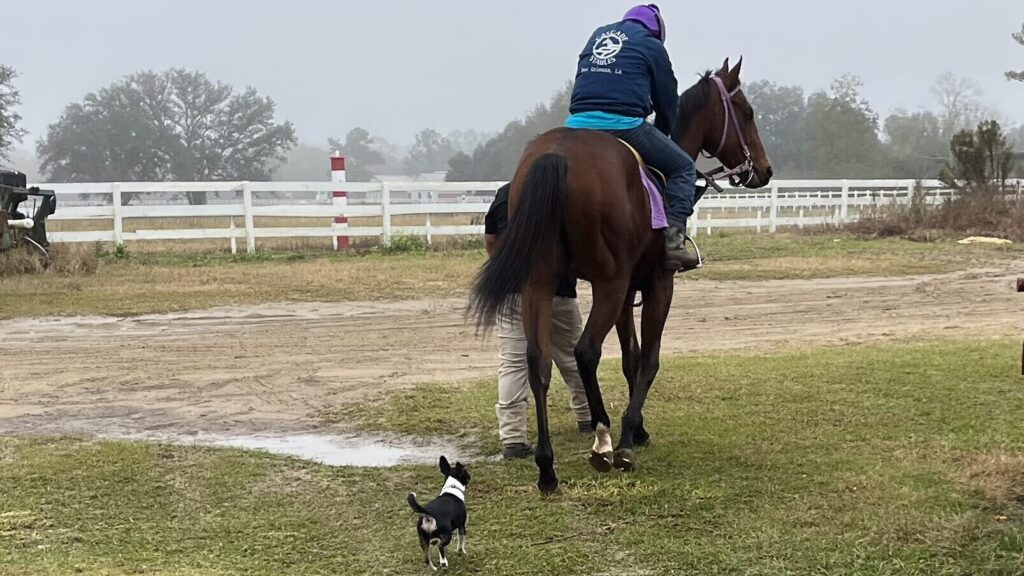
Their instincts are different, though. Horses evolved as prey animals, so a sudden noise or an unfamiliar movement can send one running. Dogs have predatory ancestry, but how they react depends a lot on breed, training, and experience. That difference explains why a dog that’s perfectly relaxed around a horse can still startle it by darting out from under a fence. People also argue over which one is smarter, and I’ve made my case that horses are smarter than dogs in some important ways.
Key Differences Between Horses and Dogs
The biggest difference isn’t size. It’s how each animal responds to danger, food, and its surroundings. Here’s how they compare where it matters most for an owner:
| Horse | Dog | |
|---|---|---|
| Role in nature | Prey animal | Predator |
| Diet | Herbivore that grazes most of the day | Omnivore with a strong preference for meat |
| Digestion | Hindgut fermenter built for steady forage | Simple stomach built for bigger, less frequent meals |
| Reaction to a scare | Runs first, thinks later | Investigates, barks, or stands its ground |
| Social life | Needs herd companions to feel safe | Bonds closely with people and can live as the only dog |
That prey-versus-predator gap is the big one. A horse that’s spooked doesn’t stop to figure out what moved in the brush, because for a prey animal, running first is what kept its ancestors alive. A lot of the facts about how horses think and behave come back to that prey instinct, and it explains much of what new owners find confusing.
Why Do Dogs and Horses Get Along?
There’s no such thing as a horse-dog hybrid, since the two are far too distantly related to interbreed. Given that one is a predator and the other is prey, you’d expect dogs and horses to stay wary of each other. Plenty of them do at first. But once they get used to each other, many become real friends, and some will play together like they’re the same species.
Researchers at the University of Pisa studied videos of dogs and horses playing together and found they copied each other’s facial expressions, including a relaxed, open-mouthed play face. The animals also rolled onto their backs and showed their bellies and throats, which is a sign they felt safe. The researchers said it was the first time they’d seen that kind of quick facial mimicry between play partners of two different species.
Not every pairing works, though. It depends on the dog’s temperament, the horse’s experience, and how you introduce them. If you’re bringing a new dog home to the barn, start with how to introduce a dog to a horse, and look into dog breeds that do well on horse farms before you pick one.
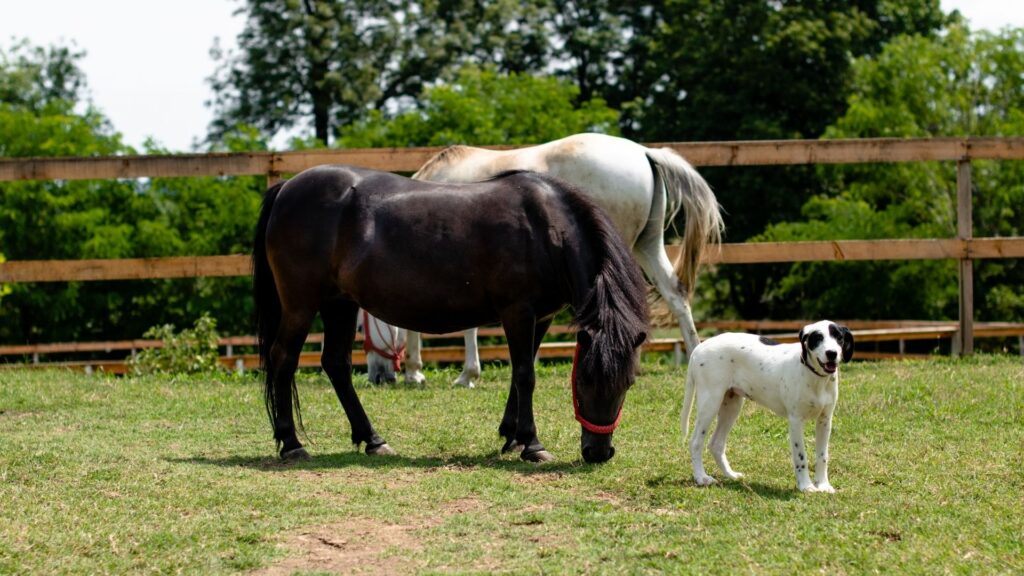
So horses and dogs aren’t close relatives, but they’re not strangers, either. They’re distant cousins that took very different paths, and then thousands of years of living with people brought them back together in the same barnyard.
About Miles Henry
Racehorse Owner & Author | 30+ Years in Thoroughbred Racing
Miles Henry (legal name: William Bradley) is a professional horseman based in Folsom, Louisiana. He holds Louisiana Racing License #67012 and has spent over three decades managing Thoroughbreds at premier tracks including Fair Grounds, Delta Downs, and Evangeline Downs.
Expertise & Hands-On Experience: Beyond the track, Miles has decades of experience in specialized equine care, covering everything from hoof health and nutrition to training protocols for Quarter Horses, Friesians, and Paints. Every guide on Horse Racing Sense is rooted in this “boots-on-the-ground” perspective.
30 of their last 90 starts
Equibase Profile.

Connect with Miles: