
Last updated: July 17, 2026
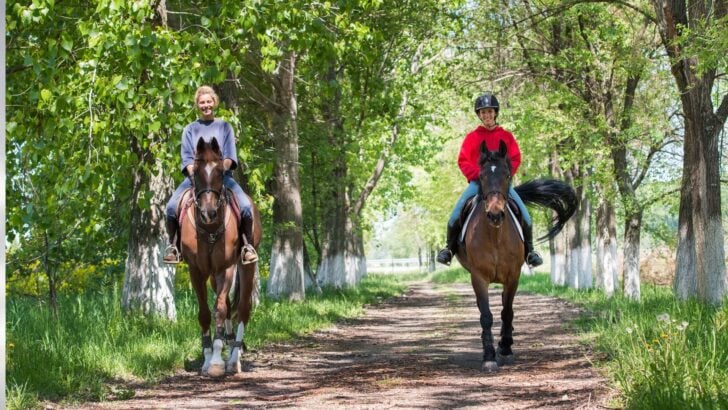
How long does it take a horse to travel 20 miles? At a steady walk, most horses cover 20 miles in 5–6 hours of riding time, or 6–8 hours total once you factor in breaks. The basic formula: Distance ÷ Speed = Riding Time — so 20 miles ÷ 4 mph = 5 hours, before terrain and rest stops. The pace and the horse’s conditioning level are the two variables that change this estimate most:
- Walk only (3.5–4 mph): 5–6 hours riding time — the realistic expectation for most trail riders
- Walk/trot mix (5–6 mph effective): 3–4 hours — requires a fit, conditioned horse
- Endurance pace (controlled trot/canter intervals): 1.5–3 hours — purpose-conditioned horses only
- Sustained gallop (25–30 mph): 40–48 minutes mathematically — not realistic; most horses can only gallop a short distance (often 2–3 miles or less) before fatigue makes continuing impractical and increases injury risk
I first worked out these numbers before a family trail ride at Bogue Chitto State Park near Folsom, Louisiana — we had kids along, so knowing how long we’d be in the saddle mattered. What I found is that the math is straightforward, but the real-world answer depends heavily on terrain, fitness, and how many breaks you take. This guide covers the numbers and the practical factors that move them.
About this guide: Trail experience based on decades of rides through Louisiana state parks and backcountry, alongside conditioning racehorses for distance at Fair Grounds and Evangeline Downs. Distance estimates cross-referenced with American Endurance Ride Conference completion data and AAEP conditioning guidelines. This is not veterinary advice — consult your equine vet for horse-specific guidance.
Table of Contents
20-Mile Time by Gait and Pace
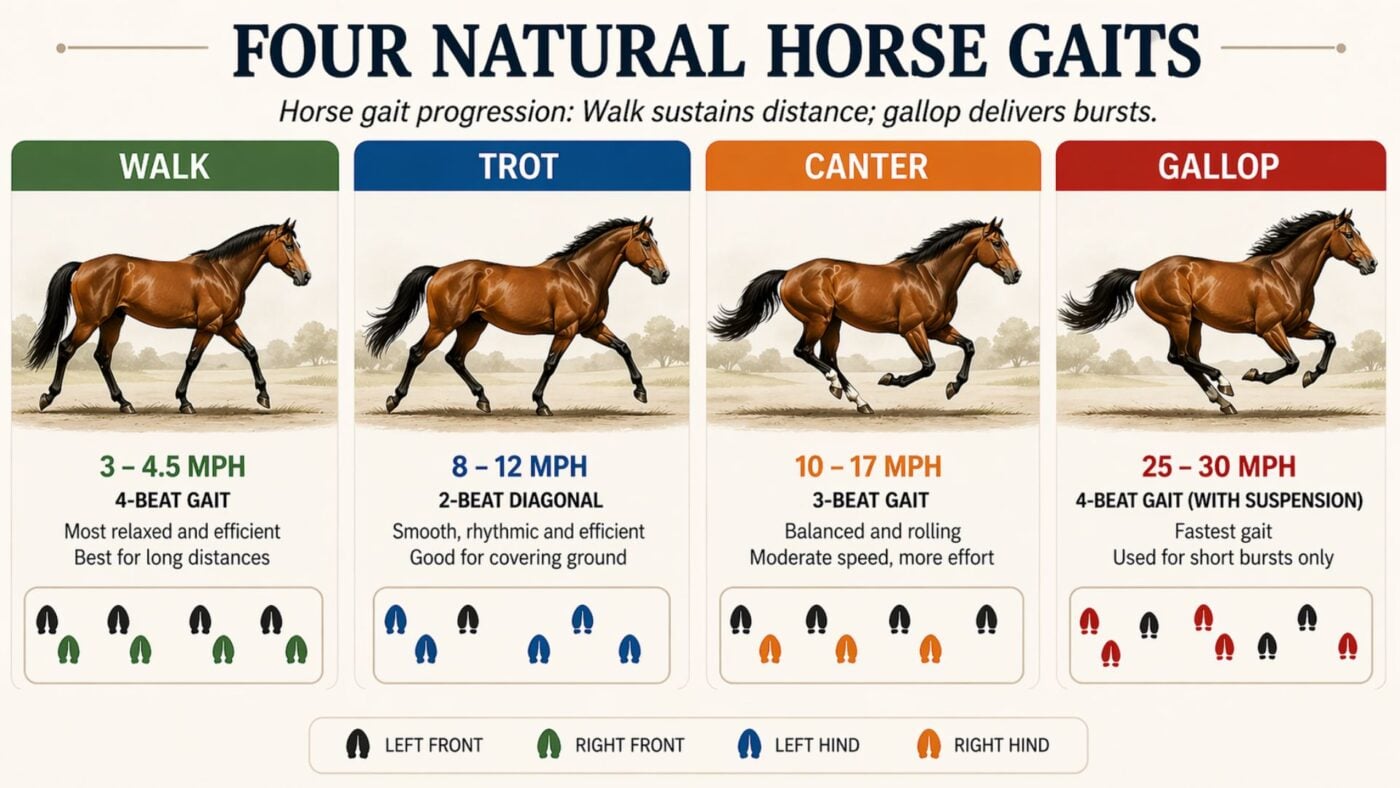
Horses have four natural gaits — walk, trot, canter, and gallop — each with a different speed range and a different sustainable distance. For 20-mile travel, only the walk and trot are realistic for most horses. The table below shows the math for each gait, along with the practical limits that apply in real trail conditions.
| Gait | Speed Range | 20-Mile Riding Time | Realistic for 20 Miles? | Notes |
|---|---|---|---|---|
| Walk | 3.5–4 mph | 5–6 hours | Yes — for most horses | The standard for recreational trail riders; sustainable all day with breaks |
| Walk/Trot mix | 5–6 mph effective | 3–4 hours | Yes — fit horses only | Requires conditioning; trot intervals of 10–15 min with walk recovery |
| Trot sustained | 8–12 mph | 1.7–2.5 hours | Rarely — endurance horses | Very few trail horses can trot 20 miles without significant walk breaks |
| Canter | 10–17 mph | 1.2–2 hours | No — for most horses | Most horses need walk breaks after 5–7 miles of canter; continuous is not realistic |
| Gallop | 25–30 mph | 40–48 min (math only) | No | Safe sustainable distance is 2–3 miles; not a trail gait |
What Changes the Estimate Most
The 5–6 hour walking estimate is a starting point, not a fixed answer. Several factors move it significantly:
| Factor | Effect on Time | Practical Guidance |
|---|---|---|
| Terrain and footing | Add 20–30% for hilly ground; 40–50% for deep sand, mud, or significant elevation | A 20-mile ride on flat, firm trail may take 6 hours; the same distance with creek crossings and sandy sections could take 8–9 hours |
| Horse conditioning level | Unconditioned horses: add 30–50% and reduce to 15 miles maximum; well-conditioned: at or slightly below baseline | An unconditioned horse pushed past 15 miles risks dehydration, lameness, or tying-up; conditioning takes 4–6 weeks of progressive work to build safely |
| Breaks and stops | Add 45–90 min total for a day-long ride with proper water and rest stops | The difference between 5–6 hours riding time and 6–8 hours total time is the break schedule — plan for water every 2 hours and a 10–15 minute rest stop every 90 minutes |
| Group pace | The slowest horse or rider sets the pace for everyone | A family ride with children or novice riders should be planned around the most conservative participant — typically 10–15 miles max, walk only |
| Heat and humidity | Add 25–40% in high heat; reduce target distance | Louisiana summer conditions (90°F+, high humidity) can reduce safe daily distance by a third compared to a cool-weather ride on the same trail |
| Rider weight | Light riders (under 15% of horse’s body weight): minimal effect; heavier riders (20%+): add 15–20% time, consider reducing target distance | The standard guideline is 20% of the horse’s body weight including tack — a 1,000 lb horse carrying a 200 lb rider plus a 15 lb saddle is at that threshold; heavier loads increase cardiovascular demand over long distances |
Horseman’s Perspective: I regularly lead 6-hour trail rides at Bogue Chitto and nearby backcountry covering 22–25 miles. Horses finish sound and could go again the next day — but we hold to a steady walk with short stops every 90 minutes and water every 2 hours minimum. The horses that do best over distance are the ones that never get pushed past that sustainable pace in the first place. Fitness matters, but pacing matters more.
Walk Pace: What 20 Miles Actually Feels Like
At a steady 3.5–4 mph walk, 20 miles is a genuine full-day commitment — not a morning ride. Once you factor in the breaks, water stops, and the natural slowdown that comes after the 12–15 mile mark, most recreational horses and riders are looking at 7–8 hours door to door. That’s not a discouragement — a 20-mile day ride on good trail is a memorable experience — but it needs to be planned as a full day, not an afternoon outing.
On trails like those at Bogue Chitto near Folsom, horses naturally settle into 3.5–4 mph on the sandy sections and slow slightly through creek crossings and wooded stretches. The terrain variation is part of what makes those trails rideable for a full day — constant variation keeps horses mentally engaged and naturally regulates pace. Flat, featureless terrain at a constant pace is actually harder on horses than varied trail because it allows fatigue to accumulate without the small recovery periods that terrain changes provide.
The 10–12 mile wall: Most horses — even fit ones — show a change in energy and attitude somewhere between 10 and 15 miles. Ears come back, the stride shortens slightly, willingness to push the pace decreases. This is not distress — it is the horse’s natural energy management system working correctly. The right response is to maintain the same steady pace rather than pushing through it. Horses that are allowed to work through this period at a consistent walk usually find a second wind; horses that get pushed at this point are the ones that struggle in the final miles.
Trot and Canter: When to Use Them Over 20 Miles
Adding trot intervals to a 20-mile ride can meaningfully reduce total time — but only if the horse is conditioned for it. A fit trail horse that has been worked at trot intervals over 4–6 weeks can sustain a walk/trot mix at an effective 5–6 mph, bringing a 20-mile ride from 5–6 hours down to 3–4 hours. The key word is conditioned — a horse that trots 20 miles without preparation is a horse that may not be sound the next day.
Canter is different. Many fit trail horses can canter for several miles under favorable conditions, but few can sustain it continuously without walk breaks — breed, footing, weather, and rider all affect that number significantly. Canter is most useful on smooth, flat stretches as a short interval to cover ground, not as a sustained travel gait. Endurance-conditioned Arabians and similar horses are the exception; they use canter/walk intervals effectively across long distances because they have been specifically trained for that rhythm over months or years.
Gallop should not be part of a 20-mile trail plan. Most horses can only safely gallop 2–3 miles before fatigue and injury risk increase significantly. At 25–30 mph, the math says 20 miles in under an hour — but that calculation has no connection to what a horse can actually sustain safely on a trail. For more on gait speeds and their limits, see the complete horse gaits speed guide.

Planning a 20-Mile Ride: Breaks, Water, and Pacing
A 20-mile ride done well is a planned event, not a spontaneous one. The schedule below is what I use for day rides in Louisiana backcountry — adjust for your terrain, your horse’s fitness, and your group’s experience level.
| Time | Miles | Activity | Notes |
|---|---|---|---|
| 7:00 AM | 0 | Departure — steady walk | Early start avoids afternoon heat; horses are freshest in the morning |
| 8:30 AM | ~5–6 | First rest stop — 10–15 min | Offer water; check tack and legs; let horses graze briefly if safe |
| 10:00 AM | ~10–11 | Midpoint stop — 20–30 min | Longer break; full water offer; assess horse energy; this is the decision point if the horse shows fatigue |
| 11:30 AM | ~15–16 | Third rest stop — 10–15 min | Final push begins; watch for early fatigue signs; maintain walk pace regardless of the group’s energy |
| 2:30–3:00 PM | 20 | Return — cool down walk last mile | Finish at a walk; allow 20–30 min of slow walking before untacking; monitor for 30 min post-ride |
Horseman’s Perspective: The pacing rule I give every rider on a long group trail is simple: if you’re wondering whether to slow down, you’ve already waited too long. On a 20-mile ride, the decision to press pace at mile 12 costs you at mile 18. I’ve seen riders push through the energy dip at the midpoint thinking the horse will recover — and it does, but it comes back slower and flatter than it went in. The best 20-mile rides I’ve done were the ones where the pace felt almost boring. That’s what a sound, repeatable long ride looks like.
Safety on Long Rides
A 20-mile ride is at the upper end of what a recreational horse should be asked to do in a single day without specific conditioning. The most important safety considerations are hydration, early fatigue recognition, and knowing when to stop.
Stop immediately if you see any of these:
- Heavy, labored breathing that does not ease within 5 minutes of stopping
- Reluctance or refusal to move forward — a horse that stops wanting to go is telling you something
- Staggering, stumbling, or loss of coordination
- Excessive sweating disproportionate to effort or, conversely, dry skin when the horse should be sweating
- Skin pinch test returns slowly (more than 2 seconds) — a dehydration sign
- Dark urine, tacky gums, or sunken eyes — more advanced dehydration signs requiring immediate attention
If any of these appear, stop, shade the horse if possible, offer water, and call your veterinarian. In distance riding, waiting to see how the horse looks in an hour is a serious mistake.
Conditioning before your 20-mile ride: A horse that has not been ridden regularly should not attempt 20 miles without a 4–6 week preparation period of progressive distance work. Start with 5–8 mile rides, add 2–3 miles per week, and include at least one 15-mile ride 10–14 days before the target date — allowing full recovery before the main effort. Horses that are fit for 15 miles adapt well to 20; horses that are fit for 8 miles should not attempt 20. For broader context on daily distance limits across fitness levels, see the complete daily horse travel guide.
What Most Riders Get Wrong About 20-Mile Rides
- The boring pace is the right pace — a 20-mile ride done well feels almost uneventful for the first 15 miles; if you’re feeling the effort before mile 12, you started too fast or the horse wasn’t ready
- Varied terrain is easier on horses than flat ground — constant variation keeps horses mentally engaged and naturally breaks up fatigue in ways that flat featureless trail doesn’t; the creek crossings and wooded stretches at Bogue Chitto are assets, not obstacles
- The 10–12 mile mark is the real test — energy and attitude shift here on almost every horse; the right response is maintaining steady pace, not pushing through; horses allowed to work through this period usually find a second wind
- Rider fitness is often the limiting factor before horse fitness — children and beginners can become sore after 3–4 hours regardless of how fresh the horse is; plan distance around who’s in the saddle, not just what the horse can handle
- Walk speed varies more than people expect — most horses settle into 3.5–4 mph naturally on trail, but gaited breeds, heavier riders, deep footing, and heat all move that number; build your schedule from your horse’s actual pace, not the theoretical average
- Recovery starts at the finish line, not the barn — the last mile should be a slow walk; untacking immediately after arrival and leaving a hot horse to stand is a common mistake; 20–30 minutes of continued slow movement before untacking makes a meaningful difference in next-day soundness
FAQs: How Long Does It Take a Horse to Travel 20 Miles
How long does it take a horse to travel 20 miles at a walk?
At a steady walk of 3.5–4 mph, a horse covers 20 miles in approximately 5–6 hours of riding time. Add breaks, terrain adjustments, and rest stops and the total day is closer to 6–8 hours. This is the realistic estimate for most recreational horses on moderate trail terrain.
Can a horse travel 20 miles in one day?
Yes — 20 miles is a realistic single-day distance for a fit recreational horse ridden at a steady walk with proper breaks. It sits at the upper end of comfortable daily range for a well-conditioned trail horse. Unconditioned horses should be limited to 10–15 miles until they are built up through progressive conditioning over 4–6 weeks. For context on overall daily limits, see the daily horse travel guide, which covers distances from 15 miles to endurance competition ranges.
How long would it take to travel 20 miles on horseback at a trot?
At a sustained trot of 8–12 mph, the math gives 1.7–2.5 hours for 20 miles. In practice, very few trail horses can sustain a trot for 20 miles without walk breaks. A realistic walk/trot mix at an effective 5–6 mph pace brings the total riding time to 3–4 hours for a conditioned horse — still significantly faster than a walk-only pace.
How far can a horse walk in an hour?
A horse walking at a typical trail pace of 3.5–4 mph covers 3.5–4 miles in one hour. Most horses settle naturally into this range on level trail ground. Some gaited breeds like the Tennessee Walking Horse can cover ground faster in their specialized running walk — typically up to 6–8 mph — making them efficient choices for long-distance riding. For most trail horses, the 3.5–4 mph estimate is a reliable planning figure.
What are early signs of dehydration during a long trail ride?
Early signs include skin tenting (skin pulled up near the shoulder returns slowly — more than 2 seconds is concerning), tacky or dry gums, reduced energy and willingness to move forward, and dark urine. More advanced signs include sunken eyes, rapid heart rate, and incoordination. Offer water at every stop and perform a quick skin pinch test every 2 hours on a long ride.
Is 20 miles too far for a beginner rider or a family ride with children?
For most beginners and family rides with children, 20 miles is too ambitious for a single day. A more appropriate target is 8–12 miles, which keeps total saddle time under 4 hours and leaves a comfortable margin for slower pace and more frequent breaks. Children and novice riders fatigue in the saddle before the horse does — plan the distance around rider comfort, not just horse capacity.
What horse breeds are best suited for long trail rides?
Arabians are considered the gold standard for long-distance riding due to their efficient metabolism, stamina, and thermoregulation. Gaited breeds such as Tennessee Walking Horses, Missouri Fox Trotters, and Paso Finos are excellent for distance because their smooth ambling gaits are comfortable for riders over many hours. Quarter Horses are versatile and commonly used for recreational trail riding at moderate distances. Thoroughbreds with trail experience can also cover long distances well, particularly in cooler conditions.
About Miles Henry
Racehorse Owner & Author | 30+ Years in Thoroughbred Racing
Miles Henry (legal name: William Bradley) is a professional horseman based in Folsom, Louisiana. He holds Louisiana Racing License #67012 and has spent over three decades managing Thoroughbreds at premier tracks including Fair Grounds, Delta Downs, and Evangeline Downs.
Expertise & Hands-On Experience: Beyond the track, Miles has decades of experience in specialized equine care, covering everything from hoof health and nutrition to training protocols for Quarter Horses, Friesians, and Paints. Every guide on Horse Racing Sense is rooted in this “boots-on-the-ground” perspective.
30 of their last 90 starts
Equibase Profile.

Connect with Miles: