Last updated: October 8, 2026
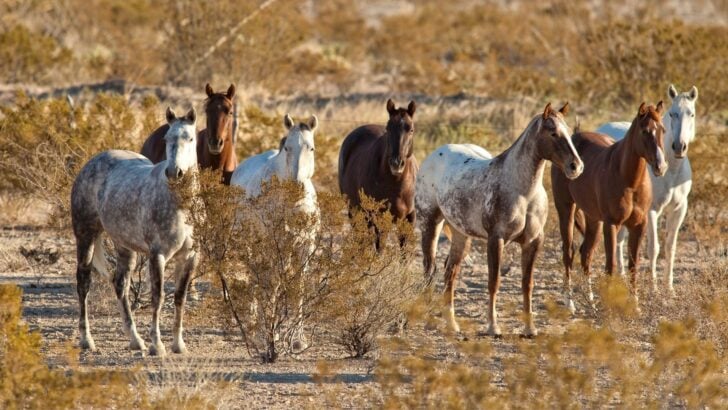
Say the word mustang, and most people picture a band of horses running across open desert. But what is a mustang horse, exactly, and is it really a breed?
Here’s how that background affects their size, conformation, and temperament, plus what to know if you’re thinking about bringing one home.
Table of Contents
What Is a Mustang Horse?
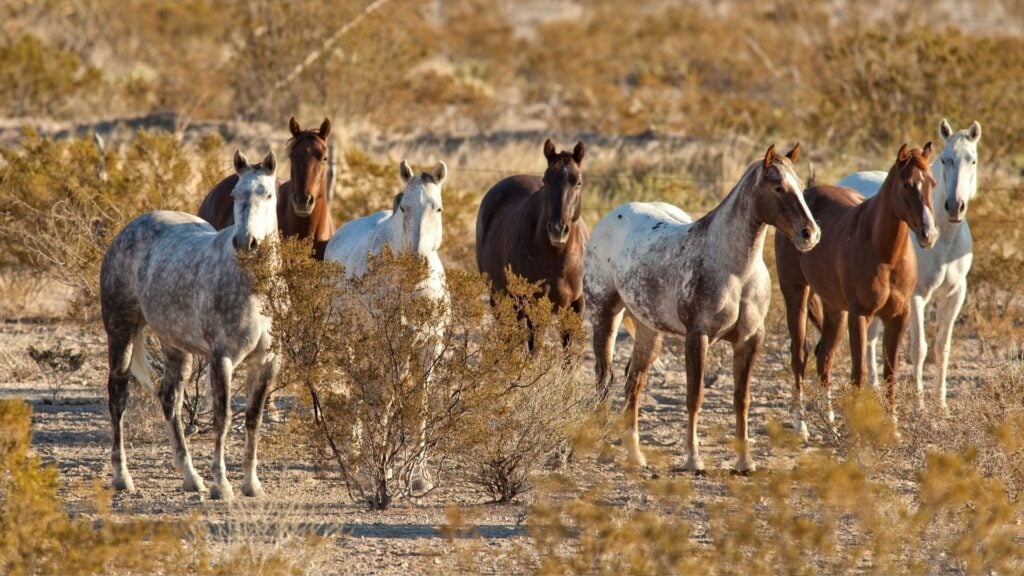
A mustang is a feral horse, which means it descends from domestic horses that got loose or were turned out and then lived and bred on their own. That’s why mustangs are different from the Przewalski’s horse of Central Asia, which is generally considered the last truly wild horse.
There’s no single studbook for mustangs, and herds vary a lot from one range to the next. Some private registries track horses with Spanish-type ancestry, but most mustangs on public land don’t fit one breed standard. Mustang and BLM horse aren’t quite the same thing, either. The BLM manages the herds on the public land it oversees, while some mustangs and Spanish-type horses are bred privately.
The name reflects that background. It comes from the Mexican Spanish mestengo, meaning a stray or ownerless animal.
Mustang Horse Characteristics and Conformation
Mustangs don’t all look alike, because their ancestry varies from herd to herd. Many are smaller, sturdy riding horses with short backs and durable hooves, but there’s no single mustang build. A horse with more Spanish-type ancestry may look quite different from one with draft blood in its background. Mad Barn’s mustang breed guide puts most of them at 14 to 15 hands and around 800 pounds. Here’s what you’ll often see:
| Trait | What’s common |
|---|---|
| Height | Usually about 14 to 15 hands, though herds and individual horses vary |
| Weight | Often around 800 pounds, depending on size and condition |
| Head | Often a flat or slightly convex profile with a broad forehead and fine muzzle |
| Body | Often compact, with a short, strong back; build varies by ancestry |
| Legs | Usually sturdy for the horse’s size, but leg conformation varies and needs to be judged horse by horse |
| Hooves | Often described as durable and thick-walled, though hoof quality varies by horse |
| Colors | Almost any color, including bay, black, sorrel, dun, grulla, buckskin, roan, palomino, and pinto |
| Markings | Dun horses often show a dark stripe down the back and barring on the legs |
A hand is four inches, so a 14-hand horse stands 56 inches at the withers. Keep in mind that the mustang label tells you about a horse’s background, not whether it’s built for the job you have in mind. Judge the individual horse’s legs, feet, and overall build rather than assuming range life has given it ideal conformation.
Mustang Horse History
Horses had died out in North America thousands of years before Europeans arrived. Columbus brought horses back to the Caribbean on his second voyage in 1493, and Spanish breeding herds there supplied the horses that later moved into Mexico and the Southwest. Some escaped, some were stolen, and some were turned loose, and free-roaming bands grew across the West. Those early Spanish horses are a big part of the history of horses in America.
Later, ranch horses, draft stock, and Army remounts were added to some herds, contributing to the mix of different horse breeds found in many mustang herds today. By the early 1900s, herds were being rounded up and slaughtered in large numbers.
That started to change thanks to Velma Johnston, known as Wild Horse Annie. According to the BLM’s wild horse program history, her campaign led to the 1959 Wild Horse Annie Act, which banned hunting wild horses and burros from motor vehicles on public lands. Congress then passed the Wild Free-Roaming Horses and Burros Act, which President Nixon signed on December 18, 1971. That law still governs how mustangs are protected and managed on public land.

Well-Known Mustang Herds and Spanish Mustangs
Mustangs aren’t divided into official types the way recognized breeds are. More often, people identify them by the herd or region they come from, or by the Spanish ancestry some populations still carry.
Pryor Mountain mustangs
The Pryor Mountain Wild Horse Range straddles the Montana-Wyoming border and was established in 1968. According to the BLM Pryor Mountain range page, genetic testing shows these horses carry a higher-than-average level of ancestry from New World Spanish breeds. They’re small, usually 13 to 14 hands, and many show a dark stripe down the back, two-toned manes and tails, and striping on the legs.
Kiger mustangs
Kiger mustangs come from southeastern Oregon. Oklahoma State University’s Kiger mustang profile explains that a herd that looked largely Spanish was gathered in 1977 and split between the East Kiger and Riddle Mountain herd management areas. The dun color is what catches your eye first, in shades from brown dun to nearly white, usually with a dark stripe down the back and stripes around the lower legs.
Spanish Mustangs
Spanish Mustang usually refers to horses bred to preserve the old Spanish-type horse, mostly through private registries rather than on public land. That makes it a different kind of category from a range herd like the Pryors or Kigers, even though all three share Spanish roots.
Mustang Temperament and Uses
On the range, a mustang grows up in a family band, usually a stallion with a few mares and their foals, and young males often run together in bachelor groups. A horse raised that way has had to look after itself, so a newly gathered mustang usually has a strong flight response and doesn’t trust people at first. Wild horses can be dangerous when they feel cornered, and an untouched mustang needs a patient, experienced handler.
With patient handling, many learn to trust people and become willing, dependable riding horses. That change isn’t automatic, though, and the individual horse matters. The important part is consistency. A mustang needs to learn that your cues are predictable and that pressure goes away when it gives the right answer, which is the same foundation behind any good horse training program.
Age matters, but it isn’t the whole story. A young, untouched mustang can be much harder to handle than an older horse that’s already spent time around people. Once they’re trained, mustangs are used for trail riding, ranch work, and endurance riding, and many become solid family horses.
How Many Mustangs Are on BLM-Managed Ranges?
The BLM’s 2026 wild horse and burro population estimate put the herds it manages at 61,523 wild horses and 23,943 burros as of March 1, 2026. That isn’t a count of every mustang in the country, just the animals on BLM-managed ranges. Nevada has by far the most horses, with an estimated 37,426, followed by Wyoming, Oregon, Utah, and California.
The BLM sets an Appropriate Management Level, or AML, for each area, meaning the number of horses and burros it determines the land can support while keeping the range healthy. The combined upper AML is 25,592 animals, so the current population is more than three times that. When herds outgrow what the range can support, the BLM gathers horses and offers them for adoption or sale. How to manage those numbers, through gathers, fertility control, or other methods, is still a heated debate.
Are Mustangs Good for Beginners?
An untrained mustang straight off the range isn’t a good choice for a beginner. A trained mustang may be suitable, but “started” doesn’t necessarily mean beginner-safe. If you’re new to horses, look for a horse with an established riding history that fits your ability, and have an experienced trainer help you assess it. Otherwise, a beginner-friendly horse is the safer place to start.
The difference isn’t that mustangs are bad-tempered. It’s that an untouched horse hasn’t learned everyday handling skills, like leading, standing tied, picking up its feet for the farrier, loading in a trailer, and responding to a rider. And just because a mustang got by on sparse range doesn’t mean it needs less care at home. It still needs appropriate feed, hoof care, vet care, and conditioning.
If you want to adopt from the BLM, here are a few of the basic requirements from its adoption FAQ. Check the full facility, shelter, and trailer rules before you apply.
- You must be at least 18 years old with no record of animal abuse.
- Adoption fees start at $125, although fees and bidding can vary by animal and event.
- You’ll need at least 400 square feet of approved corral space per animal, such as a 20-by-20-foot pen. That’s a minimum for the facility, not a recommendation for how much room a horse should have long term.
- An ungentled horse two years or older needs a 6-foot-high enclosure, while a gentled horse needs 5 feet.
- You’ll need a stock-type, covered trailer with swing gates and sturdy walls and floors to haul the horse home.
- The horse remains federal property until the BLM issues your Certificate of Title. After one year, you can complete the title process with a qualified person’s signed confirmation that you’ve provided proper care.
Whether you adopt or buy, look the horse over carefully first, and know how to check a horse before buying.
If you’re considering a mustang, look past the image of a horse running free. The individual horse’s training, temperament, feet, and conformation matter far more than the label. In the right hands, a trained mustang can be a very useful horse.
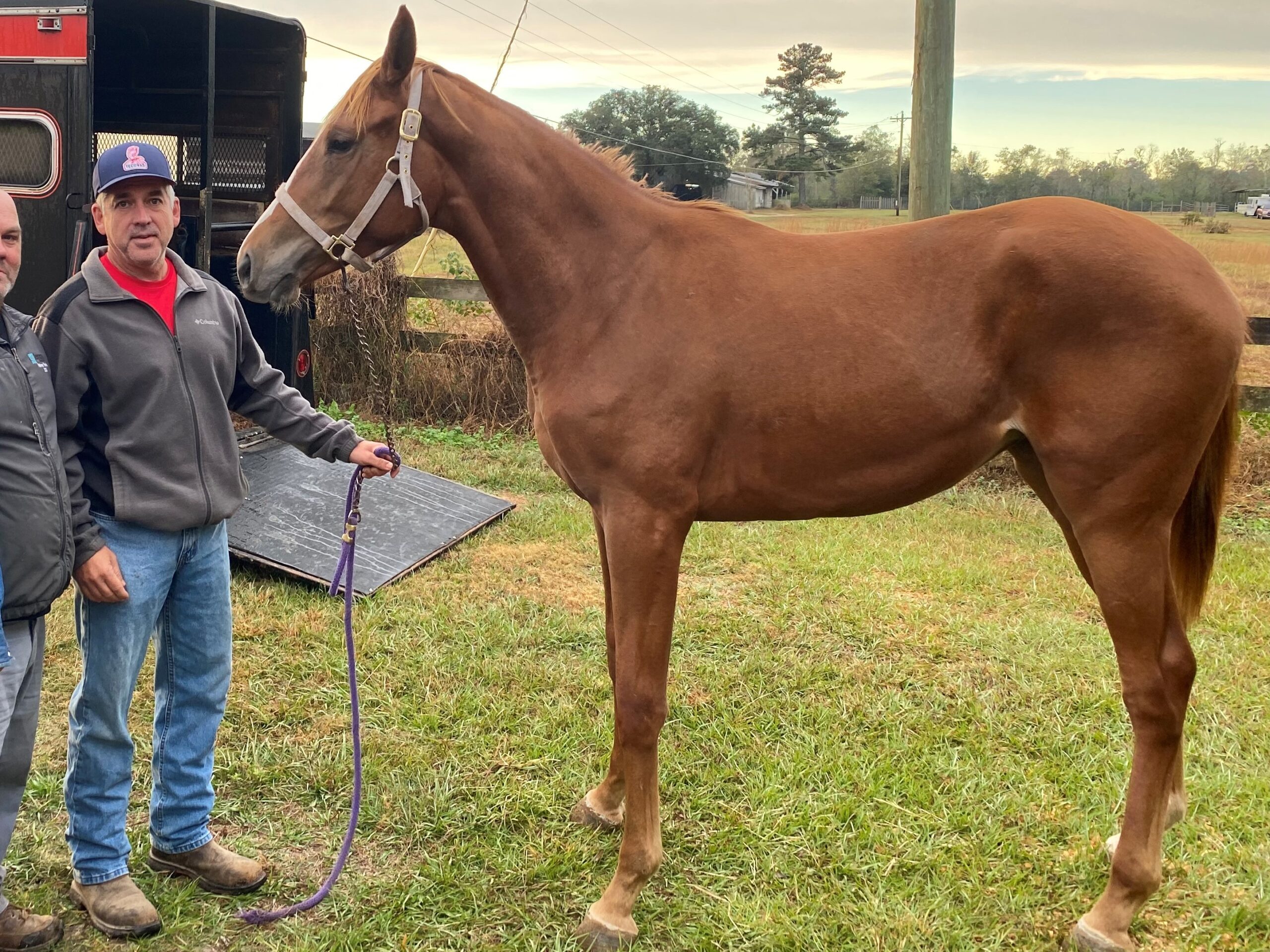
About Miles Henry
Racehorse Owner & Author | 30+ Years in Thoroughbred Racing
Miles Henry (legal name: William Bradley) is a professional horseman based in Folsom, Louisiana. He holds Louisiana Racing License #67012 and has spent over three decades managing Thoroughbreds at premier tracks including Fair Grounds, Delta Downs, and Evangeline Downs.
Expertise & Hands-On Experience: Beyond the track, Miles has decades of experience in specialized equine care, covering everything from hoof health and nutrition to training protocols for Quarter Horses, Friesians, and Paints. Every guide on Horse Racing Sense is rooted in this “boots-on-the-ground” perspective.
30 of their last 90 starts
Equibase Profile.

Connect with Miles: