
Last updated: June 29, 2026
The Jockey Club recognizes seven official coat color categories for Thoroughbred registration. The table below summarizes every accepted color, how common it is, and the defining characteristics registrars use to distinguish them.
| Official Color | How Common | Defining Characteristic |
|---|---|---|
| Bay | Very common | Reddish-brown body, black mane/tail/lower legs |
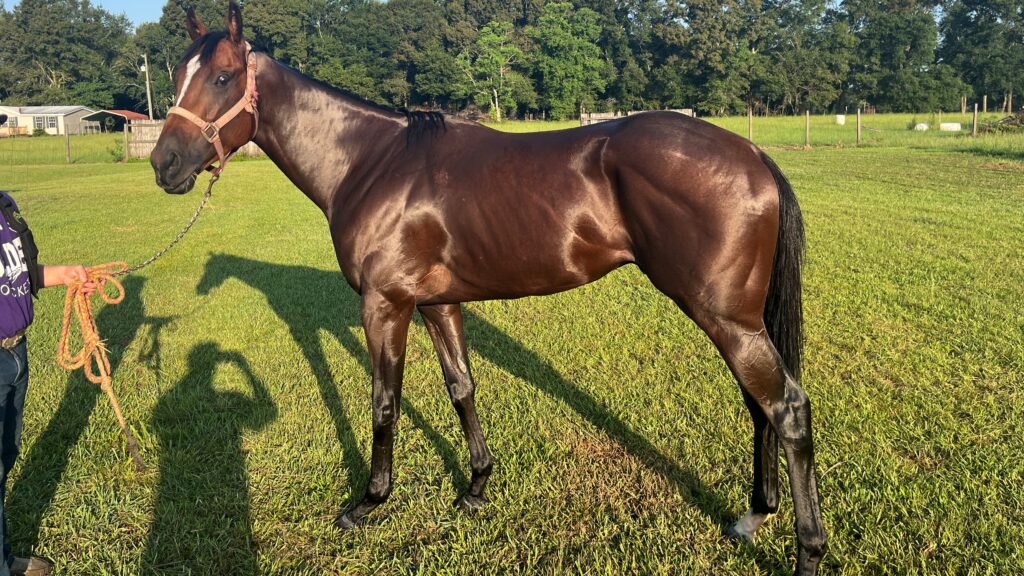
| Dark Bay / Brown | Common | Near-black coat with brown hairs at muzzle and flanks |
| Chestnut | Common | Red base coat, no black hair anywhere on the body |
| Black | Rare | Completely black coat, no brown or red hairs in direct sunlight |
| Gray / Roan Combined registry category | Gray is common (third most frequent at the track); true roan is extremely rare in Thoroughbreds — the grouping reflects registry convention, not genetic equivalence | Gray horses are born dark and progressively lighten with age; true genetic roan maintains stable mixed hairs year-round and is seldom seen in the breed |
| Palomino | Extremely rare | Golden coat with white or cream mane and tail |
| White | Extremely rare | Born white with pink skin and normally pigmented dark eyes |
About this guide: Based on personal experience owning and registering Thoroughbred foals, verified against The Jockey Club’s official color and markings registry.
Table of Contents
Official Thoroughbred Colors Recognized by The Jockey Club
When registering a foal with The Jockey Club, the owner selects the official color category that best describes the horse’s coat. The categories run from the most common — bay accounts for the largest share of registered Thoroughbreds — to the genuinely rare dilutes like palomino and white.
Bay
Bay Thoroughbreds have a reddish-brown body with black points — specifically the mane, tail, and lower legs. The body coat varies considerably, from light sandy shades to deep mahogany, but the black points are consistent across all bay registrations. Bay is the most prevalent color category in the Thoroughbred registry by a significant margin.
Dark Bay / Brown

Dark bay and brown describe horses with very deep, near-black coats that still show brown or tan hairs around the muzzle and flanks. The Jockey Club records them under a single reporting category because distinguishing between the two in practice is highly subjective — the same horse might be called dark bay by one registrar and brown by another.
Chestnut

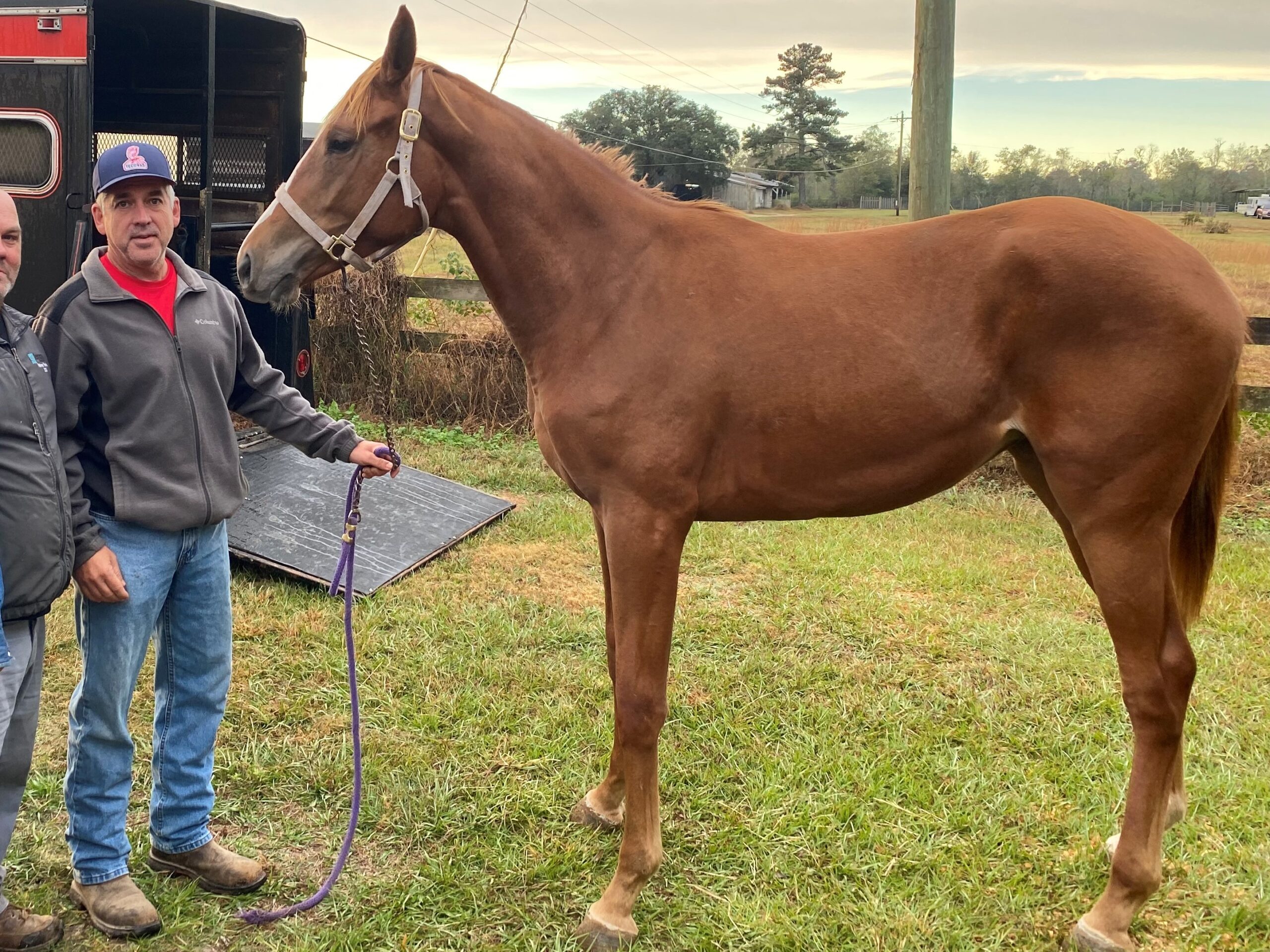
Chestnuts have a red base coat and completely lack black hair anywhere on the body. The range runs from pale golden through bright copper to dark liver chestnut. Manes and tails are typically the same shade as the body, or lighter (flaxen). Chestnut is the second most common color in the Thoroughbred registry and has produced numerous champions including Secretariat, Sir Barton, and Man o’ War.
Black

True black Thoroughbreds have a completely black coat — no brown or reddish hairs visible in direct sunlight. Many horses that appear black are actually very dark bay or dark liver chestnut and will show color variation under strong light. Genuine black is one of the rarer colors in the Thoroughbred registry.
Gray / Roan
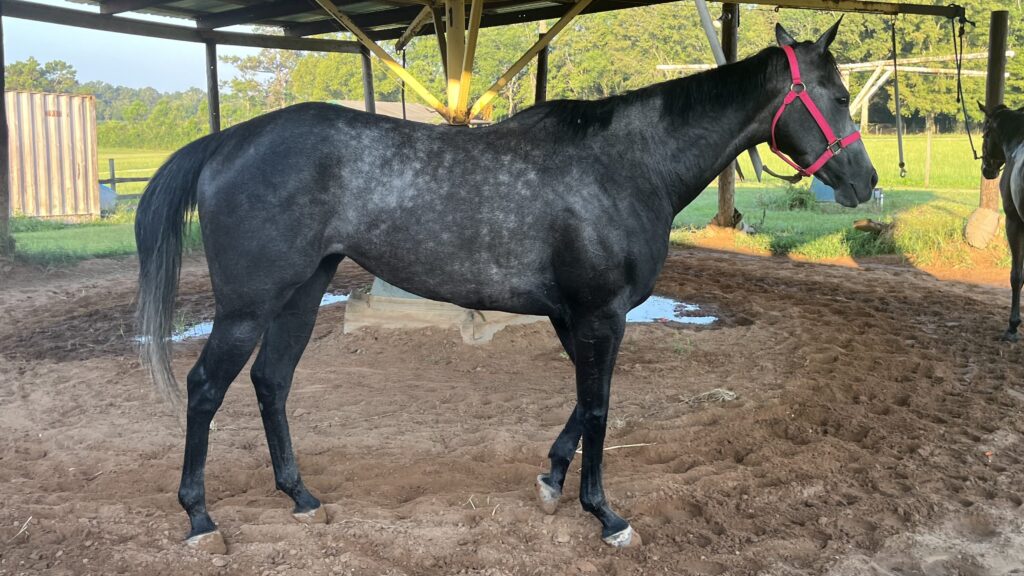
The Jockey Club records gray and roan under a single reporting category. Gray is among the most commonly seen colors at the track — a regular presence at any Louisiana meet, well behind bay and chestnut in raw numbers. Gray horses are born with a dark base coat and progressively lighten as they age, eventually appearing near-white in older horses. The distinction between gray and true genetic roan, and why The Jockey Club records both under one reporting category, is explained in the callout below.
Why are gray and roan combined into one category? Gray and roan are genetically distinct — gray horses progressively lighten throughout their lives, while true roans maintain a stable mix of white and colored hairs year-round. The registry historically combined them because young gray horses in early transition can closely resemble roans and distinguishing them visually at registration age isn’t always reliable. True genetic roan is so rare in Thoroughbreds that the combined category rarely creates practical confusion; most horses registered as “gray/roan” are grays.
Palomino
Palomino Thoroughbreds have a golden coat with a white or cream mane and tail. Palomino coloring results from a cream dilute gene acting on a chestnut base — a genetic combination that is uncommon in the Thoroughbred breed, which is why registered palominos are extremely rare. The Jockey Club accepts palomino as an official color category, but very few appear in the registry each year.
White
White Thoroughbreds are born white with pink skin and normally pigmented dark eyes. White coloring in Thoroughbreds is often associated with dominant white (W) genetic mutations — not to be confused with true albinism, which does not exist in horses. White coloring can result from more than one genetic mechanism, with W variants being the most commonly documented. True albinism involves absent pigment in the eyes and associated vision problems; white Thoroughbreds have normal vision and normal eye color. White is accepted by The Jockey Club as an official color category but is one of the rarest registrations in the breed.

How The Jockey Club Determines a Foal’s Color
Color registration happens early — typically within the first year of life — as part of the overall foal registration process. Registration officials use visual assessment to assign the color category, supported by photographs and detailed marking documentation. In my experience registering Thoroughbreds, accurately documenting markings was just as important as selecting the correct coat color — a detailed marking diagram is what distinguishes one bay from another for the rest of the horse’s career. Here is how the process works in practice:
- Visual inspection at registration age: The owner or their agent examines the foal and selects the official color category that best describes the coat at the time of registration — foals are typically registered before they are yearlings
- Photographs and marking diagrams: Registration paperwork requires photographs and a detailed marking diagram documenting every white marking on the face and legs — these are used throughout the horse’s career to verify identity
- DNA parentage verification: DNA testing is required to confirm parentage for all Thoroughbreds — this verifies bloodlines, not coat color. An unusual color on a registered-bred foal may prompt additional scrutiny of the parentage, but the DNA test confirms the pedigree rather than the color classification
- Color corrections: If a foal’s registered color turns out to be inaccurate — particularly common with gray horses that are registered before the graying gene becomes visually apparent — the registration can be corrected through The Jockey Club’s registration office
Gray foals and registration timing: Gray Thoroughbreds are born with their base coat color — bay, chestnut, or black — and the graying gene only becomes visible as white hairs begin appearing, typically in the first year. A gray foal registered early may initially be recorded under its base color, with the registration updated as the gray pattern becomes clear.
Acceptable Markings on Thoroughbreds
Markings are documented alongside base coat color for identification purposes — they are as unique to each horse as fingerprints. Every white marking must be recorded accurately on registration paperwork, as they are used throughout the horse’s life to verify identity at racing commissions and sales.
Face Markings
- Star — a small white patch on the forehead, not extending down the face
- Stripe — a narrow white line running down the bridge of the nose
- Blaze — a wider white stripe extending down the face, typically covering more of the nose than a stripe
- Snip — a small white mark between the nostrils, separate from any stripe or blaze
Leg Markings
- Sock — white marking covering the fetlock and part of the lower leg, not reaching the knee
- Stocking — white marking extending higher up the leg, reaching toward the knee or hock
Coat patterns that disqualify registration: The Jockey Club maintains a closed registry to preserve purebred Thoroughbred bloodlines. Coat patterns involving more than one primary body color — Pinto (large white patches), Appaloosa (spots or blanket patterns), or similar multi-color configurations — are inconsistent with the closed Thoroughbred stud book and are not eligible for standard registration.
It is the pattern that triggers review, not the color itself. If a foal’s appearance raises questions during registration, the registry may request additional documentation or rely on the required DNA parentage verification to confirm eligibility — DNA confirms the pedigree rather than the color classification. A Thoroughbred with a verified pedigree and an unusual but solid coat color can still be registered under the appropriate category.
Genetics Behind the Colors
All horse coat colors are produced by two base pigments — eumelanin (black) and pheomelanin (red). The interaction of two genes controls how these pigments are expressed across the body.
Two genes act as switches that control which pigment gets expressed and where. The Extension (E) gene determines whether black pigment can be produced at all; the Agouti (A) gene controls where black pigment is distributed when it is present. Together they determine the three base colors from which all Thoroughbred coat colors derive:
- Bay — dominant Extension gene (E) plus at least one dominant Agouti gene (A), which restricts black pigment to the points while the body expresses red
- Black — dominant Extension gene (E) plus two recessive Agouti genes (aa), allowing black pigment to cover the entire body without restriction
- Chestnut — two recessive Extension genes (ee), which prevent the horse from producing black pigment entirely regardless of the Agouti gene
Every registered Thoroughbred traces back genetically to one of three base coat colors: bay, black, or chestnut. Gray, white, and palomino result from additional modifier genes acting on one of these three bases rather than representing separate base colors. Gray is controlled by a separate dominant gene that progressively removes color from the coat regardless of the underlying base color — a gray horse can be genetically bay, chestnut, or black underneath. Published research on horse color genetics shows that human selection in Thoroughbred racing has directly influenced the prevalence of these color patterns over the past century, with bay consistently dominant because it represents the most common genetic combination.
Practical note on color genetics and registration: Modern DNA testing can confirm a horse’s genetic color before registration, which is particularly useful for horses with ambiguous coat colors — distinguishing true black from very dark bay, or confirming gray in a young foal that hasn’t yet started to lighten. The Jockey Club uses visual assessment for color registration, but genetic confirmation can support accurate classification.
Does Coat Color Affect Racing Performance?
Coat color has no direct genetic link to speed, stamina, or cardiovascular capacity — performance is determined by entirely separate genetic factors. But color patterns across champion racehorses do reflect the underlying population distribution rather than any athletic advantage.
- Chestnut champions: The Triple Crown has been won by chestnut horses seven times. Secretariat (1973) and Man o’ War are the most celebrated chestnut champions
- Bay and dark bay champions: Bay horses dominate track populations by volume, which means they also dominate the winner’s circle by simple numbers. American Pharoah (2015 Triple Crown) is a well-known bay; Justify (2018 Triple Crown) is registered as dark bay/brown — often incorrectly listed as chestnut in sports coverage
- Gray champions: Native Dancer — nicknamed “The Gray Ghost” — won 21 of 22 starts and is in the Hall of Fame; gray horses have a disproportionately strong following among fans relative to their registration numbers
Horseman’s Perspective: At sales, flashy grays and horses with extensive white markings consistently attract more attention and often bring slightly higher prices than comparably bred bays. Buyers respond to visual distinctiveness even when pedigree and conformation are the same. As an owner who has purchased horses at Louisiana sales, I’d say the premium is real — but it rarely correlates with performance once the horse gets to the track. Bay horses win because there are more of them, not because of the color.
Myths and Misconceptions
Every racetrack backside has its share of color superstitions. These three come up consistently and are worth addressing directly.
Myth: Certain colors are faster
Dark bay and black horses are sometimes said to be inherently faster. Speed is determined by genetics, biomechanics, lung capacity, and training — none of which are linked to coat color. Bay horses win more races because they represent the largest share of registered Thoroughbreds, not because of any speed advantage tied to their color.
Myth: Chestnut mares are temperamental
“Chestnut mare” is a persistent track stereotype for difficult temperament. Behavioral science consistently shows that temperament is shaped by training, handling, environment, and specific sire lines — not coat color. The stereotype persists partly because chestnuts are common enough that any memorable difficult mare is likely to be one.
Myth: White Thoroughbreds are albinos
True white Thoroughbreds are often incorrectly called albinos. True albinism in horses — characterized by completely absent pigment including pink eyes and associated vision problems — does not exist in the species. White coloring in Thoroughbreds is often associated with dominant white (W) mutations that produce a white coat and pink skin, but with normally pigmented dark eyes and normal vision.
FAQs: Thoroughbred Colors and Registry
What colors are accepted for Thoroughbred registry?
The Jockey Club records Thoroughbreds under seven official color categories: Bay, Dark Bay/Brown, Chestnut, Black, Gray/Roan, Palomino, and White. Bay is by far the most common. Palomino and White are accepted but extremely rare in the breed.
Can Thoroughbreds have white markings?
Yes. White face markings (star, stripe, blaze, snip) and leg markings (sock, stocking) are common in Thoroughbreds and are documented on registration papers for identity verification throughout the horse’s career.
Are there Palomino Thoroughbreds?
Yes, though they are extremely rare. Palomino is an officially recognized color category with The Jockey Club. The genetic pathway that produces palomino coloring is uncommon in the Thoroughbred breed, which is why so few are registered.
Does a Thoroughbred’s color affect its racing performance?
No. Coat color has no direct genetic link to speed, stamina, or cardiovascular capacity. Performance is determined by separate genetic factors, biomechanics, and training. Bay horses win more races simply because there are far more bay Thoroughbreds registered than any other color.
Why are Pinto and Appaloosa markings not accepted for Thoroughbred registration?
The Jockey Club is a closed registry that maintains purebred Thoroughbred bloodlines. Coat patterns such as Pinto (large white patches) or Appaloosa (spots or blanket patterns) are inconsistent with the closed Thoroughbred stud book and are not eligible for standard registration.
Why does The Jockey Club record gray and roan under one category?
Gray and roan are genetically different conditions — gray horses progressively lighten throughout their lives, while true roans maintain a stable mix of white and colored hairs year-round. The registry historically combined them because young gray horses in early transition can closely resemble roans, and distinguishing them visually at registration age is not always reliable. True genetic roan is extremely rare in Thoroughbreds, so the combined category creates little practical confusion; most horses registered as gray/roan are grays.
Can a Thoroughbred’s registered color change after registration?
Yes, color corrections are possible through The Jockey Club’s registration office. The most common situation involves gray horses, which are born with a base coat color (bay, chestnut, or black) and only begin showing white hairs as the graying gene activates, sometimes after initial registration. A foal registered as bay that later clearly develops into a gray can have its color classification corrected. Markings can also be updated if the original documentation was incomplete or inaccurate.
Key Takeaways: Thoroughbred Colors and Registry
- Seven official categories — Bay, Dark Bay/Brown, Chestnut, Black, Gray/Roan, Palomino, and White; bay accounts for the largest share of registrations by a significant margin
- Dark Bay/Brown and Gray/Roan are each combined into one category — dark bay and brown are subjectively difficult to distinguish; gray is common at the track (third most frequent) while true roan is extremely rare, which is why the combined category rarely causes confusion
- Color has no effect on performance — bay horses win more races because there are more of them, not because of their color; all three base colors (bay, chestnut, black) have produced champions at the highest level
- Markings are documented alongside color — face and leg markings are recorded in detail and used throughout the horse’s career for identity verification
- Pinto and Appaloosa patterns disqualify registration — The Jockey Club is a closed registry; multi-color patch patterns indicate crossbreeding
- White Thoroughbreds are not albinos — they carry a dominant white mutation with normal eye pigmentation and normal vision
About Miles Henry
Racehorse Owner & Author | 30+ Years in Thoroughbred Racing
Miles Henry (legal name: William Bradley) is a professional horseman based in Folsom, Louisiana. He holds Louisiana Racing License #67012 and has spent over three decades managing Thoroughbreds at premier tracks including Fair Grounds, Delta Downs, and Evangeline Downs.
Expertise & Hands-On Experience: Beyond the track, Miles has decades of experience in specialized equine care, covering everything from hoof health and nutrition to training protocols for Quarter Horses, Friesians, and Paints. Every guide on Horse Racing Sense is rooted in this “boots-on-the-ground” perspective.
30 of their last 90 starts
Equibase Profile.

Connect with Miles: