
Last updated: November 4, 2026
You may have heard someone describe a horse as a dun and wondered what that meant. Maybe you thought all tan horses were buckskins. Here’s how to recognize a dun horse, understand the different dun colors, and tell one from a buckskin.
Here’s how the dun colors differ, which markings to check, how to tell a dun from a buckskin, and when a DNA test is worth it.
Table of Contents
What Is a Dun Horse?

Dun is a coat color, not a breed. The dun gene lightens the body coat while the head, lower legs, mane, and tail stay undiluted, and it produces primitive markings. The final color depends on whether the horse’s base coat is bay, chestnut, or black. For how dun fits in with every other coat color, see this guide to horse coat colors and patterns.
A friend of mine raises duns in just about every color and trains them for barrels and roping, so I see plenty of them.
Dun Horse Colors
The shade of a dun horse depends on the base color underneath. These are the names you’ll hear, based on AQHA:
| Dun color | Base coat and dilutions | What it looks like |
|---|---|---|
| Bay dun (classic dun) | Bay + dun | Tan to sandy gold body with black mane, tail, legs, and stripe |
| Red dun | Chestnut (sorrel) + dun | Lighter red or peachy body with darker red markings instead of black |
| Grullo or grulla | Black + dun | Smoky blue-gray to mouse-gray body with black points |
| Dunskin | Bay + dun + one cream gene | A buckskin with dun markings |
| Dunalino | Chestnut + dun + one cream gene | A palomino with dun markings |
What Is a Dunskin Horse?
A dunskin is a buckskin that also carries dun, or as AQHA puts it, a dun with a cream dilution. It has a bay base, one copy of the cream gene that makes a buckskin, and the dun gene, so it can have the gold or tan body of a buckskin and black points plus a dorsal stripe and other primitive markings. If the color is hard to call by looking, testing for cream and dun will confirm it. There’s more on the cream gene in this guide to buckskin horses.


Dun Markings: What to Look For
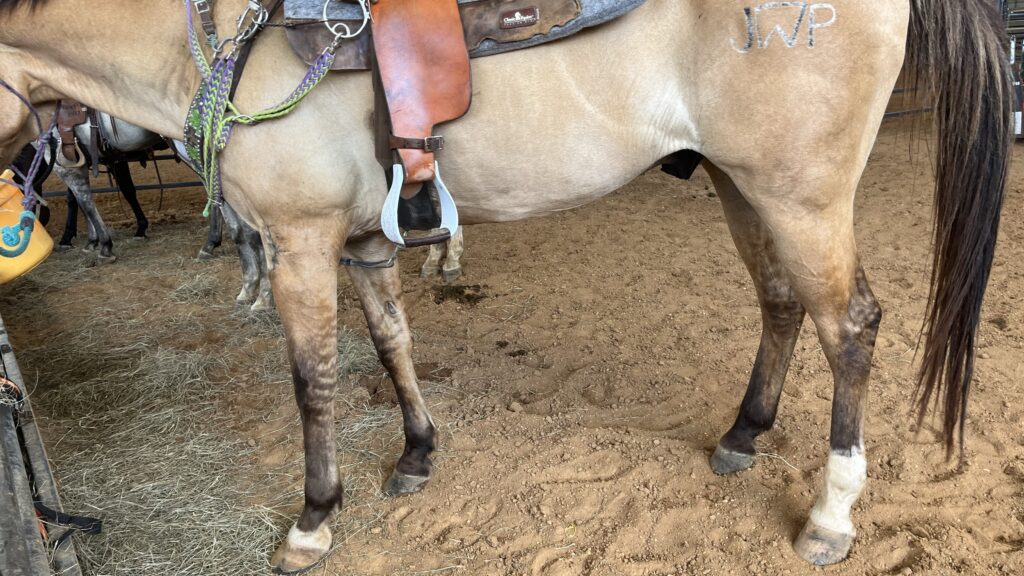
These are the markings to check on a suspected dun. How much they show varies from horse to horse, and not every dun shows all of them, according to the UC Davis Veterinary Genetics Laboratory:
Dorsal stripe. A dark stripe down the spine from the withers to the tail. It’s the most consistent dun marking and the first thing to check.
Leg barring. Dark horizontal bars on the legs.
Shoulder stripe. A dark band across the withers and shoulders.
Face mask and cobwebbing. A darker face, sometimes with faint web-like lines on the forehead.
Ear stripes and frosting. Dark edges on the ears and lighter, frosted hairs along the edges of the mane and tail.

Telling a Dun From a Buckskin or a Striped Non-Dun
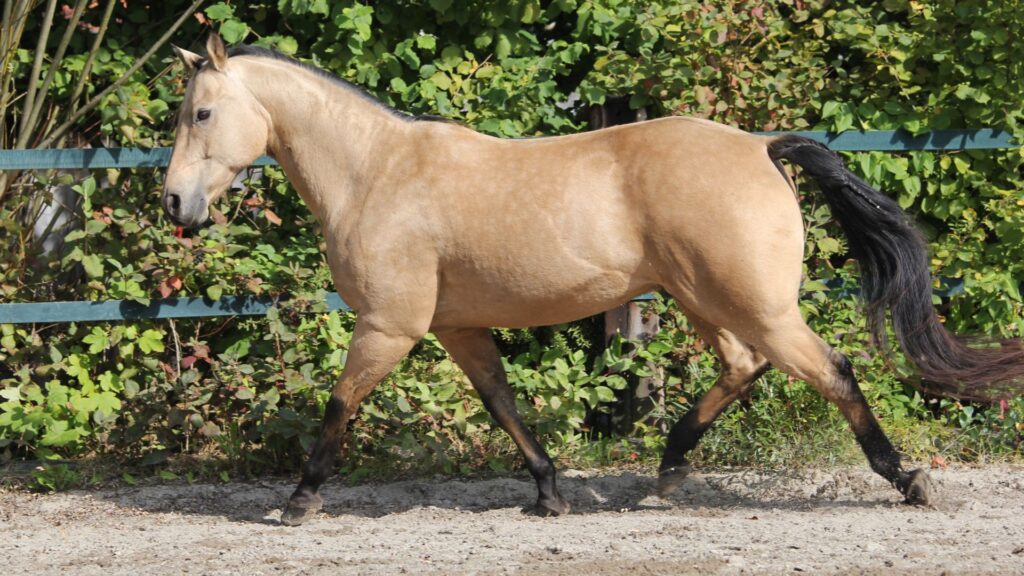
A buckskin and a bay dun can look a lot alike. Both have a tan to gold body with black points. The difference is the gene: a buckskin gets its color from the cream gene on a bay, and a dun gets it from the dun gene. Their markings can help you tell them apart, but they aren’t always conclusive. There’s a full side-by-side in this look at dun vs. buckskin horses.
Here’s the catch: a dorsal stripe alone doesn’t prove a horse is a dun. Some horses that carry a non-dun version of the gene, called nd1, lack the dun dilution but can still show some primitive markings, like a faint dorsal stripe, according to Etalon. That’s why you’ll see buckskins, bays, and other non-duns with a stripe down the back. Some dark horses also show countershading, a darker shading along the topline that can be mistaken for a stripe.
Look at the whole coat, not just the stripe. Body color and primitive markings help narrow it down, but they don’t always settle the question. If you’re unsure, a DNA test for dun and cream, along with the horse’s base color, can help sort out whether he’s a buckskin, a bay dun, or a dunskin.

Dun Horse Genetics
Dun is controlled by a single gene, TBX3, according to a 2015 Nature Genetics study, as reported by SciLifeLab. The gene affects how pigment is distributed in the growing hair, and that uneven pigment is what gives a dun’s body coat its lighter look.
There are three versions of the gene, according to the UC Davis Veterinary Genetics Laboratory:
| Version | What it does |
|---|---|
| D (dun) | Dun dilution plus primitive markings. One copy is enough. |
| nd1 (non-dun 1) | No dun dilution, but may still show some primitive markings |
| nd2 (non-dun 2) | No dun dilution; horses with two copies lack the primitive markings |
One copy of dun is enough for a horse to be a dun, and you can’t reliably tell by looking whether he has one copy or two. A horse with two copies (D/D) passes dun to every foal. A horse with one copy has a 50% chance of passing it on in each breeding, so bred to a non-dun, each foal has a 50% chance of being a dun. And since a dun foal needs a dun parent, two non-dun parents can’t produce one.
The base color still comes from the Extension and Agouti genes, which decide whether the foal will be a bay dun, red dun, or grullo. If you’re breeding for a particular color, test both parents. This guide to horse color genetics explains how those base genes work.

Dun in Wild Horses and Modern Breeds
Dun is believed to be the wild-type color of horses, a camouflage pattern most domestic horses have since lost, according to SciLifeLab. Ancient DNA from a horse that lived about 43,000 years ago carried both the dun and nd1 versions of the gene.
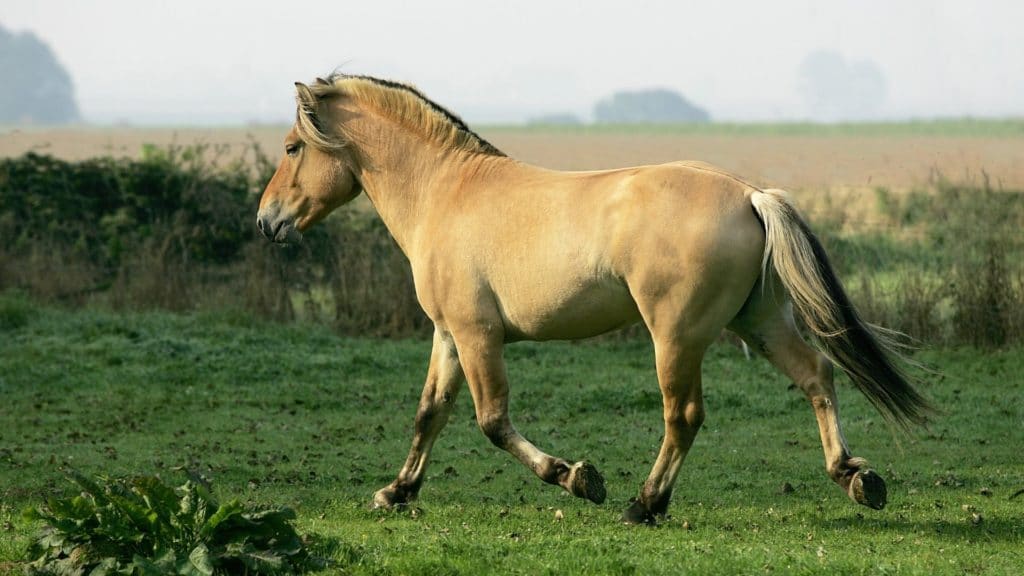
You can still see that wild color in some breeds today. The Norwegian Fjord is predominantly dun, and Przewalski’s horse shows dun coloring, too.
In the Quarter Horse world, the most famous dun is probably Hollywood Dun It, a stallion foaled in 1983. He became the National Reining Horse Association’s first $4 million sire, went on to pass $6 million in offspring earnings, and was inducted into the NRHA Hall of Fame in 2000 and the AQHA Hall of Fame in 2012, according to AQHA.

Dun Horse FAQs
Is a dun a breed of horse?
No. Dun is a coat color, not a breed. It occurs in breeds such as Quarter Horses and Norwegian Fjords, but it isn’t found in every breed.
Can two non-dun horses have a dun foal?
No. Dun is dominant, so a dun foal has to get the dun gene from at least one dun parent. Two non-dun parents can produce a foal with a faint stripe from the nd1 version of the gene, but not a true dun.
A stripe is a clue, not a verdict. When the color is uncertain, a DNA test is more reliable than guessing from a photo.
About Miles Henry
Racehorse Owner & Author | 30+ Years in Thoroughbred Racing
Miles Henry (legal name: William Bradley) is a professional horseman based in Folsom, Louisiana. He holds Louisiana Racing License #67012 and has spent over three decades managing Thoroughbreds at premier tracks including Fair Grounds, Delta Downs, and Evangeline Downs.
Expertise & Hands-On Experience: Beyond the track, Miles has decades of experience in specialized equine care, covering everything from hoof health and nutrition to training protocols for Quarter Horses, Friesians, and Paints. Every guide on Horse Racing Sense is rooted in this “boots-on-the-ground” perspective.
30 of their last 90 starts
Equibase Profile.

Connect with Miles: