
Last updated: July 24, 2026
The bedding in your horse’s stall affects more than comfort — it drives respiratory health, hoof condition, joint longevity, and how much time you spend mucking stalls every morning. After years of managing horse stalls, I’ve changed my approach to bedding more than once based on what the horses told me. A mare who started coughing in winter, a gelding with chronic thrush, a filly who stopped lying down — all of it traced back to the stall surface. There is no single perfect bedding for every barn; the right choice depends on your horses, your climate, and your management style.
What is the best horse stall bedding? For most horse owners, wood pellets offer the best balance of absorbency, ammonia control, dust reduction, and long-term cost. Horses with respiratory disease may do better on hemp or peat moss, while straw remains the preferred bedding for foaling stalls. The right choice depends on your horses, your barn, and your climate.
- Best for respiratory health: Hemp or peat moss — lowest dust of any common bedding material, significant advantage for horses with RAO or Heaves
- Best balance for most barns: Wood pellets — published tests show significantly higher absorbency than shavings, and substantially less waste per cleaning
- Best for foaling: Clean straw — won’t stick to the foal, provides traction for standing
- Best bedding for horses that eat bedding: Pellets or hemp — neither is palatable enough to encourage consumption
- Most cost-effective setup: Wood pellets over rubber stall mats — or bulk pine shavings if you have a local mill source
- Never use: Black walnut shavings — associated with laminitis in horses; severity varies with exposure but cases can develop rapidly
Research methodology: Bedding comparisons based on university extension research including University of Minnesota Extension, Frontiers in Veterinary Science dust studies, and peer-reviewed absorbency data. Practical guidance from hands-on management of horse stalls across Louisiana.
| Bedding | Dust Level | Absorbency | Relative Cost | Best For |
|---|---|---|---|---|
| Wood Pellets | Very Low | Excellent | $$ | Most barns; humid climates |
| Wood Shavings | Moderate | Good | $$ | General use; moderate climates |
| Straw | High | Fair | $ | Foaling stalls; cold climates |
| Hemp | Very Low | Excellent | $$$ | Respiratory issues; eco-conscious barns |
| Peat Moss | Lowest | Excellent | $$$ | RAO / Heaves; severe respiratory sensitivity |
| Paper / Cardboard | Lowest | Very Good | $$$ | Severe respiratory cases; veterinary stalls |
Table of Contents
Why Bedding Matters More Than Most Owners Realize
It is tempting to buy whatever is cheapest at the feed store, but the wrong bedding has costs that show up later — in vet bills, in chronic coughing, in horses that won’t lie down. University extension research confirms what experienced horsemen already know: bedding quality directly drives four outcomes that matter.

Dust control. Minimizing dust is the single most important factor for respiratory health in stalled horses. High dust levels trigger or worsen conditions like Heaves (RAO). Research published in Frontiers in Veterinary Science found straw produces 2.60 mg/m³ of inhalable dust — nearly four times the amount produced by wood shavings at 0.70 mg/m³. Pellets and peat score even lower.
Absorbency. Bedding must pull urine away from the surface quickly to prevent thrush, skin problems, and ammonia buildup. Studies show peat can absorb 7.5–12 kg of water per kilogram of dry material — far ahead of wood products. Wood pellets, once wetted and expanded, also significantly outperform shavings.
Ammonia control. Ammonia forms when urine decomposes in bedding. It’s a respiratory irritant that causes lasting lung damage at sustained levels. Peat’s naturally low pH chemically binds ammonia, which is why it performs well for horses with existing respiratory conditions. Daily removal of wet spots remains the most effective management tool regardless of bedding type — per University of Minnesota Extension guidance.
Comfort and cushioning. Horses need to lie flat for REM sleep. A surface that doesn’t support full recumbency creates a horse that is chronically sleep-deprived and sore. Research confirms a 6–8 inch bedding depth encourages full recumbency and reduces pressure on hocks and joints. This depth matters even when using rubber stall mats — mats provide traction and insulation but not the cushion required for rest.

Types of Horse Stall Bedding
1. Wood Shavings
Best for: Most barns, moderate climates, general-purpose use.
Wood shavings remain the most widely used bedding because of availability and familiar handling. Quality varies significantly by supplier — kiln-dried, screened shavings perform better and produce far less dust than unscreened mill shavings. They pair well with rubber mats and are easy to manage with a standard fork.
Horseman’s Perspective: At our Folsom training facility, we buy pine shavings in bulk directly from local sawmills — we live in a pine-dense area with several mills nearby, and the cost savings are significant enough that shavings make more sense there than pellets. When we’re traveling or keeping horses at the racetracks, we switch to pellets because bulk sourcing isn’t practical on the road. The honest answer is that shavings from a reliable local pine source are a completely legitimate choice if the supply is consistent and the wood species is confirmed. The performance gap between kiln-dried pine shavings and pellets is real but manageable with good daily maintenance.
Black Walnut Warning: Never use shavings from a sawmill unless the wood species is confirmed. Black walnut shavings are associated with laminitis in horses — severity varies with exposure level, but serious cases can develop rapidly. Even brief contact has been linked to clinical signs in some horses. This is a genuine safety risk, not a minor sensitivity. Source: Penn State Extension.
2. Wood Pellets
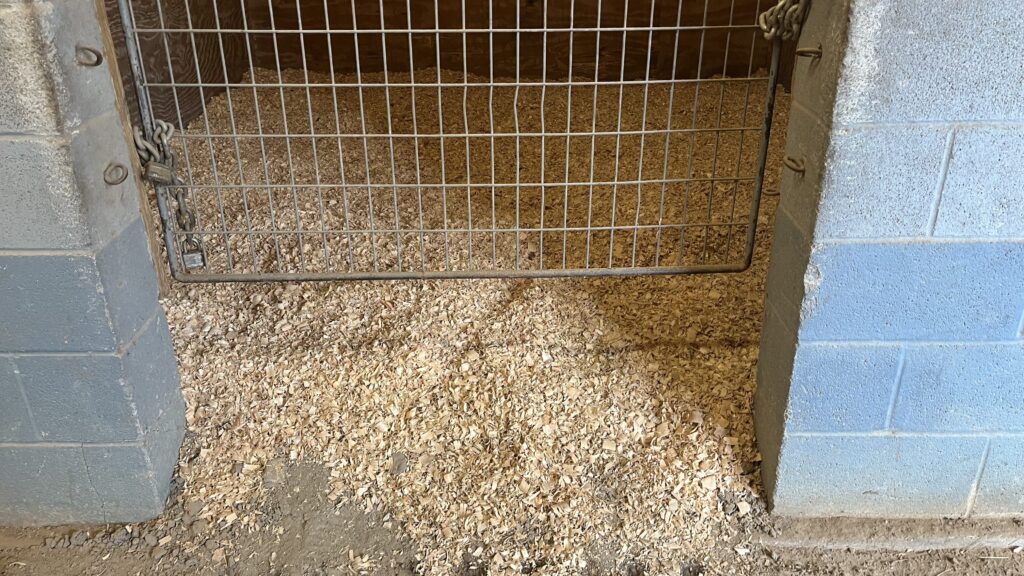
Best for: Odor-prone barns, humid climates, maximizing absorbency.
Pellets are compressed wood that expands into fine, highly absorbent sawdust when wetted. They require an initial setup — wetting the first layer thoroughly before use — but once established they’re easier to manage than shavings and produce significantly less waste per cleaning.
Horseman’s Perspective: I’ve used pellets extensively in Louisiana’s humidity, and they consistently outperform shavings for odor control. The ammonia reduction is noticeable within the first week. After a particularly wet winter at Fair Grounds, we switched several stalls from shavings to pellets and within a month were hauling noticeably fewer wheelbarrows of waste — the clumping action pulls moisture down and keeps the surrounding bedding drier. They also take up less storage space, which matters when you’re managing multiple stalls. The learning curve is real — the first time you overwater the setup it becomes mush — but once you’ve dialed it in, they’re my preferred option for active training barns.
Wood Pellets vs Wood Shavings
This is the most common comparison horse owners face. Shavings are familiar and easy; pellets perform better but require a setup step. Here’s how they compare directly:
| Factor | Wood Pellets | Wood Shavings |
|---|---|---|
| Dust level | Very low | Moderate (varies by supplier) |
| Absorbency | Excellent — absorbs significantly more per volume | Good |
| Ammonia control | Better — clumping locks in moisture | Fair — wet spots spread |
| Waste volume | Less — clean bedding stays cleaner | More — wet spots pull surrounding shavings |
| Long-term cost | Lower per month due to less waste | Higher due to greater waste volume |
| Ease of use | Moderate — requires wetting to activate | Easy — ready to use immediately |
| Storage space | Less — compact until wetted | More — bulky bags |
3. Straw
Best for: Foaling stalls, cold climates, composting programs.
Straw is the traditional foaling choice because it doesn’t stick to a wet newborn the way shavings do and provides the traction a foal needs to stand. It insulates well in cold weather and breaks down faster in compost than wood products. The drawbacks are real: low absorbency means wet spots spread quickly and ammonia builds faster if cleaning isn’t consistent.
4. Peat Moss
Best for: Horses with RAO, Heaves, or chronic respiratory sensitivity.
Peat moss is underused in American barns given its performance. It has the lowest dust output of any common bedding, absorbs heavily, and its natural acidity suppresses bacterial growth and binds ammonia. The downsides are practical: it looks dark and “dirty,” it’s harder to find in some regions, and it costs more than shavings. For horses with documented respiratory conditions, those tradeoffs are worth it.
5. Hemp Bedding
Best for: Allergy-prone horses, eco-conscious barns, high-humidity environments.
Hemp is gaining significant ground in American barns after years of dominance in Europe. It absorbs more fluid than wood shavings, composts rapidly, and produces very low dust. In some regions flax-based bedding is available and performs similarly, though it is less standardized and harder to source consistently in the US. Hemp is currently more expensive than wood products in most American markets, but availability and pricing are improving as domestic supply increases.
6. Paper and Cardboard Bedding
Best for: Severe respiratory cases, veterinary stalls, horses with extreme dust sensitivity.
Paper and shredded cardboard bedding produces the lowest dust levels of any commonly available option — even lower than peat moss in most comparisons. It absorbs well and is completely mold-resistant in dry conditions. The practical drawbacks are significant: it becomes heavy and dense when wet, making cleaning more labor-intensive, and it is harder to source and more expensive than wood products in most US markets. For horses in a veterinary hospital setting or recovering from serious respiratory episodes, it is worth the tradeoff.
Quick decision guide — bedding by situation:
- Respiratory issues (RAO, chronic cough): Hemp → Peat → Paper → Pellets
- Best balance of dust control and cost: Pellets → Hemp
- Humid climate (Gulf Coast, Southeast): Pellets → Hemp (avoid straw)
- Foaling stall: Clean straw
- Composting program: Straw → Hemp → Peat
Best Bedding for Specific Horses
Different horses have different requirements. Here’s the short answer for the most common situations:
| Horse Type / Situation | Best Bedding | Why |
|---|---|---|
| Horse with Heaves or RAO | Hemp, peat moss, or paper bedding | Lowest dust output; hemp and peat both suppress airborne particles significantly below shavings |
| Senior horse | Deep wood pellets over rubber mats | Joint support from deeper cushion; pellets stay drier, reducing skin and hoof issues common in older horses |
| Foaling stall | Clean straw | Non-adherent to wet newborn; traction for standing; warm; acceptable dust at this use case |
| Horse that eats bedding | Wood pellets or hemp | Neither is palatable enough to encourage consumption; straw is the highest risk for chronic bedding eaters |
| Horse with chronic thrush or white line disease | Wood pellets | High absorbency keeps hooves drier; key factor in preventing and managing hoof moisture diseases |
| Horse recovering from surgery or illness | Deep pellets or hemp over mats | Encourages full recumbency for REM sleep and recovery; low dust supports healing respiratory tissue |
Horseman’s Perspective: The horse-eats-bedding problem is underestimated. I’ve had horses who would work through straw or pull at shavings out of boredom or habit. Switching to pellets solved it — they simply aren’t interesting to eat once expanded. Hemp is the same. If you’ve got a horse that chronically ingests bedding, changing the material is faster than trying to train the behavior out of them.
Bedding by Climate and Stall Conditions
Bedding that performs well in one region can fail in another. The same material behaves differently under high humidity versus dry heat, and your flooring situation changes the equation further.
Humid Climates
In Louisiana, Mississippi, Florida, and similar climates, moisture management is the primary concern. Wood pellets and hemp handle humidity well because of their high absorbency — they pull moisture down and hold it rather than spreading it. Straw and peat, in a poorly ventilated barn, can harbor mold quickly. Good barn ventilation is non-negotiable before bedding choice makes much difference.
Dry and Hot Climates
In dry climates, shavings and pellets both perform reliably. Dust can become an issue when bedding dries out completely — lightly misting the stall surface helps. Peat can work well here since the dry conditions reduce its tendency to mold.
Flooring Considerations
Do rubber stall mats replace bedding? No. Rubber mats reduce the amount of bedding needed, but horses still require bedding on top for moisture absorption, cushioning, warmth, and comfort. Mats alone do not provide sufficient cushion for horses to lie flat comfortably, and urine pools on the surface without bedding to absorb it.
Concrete floors without any base require deep bedding to prevent hock sores and joint stress. The most cost-effective solution is to install quality rubber stall mats first, then run bedding on top at reduced depth. For full structural guidance: horse stall design guide and stall sizing considerations.
| Stall Type | Recommended Depth | Notes |
|---|---|---|
| Concrete floor, no mats | 6–8 inches | Minimum depth to prevent hock sores and joint stress |
| Rubber mats installed | 4–6 inches | Mats provide base cushion; bedding handles moisture and warmth |
| Foaling stall | 8–12 inches | Deep bedding needed for foal traction and mare comfort during labor |
| Senior or recovering horse | 6–8 inches | Deeper bed encourages full recumbency and reduces joint pressure |
Bedding Cost Comparison
These figures are approximate benchmarks — costs vary significantly by region, supplier, and whether you buy in bulk. The monthly cost column reflects typical usage; actual spend depends on stall size, cleaning frequency, and how much is wasted per cleaning cycle.
| Bedding Type | Typical Use/Month | Est. Cost/Month | Best Situation |
|---|---|---|---|
| Wood Shavings | 4–6 bags | $45–$80 | General use, most climates |
| Wood Pellets | 2–4 bags | $35–$70 | Humid barns, odor control, long-term savings |
| Straw | 8–12 bales | $40–$100 | Foaling stalls, cold climates |
| Hemp | 3–4 bags | $75–$120 | Respiratory issues, composting programs |
| Peat Moss | 4–6 bags | $60–$90 | RAO horses, ammonia control |
Pellets require fewer bags per month because their high clumping action means less clean bedding gets thrown out with wet spots. Published research confirms pellets produce lower long-term cost due to reduced waste volume. The savings become more significant at scale — if you’re managing six or more stalls, the difference between pellets and shavings adds up quickly over a year.

Stall Care Best Practices
The best bedding in the world underperforms in a poorly maintained stall. These are the management practices that actually move the needle:
Remove wet spots daily. This is the single most effective action for ammonia control regardless of which bedding you use. Wet spots left overnight accelerate ammonia production and degrade the surrounding dry bedding faster. Per University of Minnesota Extension, daily wet spot removal reduces ammonia more than any bedding material switch alone.
Maintain depth. Keep bedding at 4–6 inches minimum. Thin bedding compresses quickly and stops providing cushion within hours of a horse lying down. Banks around the walls add insulation and prevent injuries from a horse rolling against the stall boards.
Match bedding to your composting plan. If you compost manure, choose straw or hemp — both break down rapidly and support healthy compost. Wood shavings decompose slowly and can lock up nitrogen in the soil, making them poor compost material unless you have a long rotation. See USDA manure management guidelines for composting ratios.
Address air quality at the barn level, not just the stall. Bedding choice affects in-stall dust, but barn-wide air quality depends on ventilation, aisle management, and hay storage location. Read the barn lighting and barn fans guides for the full picture on airflow management.


Key Takeaways: Horse Stall Bedding
- Wood pellets offer the best balance for most barns — highest absorbency, best ammonia control, lowest long-term cost when used with rubber mats
- For respiratory issues, hemp or peat outperform shavings — dust reduction is measurable and matters for horses with RAO or chronic cough
- Straw belongs in foaling stalls — not because it’s superior bedding, but because it’s non-adherent to wet newborns and provides the traction foals need to stand
- Black walnut is a genuine emergency risk — never use sawmill shavings without confirmed species identification
- Daily wet spot removal beats any bedding switch — the single most effective ammonia control is consistent management, not material choice
- Depth matters — 4–6 inches minimum; horses won’t lie down fully on thin bedding, and that affects recovery and joint health
- Humidity changes the calculation — in the Gulf South, pellets and hemp outperform shavings and straw because moisture management is the primary constraint
FAQs About Horse Stall Bedding
What is the best bedding for horse stalls?
For most horse owners, wood pellets offer the best balance of low dust, high absorbency, ammonia control, and long-term cost-effectiveness. For horses with respiratory issues, hemp or peat moss perform better on dust reduction. For foaling stalls, clean straw remains the industry standard. If you have access to bulk kiln-dried pine shavings from a local source, those can be equally cost-effective with good daily management.
What is the cheapest bedding for horses?
Bulk shavings often have the lowest upfront cost, but wood pellets are typically cheaper per month once waste is factored in. Because pellets clump tightly when wet, less clean bedding gets removed during daily cleaning. Over a full year, the savings on waste alone usually make pellets more cost-effective than shavings at per-bag pricing.
What is the healthiest bedding for horses with allergies or RAO?
Hemp, peat moss, and paper or cardboard bedding have the lowest dust output of common options. A 2015 study found these materials reduce dust exposure by up to 70% compared to standard shavings. For horses already diagnosed with RAO or Heaves, switching to low-dust bedding is one of the most impactful management changes an owner can make.
What is the best bedding for foaling stalls?
Clean straw is the standard for foaling. It does not stick to a wet newborn the way shavings do, and it provides the traction a foal needs to stand. Shavings can irritate a newborn’s airways and adhere to mucus membranes. Cornell University College of Veterinary Medicine recommends straw for foaling stalls specifically for these reasons.
Are wood pellets good for horse stalls?
Yes — wood pellets are one of the best options for most barns. They are approximately 2.5 to 5 times more absorbent than traditional shavings, produce very low dust, and significantly reduce the volume of waste removed per cleaning. They require an initial wetting to activate, but once established they are straightforward to maintain. They work especially well in humid climates where ammonia and moisture management are primary concerns.
How deep should horse stall bedding be?
Minimum 4–6 inches for most horses, and up to 6–8 inches for horses that need encouragement to lie down fully for REM sleep. Horses on thin bedding often remain standing rather than lying flat, which affects recovery and joint health over time. Rubber stall mats reduce the depth requirement somewhat, but bedding on top of mats is still necessary for cushion, warmth, and moisture absorption.
What bedding should I avoid for horses?
Black walnut shavings are the primary safety concern — they are associated with laminitis and should never be used. Severity varies with exposure level, but serious cases can develop rapidly. Never use sawmill shavings unless the wood species is confirmed. Beyond that, avoid unscreened shavings of unknown origin, straw in humid climates without excellent ventilation (mold risk), and any bedding that has been stored wet or shows visible mold growth.
What are the latest trends in horse stall bedding?
Wood pellets and hemp are both seeing increasing adoption in American barns, driven by their lower long-term cost and respiratory health advantages. Hemp in particular has grown significantly as US supply has increased. European barns have used both materials as standard for years. The shift reflects a broader focus on dust reduction and sustainable waste management in stable operations.
Is pine bedding safe for horses?
Yes — kiln-dried pine shavings are safe for horses and are among the most widely used bedding materials. The key is kiln-dried and screened: fresh-cut or green pine can contain higher levels of aromatic oils that may irritate some horses, particularly those with respiratory sensitivity. Buy from a reputable supplier who specifies kiln-dried pine and avoid sawmill shavings of unknown species or processing.
How often should horse stall bedding be fully replaced?
Daily wet spot removal and manure picking are essential, but full stall strip-outs — removing all bedding down to the floor — should happen every 4–8 weeks for most management programs. Horses in intensive training may need more frequent strip-outs. The schedule depends on bedding type: shavings and straw break down faster and need more frequent full replacement than pellets, which remain cleaner longer per cleaning cycle.
Can horses sleep on rubber mats alone without bedding?
No. Rubber mats provide traction and insulation but not the cushion a horse needs to lie down fully for REM sleep. Horses on bare mats tend to stand rather than lie flat, which affects recovery and joint health over time. Bedding on top of mats is still necessary for moisture absorption, warmth, and the depth required for comfortable recumbency. The combination of mats plus 4–6 inches of bedding is more cost-effective than deep bedding on concrete alone.
What Bedding Do We Actually Use?
At our training facility in Folsom, Louisiana, we primarily use bulk pine shavings sourced directly from local sawmills. We’re in a pine-dense area with reliable local supply, and the economics are hard to argue with — the cost per stall per month is significantly lower than pellets when you’re buying in volume. The shavings are kiln-dried, the wood species is confirmed, and with consistent daily management they work well.
When we’re traveling or keeping horses at the racetracks, we switch to wood pellets. They’re easier to transport, take up less space, and handle humidity better — both of which matter when you’re moving between facilities. They also control moisture and ammonia more effectively, which is important in a track environment where stall conditions vary.
If cost and availability were equal, pellets would be my first recommendation for most horse owners. They stay drier, produce less waste, and make ammonia control easier. But good-quality pine shavings from a reliable local source remain an excellent option — and are what many successful horsemen use every day.

About Miles Henry
Racehorse Owner & Author | 30+ Years in Thoroughbred Racing
Miles Henry (legal name: William Bradley) is a professional horseman based in Folsom, Louisiana. He holds Louisiana Racing License #67012 and has spent over three decades managing Thoroughbreds at premier tracks including Fair Grounds, Delta Downs, and Evangeline Downs.
Expertise & Hands-On Experience: Beyond the track, Miles has decades of experience in specialized equine care, covering everything from hoof health and nutrition to training protocols for Quarter Horses, Friesians, and Paints. Every guide on Horse Racing Sense is rooted in this “boots-on-the-ground” perspective.
30 of their last 90 starts
Equibase Profile.

Connect with Miles: