
Last updated: August 20, 2026
Any links on this page that lead to products on Amazon are affiliate links and I earn a commission if you make a purchase. Thanks in advance – I really appreciate it!
Most riders don’t start in tall boots — they start here. The right pair isn’t just about comfort — it directly affects your stability, safety, and how long you can stay in the saddle without fatigue.
A good paddock boot has to do two things well: keep your foot secure in the stirrup and hold up through long hours on the ground. That means a defined heel for safety, a sole that won’t hang up, and enough support to handle walking, riding, and barn work without breaking down.
About this guide: Based on years managing horses that raced at Fair Grounds, Evangeline Downs, and Delta Downs — picks below reflect which boots last through daily use and which fail halfway through a season. The picks focus on fit, durability, and real-world value. For background on what makes a paddock boot work and why they’re the standard around the barn, see our paddock boots guide.
Table of Contents
Best Paddock Boots at a Glance
| Boot | Closure | Material | Best For | Price Range |
|---|---|---|---|---|
| ARIAT Heritage Zip | Side zip | Full-grain leather | Best men’s — all-day comfort, barn + riding | ~$160–$180 |
| TuffRider Ladies Starter Zip | Front zip | Synthetic leather | Best budget women’s — lessons, daily barn use | Under $65 |
| Ovation Ladies Quantum Zip | Side zip | Vega synthetic leather | Best overall women’s — comfort + value | ~$75–$90 |
| Dover Saddlery Provenance Lace | Lace-up | Synthetic leather | Best for wide feet — adjustable fit | ~$65–$80 |
| Shires Moretta Clio | YKK zip | Faux leather | Best kids’ — transitional sizing, lessons | ~$50–$65 |
| TuffRider Children’s Starter Zip | Front zip | Synthetic leather | Best budget kids’ — toddler through big kid | Under $50 |
| HORZE Signature | Slip-on | Supple leather | Best unisex — barn use + off-farm wear | ~$85–$100 |
Top 7 Paddock Boots Reviewed
Best Men’s Paddock Boot1. ARIAT Men’s Heritage Zip Paddock Boot
Why this one: The only men’s paddock boot here built on genuine footbed technology — ATS isn’t cushioning, it’s an engineered support system that holds up at hour eight. Best for: Men who want one pair to handle daily barn work and riding for 5+ years.
Worn through early morning barn work for over a decade. Full-grain leather, ATS footbed, smooth side zip — the reason your feet don’t give out at hour eight.
Typically $160–$180
Check Current Price & SizesClosure: Side zip | Material: Full-grain leather | Technology: ATS® (Advanced Torque Stability)
The Heritage Zip is the model I keep coming back to for early morning barn work. The ATS technology — a stabilizing footbed system Ariat developed specifically for equestrian use — provides cushioning and arch support that holds up through a full day without breaking down. I’ve worn them from 5am feeding through afternoon training rides without the foot fatigue that cheaper boots deliver by noon.
Full-grain leather conditioned with Leather Honey has kept my pairs going past five years. The side zip is smooth and fast — important at 5am. Riders who prefer laces should look at Ariat’s Heritage IV Lace, which is equally strong. Wide-footed riders should go straight to the Heritage Round Toe.
Pros: ATS technology delivers genuine all-day comfort; full-grain leather ages well with conditioning; smooth side zip; true to size for most riders.
Cons: Higher price point; standard width can be snug for very wide feet.
Not ideal for: Riders with significantly wide feet — consider the Heritage Round Toe instead.
→ Best overall men’s paddock boot on this list.
Pro Tip: Always check Ariat’s website directly before buying their footwear — you’ll find the latest styles and frequently better pricing than third-party retailers.
Best Budget Women’s Paddock Boot2. TuffRider Ladies Starter Front Zip Paddock Boot
Why this one: The only boot under $65 that riding instructors actively recommend by name — because the spur rests are correctly placed and the fit is consistent enough to teach in. Best for: Women riders on a budget, beginners in lessons, anyone who needs a reliable barn boot under $65.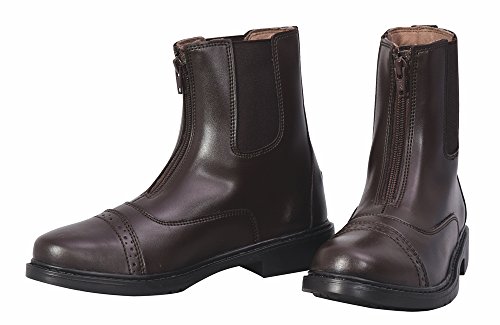
Every practical safety feature — spur rests, elastic gussets, PVC outsole — at the lowest reliable price point.
Typically under $65
Check Current Price & SizesClosure: Front zip | Material: Synthetic leather | Outsole: PVC all-weather
TuffRider Starters check every practical box at a price that doesn’t require much deliberation. Spur rests, elastic side gussets, punched toe cap, smooth zip — all present. Multiple pairs have cycled through our barn over the past two seasons, worn by students in lessons and handlers at morning turnout, and they hold up reliably for that level of daily use.
One fit note: the ankle opening runs slightly large. Fix it with thicker riding socks. If you’re just starting out, pairing these with well-fitted riding breeches and half chaps for lower-leg coverage gives you everything you need for your first lessons.
Pros: Best price-to-function ratio on this list; spur rests correctly placed; consistent sizing; instructor-recommended for beginners.
Cons: Synthetic leather shows wear faster than full-grain; ankle opening runs large.
Not ideal for: Competition or show ring — these are barn and lesson boots.
→ Best first paddock boot for women.
Also Read: Best Women’s Riding Tights and Leggings
Best Overall Women’s Paddock Boot3. Ovation Ladies Quantum Zip Paddock Boot
Why this one: More comfort technology per dollar than anything else on this list — ComforLast cushioning is the reason women in our barn stopped complaining about aching feet by noon. Best for: Regular women riders who want genuine comfort technology without paying premium leather prices.
ComforLast cushioning in a Vega synthetic boot under $90. Lightweight DuraLast outsole, Cambrelle lining for summer heat.
Typically $75–$90
Check Current Price & SizesClosure: Side zip | Material: Vega synthetic leather | Technology: ComforLast® cushioning + DuraLast TPR outsole
Ovation earns the “best overall” designation by delivering real comfort technology at a mid-range price. The ComforLast variable cushioning insole is noticeably more supportive than the flat insoles in most boots at this price — several women riders at our barn switched to these specifically because other budget boots left their feet aching by noon. The Cambrelle wicking tongue manages summer heat, and the DuraLast TPR outsole is lightweight and water-resistant.
Expect a brief break-in period with the structured insole — push through it. These are the boots riders reorder without deliberation.
Pros: ComforLast cushioning outperforms the price point; water-resistant Vega synthetic leather; Cambrelle lining manages moisture well.
Cons: Short break-in period; initial fit can feel stiff.
Not ideal for: Riders who need immediate out-of-box comfort — give these a few sessions first.
→ Best overall women’s paddock boot on this list.
Best Lace-Up Paddock Boot4. Dover Saddlery Riding Sport Ladies’ Provenance Lace Paddock Boot
Why this one: The only lace-up boot on this list — and the only option that solves wide-foot fit without compromise, because you control every inch of the tension. Best for: Riders with wide feet, high arches, or thick ankles who can’t get a proper fit from zip-style paddock boots.
The only lace-up on this list. Adjustable tension across every inch of the synthetic leather upper — loose at the instep, snug at the ankle.
Typically $65–$80
Check Current Price & SizesClosure: Lace-up | Material: Hard-wearing synthetic leather | Outsole: Rubber with traction
Zip-style paddock boots have a fixed ankle circumference. For riders with wider feet, high arches, or thicker ankles, that means a boot that either gaps at the ankle or pinches across the instep — neither fits correctly, neither rides well. A rider in our barn who’d tried three different zip styles and given up on paddock boots entirely found these fit on the first try.
The lace-up system lets you dial in tension exactly where you need it — loose across the instep if required, snug at the ankle. Spur rests, pull-on tabs, and a grippy rubber outsole complete a sturdy, easy-to-clean boot from a brand with over four decades in equestrian. This is the fix that’s worked reliably at our barn when zip styles haven’t. Riders who switch to lace-ups rarely go back.
Pros: Fully adjustable fit for wide feet and high arches; true to size; easy to clean; rubber outsole grips well.
Cons: Laces are slower than zip for daily on-and-off; synthetic leather won’t age like full-grain.
Not ideal for: Riders who prioritize quick on-and-off — zip boots are faster for daily barn use.
→ Best option for wide feet or high arches.
Best Kids’ Paddock Boot5. Shires Moretta Clio Paddock Boot
Why this one: Purpose-built for the transitional sizing gap — ages ~8–13 — that most brands skip entirely, with quality hardware that holds up through a full riding season. Best for: Young riders (ages ~8–13) moving past toddler sizing but not yet filling out adult boots.
YKK zip, moisture-wicking lining, shock-absorbing insole — built for the transitional sizing gap (ages ~8–13) that most brands skip. Worn through two full summers of lessons without a blister complaint.
Typically $50–$65
Check Current Price & SizesClosure: YKK zip | Material: Easy-clean faux leather | Lining: Moisture-wicking with shock-absorbing insole
Despite the “Adult’s” label, this boot was our riding instructor’s recommendation for young riders who have outgrown toddler sizing but aren’t yet filling out true adult boots. My grandkids wore these through two full summers of weekly lessons without a single blister complaint. The YKK zipper is quality hardware that won’t fail mid-season, the moisture-wicking lining handles summer lessons, and the shock-absorbing insole is a real benefit for kids standing around the barn between rides. Easy-clean faux leather keeps maintenance simple.
Sizing note: order up a half size if your child has a wider toe box or sits between sizes.
Pros: Quality YKK zipper; moisture-wicking lining; shock-absorbing insole; easy-clean faux leather.
Cons: Can run tight at the ankle — measure carefully; faux leather won’t outlast full-grain.
Not ideal for: Very young riders still in toddler sizing — the TuffRider Children’s Starter covers that range.
→ Best kids’ paddock boot for serious young riders.
Best Budget Kids’ Paddock Boot6. TuffRider Children’s Starter Front Zip Paddock Boot
Why this one: The widest size range of any boot here — toddler through big kid — at the lowest price, with every required safety feature intact. Best for: Young beginners just starting lessons and families who need safe boots for fast-growing feet.
Toddler through big kid, under $50, with every safety feature that matters. Multiple seasons of lesson use in our barn. Order one full size up — they run small.
Typically under $50
Check Current Price & SizesClosure: Front zip | Material: Synthetic leather | Sizes: Toddler through big kid
These are the boots I’d put on any beginner young rider just starting lessons — proper heel, toe cap, spur rests, traction outsole — at a price that makes sense when feet are growing every few months. Multiple parents at our barn have outfitted young students in these and they hold up reliably through a full season of weekly lessons.
Two sizing facts that matter: “Size 8 Child” in this line means toddler. And they run small — order one full size up from your child’s measured foot length.
Pros: Most affordable on the list; widest size range (toddler–big kid); all required safety features; durable PVC outsole.
Cons: Run small — order up; some break-in discomfort reported; synthetic leather only.
Not ideal for: Kids transitioning out of youth sizing — move to the Shires Moretta Clio.
→ Best budget paddock boot for kids starting lessons.
Best Unisex Paddock Boot7. HORZE Signature Paddock Boot
Why this one: The only slip-on paddock boot on this list — and the only one that looks as good off the farm as it functions in the barn. Best for: Riders who want a versatile boot that moves from barn to casual wear without changing shoes.
Supple leather, Cambrelle lining, Chelsea silhouette. Comfortable from first wear — no extended break-in. Size up; runs narrow.
Typically $85–$100
Check Current Price & SizesClosure: Slip-on with elastic sides | Material: Supple leather | Lining: Cambrelle moisture-wicking
HORZE primarily makes women’s equestrian products, but the Signature’s Chelsea-style silhouette and sizing range work well for men too. I keep a pair for lighter barn days when I want something easy to pull on. The supple leather is comfortable from first wear — no extended break-in — and the Cambrelle lining handles warm-weather barn work well. Multiple riders report compliments on these away from the barn because the Chelsea silhouette reads as dressed, not equestrian.
Sizing note: these run narrow. Order one full size up.
Pros: Minimal break-in; supple leather comfortable from first wear; Cambrelle lining; Chelsea-style look works beyond the barn.
Cons: Run narrow — order up; slip-on provides less ankle support than zip or lace for intense riding.
Not ideal for: Jumping or fast work where ankle lockdown matters — go with a zip style.
→ Best unisex paddock boot for barn-to-casual wear.
Also Read: 5 Great Jeans for Women for Horse Riding
Ariat vs Ovation vs TuffRider: Head-to-Head Comparison
These three brands cover the tiers most riders choose between. The upfront price difference looks bigger than it is — the cost-per-season numbers below show where your money actually goes.
Bottom Line Before the Data
- Best long-term investment: Ariat Heritage Zip — pays for itself over 5 years
- Best value per season: Ovation Quantum — same cost-per-season as Ariat, lower upfront
- Best for beginners or growing kids: TuffRider Starter — lowest upfront risk when commitment is uncertain
| Factor | ARIAT Heritage Zip | Ovation Quantum Zip | TuffRider Starter Zip |
|---|---|---|---|
| Price range | ~$160–$180 | ~$75–$90 | Under $65 |
| Comfort technology | ATS® footbed — genuine arch support and cushioning | ComforLast® variable cushioning — noticeably above average at this price | Basic insole — functional, not exceptional |
| Material | Full-grain leather — molds to foot, ages well | Vega synthetic — water-resistant, durable | Synthetic leather — holds up for lessons, shows wear over time |
| Expected lifespan | 5+ years with proper care | 2–3 seasons with regular use | 1–2 seasons under daily use |
| Break-in period | 3–5 sessions | 2–4 sessions | Minimal |
| Best rider | Daily riders who want one pair to last | Regular riders who want comfort without premium pricing | Beginners, lesson students, budget-conscious buyers |
| Cost per season | ~$30–$35/season (5-year lifespan) | ~$30–$35/season (2.5-year lifespan) | ~$35–$65/season (1–2-year lifespan) |
Horseman’s Perspective: Ariat and Ovation cost the same per season. That reframes the decision entirely — you’re not choosing between $170 and $80, you’re choosing between full-grain leather that molds to your foot and a synthetic that doesn’t. For anyone committing to regular riding, Ovation is the floor. For daily riders who want five years from one pair, Ariat is the answer. TuffRider makes sense only when commitment is uncertain — new rider, fast-growing child, or a situation where replacing boots annually is acceptable.
Best Paddock Boots for Beginners
For a first pair, three things matter above everything else: a heel between 3/4 and 1.5 inches to prevent the foot sliding through the stirrup, a reinforced toe cap, and consistent sizing. Everything else is secondary.
Women beginners: The TuffRider Ladies Starter Front Zip — under $65, spur rests included, instructor-endorsed. Men beginners: The Ariat Heritage Zip is worth the investment — ATS comfort means your feet won’t give out in your first long lesson. Budget-tight beginners who aren’t certain they’ll commit: the HORZE Signature is a solid unisex starting point.
Before your first lesson, pairing paddock boots with half chaps for lower-leg coverage gives you tall-boot protection at a fraction of the cost — that guide covers exactly how to fit them to your paddock boots.
What beginners get wrong most often: Buying a boot without verifying heel height. Anything under 3/4 inch is not safe for riding — the foot can slide through the stirrup in a fall. Confirm heel height on any boot before purchasing, especially fashion-influenced styles. When in doubt, ask your instructor before you buy.
Best Paddock Boots for Wide Feet
Wide feet are the most common fit complaint in paddock boots, and zip-style boots give you no way to adjust. Two options actually solve this:
Best lace-up: Dover Saddlery Provenance Lace — Adjustable tension across every inch means room at the instep and snug at the ankle simultaneously. For riders who’ve given up on paddock boots over fit issues, try lace-up before concluding the category doesn’t work for you.
Best zip option for wide feet: Ariat Heritage Round Toe — Meaningfully more room in the toe box than the standard Heritage Zip. Check Ariat’s website for current width availability. Understanding how leather types stretch and conform over time matters here — full-grain leather gives slightly as it breaks in, while synthetic holds its shape permanently.
Width rule: Never size up in length to gain width — you’ll get heel slip and blisters. Width and length are separate measurements. Most brands size only in standard width; Ariat offers wide (W) and extra wide (WW) in select styles. Wide-footed riders often find that paddock boots paired with half chaps are significantly more comfortable than tall field boots, which compress the calf and leave even less room for width variation.
How to Choose Paddock Boots
1. Fit and Heel Height
The heel must fall between 3/4 inch and 1.5 inches — enough to prevent foot-through-stirrup in a fall, not so high that walking becomes awkward. The boot should fit snug at the heel and ankle with about a half inch of toe room. Measure your foot against the brand’s size chart — street shoe size does not translate reliably across equestrian brands. For a thorough walkthrough of how to properly fit riding boots from heel to toe, that guide covers every measurement you need before ordering online.
2. Zip vs. Lace vs. Slip-On
Zips are the practical default — fast, secure, no maintenance. Lace-ups are the correct choice for wider feet, high arches, or any ankle dimension that doesn’t fit a standard zip. Slip-ons handle casual barn use and light riding but don’t lock the ankle in the way zip or lace does under active work.
3. Leather vs. Synthetic
Full-grain leather molds to your foot and outlasts synthetic by several seasons when properly conditioned. Synthetic is cheaper, easier to clean, and often water-resistant from day one — practical for heavy barn use. For riders buying one pair to last, invest in leather. For riders going through boots under hard use, synthetic is financially sound. The full breakdown of leather types and what to expect from each over time is worth reading before spending $150+.
4. Break-In Time
Wear new boots around the house for two to three sessions before your first ride. Leather stiffness misrepresents how a boot will actually fit once broken in. If a boot still feels wrong after a week of regular wear, the size or width is the problem — return it.
5. Ask Your Instructor
Your instructor has watched students in every boot brand available. They know which sizing runs large, which styles hold up through lessons, and whether your discipline has specific footwear requirements. Their experience beats any online review. Ask before you buy.
FAQs: Paddock Boots
What is the difference between paddock boots and riding boots?
Paddock boots are short ankle-length boots suited for both riding and barn work. Tall riding boots (field boots, dress boots) cover the lower leg to the knee and provide more leg protection in the stirrup. Paddock boots are more versatile and affordable; tall boots are preferred for showing and disciplines where leg position matters. Most everyday riders use paddock boots paired with half chaps to replicate tall-boot coverage.
Can you ride a horse in paddock boots?
Yes — paddock boots are designed specifically for riding. They have spur rests, a heel height that prevents the foot from sliding through the stirrup, and toe caps for protection. They work well for English discipline, dressage training, trail riding, and general lessons.
Can you use paddock boots for western riding?
Paddock boots are primarily an English-discipline boot. Western riders typically use cowboy boots, which have a higher heel designed for western stirrups. Paddock boots with a proper heel can be used for casual western trail riding and barn work — they won’t look correct in a western show ring.
How should paddock boots fit?
Snug at the heel and ankle with about a half inch of toe room. The boot should not slip at the heel when walking and should not pinch across the instep. Try them on with the riding socks you plan to wear. For children’s boots, allow half an inch of growing room. Most leather paddock boots loosen slightly after break-in — avoid buying too large in anticipation of this.
What do you wear with paddock boots?
Paddock boots are typically worn with jodhpurs or breeches paired with half chaps. Half chaps attach over the lower leg above the paddock boot to provide the same coverage as a tall boot — this is the everyday standard for lessons and training. Outside the barn, paddock boots pair well with jeans given their Chelsea-boot appearance.
Are paddock boots good for wide feet?
Zip-style paddock boots can be difficult for wide feet because the ankle opening is fixed. The Dover Saddlery Provenance Lace is the most accommodating — you control the tension across the full instep. The Ariat Heritage Round Toe offers more toe box room than the standard Heritage Zip for riders who need a wider zip option. Never size up in length to gain width — it causes heel slip and blisters.
What are the best paddock boots for beginners?
For beginner women, the TuffRider Ladies Starter Front Zip — under $65, spur rests included, instructor-recommended. For beginner men, the Ariat Heritage Zip is worth the investment; the HORZE Signature works as a budget unisex option. Always verify heel height is at least 3/4 inch before purchasing any boot for riding.
How long do paddock boots last?
Full-grain leather paddock boots conditioned monthly can last 5–10 years. Synthetic leather boots typically last 2–4 seasons under regular use. The zipper usually fails before the boot itself — quality hardware like YKK significantly extends the life of any zip-style paddock.
Do paddock boots need to be broken in?
Yes, particularly leather boots. Wear them around the house for two to three sessions before riding. If a boot still feels wrong after a week of regular wear, sizing or width is the problem — not the break-in period.
Can you wear paddock boots with jodhpurs?
Yes — paddock boots are called Jodhpur boots specifically because they were traditionally worn with jodhpur pants. The short ankle height of the boot works with jodhpurs, which are cut to sit over the boot at the ankle. This is one of the most classic combinations in English equestrian attire.
Do I need half chaps with paddock boots?
Not immediately — paddock boots are safe and functional for riding on their own. Half chaps become worth adding when you want tall-boot coverage and protection for the lower leg, a cleaner line in the stirrup for more advanced work, or extra grip on the calf when riding in disciplines like dressage or jumping. For beginner lessons, paddock boots alone are fine. Once you’re riding consistently, pairing them with half chaps is the most cost-effective way to get the look and function of a tall boot without the price. Fit them to the boot rather than your leg — a half chap that gaps at the ankle because it was sized to the calf won’t stay put.
Quick Picks — Best Paddock Boot by Category
- Best overall men’s: ARIAT Heritage Zip — ATS footbed, full-grain leather, 5+ year lifespan
- Best overall women’s: Ovation Quantum Zip — best comfort-to-price ratio under $90
- Best budget (women’s): TuffRider Ladies Starter — under $65, instructor-recommended
- Best for wide feet: Dover Saddlery Provenance Lace — only adjustable-fit option on this list
- Best for kids: Shires Moretta Clio — transitional sizing, quality YKK zip
- Best budget kids’: TuffRider Children’s Starter — toddler through big kid, under $50
- Best unisex: HORZE Signature — Chelsea-style, works off the farm
Final Recommendation
The decision is straightforward. For men: ARIAT Heritage Zip. For women: Ovation Ladies Quantum Zip. Both use legitimate comfort technology that holds up through real barn conditions. Both will last multiple seasons. Both are the boots I’d put on someone I was advising in person.
If budget drives the decision, TuffRider delivers for women and children without cutting the safety features that matter. For any rider who’s had fit problems with zip styles, go directly to the Dover Saddlery Provenance Lace — the adjustable lace is the solution, not a workaround.
Horseman’s Perspective: Buy the best leather you can afford, condition it from day one, and size for the foot you have. Fit first, brand second. For everything that pairs with paddock boots — fitting half chaps to your paddock boots, choosing the right riding breeches, and women’s riding tights and leggings — those guides cover what goes with these boots once you’ve chosen them.
Still undecided? Start with the Ovation Quantum or TuffRider Starter. Either gives you a reliable baseline without overspending — and once you know what fits you, upgrading is easy.

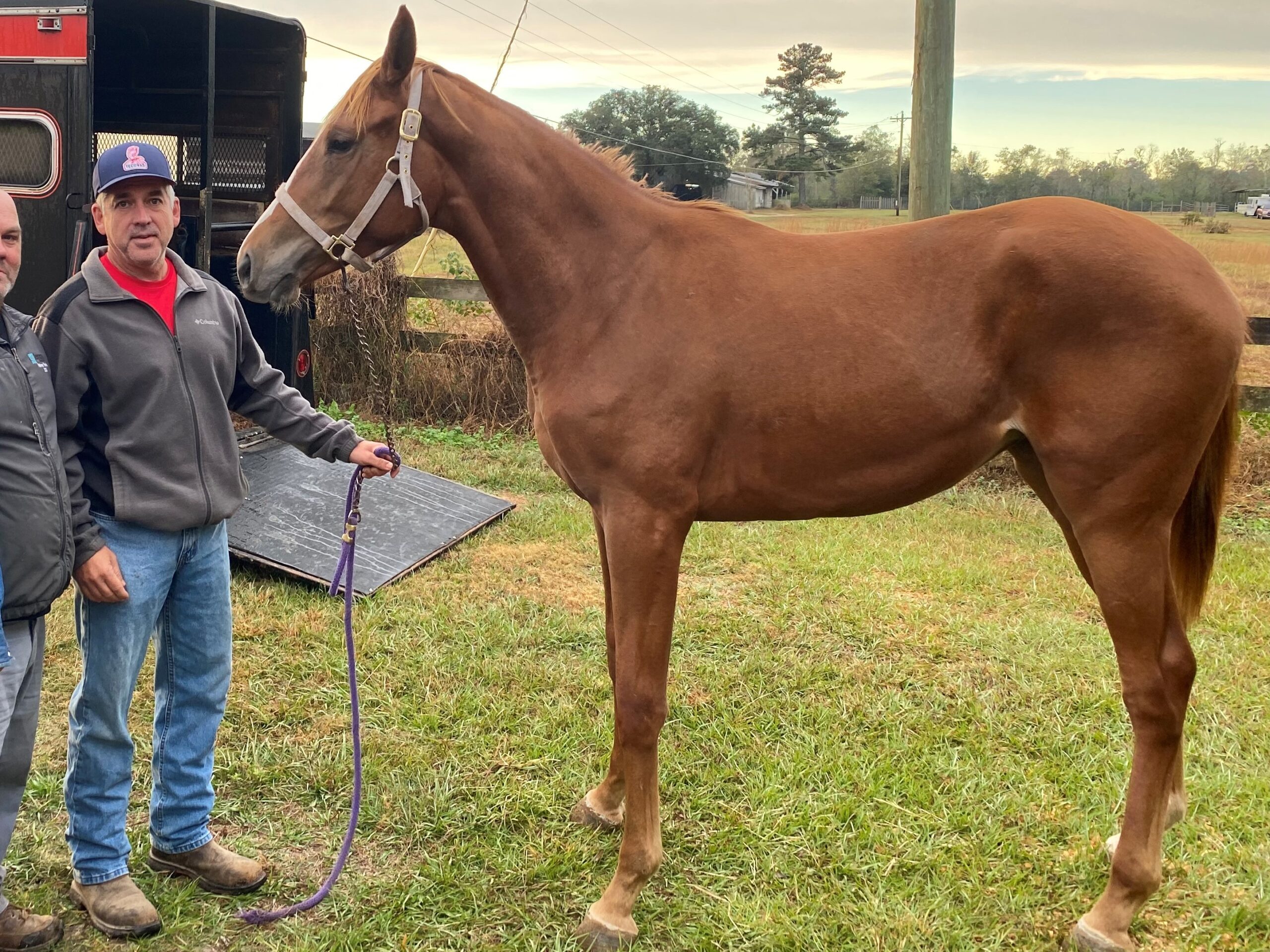
About Miles Henry
Racehorse Owner & Author | 30+ Years in Thoroughbred Racing
Miles Henry (legal name: William Bradley) is a professional horseman based in Folsom, Louisiana. He holds Louisiana Racing License #67012 and has spent over three decades managing Thoroughbreds at premier tracks including Fair Grounds, Delta Downs, and Evangeline Downs.
Expertise & Hands-On Experience: Beyond the track, Miles has decades of experience in specialized equine care, covering everything from hoof health and nutrition to training protocols for Quarter Horses, Friesians, and Paints. Every guide on Horse Racing Sense is rooted in this “boots-on-the-ground” perspective.
30 of their last 90 starts
Equibase Profile.

Connect with Miles: