

Last updated: June 3, 2026
Some racehorses are remembered for sheer dominance on the track, while others became legends because their stories captured the public imagination. This list highlights both kinds — the champions defined by performance and the icons defined by cultural impact. For a strictly performance-based ranking, see the greatest racehorses of all time.
The 11 most famous racehorses — who they were and why they mattered:
- Man o’ War — 20 of 21 wins; named Horse of the Century
- Secretariat — 1973 Triple Crown; Belmont by 31 lengths; cultural icon
- Seabiscuit — undersized underdog who inspired a nation during the Great Depression
- American Pharoah — ended a 37-year Triple Crown drought; first Grand Slam winner
- Frankel — undefeated in 14 starts; highest Timeform rating ever assigned
- Black Caviar — 25 wins from 25; undefeated across multiple countries; Australian national icon
- Phar Lap — Australia’s Depression-era hero; legendary story and mysterious death
- Winx — 33 consecutive wins; ranked world’s best horse four years in a row
- Seattle Slew — won the Triple Crown undefeated; purchased for $17,500
- Flightline — undefeated in six starts; 2022 Breeders’ Cup Classic by 19¼ lengths
- Ruffian — undefeated filly; tragic injury led to reforms in racehorse safety
| Horse | Record | Era | Why Famous |
|---|---|---|---|
| Man o’ War | 20–1 | 1919–1920 | Dominated an era; named Horse of the Century; sired Triple Crown winner War Admiral |
| Secretariat | 16–3–1 | 1972–1973 | 1973 Triple Crown; record-setting Belmont; symbol of American excellence |
| Seabiscuit | 33–15–13 | 1935–1940 | Great Depression symbol; won “Match of the Century” vs War Admiral; book and film adaptations |
| American Pharoah | 11–2–0 | 2014–2015 | Ended 37-year Triple Crown drought; first American Grand Slam winner |
| Frankel | 14–0 | 2010–2012 | Undefeated; highest Timeform rating in modern history (147) |
| Black Caviar | 25–0 | 2009–2013 | Undefeated; 15 Group 1 wins; appeared on postage stamps |
| Phar Lap | 37–3–2 | 1929–1932 | Australian national hero; mysterious death; heart preserved at National Museum |
| Winx | 37–1–3 | 2013–2019 | 33 consecutive wins; world’s top-ranked horse four consecutive years |
| Seattle Slew | 14–2–1 | 1976–1978 | Purchased for $17,500; won Triple Crown undefeated |
| Flightline | 6–0 | 2021–2022 | Dominant Breeders’ Cup Classic victory by 19¼ lengths; retired undefeated |
| Ruffian | 10–0 (DNF) | 1974–1975 | Undefeated filly; catastrophic injury triggered lasting safety reforms in racing |
Table of Contents
1. Man o’ War
Man o’ War — one of the most documented horses in American sports history — won 20 of his 21 races between 1919 and 1920, set multiple world records while carrying weights modern horses rarely see, and became famous enough that his funeral in 1947 was broadcast on radio to a nationwide audience. The Blood-Horse named him Horse of the Century. His only loss came in a race where he was reportedly facing the wrong direction at the start — he still finished second.
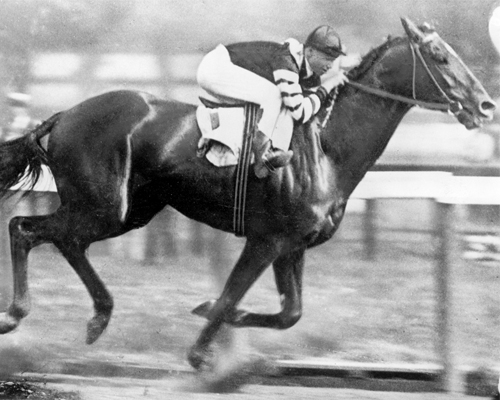
Why Man o’ War became famous:
- 20 wins from 21 starts; won the 1920 Preakness and Belmont Stakes by wide margins
- Set multiple world and American records, often while carrying 130–138 lbs
- Skipped the Kentucky Derby — his owner believed the early-season schedule was too demanding for young horses
- Sired War Admiral, who won the 1937 Triple Crown; the War Admiral vs Seabiscuit match race in 1938 connected both legacies
- Named Horse of the Century by The Blood-Horse; his funeral was broadcast on national radio
- Voted co-athlete of the year in 1920 by the New York Times alongside Babe Ruth
2. Secretariat
Secretariat became famous before he’d proven anything: he appeared on the covers of Time, Newsweek, and Sports Illustrated in the same week as a two-year-old, the first entity to ever do so. By the end of his three-year-old season in 1973, he’d earned it. His 31-length Belmont Stakes win in 2:24 flat is still the record — Secretariat’s career is detailed in full at Britannica. His Kentucky Derby time of 1:59 2/5 is still the record. His Preakness time of 1:53 was officially confirmed as the record by the Maryland Racing Commission in 2012.
Why Secretariat became famous:
- 1973 Triple Crown — first in 25 years; set records in all three races that still stand
- Won the Kentucky Derby running each quarter-mile faster than the previous — no horse has replicated this
- Belmont by 31 lengths in 2:24 flat — widely regarded as the greatest single race ever run
- Appeared on Time, Newsweek, and Sports Illustrated simultaneously — a first for any entity
- Heart estimated at roughly 22 pounds at necropsy, compared to the average horse’s 8–9 pounds — see heart size in racehorses
- A 2010 feature film brought his story to a new generation of fans
3. Seabiscuit
Seabiscuit’s racing record — 33 wins from 89 starts — doesn’t place him among the greatest by performance metrics. He’s on this list because his story connected with something beyond racing. During the Great Depression, an undersized horse with a turned-out knee who’d been overlooked and poorly handled became the most talked-about athlete in America. His 1938 match race against War Admiral — Man o’ War’s son, the reigning Triple Crown winner — drew a radio audience of 40 million people at a time when the U.S. population was 130 million.
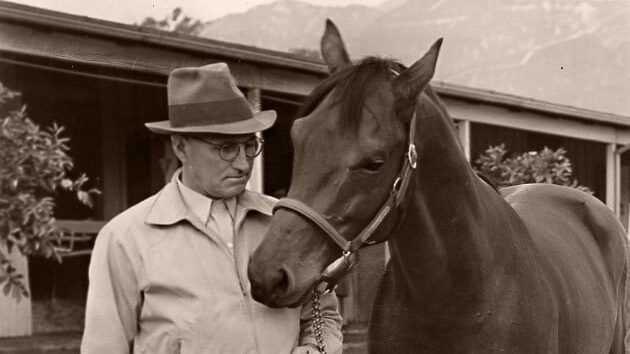
Why Seabiscuit became famous:
- Grandson of Man o’ War; initially overlooked and poorly handled before Charles Howard, Tom Smith, and Red Pollard unlocked his potential
- The 1938 “Match of the Century” against War Admiral drew a radio audience of roughly 40 million — one of the largest for any sporting event of the era
- Won the 1940 Santa Anita Handicap in his final race, completing a comeback story that captivated Depression-era America
- Laura Hillenbrand’s 2001 book Seabiscuit: An American Legend became a bestseller; the 2003 film followed
- His story was less about the records and more about what people needed to believe at the time
4. American Pharoah
American Pharoah ended a 37-year Triple Crown drought in 2015 — the longest gap between Triple Crown winners in the history of the Triple Crown series. Thirteen horses had won the first two legs of the Triple Crown since Affirmed in 1978 without completing the sweep. American Pharoah did it, then added the Breeders’ Cup Classic to complete the first “Grand Slam” of American racing. His trainer Bob Baffert, jockey Victor Espinoza, and owner Ahmed Zayat had a horse that delivered exactly when the sport needed it most.

Why American Pharoah became famous:
- First Triple Crown winner in 37 years (2015); 11 wins from 14 starts
- First horse to complete the “Grand Slam” of American racing: Triple Crown plus the Breeders’ Cup Classic
- Ended a drought that had lasted long enough that many racing fans had given up expecting it to end
- Crowd of 90,000+ at Belmont Park for the Triple Crown clincher — one of the largest in the track’s history
- Retired to Coolmore’s Ashford Stud in Kentucky; early sire results include multiple stakes winners
5. Frankel
Frankel retired in 2012 having won all 14 of his races, with a Timeform rating of 147 — the highest ever assigned to any horse in the modern era. Trained by Sir Henry Cecil at Newmarket and ridden by Tom Queally, he was named after the legendary American trainer Bobby Frankel. His 2000 Guineas win by six lengths in 2011 was the defining early performance. His Juddmonte International in 2012 — a Group 1 on a track considered better suited to stamina horses — expanded the case that he could do anything at any distance.

Why Frankel became famous:
- 14 wins from 14 starts — retired undefeated
- Timeform rating of 147 — the highest ever assigned in the modern era; official rating of 140 by the British Horseracing Authority
- Won all five races as a two-year-old, including the Dewhurst Stakes; won the 2000 Guineas by six lengths
- Named after legendary American trainer Bobby Frankel; sired by Galileo out of Kind
- Now a successful sire at Juddmonte Farms; his offspring include multiple Group 1 winners
- Widely considered the best European racehorse of the modern era and among the greatest of all time
6. Black Caviar
Black Caviar retired undefeated in 25 starts, with 15 Group 1 victories across Australia and England. She became a cultural phenomenon in Australia — appearing on postage stamps, drawing record crowds to her home tracks, and inspiring a statue in Nagambie. When she was shipped to Royal Ascot in 2012 for the Diamond Jubilee Stakes and won despite being below peak fitness after the long flight, trainer Peter Moody famously apologized to the crowd for the narrow margin. She was never beaten.
Why Black Caviar became famous:
- 25 wins from 25 starts — undefeated across a five-year career in Australia and England
- 15 Group 1 victories — an Australian record; 60% of her wins were at the highest classification
- Won the Diamond Jubilee Stakes at Royal Ascot — the first Australian horse to win a European championship sprint title
- Appeared on Australian postage stamps; a statue was erected in Nagambie; she became a national symbol of Australian racing
- Known in her stable as Nelly; her owners’ racing colors were salmon pink with black spots — the colors became iconic
7. Phar Lap
Phar Lap was born in New Zealand in 1926, trained in Australia, and became the country’s most beloved sporting figure during the Depression years. His name means “lightning” in Zhuang. He won 37 races from 51 starts, including the Melbourne Cup and the Cox Plate, under trainer Harry Telford. His final start — the Agua Caliente Handicap in Tijuana, Mexico in March 1932 — was his first race on foreign soil. He won by two lengths. Sixteen days later he was dead, the cause never definitively determined. His heart, on display at Australia’s National Museum in Canberra, is roughly twice the size of an average horse’s. If you want to understand why Phar Lap is famous, watch the 1983 Australian film about his life.
Why Phar Lap became famous:
- 37 wins from 51 starts; won the Melbourne Cup (1930), Cox Plate (1930, 1931), and 14 other major races
- Won the Agua Caliente Handicap in his first international start — then died 16 days later under unexplained circumstances that fueled decades of theories
- Became a Depression-era national symbol for Australia and New Zealand; his story paralleled Seabiscuit’s in the U.S.
- His oversized heart — preserved and on display at Australia’s National Museum — became part of his legend
- The 1983 film Phar Lap is one of the most-watched Australian films ever made and still introduces new generations to his story
8. Winx
Winx compiled a 33-race winning streak between 2015 and 2019 — the longest in Australian Thoroughbred history. Trained by Chris Waller and ridden almost exclusively by Hugh Bowman, she won the Cox Plate four consecutive times, was ranked the world’s best racehorse four consecutive years by the Longines World’s Best Racehorse Rankings, and retired in April 2019 with a career record of 37 wins from 43 starts. She never raced outside Australia, which is the main reason she’s not ranked higher on pure performance lists — but within Australian racing, her fame surpassed every horse since Phar Lap.

Why Winx became famous:
- 33 consecutive wins (2015–2019) — the longest winning streak in Australian Thoroughbred history
- Won the Cox Plate four consecutive times (2015–2018) — the greatest weight-for-age race in Australia
- Ranked the world’s best racehorse four consecutive years by the Longines World’s Best Racehorse Rankings
- 37 wins from 43 starts; career earnings exceeded AU$26 million
- Drew record crowds to Randwick and Rosehill; became a cultural institution in Australian sport
9. Seattle Slew
Seattle Slew was purchased for $17,500 at a yearling sale — a figure that looks more absurd with each passing decade. He was the first horse to win the Triple Crown while undefeated, doing so in 1977 under trainer Billy Turner and jockey Jean Cruguet. He then survived a life-threatening illness in his prime, came back, and ran a mile and an eighth in 1:45 4/5, two-fifths of a second off the world record. His sire career produced A.P. Indy, who became one of the most influential sires in North American breeding history.

Why Seattle Slew became famous:
- Purchased for $17,500 at auction — the cheapest Triple Crown winner in the history of the series
- First horse to win the Triple Crown while entering it undefeated (1977)
- Survived a near-fatal illness caused by a missed injection in his prime; came back to race competitively
- Sired A.P. Indy (Horse of the Year 1992), who became one of the most influential North American sires; also sired Swale (1984 Kentucky Derby and Belmont winner)
10. Flightline
Flightline retired in late 2022 with a record of 6 wins from 6 starts. He became famous in a single afternoon: his 2022 Breeders’ Cup Classic win by 19¼ lengths posted a Beyer Speed Figure of 134 — among the highest figures recorded in modern racing. For people who watched that race, the margin looked like a different division of competition. He’d already won the Pacific Classic by 19½ lengths and the Met Mile by 9¾. He was retired shortly after the Breeders’ Cup in his prime, which is what keeps him from a higher ranking by career length — but the performances he produced are among the most dominant in the modern era.
Why Flightline became famous:
- 6 wins from 6 starts — retired undefeated
- 2022 Breeders’ Cup Classic by 19¼ lengths — the widest winning margin in that race’s history
- Beyer Speed Figure of 134 in the Breeders’ Cup — among the highest figures recorded in the modern era
- Won the Pacific Classic by 19½ lengths; the Met Mile by 9¾ lengths
- Retired in his prime — left the sport before anyone found the answer to how to beat him
Miles’s Take — What made Flightline different: I’ve been watching horse racing for 30 years and I’ve seen dominant horses. The 2022 Breeders’ Cup Classic was something I hadn’t seen before. The field wasn’t weak — Life Is Good and Taiba were both serious horses. He went past them like they were standing still. The 19-length margin in that company, with that Beyer figure, is the kind of performance that people who weren’t watching racing at the time find hard to believe when you tell them about it. The case for Flightline in any “greatest” conversation is six starts deep — but those six starts argue more convincingly than most horses’ full careers.
11. Ruffian
Ruffian won her first 10 races, breaking or equaling track records in the first eight. She swept the 1975 New York Filly Triple Crown — the Acorn Stakes, Mother Goose Stakes, and Coaching Club American Oaks — setting new stakes records in all three. On July 6, 1975, she entered a match race against Kentucky Derby winner Foolish Pleasure. She broke down catastrophically with more than half the race remaining, fracturing both sesamoid bones in her right front leg. She was euthanized after surgery. She was three years old. Her story is on this list not just because of what she accomplished, but because of what she started: the conversation about racehorse welfare that changed how the industry thinks about the horses it runs.
Why Ruffian became famous:
- 10 wins from 10 starts; broke or equaled track records in her first eight races
- Swept the 1975 New York Filly Triple Crown, setting new stakes records in all three races
- 1974 Eclipse Award for Outstanding Two-Year-Old Filly; regarded by many who saw her as the fastest filly — possibly the fastest horse — alive at the time
- Her catastrophic breakdown in the 1975 match race against Foolish Pleasure was broadcast live on national television
- The Ruffian Handicap, established in her honor, has been run annually; her story triggered lasting reforms in equine medical protocols and racehorse safety standards

FAQs About Famous Racehorses
What is the most famous racehorse of all time?
Man o’ War and Secretariat are the most frequently named answers to this question. Man o’ War dominated his era and was named Horse of the Century by The Blood-Horse. Secretariat’s 1973 Triple Crown — particularly the 31-length Belmont win — made him a cultural icon beyond horse racing. Seabiscuit is the most famous in terms of broader cultural impact, with a bestselling book and major film bringing his story to audiences who don’t follow racing.
What horse has the most famous single race performance?
Secretariat’s 1973 Belmont Stakes — 31 lengths, 2:24 flat, still the record — is widely regarded as the greatest single race performance in history. Flightline’s 2022 Breeders’ Cup Classic (19¼ lengths, Beyer 134) is the most dominant modern equivalent. Man o’ War’s Lawrence Realization, where he won by over 100 lengths, is the largest winning margin in major American stakes racing history.
What is the fastest racehorse of all time?
By single-race speed figure, Flightline posted a Beyer of 134 in the 2022 Breeders’ Cup Classic — among the highest ever recorded. Secretariat holds the records in the Kentucky Derby (1:59 2/5) and the Belmont Stakes (2:24 flat). Dr. Fager’s mile record of 1:32 1/5, set carrying 134 pounds in 1968, has never been broken on a dirt track. See the full discussion in the horse racing speed records guide.
What factors make a racehorse famous?
Racing fame comes from a combination of performance, timing, and story. Secretariat performed at a level no one had seen before, at a moment when American audiences needed something to celebrate. Seabiscuit’s record was modest by performance standards but his story was perfectly timed for the Depression. Ruffian’s fame is inseparable from her death and what it meant for horse safety. The horses on this list became famous through different combinations of all three.
Are the greatest racehorses the same as the most famous?
Not always. Seabiscuit, Phar Lap, and Ruffian are among the most famous horses in history, but none would rank in the top ten by pure performance metrics. Conversely, Citation, Kelso, Kincsem, and Eclipse rank among the greatest performers in history but are not particularly famous outside of serious racing circles. See the companion guide to the greatest racehorses of all time for a performance-based ranking.
What horse breeds are the fastest?
The Thoroughbred is the standard for flat racing speed, bred specifically for the purpose over several centuries. The American Quarter Horse is faster over short distances — quarter-mile sprints — and holds the record for the highest measured speed of any horse at about 55 mph. Arabians are built more for stamina than outright speed but can maintain pace over longer distances. For racing purposes, Thoroughbreds and Quarter Horses are the primary breeds competing professionally.
About Miles Henry
Racehorse Owner & Author | 30+ Years in Thoroughbred Racing
Miles Henry (legal name: William Bradley) is a professional horseman based in Folsom, Louisiana. He holds Louisiana Racing License #67012 and has spent over three decades managing Thoroughbreds at premier tracks including Fair Grounds, Delta Downs, and Evangeline Downs.
Expertise & Hands-On Experience: Beyond the track, Miles has decades of experience in specialized equine care, covering everything from hoof health and nutrition to training protocols for Quarter Horses, Friesians, and Paints. Every guide on Horse Racing Sense is rooted in this “boots-on-the-ground” perspective.
30 of their last 90 starts
Equibase Profile.

Connect with Miles: