

Last updated: June 1, 2026
Handicapping horse races is where most bettors lose — not because they pick the wrong horses, but because they play the wrong races for the wrong reasons. The real edge isn’t finding winners; it’s recognizing when a race doesn’t offer a playable situation at all.
After thirty-plus years owning and racing Thoroughbreds in Louisiana, I’ve learned that the shift from losing bettor to consistently profitable one rarely comes from learning a new system. It comes from knowing which races are worth your attention — and which ones are better left alone.
I’ve used this same filter for decades, and the example below shows how it works when a field looks messy at first glance.
Handicapping in 60 seconds:
- What it actually is: A structured way to narrow a race to a few realistic contenders based on fitness, class, and pace
- Favorites win roughly one-third of races — backing them blindly is a long-term losing strategy
- Strongest single pattern: Legitimate class drop + contested pace — reliable when both conditions are confirmed, not just one
- The step most beginners skip: Pace mapping — understanding who gets pressured and who gets a free trip is usually worth more than raw speed figures
- When to pass: If the process doesn’t leave you 1–3 clear contenders, the correct move is to skip the race entirely
If you remember only three things from this article:
- Eliminate unfit horses first — readiness matters more than reputation
- Look for class and pace advantages that agree with each other, not just one
- If the process doesn’t produce 1–3 clear contenders, skip the race entirely
If you’re new to horse racing handicapping, a simple process will take you further than trying to memorize every angle at once. This guide breaks the game down into six steps you can actually apply at the track or on your next race card.
Table of Contents
If You’re Brand New — Start Here
If you’ve never opened a racing program or don’t know what a class drop means, start with this primer before going further: Horse Racing for Absolute Beginners (10-minute guide).
Jargon Key — Read Once, Then You’re Set:
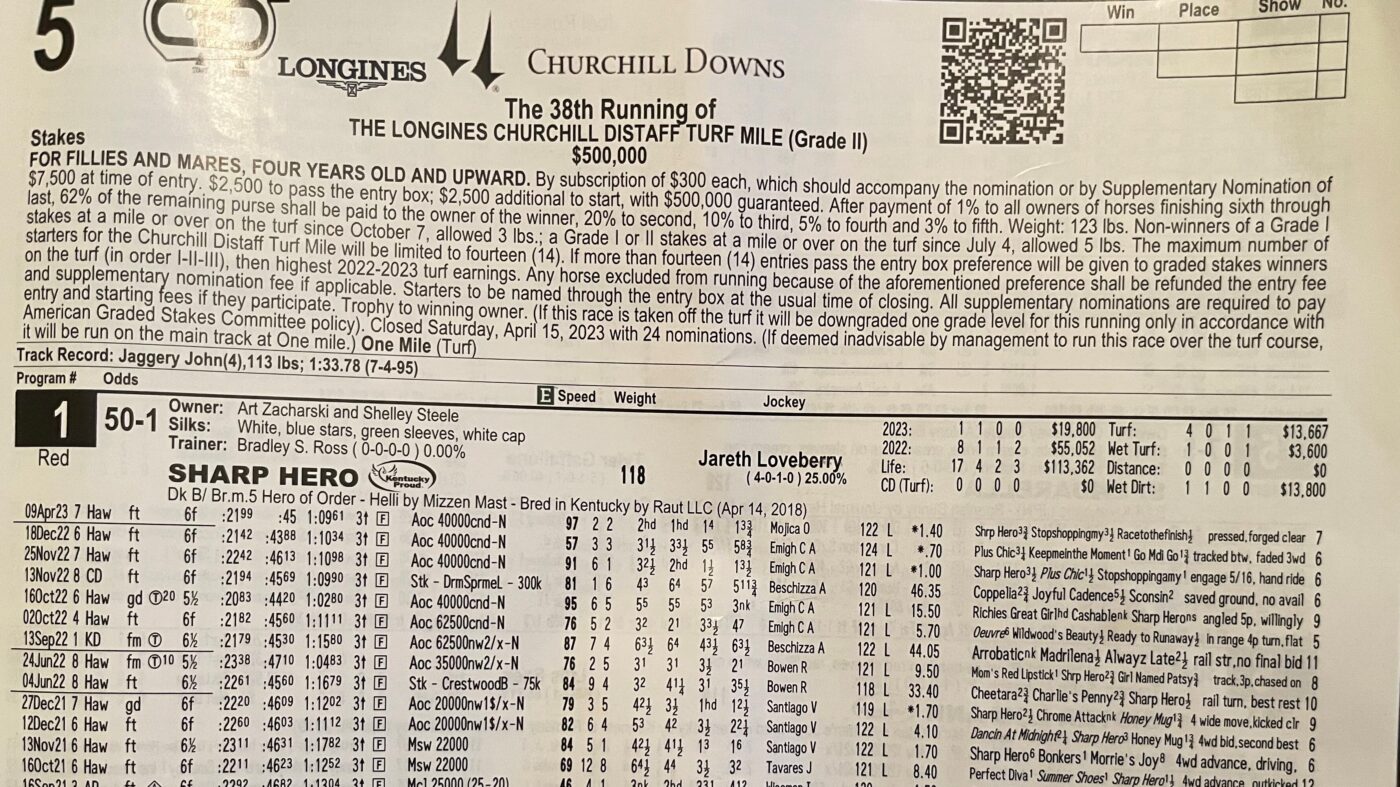
- Beyer — speed figure measuring overall race performance (higher = faster)
- E1/E2 — early pace figures at the first and second calls
- LP — late pace figure; measures closing ability in the final portion of the race
- Bullet — fastest workout of the day at that track
- E / EP / P / S — Early, Early Presser, Presser, Sustained (running styles)
The Honest Truth About Handicapping
Information in horse racing is always incomplete. You never have the full picture — you have past performance data, workout patterns, connections history, and pace projections. The goal isn’t certainty. It’s finding spots where the public is clearly wrong about one or two horses. That’s where the edge lives.
How I Actually Handicap a Race Card
When I open a race card, I don’t start with Race 1. I scan the whole card first and circle the two or three races that look playable — claiming and allowance races where there’s enough history to evaluate. Large maiden fields, races heavy with first-time starters, turf after weather changes — those get skipped before I run a single step of the process.
Once I find a race that looks playable, I run the six-step process. If I don’t end up with two or three clear contenders, I move on. On many cards I never make a bet. On others I find one race where the public is likely to misread the pace or overvalue a short-priced favorite running against a field that sets up perfectly for something overlooked.
Miles’s Take — How I approach a Saturday card at Fair Grounds: I’ll go through the full card before the first race and circle maybe three races that look playable — ones where there’s a clear pace story or a class situation I understand. Then I watch the first few races on the card before I bet anything. How the track is playing tells me more than any figure does. If closers are dying on the far turn, I adjust. If speed is holding, I don’t bet the closers I planned to bet. The process isn’t locked in before the card starts — it updates in real time.
Why Most Beginners Lose Money
I’ve seen more losing tickets come from bad race selection than from bad picks. Someone sits down for a full card, plays every race because they’re at the track and want action, and then wonders why they walked out down $200. The problem wasn’t the handicapping — it was the decision to bet races that never had a clear edge.
Beyond race selection, three patterns account for most beginner losses:
The Three Mistakes That Cost Beginners the Most Money:
- #1 — Blindly backing the favorite: Favorites win roughly 30–35% of races and almost always pay poor odds at short prices. Even when you pick them correctly, the return rarely covers the losses on the other two-thirds. Even when you pick them correctly, you often don’t make money.
- #2 — Ignoring pace shape: Speed horses that fight each other early often collapse in the stretch — setting it up for closers who look unimpressive on paper. The public keeps betting the “fast” horses and keeps losing to the closer no one noticed.
- #3 — Playing too many races: The 6-step process will naturally force you to skip most of the card on many days. That’s not a flaw — that’s the point. Waiting for clear edges is where long-term profit comes from.
The 6-Step Elimination Process
What follows isn’t a mechanical checklist — it’s a progressive narrowing of uncertainty. Each step removes horses that don’t fit today’s conditions. You’re not hunting for the perfect horse. You’re hunting for the horse that fits this race better than the others.
30-Second Odds Crash Course:
- 5-2 = bet $2, collect $7 total ($5 profit + your $2 back)
- 3-1 = bet $2, collect $8 total
- 9-2 = bet $2, collect $11 total
Lower odds = more money bet on that horse. Higher odds = overlooked horse. When this process leaves you two contenders and one is paying more than you expected, that’s usually your best value play. Full betting guide: click here.
Step 1 — Fitness: Is This Horse Actually Ready to Run Today?
Before anything else, ask: would I consider this horse if I knew nothing except its current readiness?
Look for a recent competitive effort in the last 45 days, or multiple solid workouts showing maintenance or improvement. Horses returning from a long layoff without sharp recent work are generally poor starting points — they’re not impossible, but they’re not reliable.
This step alone removes more bad tickets than any other. From here on, each step removes horses that don’t fit today’s race.
Step 2 — Speed Reality: Has This Horse Shown Enough Ability Here?
Draw a line 10 points below the best recent Beyer in the field. Any horse consistently below that line is removed — unless there’s clear evidence of upward improvement.
The important nuance: look at the trend, not just the last number. A horse running 72-75-79 is telling you something different than one running 82-76-71. Consistency and direction matter as much as peak figures.
If a horse repeats its last race, is it even competitive today? If the answer is no, it comes out.
Step 3 — Class Context: Is Today Easier, Harder, or Misleading?
Class is a context signal, not a ranking system. A drop in claiming price looks like an opportunity — but ask the harder question first: why is this horse dropping?
Legitimate drops (trainer placing a horse correctly, owner reducing expectations after a physical issue resolved) are strong. Drops hiding decline, soreness, or loss of form are traps that catch beginners every week.
A class drop paired with a favorable pace scenario remains one of the most reliable winning patterns in claiming races — but only when both conditions are confirmed, not just one.
Step 4 — Distance and Surface: Is This Actually the Horse’s Job Today?
Some horses are fundamentally mismatched to today’s conditions and don’t belong in your consideration regardless of other factors.
Check past performance records for the specific distance and surface. A horse with a strong dirt record and no turf starts is a different proposition than one with three turf wins. A closer that has never won beyond 6 furlongs in a 1-mile route is worth a second look before including.
This step is less about finding positives than eliminating mismatches that inflate the field.
Step 5 — Connections: Who Is Realistically Improving This Horse Today?
Jockey upgrades that signal trainer confidence, second-off-layoff patterns, and equipment changes (blinkers on or off) are the most meaningful signals here.
A trainer + jockey combination running under 14% combined win rate is a downgrade, not neutral. A leading jockey climbing aboard a lightly raced horse with improving figures is often a meaningful signal.
But be careful about overweighting this step. Human factors rarely create ability — they usually reveal it. A great jockey on a horse that doesn’t fit the race shape still loses.
Step 6 — Pace Map: How Will This Race Actually Unfold?
This is where the race shape becomes usable — or doesn’t. Everything before it is about narrowing the field. This is where the race shape becomes real.
Forget who is fastest on paper. The real question is how the trip unfolds — who is forced to work early, and who gets to sit in the clear while it happens.
If three or more horses (E/EP types with E1/E2 ≥105) all need the lead, they’ll apply pressure to each other from the break. That usually turns the front half of the race into a contested run and creates the conditions for a closer to inherit the final stages.
If one horse controls the pace without resistance, that horse’s chances rise sharply — often beyond what raw figures alone suggest.
At this point, you’re projecting race shape, not form figures. That’s where experience starts to matter more than form lines.
Try it yourself: Pull up today’s race card at your local track and run the six steps on one claiming race. Don’t bet. Just see if you can narrow the field to two contenders. You’ll learn more from one live race than from reading ten articles.
Miles’s Take — Why Pace Is the Last and Most Powerful Filter: You’ll hear at the barn: “Pace makes the race.” When early speedsters hook up, they don’t just go fast — they take each other out early. But when most of the field are closers and I’ve got the lone early speed horse? We’re smiling. Our horse gets loose in front, saves energy through the turn, and still has plenty left when the closers come running. That lone-front setup is often the easiest win you’ll ever cash — and the public almost never prices it correctly.

How Class Really Works
The class ladder in claiming racing runs from Maiden Claiming at the bottom through Claiming $5k–$100k, Starter Allowance, Allowance N1X/N2X, up to Overnight Stakes and graded races at the top. Understanding where a horse sits in that structure is useful — but treating every class move as a simple positive or negative is where beginners get hurt.
A $12,500 claimer with consistent recent form can be tougher to beat than a weak allowance field full of horses that have never won. The label matters less than the competition you’re actually facing. One mistake beginners make is assuming every horse dropping in class is a positive. Owners and trainers don’t always drop horses because they’re trying to win — sometimes they’re trying to move a horse before a physical problem becomes obvious. That’s why I never evaluate class in isolation. I want the class move to agree with the horse’s recent form, workouts, and the pace setup before I treat it as a signal.
Races I Usually Skip
Most handicapping guides tell you what to bet. This one is going to tell you what to skip — because the decision to not play a race is as important as the decision to play one.
Three race types I routinely pass:
- Large fields of first-time starters — not enough information to evaluate reliably; workout patterns and trainer statistics help but they’re not the same as a race record; too many unknowns at once
- Turf races after significant weather changes — surface conditions shift how the entire race plays out; horses that like firm turf run differently on soft going, and the past performance data doesn’t always reflect that accurately
- Cheap claimers with erratic recent form — horses that run 72, then 58, then 80 in the same class are telling you something, and it’s usually not good; unpredictable form cycles produce unpredictable results and there’s no reliable edge to find
Pace Mapping
When early pace is genuinely contested — multiple horses fighting for the lead through honest fractions — closers inherit the final stages at a much higher rate than raw figures suggest. The same dynamic shaped the 2025 Kentucky Derby setup — a pace-heavy field that set up perfectly for a closer coming from off the pace.
| Pace Scenario | Usually Benefits | Why |
|---|---|---|
| Multiple speed horses | Closers | Speed horses tire each other; late runners inherit the stretch |
| Lone speed horse | Front-runner | Uncontested leader controls every fraction; hard to run down |
| Moderate, honest pace | Pressers | Even fractions reward horses that track the pace and kick |
| Slow early, fast late | Speed horses | Field bunches up; late runners lack room and closing ground |
| Speed Horses in Field | Typical Pace Shape | Who Benefits |
|---|---|---|
| 1 | Uncontested lead | Front-runner — hardest setup to beat |
| 2 | Depends on quality gap between them | The faster of the two if they separate; closer if they match up evenly |
| 3+ | Genuine pace pressure | Presser or closer — front runners tire |
| 4+ | Likely collapse | Late runners and closers; speed horses rarely survive |
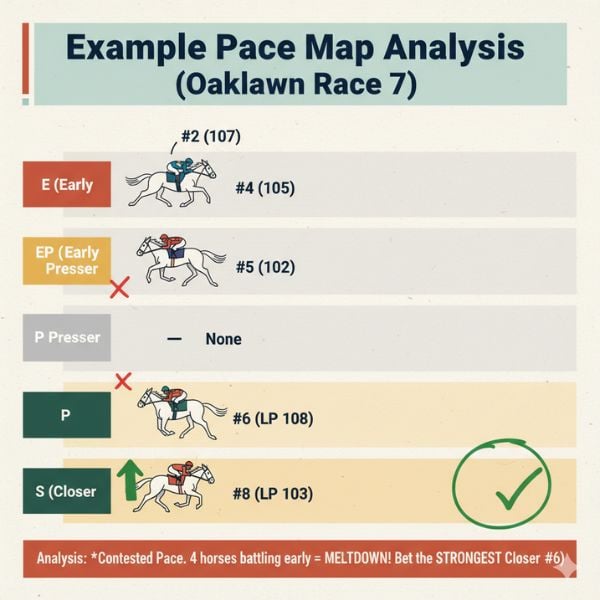
| Running Style | Horses (E1/E2 Figure) | Race Implication |
|---|---|---|
| E (Early) | #2 (107), #4 (105) | Will contest the lead aggressively |
| EP (Early Presser) | #1 (103), #5 (102) | Will press hard, adding sustained pressure |
| P (Presser) | None | — |
| S (Closer) | #6 (LP 108), #8 (LP 103) | Primary beneficiaries if early pace collapses |
Read: Four horses with high early figures means a genuinely contested pace — the early leaders will likely tire, and #6 with the strongest late pace figure becomes the primary contender. This isn’t a guarantee. If the two early horses are significantly faster than the closers at every point of call, the race may not collapse the way the setup suggests — which is why the LP figure on #6 matters as much as the pace setup itself.
Dive deeper into pace analysis and fractional conversion here.
Walkthrough: Real $12,500 Claimer — 6 Furlongs
Start with 8 horses. Here’s how the 6 steps play out in real time — including one point where it wasn’t clean.
| Step | Action | Result |
|---|---|---|
| 1. Fitness | Eliminate #3 (120 days off, no workouts) and #7 (two straight last-place finishes with declining figures) | Down to 6 |
| 2. Speed | Best recent Beyer is 84 — line at 74. Eliminate #5 and #8 (never cracked 70 in recent starts) | Down to 4 |
| 3. Class | #2 dropping legitimately from $20k. #6 jumping from $7,500 — likely overmatched, gone. | Down to 3 |
| 4. Distance/Surface | All three have competed successfully at 6 furlongs. No eliminations — this step can go either way depending on the field. | Still 3 |
| 5. Connections | #1 picks up the leading jockey (rider change, strong signal). #2 and #4 have average connections. | Still 3 — note on #1 |
| 6. Pace Map | #2, #4, and one eliminated horse all needed the lead. Contested pace sets up for the lone closer — #1 with the best LP in the field. | Final two: #1 and #2 |
Final contenders: #1 and #2. Everyone else is out in under three minutes.
Miles’s Take — Corked’s Maiden Win, Oaklawn April 6, 2024: Legitimate class drop. Three horses showed early speed on paper and all of them ended up involved in the first quarter mile. The pace didn’t settle — it stayed honest all the way through the turn. Corked sat just behind it, never more than a length or two off. Turning for home, the front group started to feel the pressure exactly as the figures suggested they would. Corked didn’t need a second move — just room and timing. Won by a neck at 9-2. See the Equibase chart.
When the Process Breaks Down
The most common failure point is pace. You can project a contested front end correctly and still get a race where one expected speed horse backs out early. When that happens, the shape changes completely — often handing an uncontested trip to a horse that never looked like the main contender on paper. In sprints especially, intent matters more than running style, and intent is the hardest variable to model.
Class is another point where signals can mislead. A sharp drop often looks like an opportunity, but it can also reflect deterioration that isn’t fully visible in the past performances. The clearest warning signs are usually outside the form line itself — light work patterns, long spacing, or inconsistent recent activity.
Speed figures are the most easily distorted input. One inflated number — earned through a perfect setup, biased surface, or weak field — can hide a horse that isn’t competitive under today’s conditions. Over time, consistency matters more than peak performance.
When signals conflict — fitness holds, class is ambiguous, pace is unclear — the goal is not to force resolution. It is to recognize uncertainty early and step away. Passing is not the absence of a decision; it is the decision that preserves capital.
What Experienced Handicappers Actually Skip
Most of what separates consistent players from inconsistent ones is not selection — it’s omission. After years around claiming races, the pattern is simple: the strongest bettors spend less time on more races.
- They skip most of the card: 2–3 plays on a full card is common. On unclear days, zero is normal. Action is not the goal — edges are.
- They bet the disagreement, not the horse: The question isn’t whether a horse is good. It’s whether it is being priced correctly relative to how the race actually sets up.
- They ignore most secondary information: Commentary, breeding notes, and narrative angles rarely matter. Fitness, class context, and pace structure dominate decisions.
- They scale bets with confidence, not participation: Strong opinions get more capital. Weak opinions get none. Flat staking across all plays is avoided.
Free Downloads — Take These to the Track
Print these before your next race day. The elimination checklist runs all six steps in order — fill it out for each race and you won’t miss a filter.
- One-Page Elimination Checklist — the 6 steps on a single printable sheet
- Blank Pace Map Worksheet — map any field in 2 minutes
- Horse Racing Odds Explainer — payout math made simple
- Guide to Reading a Race Program — where to find every number you need
How Long Does It Take to Learn Horse Racing Handicapping?
Most beginners can understand the framework after two or three race cards. Pace recognition and class evaluation take longer — those sharpen only after watching hundreds of races unfold. The patterns that look obvious in hindsight are genuinely hard to read in real time until you’ve been wrong about them enough times to understand why.
The practical answer: expect six months of consistent attention before the six-step process starts to feel instinctive rather than mechanical. The first few months you’ll be checking every step. Eventually you’ll find yourself eliminating half the field in thirty seconds without consciously running through the list. That’s when it starts to work the way it’s supposed to.
FAQs About Handicapping for Beginners
What is handicapping in horse racing?
Handicapping is the process of systematically eliminating horses that don’t fit a race until only the most likely contenders remain. It’s not about predicting the winner — it’s about removing horses that can’t win today based on fitness, speed, class, distance, connections, and pace setup. The goal is to finish with two or three live contenders on every race you play.
What is a Beyer Speed Figure?
A Beyer Speed Figure is a numerical rating of how fast a horse ran in a given race, adjusted for track conditions and distance. Higher numbers mean faster performances. Published in Daily Racing Form, it’s the most widely used speed figure in American handicapping. A horse consistently running Beyers in the 70s competing in a field where the best recent figure is 90 is almost always eliminated in Step 2.
What is a class drop and why does it matter?
A class drop is when a horse moves to a lower claiming price or race type than its recent starts. A legitimate drop paired with a favorable pace scenario is one of the most reliable winning patterns in claiming racing. The key question is why the horse is dropping: trainer placing a fit horse correctly is strong; a horse hiding soreness or declining form is a trap. See Step 3 of the process.
What does ‘pace makes the race’ mean?
It means the speed of the early fractions determines what type of horse wins. In a fast, contested early pace where multiple horses fight for the lead, closers get the advantage — the speed horses tire. In a slow pace with one lone front-runner, that speed horse can control every fraction and hold on easily. Pace is the frame around every other handicapping factor, which is why it’s Step 6 — the most powerful filter.
What if I don’t understand pace figures yet?
Start simpler: count how many horses are 1st or 2nd at the first call in their past three races. Three or more early types in the same field usually means a hot pace and a tired stretch run. That single observation gives beginners a real edge over casual players without needing to know what E1/E2 means.
Is this process safe for a small bankroll?
Yes — the process naturally forces you to pass most races on most cards, which automatically protects a small bankroll by limiting action to high-confidence spots. That said, no handicapping method guarantees profit. Horse racing is gambling. Never bet money you can’t afford to lose, and treat it as entertainment. See our complete bankroll management guide for sizing strategy.
How many races should I play per card?
One or two where the process leaves you with exactly two clear contenders and at least one of them is priced at value. On a confusing card, zero is a legitimate answer. The discipline to pass is what separates consistent bettors from recreational ones.
Where do longshots come from?
The same process — when a horse fits the pace, class, and fitness criteria but the public has underestimated it, the odds climb. That’s your longshot. The most common source is a legitimate class drop on a horse whose recent form is better than it looks at first read, combined with a pace setup that favors its running style.
What about exactas and exotic bets?
Once you’re comfortable identifying two solid contenders consistently, exactas become a natural next step — the elimination process is the same, you’re just structuring the bet differently. A two-horse exacta box on your final contenders costs $4 on a $2 base and wins if either horse wins.
Can you make money handicapping horse races?
Some bettors are profitable long-term, but most recreational players lose over time. Handicapping improves decision quality — it helps you avoid bad bets more than it helps you find winners. The players who sustain profit typically combine disciplined race selection, strict bankroll management, and the willingness to pass most races. No method guarantees profit. Horse racing is parimutuel betting, meaning the track takes a percentage of every pool regardless of outcome. That built-in takeout is the starting headwind every bettor faces.

Key Takeaways: Horse Racing Handicapping for Beginners
- Handicapping is elimination, not prediction — your job is removing horses that can’t win today; end every race with two contenders maximum
- Bad race selection costs more than bad picks — playing races without a clear edge is the primary driver of losses; the process forces you to skip most of the card on many days
- Favorites win roughly 30–35% of races — not enough to profit at short odds — the edge comes from identifying when the public has mispriced a contender
- Pace makes the race — three or more speed horses fighting early equals contested pace equals closer wins; one lone speed horse against closers equals soft lead equals speed is dangerous
- Legitimate class drops are among the most reliable patterns — horse stepping down paired with a favorable pace setup is consistently one of the strongest patterns in claiming racing
- The process breaks — pace shapes change when horses don’t run as projected; knowing where it fails is as important as knowing how it works
Responsible Gambling: Horse racing is entertainment. Never bet more than you can afford to lose, and set your limit before you arrive — not in the moment. If you or someone you know needs help: National Problem Gambling Helpline: 1-800-GAMBLER (1-800-426-2537) or ncpgambling.org.
Print the checklist, run the six steps, and when the process doesn’t give you a clear answer — don’t bet. That decision alone puts you in a better position than most casual bettors at the window.
Your Next Step
Where to go from here depends on where you are:
- Brand new to racing? — Horse Racing for Beginners covers the basics before any of this applies
- Ready to go deeper on pace? — Pace Figures and Furlong Conversion explains E1/E2/LP figures in detail
- Ready to bet? — Horse Racing Betting Strategies covers bankroll management and bet sizing
- Looking for longshots? — How to Find Longshots applies this same process specifically to value hunting
- Want to understand the betting structure? — Every Wager Type Explained covers win, place, show, and all exotic bets
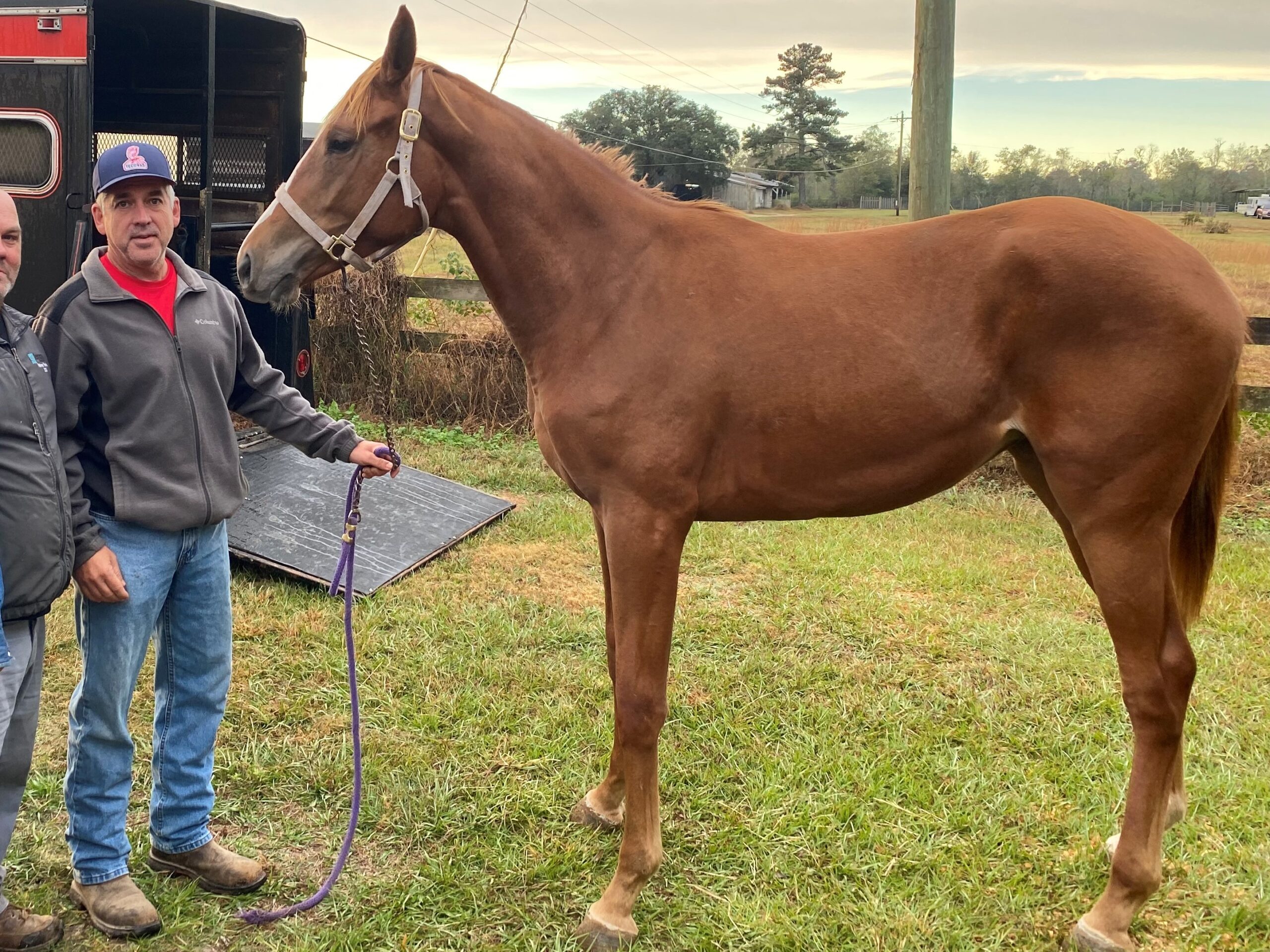
About Miles Henry
Racehorse Owner & Author | 30+ Years in Thoroughbred Racing
Miles Henry (legal name: William Bradley) is a professional horseman based in Folsom, Louisiana. He holds Louisiana Racing License #67012 and has spent over three decades managing Thoroughbreds at premier tracks including Fair Grounds, Delta Downs, and Evangeline Downs.
Expertise & Hands-On Experience: Beyond the track, Miles has decades of experience in specialized equine care, covering everything from hoof health and nutrition to training protocols for Quarter Horses, Friesians, and Paints. Every guide on Horse Racing Sense is rooted in this “boots-on-the-ground” perspective.
30 of their last 90 starts
Equibase Profile.

Connect with Miles: