
Last updated: June 19, 2026
There is no single fastest horse breed — the answer depends entirely on what distance you’re measuring. Over a quarter mile, a Quarter Horse will beat everything. Over a mile and a half, a Thoroughbred wins. Over 100 miles, an Arabian is in a category of its own. Each breed is the fastest at something specific, and understanding why requires looking at how they’re built, not just how fast they’ve been clocked.
What is the fastest horse breed?
- Quarter Horse — fastest over 220–440 yards; elite sprint averages exceed 43 mph across the full quarter mile; peak burst speeds commonly cited at 45–50 mph (estimated, conditions vary)
- Thoroughbred — fastest over classic flat racing distances (½ to 1½ miles); verified record of 43.97 mph set by Winning Brew (Guinness World Record, 2008)
- Arabian — fastest over extreme distance; dominates 50–100 mile endurance events where stamina and recovery matter more than peak speed
- Standardbred — fastest harness racer; elite pacers cover one mile in under 1:50 while pulling a sulky at a trot or pace
Speed figures vary by timing method, track surface, and individual horse. Verified race records are noted where available.
About this guide: Speed figures are drawn from verified race records where available — Thoroughbred record per Guinness World Records; Quarter Horse and Standardbred figures per AQHA and USTA. Peak speed estimates are commonly cited in racing literature and vary by conditions. Miles Henry, Louisiana Owner License #67012.
Table of Contents
Quarter Horse: The Sprint Champion
Over a quarter mile, nothing beats a Quarter Horse. Elite sprint times cover 440 yards in under 21 seconds — an average of over 43 mph across the full distance from a standing start. Peak burst speeds in short-distance events are commonly cited at 45–50 mph; these figures are biomechanical estimates derived from radar and timing extrapolations rather than standardized record certifications, and should be treated as such. What’s not in dispute is the outcome: Quarter Horses have won quarter-mile match races against Thoroughbreds consistently throughout racing history, and they still do.
The breed earned its name from those colonial-era quarter-mile match races, a legacy that continues in a dedicated racing circuit governed by the American Quarter Horse Association. Major venues include Ruidoso Downs in New Mexico — home of the All American Futurity, the richest Quarter Horse race in the world — and Lone Star Park in Texas. For a deeper look at the breed’s racing history and performance profile, see our American Quarter Horse guide.
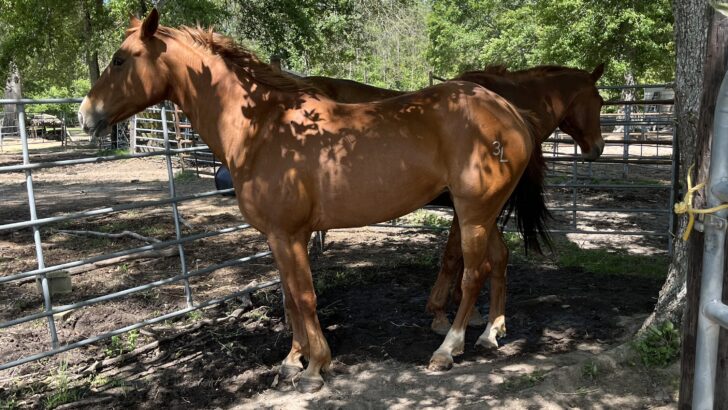
What physically separates a Quarter Horse from other speed breeds is explosive hindquarter power and a high concentration of fast-twitch (Type II) muscle fibers. These fibers generate maximum force rapidly but fatigue quickly — which is exactly right for a 21-second race and exactly wrong for a mile. Beyond 440 yards, Quarter Horses lose their advantage. The breed is built for one thing and built extremely well for it.
From the barn: I’ve watched Quarter Horse races at Evangeline Downs when they run them on the same card as the Thoroughbreds. The contrast is striking. A Quarter Horse race is over before some people in the grandstand realize it started. There’s no pace, no strategy, no positioning — it’s decided at the break. Either your horse gets out clean and runs in a straight line at maximum effort for 20 seconds, or the race is already lost. I have a lot of respect for what those horses do, but it’s a completely different sport from what I run.
Thoroughbred: The Fastest at Distance
The only verified world speed record for a racehorse belongs to a Thoroughbred. Winning Brew, a two-year-old filly, was timed at 43.97 mph over two furlongs at Penn National Race Course in 2008 — a mark ratified by Guinness World Records as the fastest recorded speed for a racehorse. Quarter Horses run faster in sprint events, but their timing methods differ and those figures haven’t been ratified at the same level. If you want a number you can cite with confidence, 43.97 mph is it.
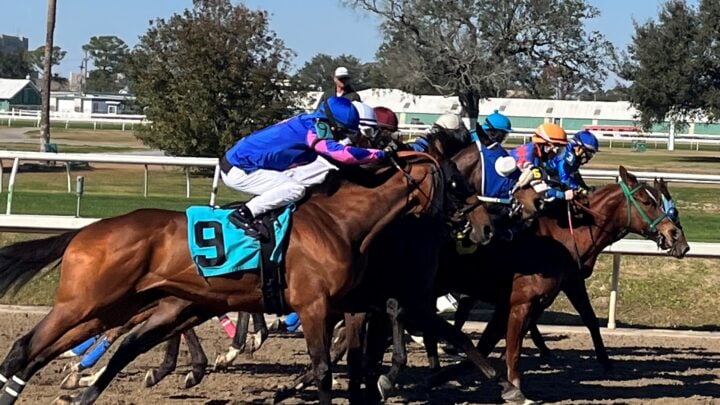
Beyond that record, Thoroughbreds are the dominant speed breed for the distances that define mainstream racing — five furlongs to a mile and a half. Their advantage isn’t peak velocity but the ability to sustain high speed over distance. A Quarter Horse burning at maximum effort is spent after 440 yards. A Thoroughbred at a mile and a quarter is still fighting. That combination of speed and stamina is what makes Thoroughbreds the breed of the Kentucky Derby, the Breeders’ Cup, and every major flat racing circuit in the world.
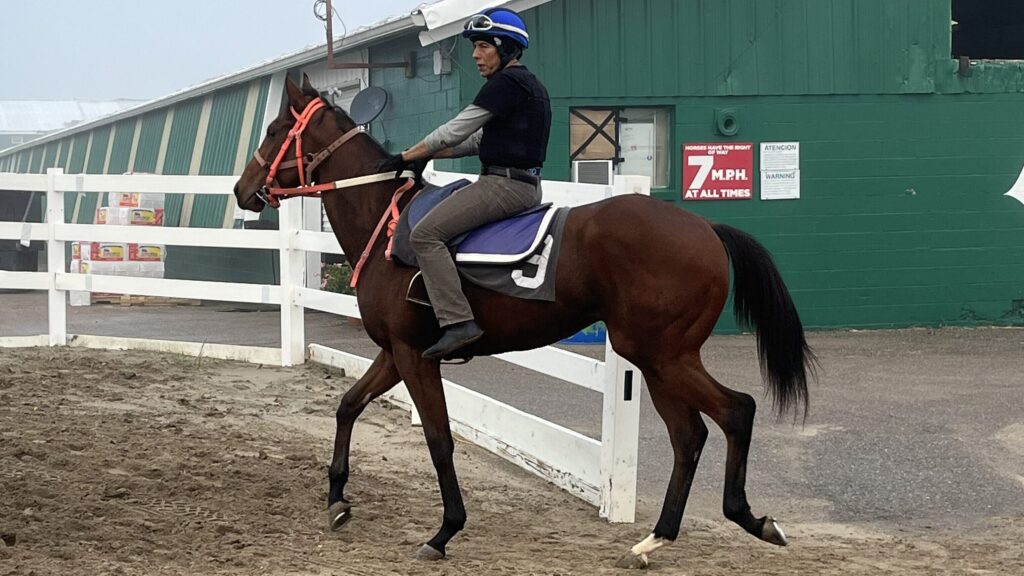
Miles’s Take — What Sustained Speed Actually Looks Like: Ashton — Astrology’s Protege — ran a mile at Fair Grounds at speeds that would have exhausted a Quarter Horse after the first quarter. That’s the Thoroughbred advantage in practice. When I watch replays of his races, what strikes me isn’t the top speed — it’s that he’s still accelerating at the quarter pole while a sprint breed would be decelerating. The Guinness record is a data point, but it’s the sustained effort that separates the breed at distance.
The table below shows how Thoroughbred race speeds drop as distance increases — a pattern that explains why different horses are bred for different trip lengths, and why a miler and a route horse are almost different athletes even within the same breed.
| Distance | Elite Average Speed | Context |
|---|---|---|
| 6 furlongs (¾ mile) | 40–42 mph | Sprint championships; pure speed emphasis |
| 1 mile | 37–39 mph | Classic miler distance; balance of speed and stamina |
| 1¼ miles | 35–37 mph | Kentucky Derby standard for elite three-year-olds |
| 1½ miles | 34–37 mph | Belmont Stakes; heavily dependent on early pace setup |
Notice the 5–7 mph drop from the sprint distances to the classic routes. A horse holding 37 mph at the end of ten furlongs is doing something physiologically rare — most horses in most fields are well below that by the final furlong. For a detailed look at the science behind Thoroughbred speed, see our guide to horse speed science and stride efficiency in racehorses.
Arabian: The Endurance Speed Record
Arabians can reach 35–40 mph in short bursts, which puts them below Thoroughbreds and well below Quarter Horses in a sprint. That comparison misses the point. Arabians are the dominant breed in endurance racing — events of 25 to 100 miles in a single day with mandatory veterinary checks at intervals. The Tevis Cup, 100 miles through the Sierra Nevada mountains, is the sport’s premier event. Arabians win it routinely. No flat racing breed can sustain effort at those distances under those conditions.
What makes Arabians fast over extreme distance isn’t muscle power — it’s metabolic efficiency, heat tolerance, and recovery rate. Their respiratory system extracts oxygen efficiently over hours of effort. Their heart rate drops quickly at vet check stops, which is a mandatory criterion for continuing the race. A horse that arrives at a checkpoint with an elevated heart rate that won’t come down gets pulled. Arabians are specifically bred for that recovery capacity. It’s also worth noting that course elevation and vet-check strategy often matter as much as raw pace in endurance racing — terrain variability can shift finishing times by hours regardless of breed. For more on the breed’s physiology and history, see our Arabian horse breed profile.

Miles’s Take — Speed Isn’t Always Peak Velocity: I run Thoroughbreds on a Louisiana circuit and I’ve never competed in endurance racing. But when someone asks me which breed is fastest, I’m careful about what I say. A horse covering 100 miles through mountain terrain in under 12 hours while passing heart rate checks every 25 miles is performing a feat of speed that a flat racing stopwatch doesn’t capture. “Fastest” in endurance racing means something different — it means who can sustain the most effort over the longest distance without breaking down. Arabians own that definition completely.
Standardbred: The Harness Speed Standard
Standardbreds are the fastest horses in the world while pulling a two-wheeled sulky at a regulated gait. Elite pacers cover one mile in under 1:50 — roughly 33–35 mph while maintaining a lateral pace gait and pulling approximately 200 pounds of driver and cart. The breed’s name comes from the original registration requirement: a horse had to meet a standard time of one mile in 2:30 to be registered. Modern Standardbreds have surpassed that mark by 40 seconds.
The speed comparison to flat racing breeds is complicated by gait restrictions. A Standardbred breaking into a gallop during a race incurs penalties — so the 33–35 mph figures represent what the breed achieves at a controlled trot or pace, not at full gallop. Allowed to gallop freely, Standardbreds would run faster. But they race under rules designed for gait purity, and within those rules they are as fast as any horse in the world at what they do. For more on how harness racing works, see our guide to horse racing with a cart and sulky.

From the barn: I’ve watched harness racing at county fairs and at venues that share a card with Thoroughbred racing. It genuinely feels like a different sport. In flat racing you’re reading pace develop over a distance — positioning, energy management, the stretch run. In harness racing the pace is metronomic and you’re watching for gait breaks and lane positioning around turns. A pacer going under 1:50 for a mile while pulling a driver is an impressive athlete — the speed just doesn’t look like speed the way a Thoroughbred in full flight does. Easy to underestimate if you haven’t watched it closely.
Why Each Breed Is Fast: Muscle, Build, and Biology
The speed differences between breeds aren’t arbitrary — they follow directly from muscle fiber composition, skeletal structure, and cardiovascular capacity. Each breed was shaped by what it was selected for over centuries, and those selections left measurable biological signatures.
Muscle Fiber Composition
Fast-twitch (Type II) muscle fibers generate explosive force but fatigue rapidly. Slow-twitch (Type I) fibers are efficient and sustained but produce less peak power. Quarter Horses have the highest fast-twitch concentration of any racing breed — which is why they explode off the gate and spend themselves in 20 seconds. Arabians have a higher proportion of slow-twitch fibers — which is why they’re still moving efficiently at mile 80 when other breeds have stopped. Thoroughbreds sit between them, with a balanced mix that produces sustained high-speed output over middle distances. For a deeper look at the underlying science, see our guide to horse speed science.
Skeletal Structure and Stride
Quarter Horses are compact and heavily muscled through the hindquarters — built for thrust, not for covering ground efficiently. Thoroughbreds are longer-legged with a deep chest, producing a stride length of 20–26 feet at full gallop and efficient oxygen delivery through a large lung capacity. Elite Thoroughbreds also tend to have notably large hearts — Secretariat’s was commonly estimated at approximately 22 lbs, roughly twice the average — which underpins the cardiac output needed for sustained high-speed effort. Arabians compensate differently: smaller and lighter than Thoroughbreds, with dense bone for durability and a skeletal structure optimized for efficiency over power. For a detailed breakdown of how stride mechanics affect racing performance, see our guide to stride efficiency in racehorses.
Centuries of Selective Breeding
Every breed on this page is the product of sustained selection for a specific task. Quarter Horses were bred for colonial-era quarter-mile match races for over 300 years. Thoroughbreds were developed for English classic distances — a mile to a mile and a half — over the same period. Arabians were bred for desert travel and endurance over thousands of years on the Arabian Peninsula, long before organized racing existed. Standardbreds were specifically selected for harness speed at a trot or pace, with registration gated by a time standard from the start. In each case, the biology followed the selection pressure. None of these breeds are accidental — they are what they are because horsemen knew exactly what they were breeding for.
Speed Comparison by Distance
The table below puts the key speed figures side by side across breeds and distances. Reading across the distance column makes clear why “fastest breed” is a question that requires a distance qualifier before it can be answered.
Speed figures explained: Not all horse speed numbers mean the same thing. Race average speed is derived from official race times over a set distance — the most reliable figure. Peak instantaneous speed is the highest speed reached during a race, measured by radar or GPS — harder to standardize. Estimated radar speed is a biomechanical extrapolation, commonly cited for Quarter Horses, not certified to the same standard as race-timed records. Endurance sustained speed is calculated from finish times over 50–100 miles and reflects terrain, vet checks, and pacing strategy as much as raw horse speed. The table below notes which type applies to each figure.
| Breed | Best Distance | Speed Figure | Status | What It Represents |
|---|---|---|---|---|
| Quarter Horse | 220–440 yards | 43+ mph average; ~45–50 mph peak | Average verified; peak estimated | Fastest sprint breed from a standing start |
| Thoroughbred | ½–1½ miles | 43.97 mph (Winning Brew, 2008) | Guinness World Record — verified | Fastest verified racehorse speed on record |
| Thoroughbred | 1¼ miles | 35–37 mph race average | Estimated from race times | Kentucky Derby-distance sustained speed |
| Standardbred | 1 mile (harness) | ~33–35 mph | Derived from sub-1:50 mile times | Fastest harness speed at regulated gait |
| Arabian | 50–100 miles | 35–40 mph (short burst); 10–15 mph sustained | Estimated; endurance pace verified by finish times | Fastest breed over extreme endurance distance |
Miles’s Take — The Number That Matters Depends on Your Question: People often want one number — the fastest horse. The honest answer is that the Thoroughbred holds the only verified world record at 43.97 mph. But a Quarter Horse averaging 43 mph across a 440-yard standing-start sprint from a gate is doing something the Thoroughbred record horse wasn’t doing. And an Arabian finishing 100 miles of mountain terrain in under 12 hours is doing something neither of them can touch. The breed comparison only makes sense if you’re comparing them at the same distance, which almost never happens in practice.
Key Takeaways — Fastest Horse Breeds
- The Thoroughbred holds the only verified world speed record — 43.97 mph, set by Winning Brew in 2008 and ratified by Guinness World Records
- Quarter Horses are the fastest breed over short distances — elite sprints average over 43 mph across 440 yards; peak burst estimates of 45–50 mph are commonly cited but not verified to the same standard
- Arabians are the fastest over extreme distance — no flat racing breed can sustain competitive effort over 50–100 miles; Arabians dominate that discipline entirely
- Standardbreds are fastest in harness — sub-1:50 miles at a regulated trot or pace while pulling driver and cart; a different speed record in a different discipline
- The speed difference between breeds is biological — muscle fiber composition, stride length, cardiac capacity, and centuries of selective breeding have produced horses that are genuinely different athletes, not just differently trained ones
- “Fastest breed” requires a distance qualifier — Quarter Horse wins the sprint, Thoroughbred wins at distance, Arabian wins the endurance comparison; they don’t compete in the same races for good reason
Frequently Asked Questions
What is the fastest horse breed in the world?
It depends on distance. The only verified world speed record belongs to a Thoroughbred — Winning Brew ran two furlongs at 43.97 mph in 2008, ratified by Guinness World Records. Quarter Horses run faster in sprint events but their peak figures are estimates rather than verified records to the same standard. Over extreme distances (50–100 miles), Arabians are fastest. There is no single answer that applies across all distances.
Can a Quarter Horse beat a Thoroughbred in a race?
Yes — at distances under half a mile, Quarter Horses beat Thoroughbreds consistently. Their explosive acceleration from a standing start produces a significant early advantage that Thoroughbreds can’t overcome at short distances. At a mile or beyond, the situation reverses — Thoroughbreds sustain high speed long after Quarter Horses have spent their energy reserves.
What is the verified speed record for a racehorse?
The verified world record is 43.97 mph, set by Winning Brew, a Thoroughbred filly, over two furlongs at Penn National Race Course in 2008. This figure was ratified by Guinness World Records. Quarter Horse sprint speeds of 45–50 mph are commonly cited in racing literature but have not been verified to the same standard.
Why are Arabians the fastest endurance breed?
Arabians have a physiology built for sustained effort — efficient oxygen use, heat tolerance, dense bone structure for durability, and a rapid heart rate recovery that is tested at mandatory veterinary checks during endurance races. Their slow-twitch muscle fiber ratio is higher than sprint breeds, which means they fatigue more slowly over long distances. No flat racing breed can sustain competitive effort over 50–100 miles; Arabians dominate that discipline entirely.
How fast do Thoroughbreds run in a typical race?
Elite Thoroughbreds average 40–42 mph over six furlongs, 37–39 mph at a mile, 35–37 mph at a mile and a quarter (Kentucky Derby distance), and 34–37 mph at a mile and a half (Belmont Stakes distance). The drop reflects the increasing demands of stamina at longer distances. These are race averages, not peak burst speeds — the verified Guinness record of 43.97 mph was set over a shorter two-furlong sprint.
How fast are Standardbreds compared to other breeds?
Elite Standardbreds cover one mile in under 1:50 at a trot or pace — roughly 33–35 mph — while pulling a driver and sulky weighing approximately 200 pounds. That speed is lower than Thoroughbred or Quarter Horse figures, but the comparison isn’t direct: Standardbreds race under gait restrictions that prohibit galloping. Within their discipline, they are as specifically optimized for harness speed as Quarter Horses are for sprinting.
What makes horses fast at a biological level?
Speed comes from the interaction of muscle fiber composition, skeletal structure, cardiovascular capacity, and stride mechanics. Fast-twitch muscle fibers produce explosive power but fatigue quickly — Quarter Horses have a high concentration of these. Slow-twitch fibers sustain effort efficiently — Arabians have more of these. Thoroughbreds have a balanced mix that produces sustained high-speed output. Large hearts — Secretariat’s was estimated at approximately 22 lbs — increase cardiac output, which supports the oxygen delivery needed for distance speed. For a detailed breakdown, see our guide to horse speed science.
About Miles Henry
Racehorse Owner & Author | 30+ Years in Thoroughbred Racing
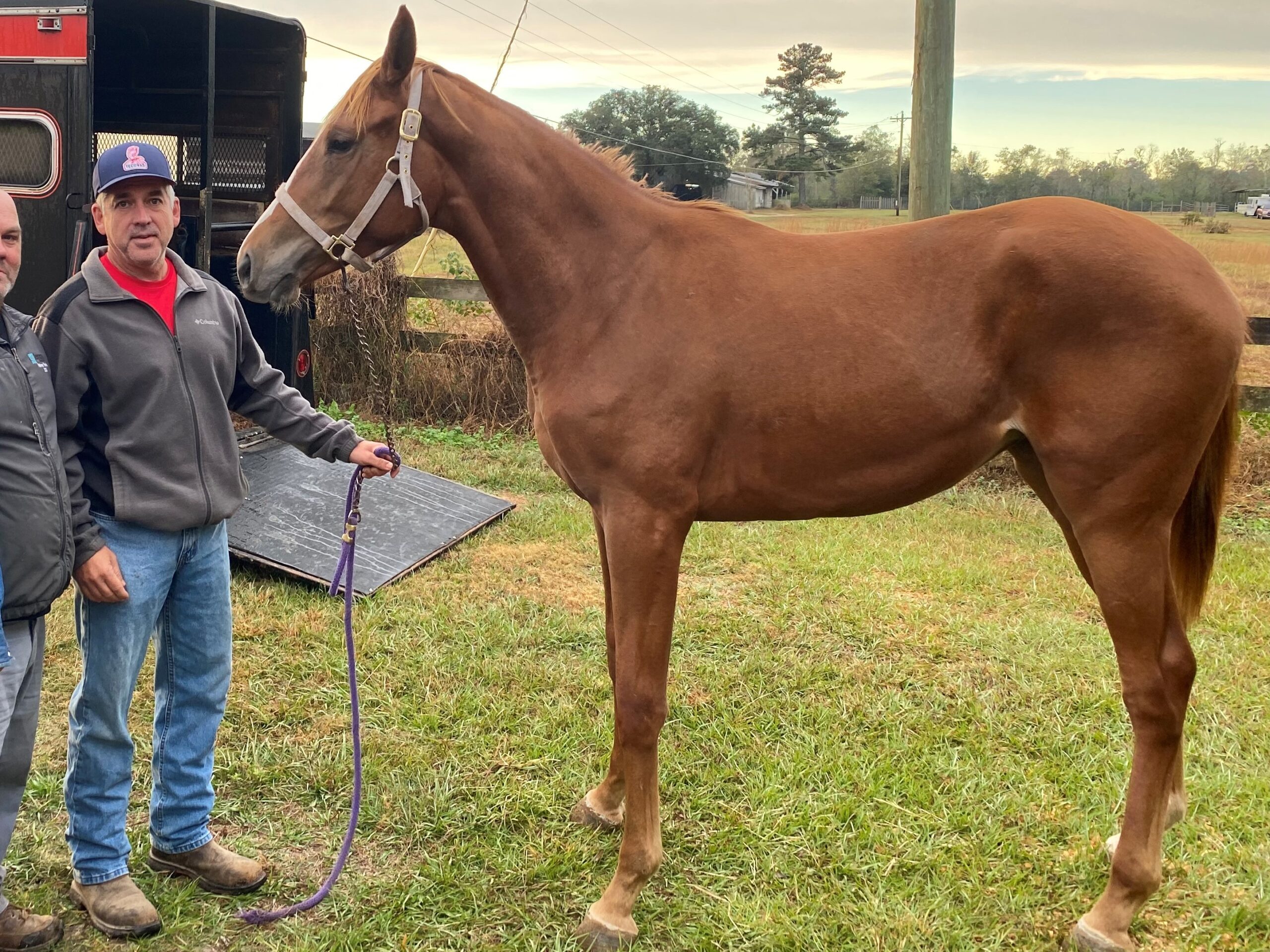
Miles Henry (legal name: William Bradley) is a professional horseman based in Folsom, Louisiana. He holds Louisiana Racing License #67012 and has spent over three decades managing Thoroughbreds at premier tracks including Fair Grounds, Delta Downs, and Evangeline Downs.
Expertise & Hands-On Experience: Beyond the track, Miles has decades of experience in specialized equine care, covering everything from hoof health and nutrition to training protocols for Quarter Horses, Friesians, and Paints. Every guide on Horse Racing Sense is rooted in this “boots-on-the-ground” perspective.
30 of their last 90 starts
Equibase Profile.

Connect with Miles: