
Last updated: August 14, 2026
Any links on this page that lead to products on Amazon are affiliate links and I earn a commission if you make a purchase. Thanks in advance – I really appreciate it!
The Bottom Line Most healthy horses can have a few familiar fruits and vegetables as occasional treats. Apples, carrots, bananas, strawberries, watermelon, cucumber, pumpkin, and grapes are commonly fed in small, prepared pieces. I would skip broccoli and cauliflower, never feed onion-family foods, avocado, raw potatoes, or tomatoes, and be more careful with any horse on a veterinarian-directed diet.
When a horse reaches over the stall door looking for a bite of whatever you are eating, it is easy to think, “What is the harm in one piece?” Usually, a small piece of the right food is fine. The trouble is that a few kitchen foods do not belong in a horse’s feed bucket, and a horse that gulps treats needs more preparation than one that chews slowly.
After decades of feeding horses – I have learned to keep treats simple. Produce is a reward, not part of the feed program. Here is the practical list I use: what horses can eat, what I leave alone, how I prepare treats, and when to call the veterinarian.
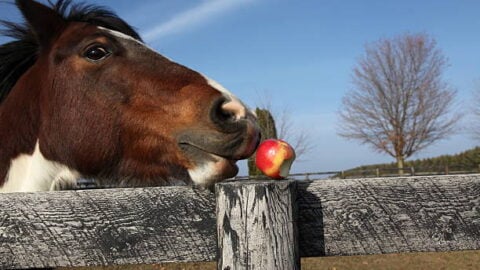
Apples are a familiar occasional treat; cut them into smaller pieces for horses that tend to gulp food.
Table of Contents
What Fruits and Vegetables Can Horses Eat?
For a healthy horse, the simplest choices are usually the best: apples, pears, carrots, bananas, strawberries, blueberries, watermelon, cucumber, pumpkin, squash, celery, peas, green beans, and a few grapes. Penn State Extension also lists pears, blueberries, peaches with pits removed, lettuce, turnips, beets, and corn among produce that can be offered as treats.
Keep the serving small. Good forage and the horse’s regular ration should still do the nutritional heavy lifting.
| Food | My Take | How I Would Offer It |
|---|---|---|
| Apples and pears | Good occasional treats, but sweet | Slice or quarter into manageable pieces; remove the core and seeds |
| Carrots | A familiar treat for most horses | Cut lengthwise or into chunks; grate for a senior horse with poor teeth |
| Bananas | Fine for many horses, but still a sweet treat | Offer a few pieces or part of a banana; the peel is commonly fed, but wash it first |
| Strawberries and blueberries | Good occasional options for a healthy horse | Wash them; halve larger strawberries for a horse that gulps treats |
| Watermelon | A watery occasional treat that many horses enjoy | Offer small chunks of flesh or clean rind; do not make it a large serving |
| Cucumber and celery | Simple choices when cut properly | Slice cucumber; chop celery into short pieces to avoid long, stringy strands |
| Pumpkin and squash | Fine as an occasional treat if fresh and unseasoned | Cut the flesh into small pieces; avoid canned pie filling or seasoned leftovers |
| Peas and green beans | A small amount is generally reasonable for a healthy horse | Offer plain, fresh pieces; chop long pods for a horse that gulps |
| Grapes | Fine in small numbers, not by the bunch | Wash and offer a few at a time; use extra caution with ponies and restricted diets |
| Spinach | Not poisonous, but not a regular treat | If offered, keep it to a small handful once in a while rather than a daily habit |
Can Horses Eat Spinach?
Yes, most healthy horses can eat a small amount of spinach occasionally. Spinach contains oxalates, so I wouldn’t make it a routine part of a horse’s diet when there are plenty of simpler treat options. A small handful once in a while is different from routinely adding spinach to the feed bucket.
My practical answer is simple: if your horse likes spinach, a little now and then is unlikely to be a concern for a healthy horse. If the horse has kidney disease, a urinary issue, a mineral-balance concern, or a veterinarian-managed diet, skip it unless your veterinarian says it fits the feeding plan.
Can Horses Eat Strawberries?
Yes. Washed strawberries are a reasonable occasional treat for most healthy horses. Offer a few rather than a bowlful, and cut large berries for a horse that tends to swallow treats quickly.
Can Horses Eat Grapes?
Yes, most healthy horses can have a few grapes as an occasional treat. Grapes are not known to cause the same kidney toxicity in horses that they can cause in dogs, but they are still sweet, easy to overfeed, and potentially easy for a horse to gulp.
Wash them, offer only a few at a time, and do not make them a daily habit – especially for a pony, an easy keeper, or a horse on a restricted diet.
Can Horses Eat Broccoli and Cauliflower?

I leave broccoli and cauliflower out of the treat bucket. They are not in the same emergency category as onion or avocado, but they offer no advantage over simpler treats, and broccoli may contribute to excess gas in the hindgut.
There are too many better options to experiment with broccoli, cauliflower, cabbage, or Brussels sprouts. If I have carrots, cucumber, a little watermelon, or a few berries available, that is where I stop.
How I Prepare Treats for Horses
Preparation is where a harmless treat can turn into a problem. Horses that grab and swallow instead of chewing are the ones I worry about most. Cut larger fruits and vegetables into manageable pieces, especially for seniors, horses with poor teeth, and horses that tend to gulp treats.
- Wash produce well: Remove dirt and residues before feeding.
- Cut for the horse in front of you: Slice apples and pears; cut large carrots lengthwise or into chunks; halve oversized berries; and chop stringy celery.
- Remove pits, cores, and spoiled portions: Never feed moldy, fermented, heavily bruised, or rodent-contaminated produce.
- Keep it plain: No salt, butter, sugar, spices, chocolate, candy coating, pie filling, or leftovers from the dinner table.
- Do not make hand-feeding a bad habit: A horse that gets nippy or pushy for treats is safer receiving them in a bucket or from an open, flat palm.
Plain, fresh peas can be an occasional treat; keep the amount small and avoid seasoned human-food leftovers.
Treats for Horses With Metabolic Problems
If your horse has insulin dysregulation, equine metabolic syndrome, PPID with insulin dysregulation, obesity, a history of laminitis, or a veterinarian-directed low-NSC diet, do not assume a fruit or vegetable is suitable just because it is safe for a healthy horse.
The question is whether that particular treat fits the horse’s complete ration and medical plan.
For these horses, I don’t make apples, carrots, bananas, watermelon, grapes, or commercial sweet treats a routine reward. In many cases, a small amount of the horse’s approved forage or ration balancer is the better choice.
Ask your veterinarian or equine nutritionist what is appropriate for your individual horse before adding produce.
Foods I Keep Out of the Treat Bucket
Some foods aren’t worth experimenting with. These are the everyday foods and substances I keep out of the treat bucket.
| Food | Why I Avoid It | What to Do |
|---|---|---|
| Onions, garlic, chives, leeks, and shallots | Allium-family foods can damage red blood cells and cause anemia | Do not feed. Call your veterinarian if the amount or exposure is concerning |
| Avocado | Avocado contains persin and is not a food I would offer horses. | Do not feed; seek veterinary advice after ingestion |
| Raw potatoes and tomatoes | Nightshade plants contain glycoalkaloids, and potatoes that are green or sprouting are particularly concerning. I don’t use potatoes or tomato plant material as horse treats. | Do not feed; contact your veterinarian if a meaningful amount was eaten |
| Persimmons | They can form sticky masses in the digestive tract and have been associated with serious impactions | Keep trees and fallen fruit away from horses; call your veterinarian after ingestion |
| Lawn clippings | Clippings can heat, ferment, mold, and may include toxic plants or chemical residues | Never dump lawn clippings in a pasture or feed them as forage |
When in doubt, do not feed it: Household-food exposure is not the time for home remedies. Save a sample, package, or photo of what the horse ate, then call your veterinarian for advice. The Merck Veterinary Manual provides additional information about onion toxicosis and other food and plant hazards.
Onions, garlic, leeks, and shallots belong to the allium family and should not be fed to horses.
If Your Horse Eats Something It Shouldn’t
If you believe your horse has eaten a toxic food, an unknown plant, lawn clippings, or a substantial amount of something it should not have had, do not guess at treatment.
- Remove the remaining food and keep a sample, label, package, or clear photo if possible.
- Call your veterinarian or equine emergency service. Be ready to say what was eaten, approximately how much, and when.
- Do not give medications, oil, supplements, or other home remedies unless your veterinarian directs you to.
- Follow the veterinarian’s instructions. If the horse is choking, showing colic signs, having trouble breathing, becoming weak, sweating heavily, or repeatedly rolling, treat it as an emergency.
If you suspect choke, do not offer feed or water while you wait for veterinary advice. The AAEP’s choke guidance recommends withholding food and water until the veterinarian has evaluated the horse.
FAQs About Fruits and Vegetables for Horses
Do horses like spinach?
Some do, and some will turn their nose up at it. Spinach is not a normal part of a horse’s forage-based diet, so offer only a small amount if you want to see whether your horse likes it. There is no reason to keep offering it simply because it is considered healthy for people.
Are fruit peels and vegetable skins safe for horses?
Some are commonly fed, including banana peel, watermelon rind, and cucumber skin, provided they are clean and cut into manageable pieces. That does not make every peel or skin safe, so check the specific food before offering it.
Can horses eat grass clippings from the lawn?
No. Do not feed lawn clippings or dump them in a pasture. Clippings can heat, ferment, mold, and may contain toxic plants or chemical residues.
How should I introduce a new fruit or vegetable?
Start with one small piece of one food, rather than a mixed handful of new treats. Watch how the horse eats it and whether it causes any digestive upset. If your horse has a medical condition or a restricted ration, ask your veterinarian or equine nutritionist first.
Are frozen fruit treats okay for horses?
For most healthy horses, a small frozen piece of an already-familiar fruit can be fine on a hot day. Keep the portion modest, avoid sugary mixtures, and do not use frozen treats for horses on restricted diets without checking their feeding plan.
About Miles Henry
Racehorse Owner & Author | 30+ Years in Thoroughbred Racing
Miles Henry (legal name: William Bradley) is a professional horseman based in Folsom, Louisiana. He holds Louisiana Racing License #67012 and has spent over three decades managing Thoroughbreds at premier tracks including Fair Grounds, Delta Downs, and Evangeline Downs.
Expertise & Hands-On Experience: Beyond the track, Miles has decades of experience in specialized equine care, covering everything from hoof health and nutrition to training protocols for Quarter Horses, Friesians, and Paints. Every guide on Horse Racing Sense is rooted in this “boots-on-the-ground” perspective.
30 of their last 90 starts
Equibase Profile.

Connect with Miles: