
Last updated: September 20, 2026
Any links on this page that lead to products on Amazon are affiliate links and I earn a commission if you make a purchase. Thanks in advance – I really appreciate it!
A crack, abscess track, or strange mark in your horse’s hoof can seem like it stays there forever. If you’re trying to figure out whether it’s growing out normally – or whether something is wrong – you first need a realistic idea of how quickly hoof wall grows.
Quick answer: Most horses grow about 1/4 to 3/8 inch of hoof wall per month. At that pace, a full hoof wall at the toe commonly takes around 9 to 12 months to grow from the coronary band to the ground.
That average only tells part of the story. A crack near the coronary band has much farther to travel than one near the ground, and factors such as age, health, nutrition, season, footing, and hoof balance can affect both growth and wear. Below, I’ll explain how hoof wall grows, how long common defects may take to move out, what can change the timeline, and when it’s time to call your farrier or veterinarian.
Table of Contents
How Horse Hooves Grow

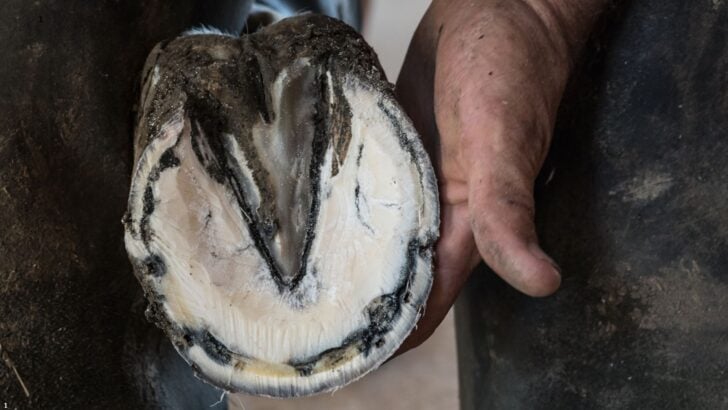
New hoof wall is produced at the coronary band, where the hairline meets the top of the hoof. Fresh horn forms there and is gradually pushed downward as more horn grows in behind it. That’s why a horizontal mark, an abscess track, or a crack that began high on the foot can stay visible for months: you’re watching the same section of hoof wall travel toward the ground.
The important part for owners is simple: healthy hoof growth depends on a functioning coronary band and healthy tissue inside the foot. Damage to the coronary band can leave a lasting mark in the wall, while problems lower on the hoof usually have to grow down and be trimmed away over time. If you’d like a closer look at hoof anatomy and growth, Extension’s overview of hoof growth and UC Davis’s hoof facts are useful references.
How Fast Do Horse Hooves Grow?
Most mature horses grow about 1/4 to 3/8 inch of hoof wall a month, and that range shifts with age: foals and young growing horses tend to grow faster, while older horses often slow down. A slower-growing adult horse isn’t automatically unhealthy; it may simply have a different normal baseline than a young, actively growing horse.
How Long Does It Take a Hoof Crack to Grow Out?
There’s no reliable calendar for every type of hoof defect. The farther the damage is from the coronary band, the less hoof wall has to grow before it reaches the ground, but the actual timeline also depends on the horse’s growth rate and the location and severity of the defect. As a rough guide, a damaged section of hoof wall may take several months to grow out, and a defect that begins high on the foot can take roughly 4 to 12 months to be fully replaced, depending on where it sits.
| What You’re Seeing | What Usually Determines the Timeline | Practical Expectation |
|---|---|---|
| Crack beginning near the coronary band | How far the wall must travel to the ground, plus whether the crack is stabilized | Often many months; a complete grow-out at the toe commonly takes about 9-12 months |
| Crack or chip starting near the ground | How low it starts and whether it continues to split upward | May be trimmed away within one or several farrier cycles if the underlying cause is corrected |
| Abscess drainage track in the wall | Where the track exits and how quickly that area grows down | Usually becomes less noticeable as it migrates down, but the original abscess still needs proper assessment |
| Laminitic growth rings or distorted wall | Severity of the episode, laminar damage, and ongoing metabolic or mechanical management | Often requires a longer rehabilitation plan than a simple wall defect |
That’s why I wouldn’t put too much faith in a calendar date. What matters is whether healthy new horn is growing down from the coronary band and whether the original problem has been corrected. If a crack isn’t visibly moving down the hoof over a few months, that’s worth mentioning to your farrier rather than assuming it will resolve on its own.
What Can Change Hoof Growth
Nutrition affects hoof quality and supports normal growth, especially when a horse’s overall diet is short on key nutrients. Adequate calories, quality protein, essential amino acids, and properly balanced minerals matter more than adding a hoof supplement to an otherwise unbalanced ration. For the details, see my complete guide to hoof nutrition.
Environment affects hoof quality and wear. Long stretches of wet, muddy footing can soften the wall and frog, while repeated wet-to-dry swings can leave some horses more prone to chipping or cracking. Turnout surface, daily movement, footing, and how often the horse is worked all influence how the feet wear between farrier visits.
Age and overall health matter too. Younger horses often grow more hoof than older horses, while illness, reduced movement, poor body condition, and some metabolic or endocrine problems can affect hoof quality and how the feet respond to normal trimming and shoeing. If a horse’s hoof growth suddenly changes, I’d want to know why before I started throwing supplements at it.
Why Hooves Sometimes Grow Unevenly
Hooves don’t always grow and wear evenly around the capsule. Conformation, old injuries, uneven loading, footing, and trim or shoeing balance can all change where the foot carries pressure and how the wall wears. Over time, that can leave one side looking more flared, chipped, upright, or slow-growing than the other. A farrier is usually the right first person to ask whether the pattern is normal for that horse or a sign the foot needs a different mechanical approach.
Miles’s take: My gelding Corky had a conformation quirk that loaded his feet unevenly, and over time you could see it in the way one side of the wall grew and cracked. My farrier and I used a therapeutic shoeing plan with a rocker toe to improve breakover and take pressure off the stressed area. It wasn’t an overnight fix, but after a few months his feet were growing in more evenly and the recurring cracks stopped. That was the right approach for Corky, not something I’d recommend blindly for another horse. Most owners don’t need to chase uneven growth with supplements or hoof products. If one side of a foot consistently looks more stressed than the other, ask your farrier whether conformation, breakover, or trim balance could be part of it.
Therapeutic trimming or shoeing can be useful when a horse has a diagnosed mechanical problem, but the plan should be built around the cause of the issue and the horse in front of you. In cases involving lameness, laminitis, navicular-region pain, or recurring wall defects, farrier work is often most effective when the farrier and veterinarian are working from the same diagnosis and radiographs when needed.
Does Trimming or Shoeing Change Hoof Growth?
Regular trimming and shoeing aren’t a shortcut to faster hoof growth, but they do affect how that growth is managed and how the foot carries the load. If a horse grows 3/8 inch in a month but wears very little hoof, that growth accumulates and needs trimming away on schedule. On abrasive footing, some of the new wall may wear away naturally before the farrier ever sees it. For scheduling, cost, and signs that a horse needs attention sooner than planned, see my complete reshoeing guide.
When Abnormal Growth Deserves Attention
Slow growth by itself isn’t always an emergency. But don’t assume a persistent crack, distorted new wall, or sudden change in the feet is just a cosmetic problem. Call your farrier, and involve your veterinarian when there’s pain, heat, infection, or concern about laminitis.
- A crack that’s deep, widening, bleeding, draining, painful, or causing lameness
- A crack that keeps reopening or doesn’t seem to migrate downward with normal growth
- New wall coming in markedly distorted, weak, separated, or unusually flared
- Heat in the foot, a noticeably stronger digital pulse, reluctance to turn, a short stride, or a stance that concerns you for laminitis
- Repeated abscesses, persistent thrush, foul odor, or discharge from the hoof
- A sudden change in hoof shape, wear pattern, or growth in one foot compared with the others
FAQ
How fast do horse hooves grow?
Most horses grow about 1/4 to 3/8 inch of hoof wall per month, though the rate varies with age, season, nutrition, and overall health. A complete hoof wall typically takes about 9 to 12 months to grow from the coronary band to the ground at the toe.
How long does it take for a hoof crack to grow out?
It depends mainly on where the crack began. A defect near the coronary band may take close to a year to reach the ground at the toe, while a low crack or chip may be trimmed away much sooner. What matters most is whether the crack is stable and moving down with growth. If it’s widening, bleeding, causing lameness, or repeatedly reopening, call your farrier and veterinarian.
Do hoof supplements actually speed up hoof growth?
Not necessarily. A properly balanced diet is the foundation for healthy hoof growth and horn quality. Specific nutrients, including biotin, zinc, and copper, may be useful when the diet doesn’t adequately supply them, but supplements aren’t a shortcut that makes every horse’s feet grow faster. The goal is to support the horse’s ability to produce good-quality hoof horn.
Educational only: This article is about normal hoof growth, not diagnosing hoof problems. If your horse is lame, has a deep or infected crack, or suddenly develops abnormal hoof growth, involve your farrier or veterinarian.
Hoof growth is slow, and there’s no shortcut around that. What you can control is the management around it: regular farrier care, a sound feeding program, good footing, and early attention when a crack, growth ring, or uneven pattern starts telling you something is off. If you can see the defect steadily moving down the wall, you’re usually watching normal grow-out. If it’s worsening, recurring, or making the horse sore, get your farrier and veterinarian involved.
About Miles Henry
Racehorse Owner & Author | 30+ Years in Thoroughbred Racing
Miles Henry (legal name: William Bradley) is a professional horseman based in Folsom, Louisiana. He holds Louisiana Racing License #67012 and has spent over three decades managing Thoroughbreds at premier tracks including Fair Grounds, Delta Downs, and Evangeline Downs.
Expertise & Hands-On Experience: Beyond the track, Miles has decades of experience in specialized equine care, covering everything from hoof health and nutrition to training protocols for Quarter Horses, Friesians, and Paints. Every guide on Horse Racing Sense is rooted in this “boots-on-the-ground” perspective.
30 of their last 90 starts
Equibase Profile.

Connect with Miles: