

Last updated: October 11, 2026
Any links on this page that lead to products on Amazon are affiliate links and I earn a commission if you make a purchase. Thanks in advance – I really appreciate it!
Walk into a tack store looking for reins, and you’ll find a whole wall of them, from short braided English reins to long Western split reins and single-loop roping reins. If you’re new to horses, it’s not always obvious which ones go with your bridle or how they hook on.
Here’s how reins work, what they attach to, the main types and lengths, and how to hold split reins.
Table of Contents
What Are Horse Reins, and How Do They Work?
The reins on a horse are your main line of communication with the horse’s mouth or nose. With a direct rein, a light feel on one rein asks the horse to turn that way. With a neck rein, you lay the rein against his neck and he moves away from it. Either way, the cue comes first and the release is what tells him he got it right.
Steady pressure on both reins asks him to slow down or stop, but backing up takes more than pulling. A well-trained horse backs off your seat and legs with a light feel on the reins, not a hard haul on his mouth. Reins work alongside your legs, seat, and weight, not in place of them, and soft, steady hands keep a horse light.
What Do Reins Attach To on a Bridle?
On most bridles, the reins attach to the bit, not directly to the headstall. English reins attach to the bit with hook studs or buckles, and riders usually match the closure to the bridle’s cheekpieces. Here’s where they go on the most common setups:
- Snaffle bit: The reins attach to the same rings as the cheekpieces. A snaffle bit works with direct pressure, so the rein connects straight to the mouthpiece.
- Curb bit: The reins attach to the rein rings near the bottom of the shanks. That’s where the bit gets its leverage, so a curb calls for a lighter hand.
- Double bridle: A double bridle uses two bits, a bradoon (a small snaffle) and a curb, with a separate set of reins for each.
- Pelham: A Pelham combines snaffle and curb action in one bit, with separate rings for two reins when it’s ridden with double reins.
- Mechanical hackamore: The reins attach to rings at the lower ends of the shanks rather than to a bit.
- Sidepull: The reins attach to rings on either side of the noseband.
- Bosal: A bosal is part of a traditional hackamore setup. It’s usually paired with a mecate, a long rope tied around the bosal near the heel knot to form both a rein loop and a lead.
Western reins often attach with Chicago screws or water loops. Water loops pass through the bit rings and are secured with leather ties. Chicago screws can work loose, so check them every time you tack up. Some setups use slobber straps, short leather pieces that connect the reins to the bit. Each of the main types of horse bits takes the reins a little differently, so know which one your horse is wearing before you buy.

Types of Horse Reins
Reins fall into two main groups, English and Western, plus a few specialty types. The material, closure, and length change how a rein feels in your hand, and the types of English and Western reins break down like this. Some rein names describe how they’re made or how they feel in your hand, and others describe their design, so the categories overlap. A split rein can be braided, for example.
| Type | Used for | What to know |
|---|---|---|
| Laced or braided | English riding, exercising racehorses | Lacing or braiding gives a better grip than plain leather |
| Rubber or rubber-lined | Jumping, eventing, racing | Grips well when hands or reins are wet or sweaty |
| Web | Schooling, eventing, trail | Lightweight cotton or synthetic, often with hand stops |
| Split reins | Western riding, ranch work, trail | Two separate reins that aren’t joined at the end |
| Roping reins | Barrel racing, trail, roping | A closed loop that’s easy to manage one-handed |
| Romal | Western shows, traditional bridle horses | Closed reins with an attached romal, a long single strap at the end |
| Mecate | Bosals, and some snaffles with slobber straps | One long rope that forms the rein loop plus a lead, tied on differently for each setup |
Split reins are the most common Western rein, and split reins are accepted in most association classes with either a snaffle or a curb bit. A lot of barrel and speed-event riders prefer roping reins because there’s no loose end to drop when things happen fast.
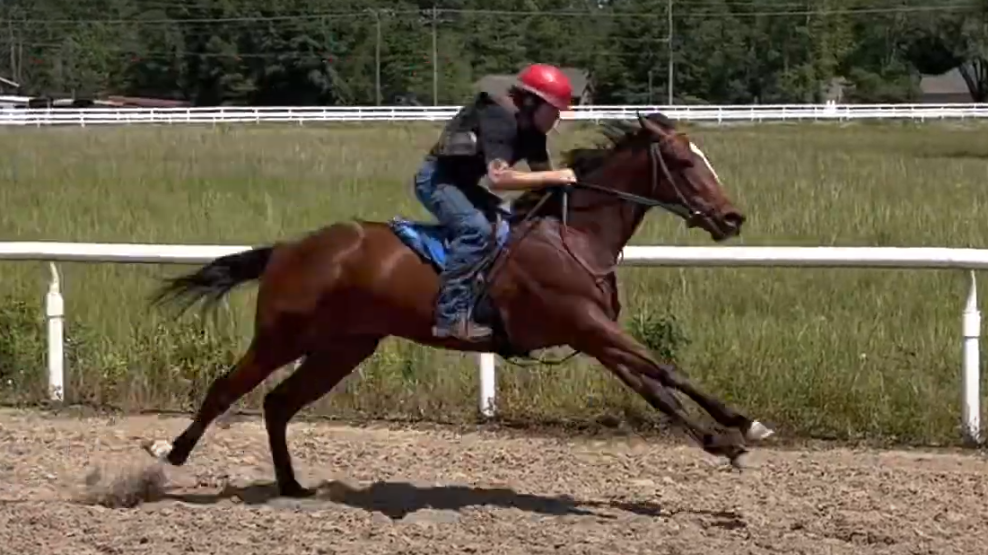
On the racetrack, jockeys and exercise riders sometimes bridge their reins by crossing them over the horse’s neck and holding the two sides together. A bridge gives the rider a steadier hold, especially when a horse is pulling.
How Long Should Reins Be?
Rein length depends on the type of rein and the size of the horse. English reins are usually measured on one side, from the bit attachment to the center buckle. Typical lengths are 48 inches for ponies, 52 for cobs, 54 for average horses, and 60 for oversize horses. Sizing varies by manufacturer, so check the brand’s chart before buying.
Western reins run longer. SmartPak gives about 72 to 96 inches for roping and barrel reins and about 96 to 120 inches for trail reins. Lengths vary a lot by design and discipline, so check whether the listing gives the length of each rein or the whole set.
The easiest way to check the fit is to put a pair on your bridled horse. You want enough length to give him his head on a loose rein without so much extra that it loops low enough for him to catch a foot in it.
How to Hold Split Reins
Split reins can be held in two hands for direct reining or in one hand for neck reining. In one hand, the reins usually come up through your fist with your thumb on top and the ends falling on the same side as your rein hand. Many riders keep one finger between the reins to separate them, but which finger, and whether that’s allowed at all, depends on the riding tradition and, at a show, the rulebook.
Keep your grip relaxed, with enough slack that you’re not pulling on the horse’s mouth just by holding the reins. Some riders bridge the reins and ride two-handed while they’re learning or schooling a young horse. If you’re learning to ride one-handed, have an experienced Western instructor show you the hold for your discipline.
Draw Reins and Other Training Reins
Draw reins run from the girth, through the bit rings, and back to the rider’s hands. They limit how high a horse can carry his head, but they don’t automatically create correct carriage, and a horse can learn to curl behind the bit instead of working over his back. When they’re used for riding, they go on alongside a regular set of reins. Draw reins are a controversial training aid, and they aren’t for beginners. Use them sparingly and under the guidance of an experienced trainer.
Side reins run from the bit to the saddle or a surcingle and are used for lunging, not riding. They need to be adjusted correctly to help rather than hurt. If you’re learning to ride, get comfortable with ordinary reins before you experiment with training aids.
About Miles Henry
Racehorse Owner & Author | 30+ Years in Thoroughbred Racing
Miles Henry (legal name: William Bradley) is a professional horseman based in Folsom, Louisiana. He holds Louisiana Racing License #67012 and has spent over three decades managing Thoroughbreds at premier tracks including Fair Grounds, Delta Downs, and Evangeline Downs.
Expertise & Hands-On Experience: Beyond the track, Miles has decades of experience in specialized equine care, covering everything from hoof health and nutrition to training protocols for Quarter Horses, Friesians, and Paints. Every guide on Horse Racing Sense is rooted in this “boots-on-the-ground” perspective.
30 of their last 90 starts
Equibase Profile.

Connect with Miles: