
Last updated: June 2, 2026
Any links on this page that lead to products on Amazon are affiliate links and I earn a commission if you make a purchase. Thanks in advance – I really appreciate it!
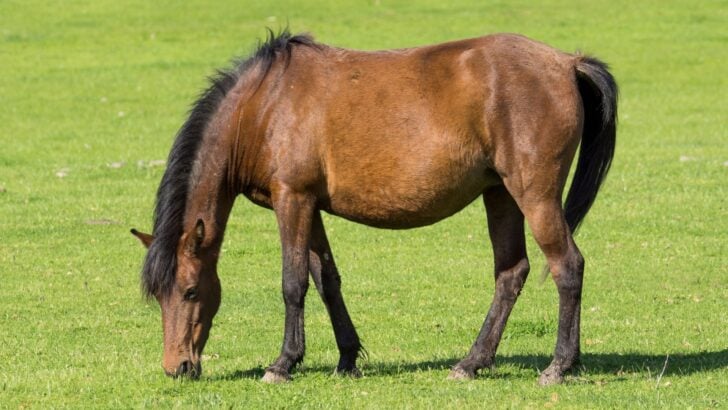
How old can a horse breed? Most mares remain productive until their mid-to-late teens, with some producing foals into their early twenties. Stallions generally stay fertile much longer and may continue breeding into their mid-twenties or beyond. But breeding age isn’t determined by a number alone. Fertility depends on reproductive health, breeding history, genetics, and management. After 30 years of owning and breeding Thoroughbreds, I’ve learned that an older horse’s reproductive record and veterinary evaluation matter far more than its birth date.
In this guide, I’ll explain the realistic breeding age limits for mares and stallions, when fertility starts to decline, and how experienced breeders decide when an older horse is still worth breeding.
Horse Breeding Age — At a Glance:
- Mares breed productively from ages 4–16 — peak fertility runs 5–12, with prime broodmare years between 6 and 10
- Stallions remain fertile from about 3 years old into their mid-20s, with a noticeable decline in sperm quality after 20
- Oldest mares commonly bred: 17–20 years old; beyond 20, conception rates drop significantly
- Oldest stallions in active service: some continue to age 25–30, depending on sperm count testing
- Prime broodmare years: 6–10 — highest conception rates and lowest pregnancy complication risk; fertility starts declining after 12
- When to stop: let reproductive exams, not a fixed number, guide the retirement decision
| Factor | Mare | Stallion |
|---|---|---|
| Recommended First Breeding Age | 3–4 years old | 3–4 years old |
| Peak Fertility | 5–12 years (prime broodmare years: 6–10) | 8–13 years |
| When Fertility Begins to Decline | Typically after 12 years; more noticeable after 15 | Usually after 20 years |
| Typical Productive Breeding Range | 4–16 years | 3–20+ years |
| Practical Upper Breeding Age | 17–20 years for most broodmares | 25–30 years in exceptional cases |
| Main Limiting Factor | Conception rates, pregnancy maintenance, and reproductive tract changes | Sperm count, motility, and semen quality |
| Best Retirement Indicator | Reproductive exam and foaling history | Fertility testing and prior-season foaling rates |
| Horse | Consider Evaluation At | Key Factor |
|---|---|---|
| Mare (proven broodmare) | 15–17 years | Reproductive exam, uterine culture, ovarian ultrasound |
| Mare (older maiden) | 12–14 years | Never-pregnant reproductive tract plus age-related decline compounds risk |
| Stallion (any) | 18–20 years | Sperm motility and concentration testing — not age alone |
| Proven older stallion | Based on testing | Foaling rate from prior season is a better signal than any age threshold |
Table of Contents
How Long Can a Mare Breed?
A mare can produce foals well into her teens or early twenties, but age steadily works against her fertility. Mares are at their reproductive peak between five and twelve, with prime broodmare years running from six to ten — conception rates are highest, pregnancy complications are lowest, and recovery between foals is fastest. After eleven, conception rates begin to decline gradually — see when mares stop cycling for a full breakdown of how heat cycles change with age. By the late teens they can fall sharply, and by twenty most mares have become difficult to get in foal consistently.
Conception rates in older mares can fall to roughly 20–40% per cycle, compared with 60–70% or higher in mares during their prime breeding years — which is why older mares often need multiple breeding attempts and why costs accumulate quickly. Several physical problems compound as a mare ages.
Common fertility problems in mares over 15:
- Uterine infections — caused by pooling urine as suspensory ligaments weaken and the uterus tilts; most common in mares over 12
- Changes in reproductive tract anatomy — including the vulva, vagina, cervix, uterus, oviducts, and ovaries
- Inward vulva sloping and muscle tone loss — allows bacteria and debris to accumulate, hindering conception
- Declining egg production — fewer viable eggs per cycle as ovarian function diminishes
- Higher pregnancy loss rates — early embryonic death increases significantly with age
For all these reasons, many professional breeders choose not to breed mares past 17 years old. The economics are straightforward: vet bills for reproductive work on an older mare can easily exceed the value of the foal she might produce, and the odds of a successful pregnancy at 20 are not in your favor.
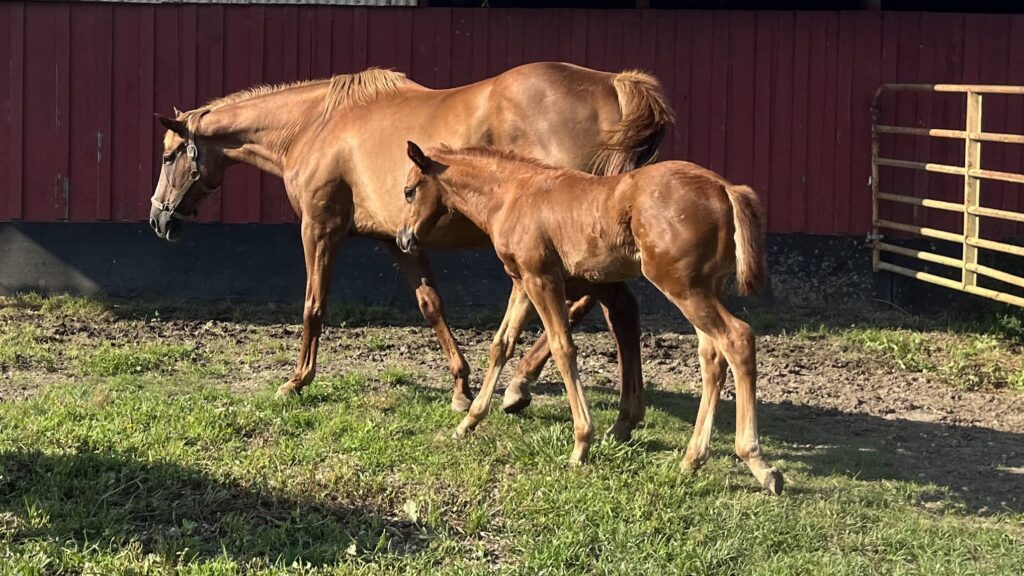
Miles’s Take — The corporate farm cutoff: Near our training operation in Folsom, Louisiana, there’s a corporate breeding farm with hundreds of broodmares that has a firm policy of selling off mares at a certain age regardless of individual fertility. Some of those mares at 17 still have productive seasons in them — they’re just not worth the management time and vet cost at scale. For a small breeder, those discarded mares can be a genuine opportunity. Most of them are healthy, proven producers, and the only thing wrong with them is a spreadsheet said so. Get a reproductive exam done before you buy, but don’t dismiss a mare just because a corporate operation was done with her.
What Is the Oldest Age a Mare Can Safely Give Birth?
Most veterinarians consider 20 to be the practical upper limit for a mare to safely carry and deliver a foal, though individual variation is significant. Mares in their early twenties can and do produce healthy foals — but the risks escalate meaningfully with each passing year: higher rates of dystocia (difficult birth), retained placenta, uterine infection post-delivery, and weaker immune transfer to the foal through colostrum.
The foal itself also faces elevated risk. Foals from very old mares have higher rates of premature birth, lower birth weight, and weaker early immune response compared to foals from mares in their prime. For a racehorse breeder, those early disadvantages can compound through a foal’s development and affect everything from growth rate to soundness.
Signs a mare is approaching the end of her safe breeding window:
- Irregular estrous cycles or failure to cycle during the normal breeding season
- Repeated early embryonic loss after confirmed conception
- History of retained placenta or post-foaling uterine infections
- Visible muscle wasting or difficulty maintaining weight during pregnancy
- Veterinary findings of significant uterine cyst load or structural changes on ultrasound
Any of these signals warrants a direct conversation with an equine reproduction specialist before committing to another breeding season.
Exceptional mares have foaled in their mid-20s and occasionally later, but those cases are outliers. The more useful question isn’t “what’s the oldest recorded foaling mare” — it’s whether this specific mare is still a good candidate based on her reproductive exam. A 21-year-old with clean uterine cultures and active ovarian function can be a better breeding prospect than a 15-year-old with chronic uterine cysts and a history of early pregnancy loss.
Breeding Older Maiden Mares
A maiden mare is a horse that has never produced a foal. Older maiden mares present a specific challenge that goes beyond age alone — the reproductive system in a mare that has never been pregnant behaves differently from one that has. After 14–15, maiden mares can be more difficult to get in foal, and when pregnancy does occur, the risk of early loss is higher than in a mare with an established breeding history.
Peak reproductive years for broodmares are six to seven. A maiden mare at that age has a straightforward path to a first foal with proper management. A maiden mare at 14 or 15 faces compounding challenges: reduced egg quality, a reproductive tract that has never been primed by pregnancy, and the same age-related anatomical changes that affect all older mares.
Before breeding an older maiden mare: Have an equine reproduction veterinarian evaluate her fertility directly — uterine culture, ultrasound exam, and ovarian assessment. It’s the most cost-effective step you can take. A vet who specializes in equine reproduction will give you a realistic picture of her chances and flag any problems before you commit to a breeding season.
How Old Can a Stallion Breed?
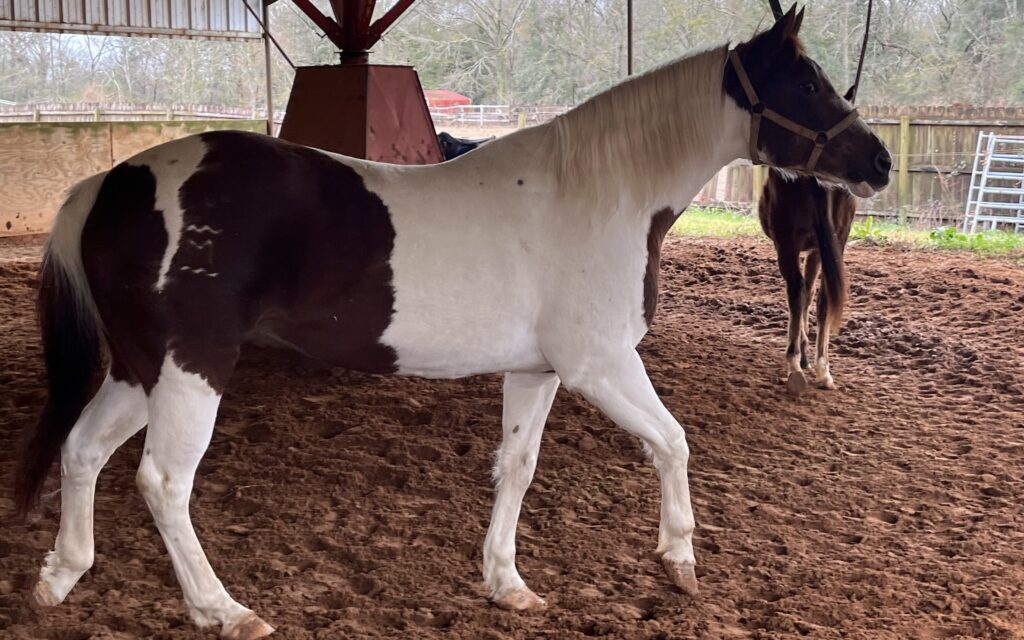
A stallion can produce sperm as young as 12 to 14 months old, but most breeders wait until he’s three or four before using him at stud. His prime producing years generally run from eight to thirteen — which is consistent with most veterinary literature on stallion fertility — when libido is high, sperm quality is at its best, and the energy demands of covering multiple mares aren’t yet taking a toll.
Most stallions show a meaningful decline in sperm count and quality after 20, but many remain fertile well beyond that. Some exceptional stallions have continued covering mares into their late twenties or even thirty, particularly those with high stud fees that justify the ongoing management and testing costs.
How stallion fertility is monitored — and what the numbers actually mean: Stallions in active breeding service are tested for fertility and sperm count every few days during the breeding season. As a stallion ages, sperm motility and concentration become better predictors of actual fertility than age alone — a 22-year-old with strong counts is often more useful to a small breeder than an 18-year-old with declining motility and a big reputation.
Book size vs foaling rate: A stallion’s advertised book size (mares covered per season) is not the same as his fertility efficiency. Some stallions breed 130 or 140 mares but show declining foaling rates that only surface in end-of-season statistics. As a stallion ages, monitoring actual foaling percentages — not covering numbers — is the only reliable measure of whether he’s still performing. An aging stallion at a sharply reduced fee who’s still posting 65% foaling rates can be one of the most undervalued opportunities in Thoroughbred breeding.
How Many Mares Can a Stallion Cover?
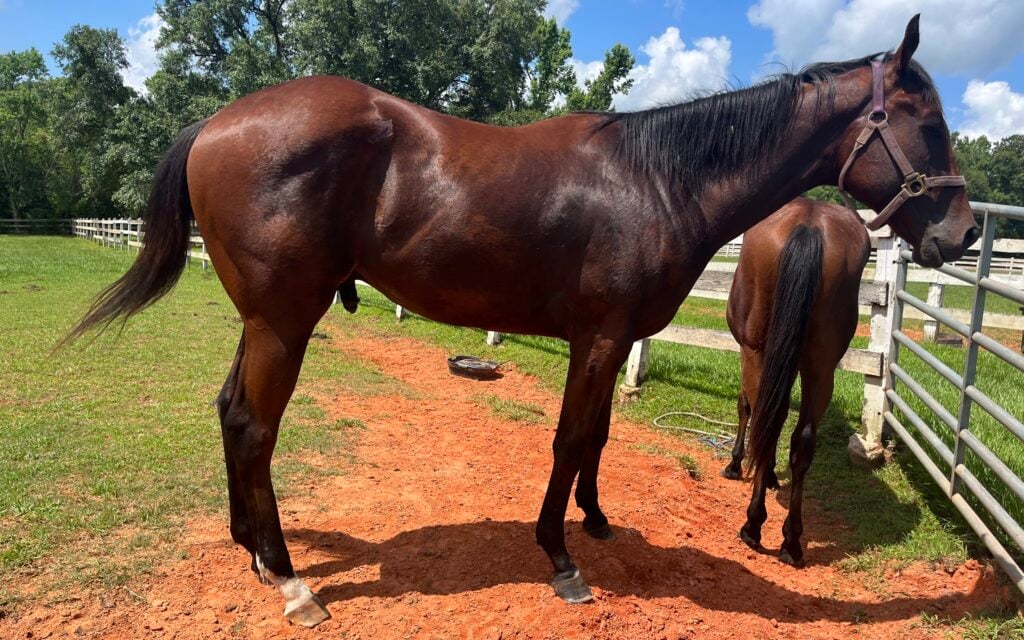
The number of mares a stallion can breed in a season depends largely on the breeding method — live cover or artificial insemination — and on the rules of the breed registry involved.
Thoroughbreds require live cover for registration — foals must result from a stallion mounting the mare naturally, either in a pasture or through hand-mating where a handler leads the mare to the stallion. Hand breeding is most common among racehorse breeders, allowing a stallion to cover 100 or more mares per season under controlled conditions. The Jockey Club set an upper limit of 140 foals per stallion per season in 2020 — a cap designed to prevent any single sire from dominating the breed gene pool.
For breeds that permit artificial insemination — Warmbloods, Quarter Horses, and most sport horse breeds — the numbers are dramatically higher. Semen is collected every other day during the breeding season, and a single collection can be divided to cover multiple mares. The practical ceiling for AI breeding is determined by semen quality and volume, not physical capacity.
The Economics of Breeding Older Mares — and the Auction Opportunity
Breeding decisions are often driven less by biology than by economics — a reality explored in depth in our horse breeding business plan guide. The cost of repeated veterinary cycles, boarding, and pregnancy loss on older mares can exceed the expected value of the foal — which is why professional operations set informal age cutoffs rather than relying on fertility alone. At 17 or 18, a mare that still has two or three productive seasons in her isn’t worth the management overhead at a farm running hundreds of broodmares. So she goes to auction.
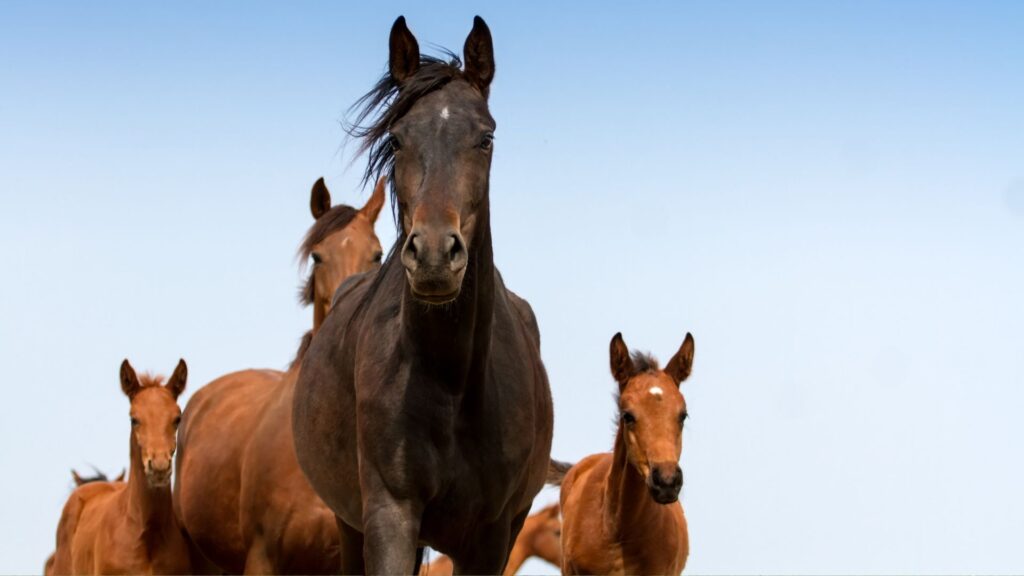
For small breeders and first-time racehorse owners, those auction sales are one of the best entry points in the business. Mixed sales at places like Keeneland, Fasig-Tipton, and regional auctions regularly offer older broodmares — many with a foal at their side — at prices that reflect the seller’s business model, not the individual mare’s actual fertility. A mare selling for $3,000–$8,000 with a proven breeding record and a healthy weanling is a very different proposition from a $3,000 maiden who has never been tested.
Miles’s Take — What I look for at a mixed sale: When I walk through the broodmare barn at a mixed auction, I’m not looking at age first. I’m looking at the foal on her side — how well it’s developed, how it moves, whether the mare is protective or indifferent. A mare that raises a strong foal tells you more about her value as a broodmare than her age does. After that I look at her prior foaling record. Four or five clean foals with no history of retained placentas or reproductive surgery is the profile I want, regardless of whether she’s 14 or 19. Then I get a reproduction vet involved before I ever bid. A $300 pre-purchase reproductive exam on a $5,000 broodmare is the best money you can spend.
The question of whether an older mare or an aging stallion represents good value comes down to the same framework you’d apply to any bloodstock purchase: expected cost versus expected return, adjusted for the probability of getting a live foal. An older stallion whose stud fee has dropped from $25,000 to $5,000 because of age — but whose book is still producing Grade 1 horses — can be one of the most undervalued opportunities in Thoroughbred breeding. The math changes when fertility testing confirms he’s still producing quality sperm at volume.
What to check before buying an older broodmare at auction:
- Prior foaling record — how many foals, any history of complications, retained placentas, or surgical intervention
- Foal quality — inspect the foal at her side; that’s her most recent work product and the clearest signal of her current output
- Reproductive exam — uterine culture, ultrasound, ovarian assessment before you bid or immediately after for live foal guarantees
- Reason for sale — age-based culling from a large operation is very different from a fertility problem; ask the consignor directly
- Pedigree value — an older mare by or out of a proven sire has residual value as a producer even if her foaling years are limited
When Do Horses Start Breeding?
Horses reach sexual maturity around two years old — both fillies and colts can technically reproduce at that age. But sexual maturity and physical readiness are different things. Most breeders wait until three or four before breeding a filly, giving her time to develop the skeletal structure and muscle mass needed to carry a foal safely. Colts started too early often have behavioral issues and produce less consistent results than those given time to mature.
Recommended starting ages by horse type:
- Fillies / mares: first breeding at 3–4 years; first foal at 4–5; most productive from 6–10
- Colts / stallions: first use at 3–4 years; prime producing years from 8–13
- Yearling colts: can occasionally impregnate mares — keep separated from fertile mares if unintended pregnancies are a concern
Breeding too young creates real health risks. Fillies bred before their pelvis has fully developed face higher rates of difficult deliveries and uterine complications. A horse that isn’t physically mature enough to carry offspring isn’t ready to breed, regardless of age on paper.


FAQs About Horse Breeding Age
How old can a horse breed?
Mares can breed productively until their mid-to-late teens, with some continuing into their early twenties. Stallions typically remain fertile longer — often into their mid-twenties, with exceptional cases reaching 30. Peak fertility for mares runs from ages 5 to 12, with prime broodmare years from 6 to 10; for stallions, peak fertility runs from 8 to 13. Health and reproductive history matter as much as age.
When can a mare have her first foal?
A mare can have her first foal at three, but most breeders prefer to wait until she is four, with the foal arriving at five. Breeding a three-year-old isn’t harmful if she’s fully developed, but waiting a year gives her time to build the physical strength to handle pregnancy and delivery more safely.
Can a yearling colt get a mare pregnant?
Yes — yearling colts can occasionally get mares pregnant. Colts start producing sperm at an early age and will pay attention to mares in estrus. Keep yearling colts separated from fertile mares if unintended pregnancies are a concern.
How many foals can a mare have in her lifetime?
A productive broodmare typically has 10 to 13 foals over her lifetime. A mare that starts at four and breeds regularly until 17 could theoretically produce more, but not every season results in a live foal. Mares that remain healthy and fertile into their early twenties occasionally reach higher numbers, but it’s uncommon.
What age do mares stop cycling?
Most mares cycle from spring through fall — the breeding season — until their late teens or early twenties, when estrous cycles become irregular. Some older mares continue to cycle but fail to conceive or carry a foal to term. Regular veterinary monitoring is the most reliable way to track a mare’s reproductive status as she ages.
At what age is a stallion most fertile?
Most stallions reach peak fertility between 8 and 13 years old — when sperm count, motility, and libido are all at their best. Fertility begins to decline after 20, though many stallions remain productive well into their mid-twenties with proper management and regular semen evaluation.
Veterinary references used in this article: The fertility figures and age-related reproductive changes described here draw on guidance from the American Association of Equine Practitioners (AAEP) reproductive management guidelines, the Merck Veterinary Manual equine reproduction section, Colorado State University Equine Reproduction Laboratory research, and peer-reviewed Theriogenology literature on mare age and fertility. Specific management recommendations should always be confirmed with a veterinarian specializing in equine reproduction.
About Miles Henry
Racehorse Owner & Author | 30+ Years in Thoroughbred Racing
Miles Henry (legal name: William Bradley) is a professional horseman based in Folsom, Louisiana. He holds Louisiana Racing License #67012 and has spent over three decades managing Thoroughbreds at premier tracks including Fair Grounds, Delta Downs, and Evangeline Downs.
Expertise & Hands-On Experience: Beyond the track, Miles has decades of experience in specialized equine care, covering everything from hoof health and nutrition to training protocols for Quarter Horses, Friesians, and Paints. Every guide on Horse Racing Sense is rooted in this “boots-on-the-ground” perspective.
30 of their last 90 starts
Equibase Profile.

Connect with Miles: