
Last updated: August 14, 2026
Two inches can change how a horse looks on paper. At a sale, a 16-hand colt and a 15.2-hand colt may bring different expectations before they ever walk into the ring. In pony competition, even a small measurement difference can determine eligibility. Knowing how to measure a horse correctly is not just a technical detail — it is part of understanding the horse in front of you.
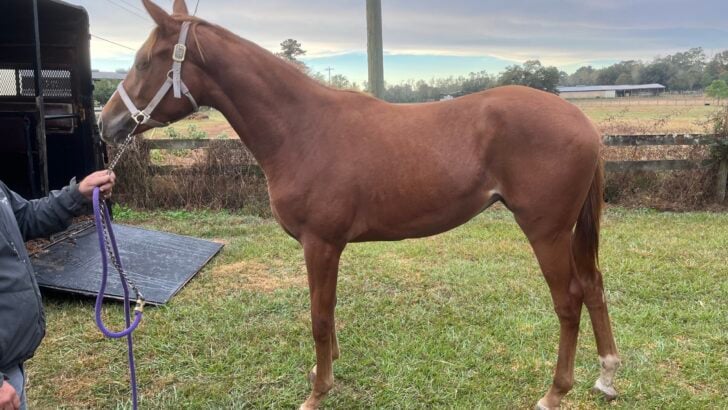
Horses are measured from the ground to the withers, the bony ridge between the shoulder blades. The withers are used because the head and neck move, while the withers provide a consistent reference point. One hand equals exactly 4 inches (10.16 cm), so a 15.2-hand horse is 15 hands plus 2 inches, or 62 inches total. The decimal isn’t a fraction – it can only be .0, .1, .2, or .3, since 4 extra inches rolls over into the next full hand.
How to Measure a Horse Correctly
Accurate measurement matters for sales listings, registration, competition eligibility, and tack fitting. Most bad measurements are not caused by the measuring stick. They happen because the horse is not standing correctly. A horse leaning, standing downhill, or resting one hind leg can change the number enough to matter.
Find level ground
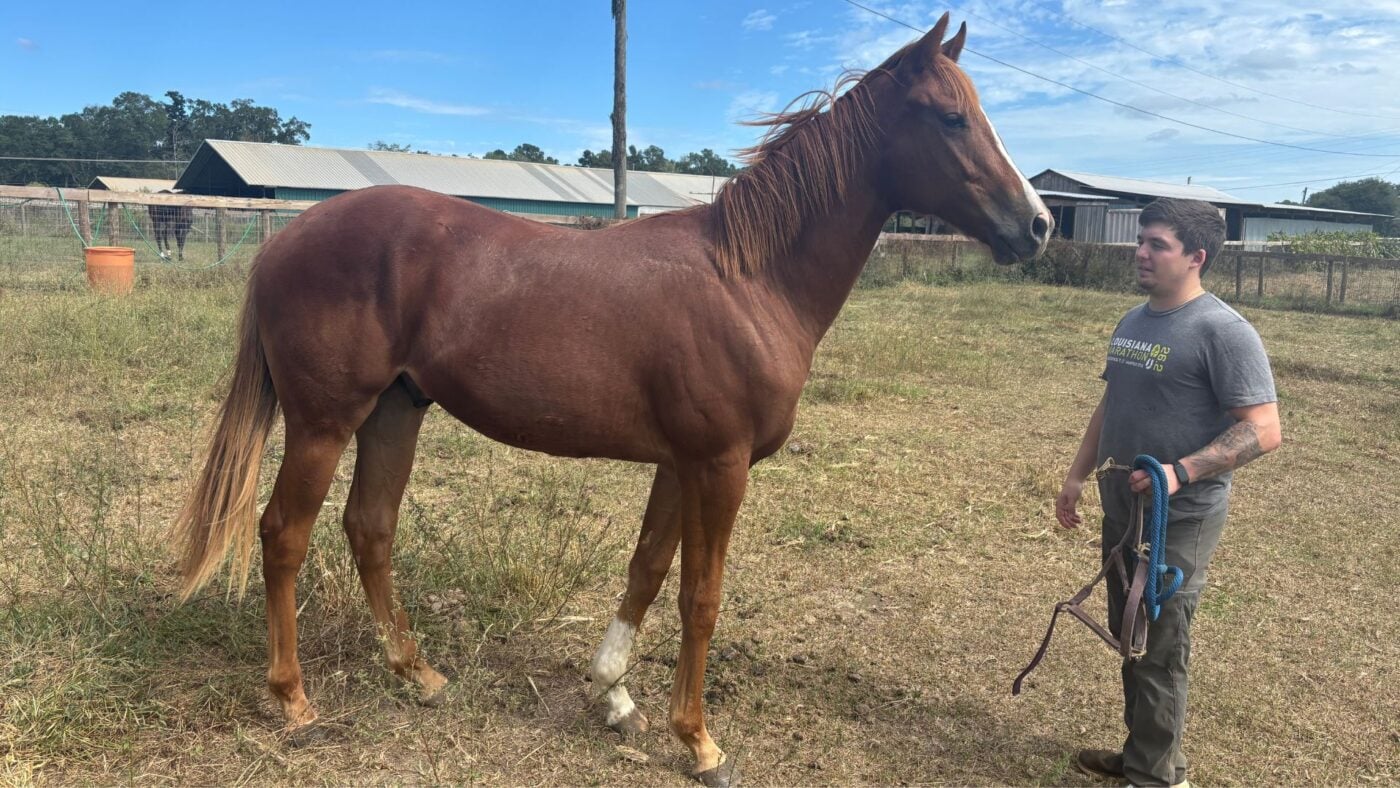
Measure on a flat, hard surface – concrete barn aisle or packed level dirt. Even a slight incline adds or subtracts meaningful inches.
Stand the horse square
All four feet should be as even as possible, weight distributed, relaxed but attentive. A horse with one leg cocked or leaning will give an inaccurate reading. Use an assistant to keep the horse square if needed.
Locate the withers
Find the highest point of the withers—the bony ridge where the neck meets the back. This is the point used for an official height measurement. Understanding wither anatomy helps when the point is subtle on a well-muscled horse.
Use a measuring stick with a level arm
A rigid horse measuring stick with a built-in level gives the most accurate result. Tape measures sag and arc, creating errors. Position the base flat on the ground as close to the front of the withers as possible.
Read and record
Slide the arm up and rest it on the highest point of the withers, perpendicular to the stick. Read the scale: whole hands plus extra inches (e.g., 15 hands 2 inches = 15.2 hh). Record whether the horse was shod, since shoes can add a fraction of an inch that matters for competition eligibility near class dividing lines – check the specific rulebook for the exact allowance in your discipline.
Miles’s Take — Measuring a horse is easier than interpreting the number: A horse’s height tells you something, but it doesn’t tell you everything. I’ve seen smaller horses with plenty of scope and bigger horses that lacked the balance buyers were looking for. Height is one useful measurement, but it is never the whole horse.

Common Measuring Mistakes
A horse described as 16 hands that’s actually 15.2 hands has blanket sizing, trailer clearance, and jump-height eligibility calculated on a wrong foundation. These mistakes are easy to avoid once you know what to watch for.
The most common measurement errors:
- Measuring to the top of the head – the head moves constantly; the withers are the accepted fixed point
- Uneven ground — even a small slope can change the reading; use level concrete or another firm, level surface.; find level concrete or packed dirt
- Using a tape measure at an angle – A rigid measuring stick with a level arm is the best choice for an accurate reading. A tape can be useful for a rough estimate, but it is easier to hold off vertical or let sag.
- Misreading base-4 notation – 15.2 hands is not 15 1/2 hands; the decimal only runs from .0 to .3
- Not accounting for shoes – shoes typically add a small amount of height; for ponies near the 14.2 cutoff this can determine competition eligibility, so check your specific discipline’s rulebook for the exact allowance
- Measuring a nervous or fidgeting horse – if he is parked out, leaning, or standing unevenly, take another reading once he settles and stands square.
- Measuring growing horses once – foals gain height quickly in their first year; remeasure periodically during active growth phases
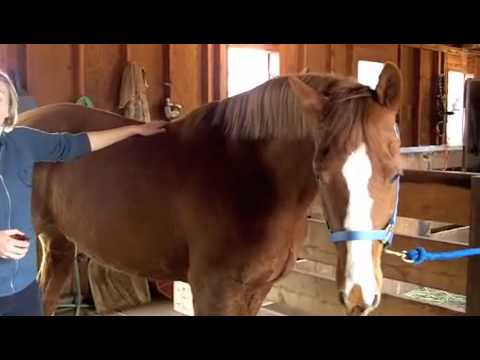
From the barn: I’ve measured horses that looked taller at first glance simply because they were standing downhill or parked out behind. Once the horse was brought onto level ground, squared up, and measured with a proper stick, the number changed. That is why I don’t put much stock in an estimated height from across a stall or paddock—especially when a purchase is being considered.

Hands to Inches and CM Converter
Conversion formulas: To convert hands to centimeters, multiply the whole hands by 4, add the extra inches, then multiply by 2.54. To go the other direction, divide centimeters by 2.54 to get total inches, then divide by 4 – the whole number is your hands, the remainder is the decimal.
Equine Measurement Converter
Result: 157.5 cm
Result: 15.3 hands
What a Hand Means and How to Read It
One hand equals exactly 4 inches (10.16 cm), measured from the ground to the withers. The notation is base-4: the number after the decimal is extra inches, running only from .0 to .3. Add four more inches and you roll over to the next whole hand – “15.3 hands” is 63 inches, but “15.4 hands” isn’t a real measurement. For why this system exists in the first place, see my companion piece on why horses are measured in hands.
| Hands | Inches | Centimeters | A common size for |
|---|---|---|---|
| 14.2 | 58 | 147.3 | Pony/horse dividing line; small Quarter Horses |
| 15.0 | 60 | 152.4 | Compact Thoroughbreds, most Arabians |
| 15.2 | 62 | 157.5 | A common size for a Thoroughbred |
| 16.0 | 64 | 162.6 | Large Thoroughbreds, warmbloods, sport horses |
| 16.2 | 66 | 167.6 | A tall Thoroughbred, though not unusual |
| 17.0 | 68 | 172.7 | Large sport horses and many draft breeds |
FAQs About How Horses Are Measured
How many inches is a hand?
One hand equals exactly 4 inches (10.16 centimeters). The subdivision is base-4: a measurement like 15.2 hands means 15 complete hands plus 2 additional inches, for a total of 62 inches. The decimal can only be .0, .1, .2, or .3 – never .4 or higher.
What does 15.2 hands mean?
15.2 hands means 15 complete hands plus 2 extra inches. Calculation: (15 x 4) + 2 = 62 inches, or 157.5 centimeters. It’s often written 15.2 hh (hands high). You’ll never see 15.4 or 15.5 hands in correct notation – four additional inches becomes 16.0 hands.
How do I convert hands to centimeters?
Multiply whole hands by 4, add the extra inches, then multiply the total by 2.54. Example: 15.2 hands = (15 x 4) + 2 = 62 inches x 2.54 = 157.5 cm. To go from centimeters to hands, divide by 2.54 to get total inches, then divide by 4 – the whole number is your hands, and the remainder (0, 1, 2, or 3) is the decimal.
How tall is a 15 hand horse?
A 15-hand horse is 60 inches (152.4 cm) tall at the withers – exactly 5 feet. That’s on the smaller end for a Thoroughbred and typical for a compact riding horse or larger pony breed.
What does hh mean in horse measurements?
HH stands for hands high. It’s the standard way to write a horse’s height measurement – for example, 15.2 hh means 15 hands, 2 inches, measured from the ground to the withers.
Is a 16 hand horse tall?
A 16-hand horse is 64 inches (162.6 cm) at the withers. That’s above average for a Thoroughbred and considered tall for most riding disciplines, though it’s a normal size for warmbloods and larger sport horse breeds.
About Miles Henry
Racehorse Owner & Author | 30+ Years in Thoroughbred Racing
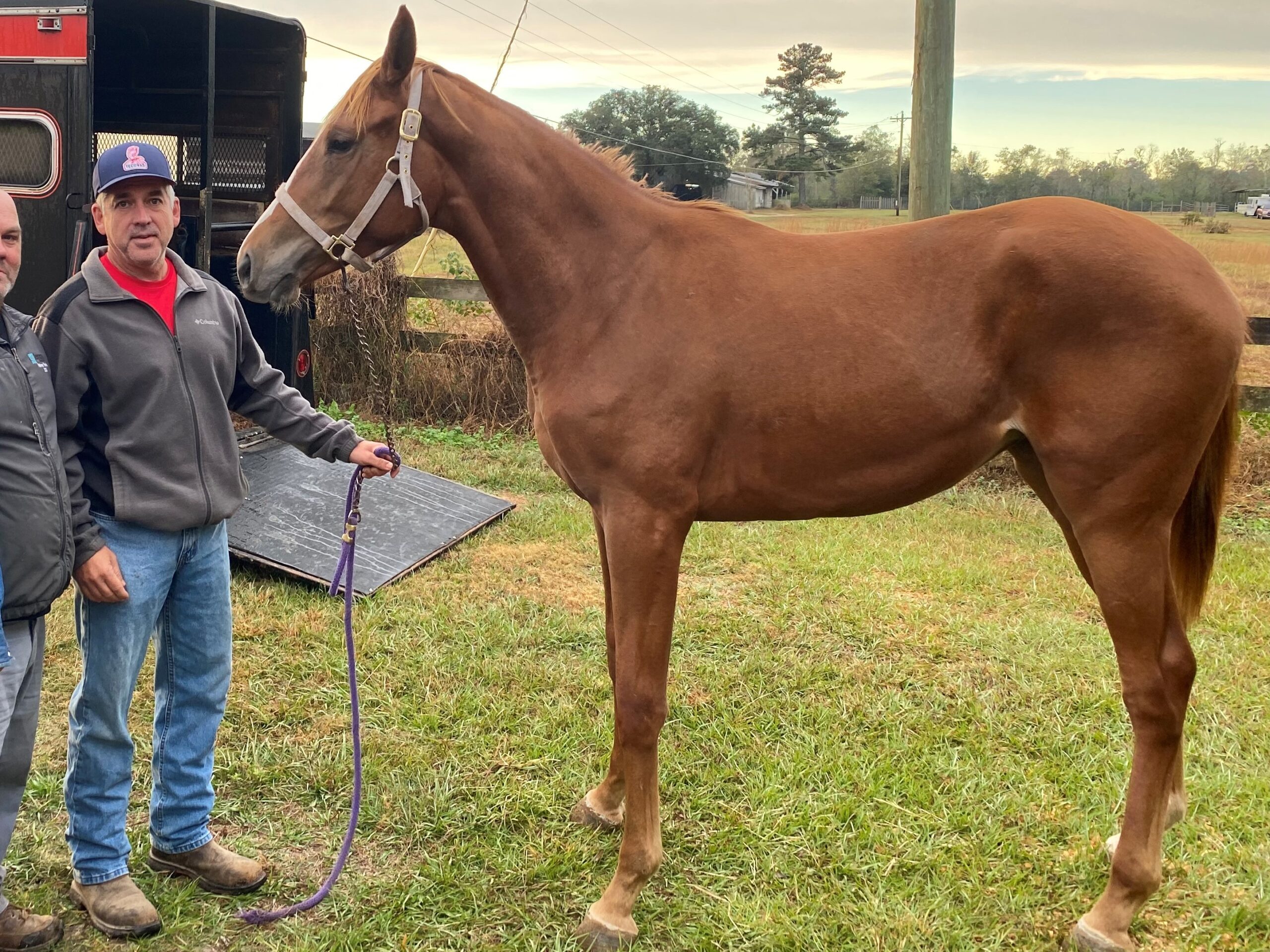
Miles Henry (legal name: William Bradley) is a professional horseman based in Folsom, Louisiana. He holds Louisiana Racing License #67012 and has spent over three decades managing Thoroughbreds at premier tracks including Fair Grounds, Delta Downs, and Evangeline Downs.
Expertise & Hands-On Experience: Beyond the track, Miles has decades of experience in specialized equine care, covering everything from hoof health and nutrition to training protocols for Quarter Horses, Friesians, and Paints. Every guide on Horse Racing Sense is rooted in this “boots-on-the-ground” perspective.
30 of their last 90 starts
Equibase Profile.

Connect with Miles: