
Last updated: August 17, 2026
Any links on this page that lead to products on Amazon are affiliate links and I earn a commission if you make a purchase. Thanks in advance – I really appreciate it!
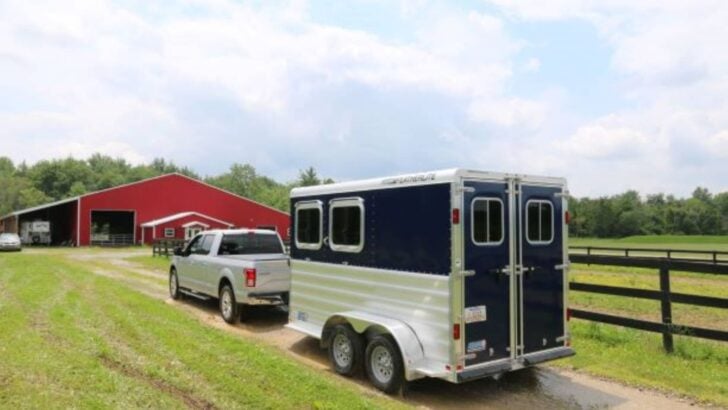
Before you buy a two-horse trailer—or the truck to pull it—you need a real number to work with. Trailer weight is not something I guess at; it affects the tow vehicle, hitch setup, and how much capacity is left once the horses, tack, hay, and water are loaded.
Most two-horse bumper-pull trailers weigh roughly 2,500 to 4,000 pounds empty, though lightweight models can fall below that and larger or heavily equipped models can exceed it. Once you load two horses, tack, hay, and water, a loaded two-horse trailer often weighs 5,000 to 7,000 pounds or more.
Here’s how that empty-to-loaded weight actually breaks down, what GVWR means for your specific trailer, and what it means for choosing a tow vehicle and hitch.
Table of Contents

How Much Does a Two-Horse Trailer Weigh Empty?
An empty two-horse bumper-pull trailer can weigh anywhere from roughly 2,000 to 5,000 pounds, depending on construction, size, and options. That’s a wide range on purpose; “two-horse bumper pull” covers everything from a stripped-down aluminum or European-style trailer to a steel-framed model with a full dressing room, and those aren’t close to the same weight.
| Trailer type | Empty-weight planning range | What drives the weight |
|---|---|---|
| Lightweight aluminum / European-style | ~2,000-3,000 lbs | Smaller body, minimal options, lower profile |
| Standard U.S. bumper pull | ~2,500-4,000 lbs | Construction, stall dimensions, dressing room, tack storage |
| Larger or heavily equipped bumper pull | ~3,500-5,000+ lbs | Steel components, added height/width, larger tack room, extra features |
These are planning estimates, not manufacturer specifications. Use the trailer’s VIN/weight label and the manufacturer’s spec sheet to get the exact empty weight and GVWR of the trailer you own or are considering.
Material. Aluminum trailers run lighter than steel, which is part of why they cost more; you’re paying for the weight savings. All-steel trailers are more affordable but heavier, which affects both fuel economy and what tow vehicle you need.
Features. A dressing room is one of the bigger weight additions on a standard model, adding several hundred pounds depending on its size and construction, more if it includes cabinetry, insulation, or extra windows. A tack room, additional windows, or upgraded flooring all add incremental weight too.
Style. Bumper-pull trailers are generally lighter than gooseneck trailers built to carry the same number of horses, which is one reason bumper-pull models are popular for owners who only need to haul one or two horses and don’t want to step up to a heavier rig or a bigger truck.
How Much Does a Two-Horse Trailer Weigh Loaded?
The empty weight on the spec sheet isn’t the number your truck actually deals with going down the highway. Once you load horses, tack, hay, and water, the total climbs fast. Here’s a realistic example:
| Item | Approximate weight |
|---|---|
| Empty trailer | 2,500 lbs |
| Horse #1 | 1,100 lbs |
| Horse #2 | 1,100 lbs |
| Tack and equipment | 200 lbs |
| Hay, feed, and water | 150 lbs |
| Loaded trailer, approximate total | ~5,050 lbs |
Two-horse trailer weights vary considerably by model and equipment, so compare the manufacturer’s specifications for the exact trailer you are considering. For example,
Trails West publishes model-specific horse-trailer specifications. In addition, horse weight varies a lot, so adjust the math for your actual horses. If yours are 1,300 pounds each instead of 1,100, you’ve added another 400 pounds to the rig before changing anything else.
I wouldn’t shop for a tow vehicle based on a trailer advertised as “2,500 pounds.” That’s an empty number on a spec sheet. Once the horses are standing in it and you’ve loaded the tack and feed you actually take to the barn, you’re dealing with a very different weight, and that’s the number that matters for towing safety. This is also why I pay more attention to the loaded rig than the advertised trailer weight when I’m looking at a towing setup; the empty number is useful for comparison, but it isn’t the number you experience once you’re headed down the road with horses aboard.
Trailer Weight, GVWR, and Payload
Two terms get mixed up constantly here, and the difference matters. GVW (Gross Vehicle Weight) is the trailer’s actual weight at a given moment, what you’d get weighing it on a scale right now. GVWR (Gross Vehicle Weight Rating) is the manufacturer’s maximum allowed loaded weight for that trailer, including the trailer itself plus every horse, every bag of feed, and every piece of tack riding in it.
Subtract the trailer’s actual empty weight from its GVWR to estimate how much additional weight the trailer can carry. For example, a trailer that weighs 3,100 lbs empty with a 7,000-lb GVWR has 3,900 lbs of available payload. Two 1,100-lb horses use up 2,200 lbs of that, leaving 1,700 lbs for tack, hay, water, feed, and everything else. That fills up faster than most people expect, especially with a loaded tack room and a full water tank. Advertised “empty weight” is sometimes based on a base configuration that doesn’t include every option on your specific trailer, so the weight sticker on your actual trailer is more reliable than a brochure figure.
Don’t exceed the GVWR. Exceeding a trailer’s GVWR can overload its axles, tires, brakes, frame, or coupler, and it can contribute to poor handling. Trailer sway itself has several causes beyond overloading, including improper tongue weight, uneven loading, speed, wind, tire condition, and incorrect hitch setup. Before buying or loading a trailer, verify its GVWR on the VIN/weight label, and confirm your actual loaded weight on a certified scale rather than estimating it.
If you weigh the rig, weigh it in the condition you actually travel in: horses aboard, water tank filled as usual, tack room loaded, passengers in the tow vehicle, and the hitch connected. Most owners underestimate how much water, hay, and gear add up, and a rig weighed empty or half-loaded won’t tell you what you actually need to know.
For a plain-language safety reminder on matching trailer weight, fully loaded tongue weight, and tow-vehicle axle ratings, see the NHTSA’s towing safety guidance.
.
What Trailer Weight Means for Your Truck
A lot of full-sized trucks and SUVs can pull a two-horse trailer, but “can pull it” and “is a good match for it” aren’t necessarily the same thing. I wouldn’t choose a tow vehicle based solely on the trailer’s empty weight or the maximum tow rating printed in a brochure.
A vehicle can have plenty of advertised towing capacity and still fall short once you add the trailer’s tongue weight, the driver and passengers, cargo already in the vehicle, and any hitch equipment. I don’t select a tow vehicle by the maximum towing number alone; “the vehicle also needs enough payload capacity to carry the trailer’s actual loaded tongue weight along with everything else riding in it. Check the tire-and-loading label on the driver’s door jamb, the owner’s manual, the receiver-hitch rating, the manufacturer’s towing guide, and your trailer’s actual loaded weight, not just its empty weight, before deciding a vehicle is a good match.
A properly equipped full-sized truck is often the more comfortable choice for a loaded two-horse bumper-pull, particularly with full-sized horses, longer trips, hills, wind, or a larger tack room. Some full-sized SUVs and midsize trucks can work for certain setups, but only when their towing, payload, tongue-weight, axle, and combined-weight ratings all genuinely cover the actual loaded rig, not just the trailer’s empty weight. If the trailer puts 600 pounds of tongue weight on the hitch, for example, that 600 pounds counts against the truck’s available payload right alongside the driver, passengers, and anything else in the cab or bed.
Do You Need a Weight-Distributing Hitch?
A weight-distributing hitch transfers part of the trailer’s tongue load from the tow vehicle’s rear axle toward its front axle and the trailer’s own axles. That helps restore the tow vehicle’s front-axle weight and improves handling; it isn’t simply spreading the load evenly across the trailer.
Whether you need one isn’t determined by a single universal trailer-weight number. It depends on the tow vehicle, the receiver hitch, the trailer, and the actual loaded tongue weight, and it must be compatible with both the vehicle and trailer manufacturer’s instructions. Some combinations require one at relatively modest trailer weights; others don’t. Check your owner’s manual and the trailer manufacturer’s requirements, and have the system sized and installed by a qualified installer rather than guessing. A weight-distributing hitch doesn’t increase the truck’s payload, GVWR, GCWR, or tow rating; it has to be used within the ratings of the complete combination, not as a way to exceed them.
See our guide to the best weight-distributing hitches on the market for specific options once you know what your setup requires.
Key Takeaways: Two-Horse Trailer Weight
- Expect 2,500 to 4,000 lbs empty — lighter aluminum models run closer to 2,000 lbs, heavier steel or fully equipped trailers can exceed 4,000 lbs.
- Loaded weight is what matters — two horses, tack, hay, and water can push a rig to 5,000-7,000+ lbs, well past the empty spec-sheet number.
- Know the difference between GVW and GVWR — GVWR is the maximum allowed loaded weight; subtract the empty trailer weight to estimate available payload.
- Don’t pick a tow vehicle by max tow rating alone — payload, tongue weight, and combined-weight ratings all have to cover your actual loaded rig.
- Weight-distributing hitch needs vary by setup — there’s no single universal weight threshold; check your vehicle and trailer manufacturer’s requirements.
Two Horse Trailer Weight FAQs
How much does a two-horse trailer weigh empty?
Most two-horse bumper-pull trailers weigh 2,500 to 4,000 pounds empty. Lightweight aluminum models run closer to 2,000 pounds, while steel construction and added features can push the weight beyond 4,000 pounds.
How much does a two-horse trailer weigh loaded with two horses?
A loaded two-horse trailer commonly weighs 5,000 to 7,000 pounds or more, once you add two horses (roughly 1,000-1,300 lbs each), tack, hay, feed, and water to the empty trailer weight.
How much weight does a dressing room add to a horse trailer?
A dressing room typically adds several hundred pounds, depending on its size and construction, more if it includes cabinetry, insulation, or extra windows. There’s no single fixed number since dressing rooms vary a lot by trailer and manufacturer.
Can a half-ton truck tow a two-horse trailer?
It depends on the specific truck’s payload, towing, and tongue-weight ratings compared with your trailer’s actual loaded weight, not just the trailer’s empty weight or the truck’s maximum advertised tow rating. Some half-ton trucks can handle a lighter, well-matched two-horse bumper-pull; others fall short once tongue weight and payload are accounted for. Check your specific truck’s ratings before assuming it’s adequate.
Trailer weight is not just a spec-sheet number. It determines whether your tow vehicle is properly matched to the trailer, how much you can load, and whether your hitch setup is appropriate. Before you hook up, know the trailer’s empty weight, GVWR, and actual loaded weight, and compare those figures with the vehicle’s towing, payload, tongue-weight, axle, and combined-weight ratings.
About Miles Henry
Racehorse Owner & Author | 30+ Years in Thoroughbred Racing
Miles Henry (legal name: William Bradley) is a professional horseman based in Folsom, Louisiana. He holds Louisiana Racing License #67012 and has spent over three decades managing Thoroughbreds at premier tracks including Fair Grounds, Delta Downs, and Evangeline Downs.
Expertise & Hands-On Experience: Beyond the track, Miles has decades of experience in specialized equine care, covering everything from hoof health and nutrition to training protocols for Quarter Horses, Friesians, and Paints. Every guide on Horse Racing Sense is rooted in this “boots-on-the-ground” perspective.
30 of their last 90 starts
Equibase Profile.

Connect with Miles: