
Last updated: July 8, 2026
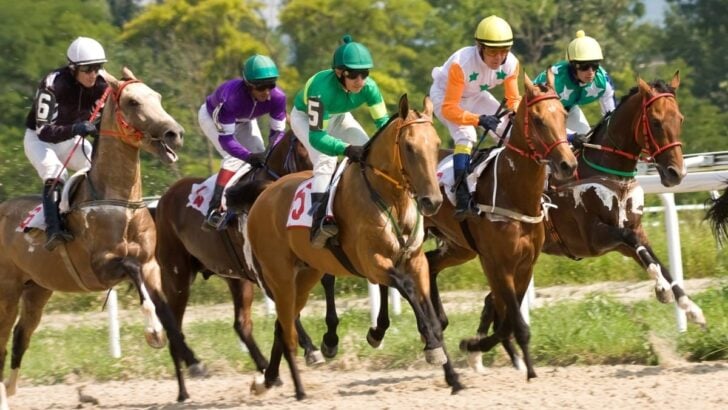
What is a furlong in horse racing? A furlong is a unit of distance equal to one-eighth of a mile — 220 yards or 660 feet. Eight furlongs equals one mile. In horse racing, it is the standard distance unit for races under one mile. Key facts:
- Origin — from Old English furlang, meaning the length of a furrow plowed across a one-acre field; standardized in England in the early 1300s
- Why racing uses it — tradition; furlongs were the unit used when English horse racing was formalized in the 1500s and the term never changed
- How to read it in a race program — races under a mile are listed by furlongs (6f = ¾ mile, 7f = ⅞ mile); races over a mile switch to fractions (1¼ miles, not 10 furlongs)
- Conversions — 1 furlong = ⅛ mile = 220 yards = 660 feet = 201.1 meters
- Speed benchmark — a fast Thoroughbred runs one furlong in 12–13 seconds in a sprint; 13–14 seconds in a route
Table of Contents
What Is a Furlong?
One furlong equals one-eighth of a mile. That is the most useful number to memorize — everything else in race-distance reading follows from it. Eight furlongs equals one mile; a six-furlong race is three-quarters of a mile; a five-furlong race is just over half a mile.
Furlong conversions — the numbers you need:
- 1 furlong = ⅛ mile
- 1 furlong = 220 yards
- 1 furlong = 660 feet
- 1 furlong = 201.168 meters
- 8 furlongs = 1 mile
For context: one furlong is roughly three-fifths the height of the Eiffel Tower (the tower is about 1.61 furlongs tall). Outside of horse racing, furlongs are still used on highway signs in Myanmar (formerly Burma) and to measure canal lengths in England.
Where Did the Word Furlong Come From?
The word furlong comes from Old English furlang, a combination of furh (furrow) and lang (long) — literally, the length of a furrow. According to Encyclopaedia Britannica, the term was standardized at 40 rods, or 660 feet. The spelling shifted slightly over time, but the meaning stayed the same.
The Romans had their own unit — the stadium — equal to 600 Greek feet, roughly comparable to the English furlong. Roman influence pushed England to align its mile with the Roman mile, which is why the English mile was standardized at exactly 8 furlongs in the early 1300s under statute. England’s official weights and measures were codified during the Elizabethan era in the 16th century, cementing the furlong at 660 feet. The University of North Carolina’s dictionary of measurement units notes that the furlong, rod, yard, and foot were established together as an integrated system at this time. The word itself shifted from furlang to furlong — a single vowel change — and has stayed there ever since. Over 85 percent of Old English words have vanished from the language. Furlong survived, unchanged in meaning if not quite in spelling, for around 1,500 years.
A perfect acre is exactly one furlong long and 4 rods wide. That geometric relationship between furlong, rod, acre, and mile is not coincidence — those units were designed together as an integrated land measurement system. The furlong was the agricultural backbone before it became a racing term.
Why Horse Racing Uses Furlongs
The short answer is tradition. When organized horse racing developed in England in the 1500s, furlongs were already the standard unit of land measurement, so they became the unit of racecourse measurement. Racing kept the term even as much of the world moved to metric. The Equibase racing glossary — the official record-keeping system for North American racing — uses furlongs as the standard distance unit across all American tracks.
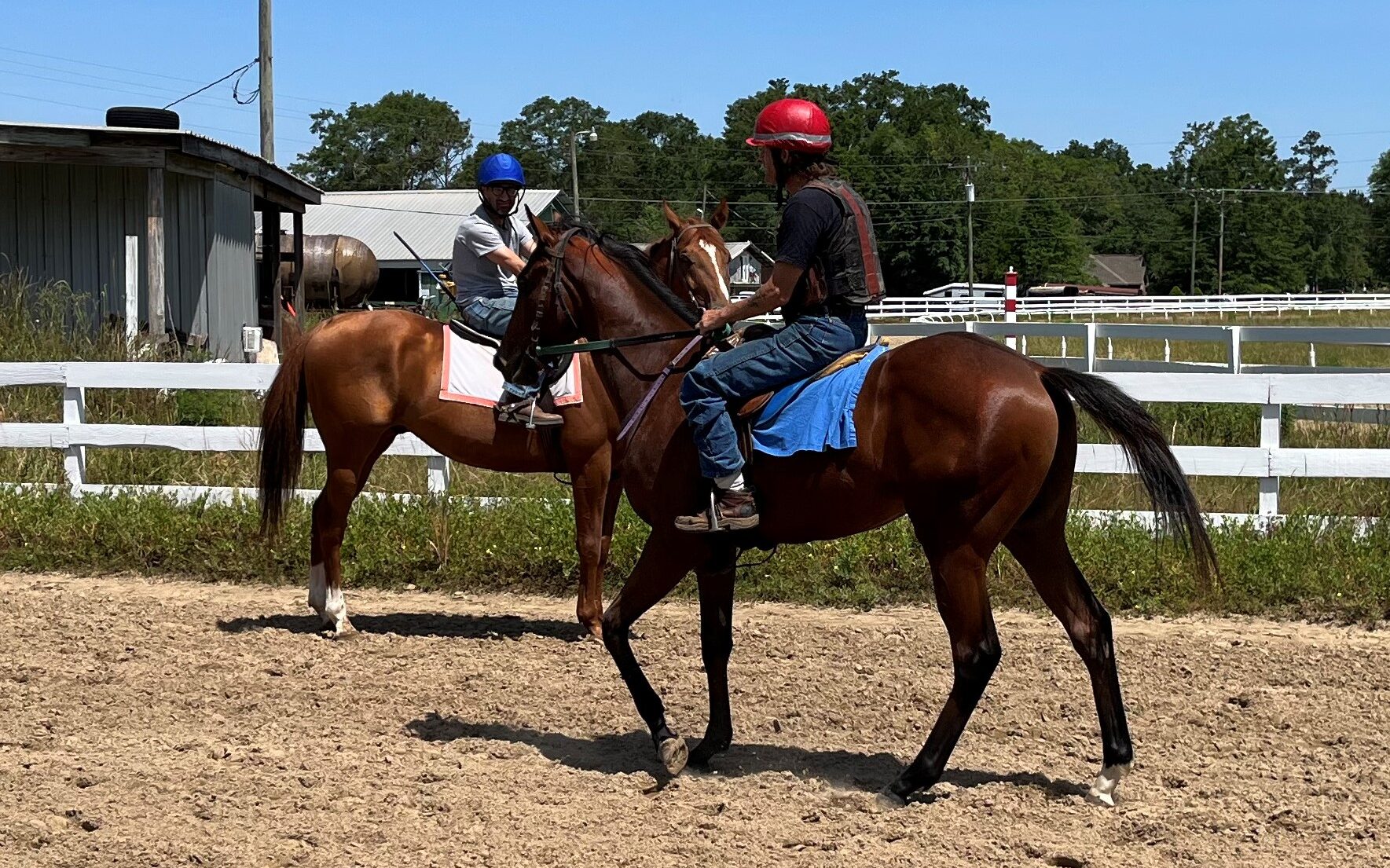
Horseman’s Perspective: Furlongs become completely intuitive once you spend time at the track. Every pole on the track is a furlong marker. The quarter pole is 2 furlongs from the finish; the half-mile pole is 4 furlongs out. When you watch a race from the rail, you naturally start reading in furlongs — “they hit the half in 47 seconds, that’s a fast pace for 6 furlongs.” It clicks pretty quickly. If you are new to claiming races or reading a turf versus dirt race, the furlong is just a given — you stop thinking about it as a unit of measurement and start thinking about it as a position on the track.
How to Read Furlongs in a Race Program
Race programs and Daily Racing Form entries list distances in furlongs for races under one mile, then switch to fractions of a mile for longer races. This is not a rule anyone decided — it is just how the convention settled.
| Furlong notation | Mile equivalent | How it appears in programs |
|---|---|---|
| 5f | ⅝ mile | 5 furlongs — short sprint, common for maiden races and 2-year-olds |
| 5½f | 11/16 mile | 5½ furlongs — sprint step-up distance |
| 6f | ¾ mile | 6 furlongs — the most common claiming distance in American racing |
| 6½f | 13/16 mile | 6½ furlongs — less common; used as a stepping stone between 6f and 7f |
| 7f | ⅞ mile | 7 furlongs — listed as “7 furlongs” not as a mile fraction |
| 8f = 1 mile | 1 mile | Listed as “1 mile” — the transition point where fractions replace furlongs |
| Beyond 1 mile | 1¼ miles, 1½ miles | Routes listed as mile fractions, never as “10 furlongs” or “12 furlongs” |
The letter f abbreviates furlong in racing programs. A race listed as 6f is six furlongs — three-quarters of a mile. Distance changes are a major handicapping factor; for a full breakdown of how sprint and route distances affect pace and post position, see our guide to horse racing distances.
Horse Racing Speed Records by Furlong Distance
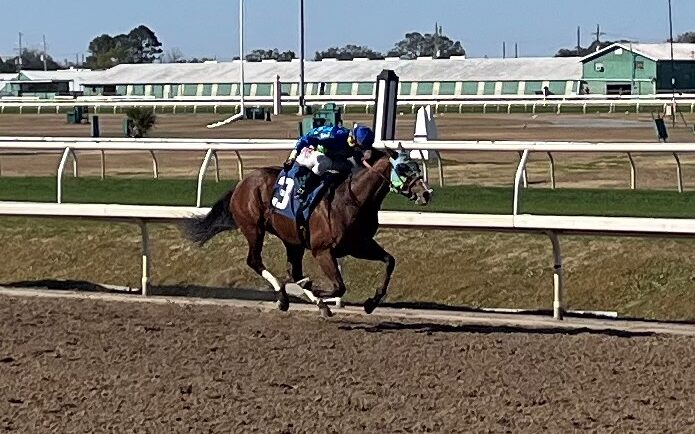
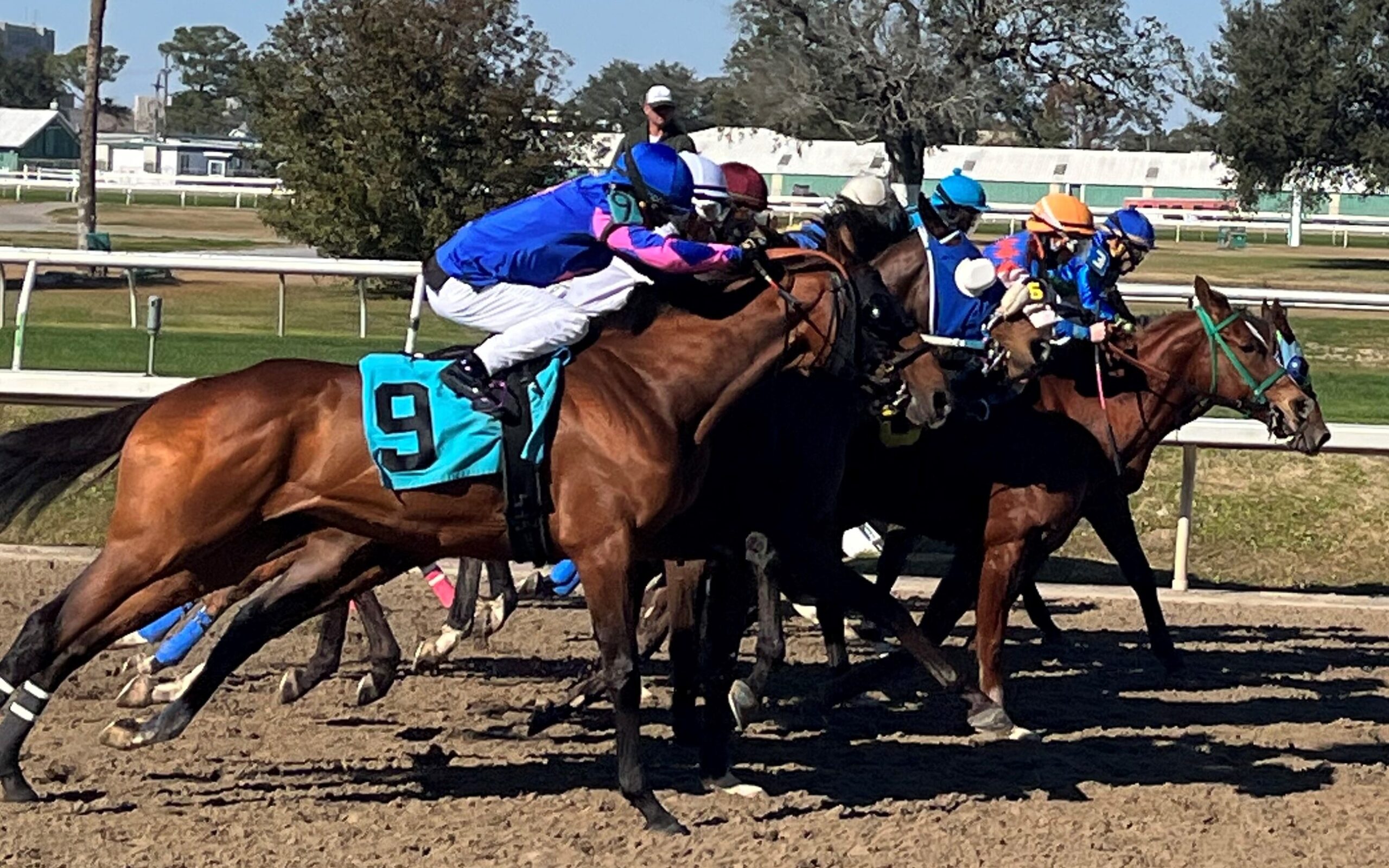
Races are timed at each quarter pole (every 2 furlongs), and those fractional times appear in the racing form. Thoroughbred speed records at specific furlong distances are a combination of officially timed races and splits recorded during longer races — which is why Thoroughbred times at short distances often reflect a running start rather than a gate start.
| Distance | Record holder | Time | Notes |
|---|---|---|---|
| 1 furlong (220 yds) | Travel Plan (Quarter Horse) | 11.493 seconds | Set 2009, Los Alamitos — gate start; Thoroughbreds don’t race 1f but are timed at ~12–13 seconds per furlong in sprints |
| 2 furlongs (¼ mile) | Drip Brew (Thoroughbred mare) | 19.93 seconds | Set 2020, Prairie Meadows — timed from a running start during a longer race; previous record 20.57 by Winning Brew (2008) |
| 5 furlongs | Chinook Pass (Thoroughbred) | 55⅓ seconds | Set 1982; ridden by Hall of Famer Laffit Pincay Jr.; earned nearly $500,000 career |
| 5½ furlongs | Hollywood Harbor | 1:00.87 | Set 2012, Emerald Downs |
| 6 furlongs | Twin Sparks | 1:06.49 | Set 2009, Turf Paradise |
| 7 furlongs | Rich Cream | 1:19⅔ seconds | Set 1980; the record has stood over 40 years — Rich Cream was a late bloomer who didn’t find his form until age 5 |
A note on the Thoroughbred times at 1 and 2 furlongs: these are recorded during longer races, not from a gate start. Quarter horses run dedicated 220-yard races and are timed from the gate, which makes direct comparison tricky. The Quarter Horse record of 11.493 seconds for 220 yards reflects a true gate-to-finish time; the Thoroughbred 2-furlong time of 19.93 seconds reflects the horse already traveling at speed. For more on how fast horses actually run and what those speeds mean, that article covers the full picture.

Furlongs in the Bible — the word appears in several New Testament passages as a translation of the Greek stade, a unit of about 600 Greek feet, slightly shorter than the modern 660-foot furlong. John uses it in John 6:19 and John 11:18, Luke uses it in Luke 24:13, and John also uses it in Revelation 21:16. The unit was common in the Greco-Roman world, which is why it appears in these passages. For more on the role of horses in the Bible and horse imagery in Revelation, that article covers it in depth.
FAQs: What Is a Furlong in Horse Racing
What is a furlong in horse racing?
A furlong is a unit of distance equal to one-eighth of a mile — 220 yards or 660 feet. Eight furlongs equals one mile. It is the primary unit of distance measurement in American horse racing for races under one mile. Races over a mile are listed as mile fractions rather than furlongs.
What is a 6-furlong race?
A 6-furlong race is three-quarters of a mile — the most common race distance in American claiming and allowance racing. Six furlongs is considered the benchmark sprint distance. A competitive time for a 6-furlong race is around 1:09 to 1:11 depending on track surface and conditions.
What is a good time for a 7-furlong race?
Most competitive 7-furlong races are run in 1:20 to 1:25. A time under 1:22 on a fast track is generally considered strong. The world record for 7 furlongs is 1:19⅔, set by Rich Cream in 1980 — a record that has stood for over 40 years.
What is a good time for a 3-furlong workout?
For a conditioned sprinter, a 3-furlong workout in 36 seconds or faster is considered sharp. Distance horses and horses coming off a layoff typically work slower. A 3-furlong bullet (the fastest workout at that distance at a given track on a given day) is usually in the 34–35 second range at major tracks.
Why do horse races use furlongs instead of miles or meters?
Tradition. When organized horse racing was formalized in England in the 1500s, furlongs were the standard unit of land measurement. Racecourses were measured and described in furlongs from the start, and the convention never changed even as the rest of the world shifted to metric.
How fast does a horse run one furlong?
A fast Thoroughbred runs one furlong in approximately 12 to 13 seconds in a sprint race. In longer routes, the pace is typically 13 to 14 seconds per furlong. Elite horses can run closer to 11 seconds per furlong in the early stages of a sprint. Quarter horses, racing from a standing start over a single furlong, can cover 220 yards in under 12 seconds.
Key Takeaways: What Is a Furlong
- 1 furlong = ⅛ mile = 220 yards = 660 feet — the single conversion to memorize; everything else follows from it
- Races under a mile are listed by furlongs; races over a mile switch to fractions — 6f means ¾ mile; beyond 8f it becomes 1¼ miles, not 10 furlongs
- Furlongs originated as agricultural measurement — the length of a furrow across a one-acre field, standardized at 40 rods in 14th-century England
- Racing uses furlongs because of tradition — they were the unit in use when English horse racing was formalized in the 1500s and have never been replaced
- A fast Thoroughbred runs one furlong in 12–13 seconds in a sprint — use this as a mental benchmark when reading fractional times in the racing form
- The biblical furlong (stade) is slightly shorter — 600 Greek feet versus 660 English feet, but close enough that it appears as “furlong” in English translations throughout both the Gospels and Revelation
About Miles Henry
Racehorse Owner & Author | 30+ Years in Thoroughbred Racing
Miles Henry (legal name: William Bradley) is a professional horseman based in Folsom, Louisiana. He holds Louisiana Racing License #67012 and has spent over three decades managing Thoroughbreds at premier tracks including Fair Grounds, Delta Downs, and Evangeline Downs.
Expertise & Hands-On Experience: Beyond the track, Miles has decades of experience in specialized equine care, covering everything from hoof health and nutrition to training protocols for Quarter Horses, Friesians, and Paints. Every guide on Horse Racing Sense is rooted in this “boots-on-the-ground” perspective.
30 of their last 90 starts
Equibase Profile.

Connect with Miles: