
Last updated: July 23, 2026
Any links on this page that lead to products on Amazon are affiliate links and I earn a commission if you make a purchase. Thanks in advance – I really appreciate it!
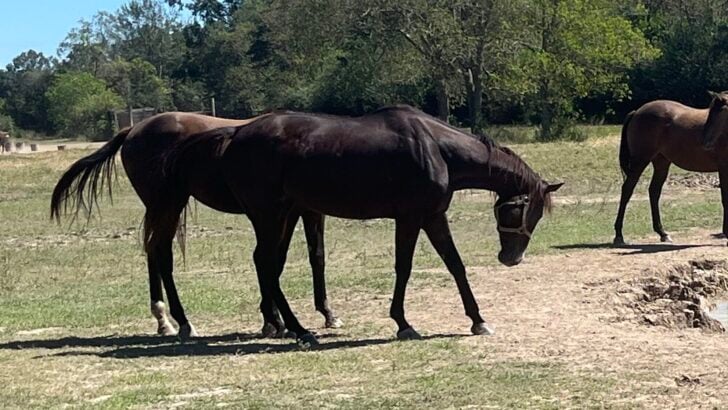
I had a barrel-racing mare that sucked wind every time she jogged, and another that only did it at a full run. Most of the racing and performance mares I’ve owned over the years have needed a Caslick’s procedure at some point. If you’ve ever heard an odd sucking or gurgling noise from behind your mare during work, or dealt with recurring vaginal infections you can’t explain, this is very likely what’s going on.
Wind sucking, or pneumovagina , happens when a mare’s vulva doesn’t seal properly, letting air — and sometimes debris — get drawn in, most noticeably during exercise. The basic problem is always the same: an incompetent seal at the vulva. What varies is why that seal fails — conformation is the most common factor, and age, excess weight, and past injury can each make it worse. Left unaddressed, it raises real risk of uterine infection and infertility. The standard treatment is a Caslick’s procedure — a vet surgically closes the upper part of the vulva, leaving enough opening for normal urination.
A note on terminology: some horse owners use “wind-sucking” to describe cribbing — a stable vice where a horse grips something with its teeth and swallows air. That’s a completely different condition from what this article covers. Here, we’re talking specifically about pneumovagina, an issue affecting only mares.
Table of Contents
What Is Wind Sucking in Mares?
Wind sucking — the technical term is pneumovagina — is a condition unique to mares and fillies, where air gets drawn into the vagina because the vulva lips aren’t sealing the entrance properly. It affects horses of any breed. Some mares only show it occasionally; others deal with it chronically. It’s usually most obvious at speed or under exertion, since the change in intra-abdominal pressure during exercise pulls the vulva open and causes the vagina to balloon with air.
In healthy conformation, the vulva lips are the reproductive tract’s first line of defense — sealing out external debris and bacteria that would otherwise cause infection. When that seal fails, air moves in and out freely, and often carries fecal debris and contaminants along with it.
What Causes Mares to Wind Suck?
The basic problem is always the same: the vulva fails to form a proper seal. The factors below are what typically drive that failure, or make an existing weak seal worse — some are structural conformation issues, others are things like weight or age that can shift over a mare’s lifetime.
Poor Vulva Conformation
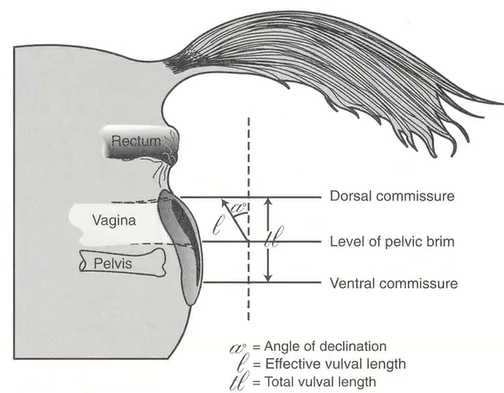
Conformation is the single biggest factor. In simple terms, a vulva that sits too horizontal, rather than sloping down and in toward the body, doesn’t close well on its own — the flatter the angle, the more likely air gets in. Vets have a precise way of measuring this if you want the detail: it’s called the Caslick Index, calculated from the vulva’s length and its angle of declination from vertical. A vulval angle of 80 degrees to the horizontal is considered ideal; angles below 50 degrees are strongly associated with clinical wind-sucking. This isn’t something you can reliably judge by eye — a vet measures it directly during a breeding soundness exam.
Vaginal Injuries and Multiple Foalings
Injuries from previous pregnancies or foalings can reduce the vulva’s sealing ability, leaving a small gap that lets air — and fecal debris — enter more easily under exertion. Repeated foaling has a cumulative effect here; in plain terms, everything is no longer as tight as it used to be.
Poor Muscle Tone, Weight, and Age
Poor muscle tone from neglect, illness, or advanced age weakens the vulva’s ability to seal. Overweight mares face a related but distinct problem: internal pressure can push the labia outward and cause the lips to invert, which also reduces the seal. Body condition and age are two of the more manageable risk factors here, compared to structural conformation issues.
External Trauma and Underlying Conformation Issues
An acute injury to this area can weaken the surrounding muscle on its own. Separately, broader conformation issues — a flat croup, a high tail head, or a sunken anus — can pull the opening deeper under the tail, reducing the effective angle and forcing it open regardless of how good the tone is otherwise.
Miles’ Take: I’ve owned mares on both ends of this — one that only wind-sucked at a dead run, and one that did it just jogging around the barn. The severity really does vary that much between horses, which is exactly why a vet exam matters more than trying to judge it yourself from watching her move.
What Is a Caslick’s Procedure?
A Caslick’s procedure is the standard surgical treatment for wind-sucking. Under local anesthetic, the vet trims a small strip of tissue along both edges of the upper vulva lips, then sutures them together so the raw edges heal joined. This closes the upper portion of the vulva while leaving enough of an opening lower down for the mare to urinate normally. The procedure takes its name from Dr. Caslick, who first described the technique and its importance for fertility back in the 1930s.
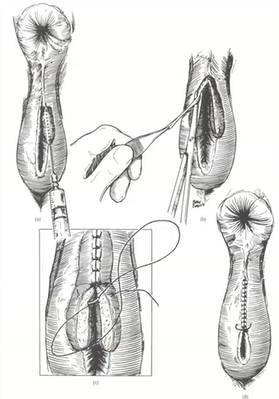
A Caslick’s closure isn’t permanent — it can be surgically reopened (sometimes called a Caslick’s release) whenever access is needed, such as breeding or foaling, and a vet will typically resuture it afterward if the mare’s conformation still calls for it.
Why Do Mares Get Caslicks?
There are a few overlapping reasons a mare ends up needing this procedure:
- To prevent infection. An open vulva lets dirt and fecal debris enter and get drawn into the vagina, causing irritation and infections that can progress to the uterus.
- To protect performance. Wind-sucking irritates and balloons the vagina, which can cause visible discomfort under saddle — some mares will stop or refuse a rider’s requests specifically to avoid the pain.
- To protect fertility. Ascending infection from an unsealed vulva is a real threat to establishing and maintaining a pregnancy.
For breeding mares specifically, the stakes are highest: an unaddressed pneumovagina raises real risk of endometritis (uterine infection) or placentitis (infection of the placenta), either of which can prevent conception or cause a mare to lose a pregnancy she’s already carrying.
Miles’ Take: in my experience around Louisiana tracks, most fillies and mares are sewn up at some point during their racing careers — including ones that will later become broodmares. It’s kind of like tongue ties, honestly: some trainers do it as a matter of habit, while others are increasingly willing to wait and see whether a horse actually needs it before reaching for the suture.
When Should a Caslick Be Removed?
A mare with a Caslick’s closure can’t be naturally covered by a stallion without the closure being opened first — trying to breed her through a sutured vulva risks tearing. She can, however, be artificially inseminated through a speculum below the closure without opening it at all, which is one real practical advantage of AI over natural cover for a mare who needs a Caslick’s.
If she is bred naturally, the closure is reopened beforehand and then resutured afterward to prevent air and contaminants from reaching a developing pregnancy — a real risk to the embryo. Pregnant mares need the closure removed again one to two weeks before foaling, so the partially closed vulva doesn’t tear as the foal is born. Some owners also remove it during the off-season when a mare is simply turned out and not being ridden or bred.

Can You Breed a Mare With a Caslick?
Needing a Caslick’s procedure — or buying a filly off the track that already has one — doesn’t disqualify a mare from breeding. A vet can reopen the closure along the original surgical line whenever needed, and many mares who require one will need it resutured again after breeding or foaling, though your vet is the one who determines that on a case-by-case basis.
That said, it’s worth thinking through the breeding career you’re planning. A mare bred by natural cover will typically be opened and resutured twice per pregnancy — once for mating, once for foaling — while artificial insemination only requires opening her once, at foaling. There’s also a practical limit to how many times this can be done well: each Caslick’s procedure adds scar tissue to the vulva, and over time that makes clean incisions and a good seal harder to achieve. Worth factoring that into how you plan a mare’s breeding career, along with the possibility of passing on the same vulva conformation to her fillies.
Key Takeaways
- Wind-sucking (pneumovagina) is a seal failure at the vulva, not a disease on its own — conformation, age, weight, and injury are what typically drive it
- Conformation is measured with the Caslick Index — a vulval angle of 80° to the horizontal is ideal, and angles below 50° carry real risk
- A Caslick’s procedure closes the upper vulva under local anesthetic, leaving an opening for normal urination, and it’s fully reversible when needed
- Artificial insemination avoids one surgical reopening compared to natural cover, since it doesn’t require opening the closure for mating
- Repeated procedures add scar tissue — factor a mare’s expected breeding career into the decision, not just the immediate problem
FAQs: Wind Sucking and Caslicks
What is wind sucking in mares?
Wind sucking, or pneumovagina, is a condition where a mare’s vulva lips fail to seal properly, letting air and debris get drawn into the vagina — most noticeable during exercise. It’s unrelated to cribbing, a separate stable vice sometimes also called wind-sucking.
Is wind sucking the same thing as cribbing?
No. Cribbing is a stable vice where a horse grips an object with its teeth and swallows air, unrelated to reproduction. Pneumovagina (wind sucking in this article’s sense) affects only mares and involves air entering the vagina due to poor vulva conformation.
What is a Caslick’s procedure?
A Caslick’s procedure is a surgical treatment where a vet sutures the upper part of a mare’s vulva closed under local anesthetic, leaving enough opening for normal urination. It prevents air and debris from entering the vagina and is reversible when needed for breeding or foaling.
Can a mare with a Caslick’s still be bred?
Yes. A vet can reopen the closure along the original surgical line for natural cover or leave it closed and breed via artificial insemination through a speculum below it. The closure is then resutured after mating or foaling.
How many times can a mare have a Caslick’s procedure?
There’s no fixed number, but each procedure adds scar tissue to the vulva, which makes future incisions and a clean seal progressively harder to achieve. This is worth factoring into a mare’s overall breeding plan rather than treating each procedure in isolation.
Sources: WikiVet — Pneumovagina in Horses; Merck Veterinary Manual; Vetlexicon — Pneumovagina; AQHA — Caslick’s 101; BloodHorse — The Caslick’s Operation.
About Miles Henry
Racehorse Owner & Author | 30+ Years in Thoroughbred Racing
Miles Henry (legal name: William Bradley) is a professional horseman based in Folsom, Louisiana. He holds Louisiana Racing License #67012 and has spent over three decades managing Thoroughbreds at premier tracks including Fair Grounds, Delta Downs, and Evangeline Downs.
Expertise & Hands-On Experience: Beyond the track, Miles has decades of experience in specialized equine care, covering everything from hoof health and nutrition to training protocols for Quarter Horses, Friesians, and Paints. Every guide on Horse Racing Sense is rooted in this “boots-on-the-ground” perspective.
30 of their last 90 starts
Equibase Profile.

Connect with Miles: