
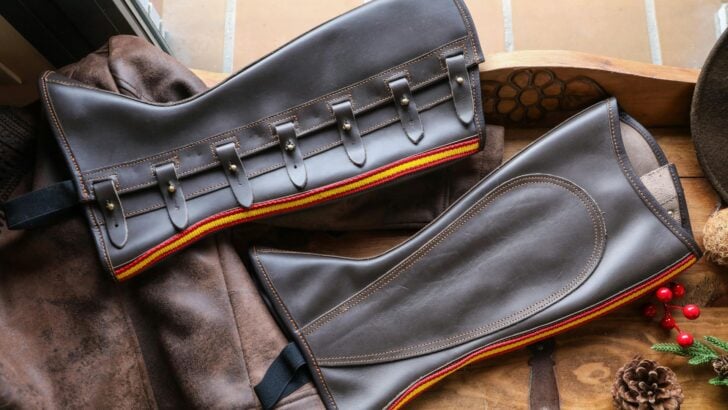
Published on: April 10, 2026
Any links on this page that lead to products on Amazon are affiliate links and I earn a commission if you make a purchase. Thanks in advance – I really appreciate it!
Here are the best half chaps for horse riding based on fit, durability, and real barn use:
- Best overall: Ariat Heritage Contour — full-grain leather, built to last 5+ years
- Best value: HORZE Amara Adult — machine washable, accurate sizing, $45–55
- Best budget: TuffRider Grippy Grain — reinforced inner patch, under $70
Measure first: If your calf measurement is off, half chaps will gap, slip, or not zip — no matter the brand.
Most riders discover half chaps the same way — a pair of paddock boots that fit perfectly, but a lower leg exposed to stirrup leather rub by the second lesson. After 30+ years working horses at the barn and watching riders at Fair Grounds, Evangeline Downs, and Delta Downs, I can tell you the best half chaps for horse riding solve that problem when they fit correctly.
A well-fitted half chap does three things: protects the lower leg from stirrup leather friction, improves calf grip and contact with the horse, and delivers the function of a tall boot at a fraction of the cost. Paired with quality paddock boots, you get nearly the same performance as a $400 tall boot setup for under $200 combined.
I’ve watched riders cycle through two or three pairs of poorly fitted half chaps before finding the right one. The difference almost always comes down to sizing — calf circumference matters more than height, and most buyers get that wrong. The picks below are based on real barn use and rider feedback from full seasons of wear, covering the best half chaps for horse riding across beginner, budget, and performance needs.
Do You Need Half Chaps?
Half chaps are an addition to a paddock boot setup, not a requirement. Whether they’re worth buying depends entirely on how often and how seriously you ride.
| Riding Frequency | Do You Need Half Chaps? |
|---|---|
| Once a week or less | Optional — paddock boots alone are fine |
| 2–3 times a week | Worth it — stirrup leather rub adds up fast |
| Serious training or showing | Yes — lower-leg protection and grip matter at this level |
The practical rule: if you’ve had any soreness or redness on the inner lower leg after riding, half chaps will fix it immediately. If your paddock boots are new and you’re still in once-a-week lessons, finish your first month before deciding — you may not need them yet.
- Riders in lessons who want lower-leg protection and grip without buying tall boots
- Beginners pairing paddock boots for the first time and not sure which half chap fits their boots and budget
- Parents buying for kids or young riders who need affordable, washable protection for weekly lessons
- Riders with wide calves who’ve had half chaps gap, roll down, or pinch — and need a sizing-forward solution
- Hot-weather riders in the South who need breathable options for summer barn work
- Experienced riders replacing worn-out half chaps and evaluating whether to move up to leather
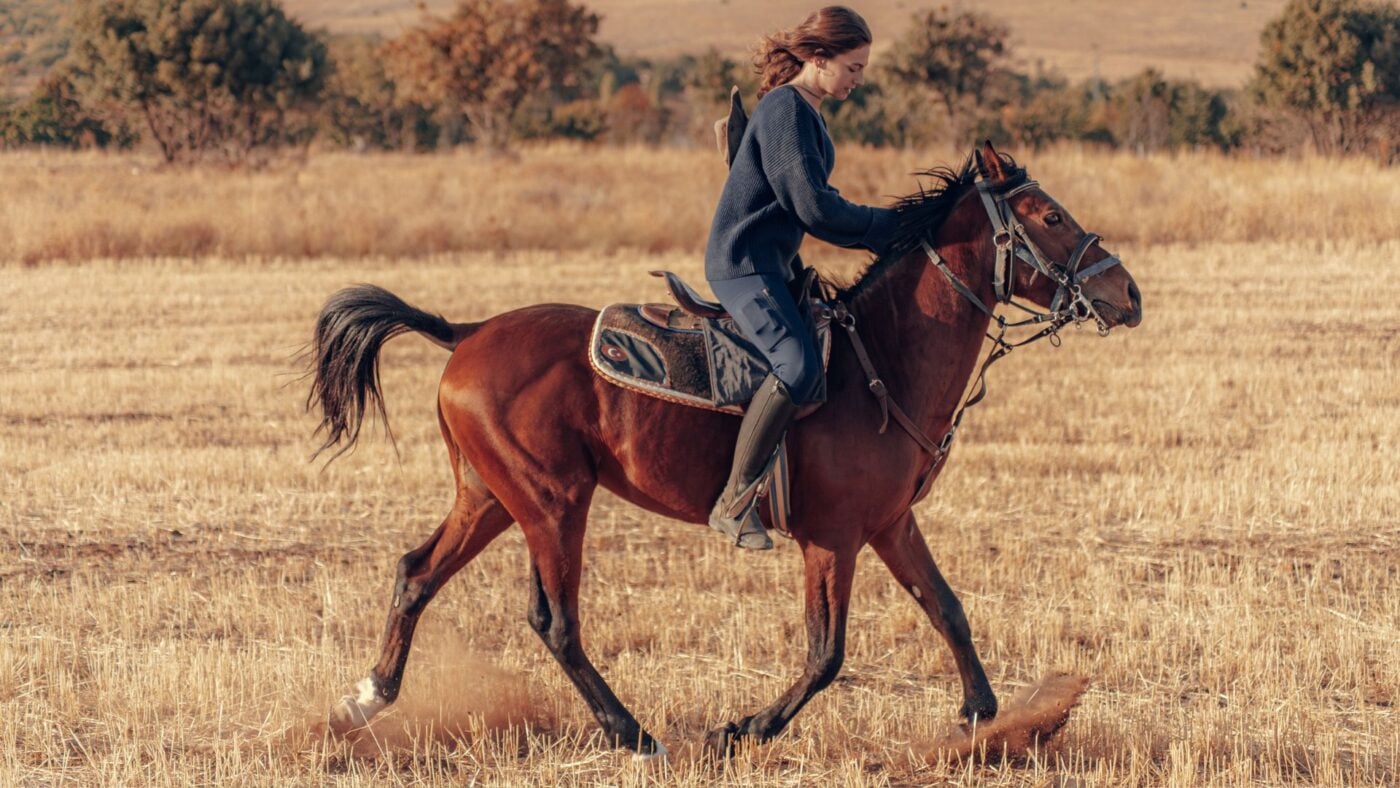
Table of Contents
Measure your calf circumference and height before ordering. It takes two minutes and prevents the most common reason riders return half chaps. How to measure →
Best Half Chaps for Horse Riding at a Glance
| Half Chap | Material | Closure | Best For | Price Range |
|---|---|---|---|---|
| Ariat Heritage Contour | Full-grain leather | YKK zip + keeper | Best overall — daily riding, long-term investment | ~$145–$165 |
| TuffRider Grippy Grain | Synthetic grain leather | Zip + snap | Best budget adult — lessons, everyday barn use | Under $70 |
| HORZE Amara Adult | Amara synthetic (washable) | YKK zip + velcro top | Best value — unisex, machine washable | ~$45–$58 |
| Ovation EquiStretch II | Stretch leather panel | Zip | Best for wide calves — 30+ sizing combinations | ~$70–$80 |
| TuffRider Children’s Washable | Synthetic (washable) | Zip | Best kids’ — lesson use, machine washable | ~$38–$45 |
| Saxon Adult Equileather | Equileather synthetic | Zip | Best entry-level — lowest cost adult option | ~$38–$50 |
| Dublin Easy-Care Mesh | Breathable mesh | Zip | Best hot weather — summer lessons, warm climates | ~$55–$70 |
Top 7 Half Chaps Reviewed
Best Overall Half Chap1. Ariat Heritage Contour Half Chap
Why this one: Full-grain leather with a stretch gore panel — it delivers the fit and durability of a custom half chap without the custom price, and pairs visually with Ariat paddock boots like they were made together. Best for: Regular adult riders who want one pair to last 5+ years and a close, contoured fit through the calf.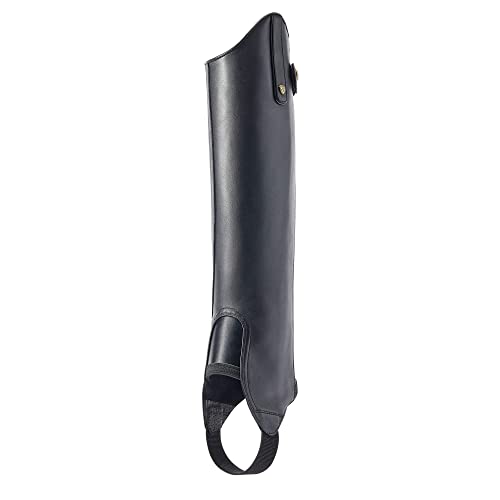
Full-grain unlined leather, stretch gore panel, high Spanish topline, YKK zipper with keeper. Built to mirror the silhouette of Ariat’s tall boots. The half chap riders reorder without deliberation.
Typically $145–$165
Check Current Price & SizesMaterial: Full-grain unlined leather | Closure: Full-length YKK zip with keeper guard | Design: Stretch gore panel + high Spanish topline
The Ariat Heritage Contour is what every other half chap on this list is being compared against. Full-grain leather that molds to the shape of your leg over the first few sessions, a stretch gore panel that accommodates calf shape variation without gapping at the top or bunching at the ankle, and a YKK zipper with a keeper that won’t fail on you mid-season. The high Spanish topline gives it the visual profile of a proper tall boot when paired with Ariat paddock boots — riders who’ve worn both confirm they’re nearly indistinguishable from a distance. I’ve watched riders in our barn use these for three and four consecutive years without replacement.
Full-grain leather does require conditioning — treat it with Leather Honey monthly in heavy use conditions. It will not survive machine washing. For riders who want zero maintenance, the HORZE Amara below is the better choice. But if you’re riding consistently and want one pair that lasts, the investment math on the Heritage Contour is hard to argue with. Always check Ariat’s website directly before purchasing — pricing and size availability are better there than through third-party retailers.
Cons: Highest price point on this list; requires regular conditioning; not machine washable.
Not ideal for: Riders who want zero maintenance or who ride infrequently — the synthetic options below are more practical for casual use.
→ Best overall half chap for committed riders.
I’ve seen the Heritage Contour survive three Louisiana summers of mud and humidity without the zipper failing—that’s rare for unlined leather.
Best Budget Half Chap for Adult Riders 2. TuffRider Grippy Grain Half Chap
Why this one: The reinforced inner patch is what separates this from every other sub-$70 half chap — it’s the part that takes stirrup leather abuse, and TuffRider put real material there. Best for: Adult riders on a budget, lesson students, and anyone who wants a reliable half chap without the leather price tag.
Stretchy imitation grain leather with reinforced inner leg, contoured cut, and zipper with snaps. Best price-to-function ratio on this list for adult riders.
Typically under $70
Check Current Price & SizesMaterial: Stretchy imitation top grain leather | Closure: Zip with snaps | Feature: Reinforced inner leg patch
TuffRider made a deliberate engineering decision with the Grippy Grain that matters in practice: the inner leg — the part that contacts stirrup leather constantly — is reinforced with a more durable material than the outer face. That’s the detail that separates a half chap that lasts a full season from one that shows through by month three. The stretchy grain synthetic accommodates mild calf shape variation, and the contoured cut stays put better than flat-cut alternatives at this price. Multiple lesson students in our barn have worn these through full six-month seasons of weekly riding without failure. In our experience, the outer face shows light surface scuffing around month four under daily use — normal cosmetic wear, not structural.
One sizing note that matters: these run small. Order one size up from your measured calf circumference. Pair them with well-fitted riding tights or jeans for horseback riding — a smooth base layer under the chap prevents bunching through the calf.
Cons: Runs small — order up; synthetic shows wear after 1–2 seasons of heavy daily use.
Not ideal for: Riders who want leather durability or machine washability — the Ariat and HORZE below are better in those categories.
→ Best first half chap for adult riders on a budget.
The half chap I’d put on any adult beginner without a second thought.
Also Read: Best Paddock Boots for Men, Women, and Kids
Best Value Half Chap3. HORZE Amara Adult Half Chap
Why this one: Machine washable with a YKK zipper and a size chart that actually reflects real measurements — three things most half chaps at this price get wrong. Best for: Unisex adult riders who want a low-maintenance, dirt-resistant half chap that can go straight in the washing machine after a muddy session.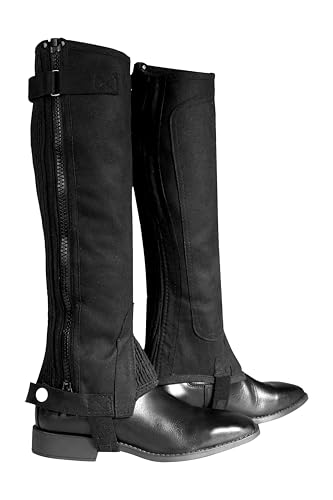
Amara synthetic leather — dirt resistant, machine washable, preshaped for a natural leg contour. Full-length YKK zipper, snap at bottom, velcro at top. Size chart in the product images is accurate — trust it.
Typically $45–$58
See Sizes & PriceMaterial: Amara synthetic leather (60% polyamide, 40% polyurethane) | Closure: Full-length YKK zip + snap bottom + velcro top | Care: Machine washable
HORZE solved the two biggest frustrations with budget half chaps in one design: they published a size chart in the product images that actually matches real calf measurements, and they made the material machine washable. Amara synthetic resists dirt better than standard synthetic leather — meaning less frequent washing in the first place — and the pre-shaped mold presses to the natural contour of the lower leg rather than sitting flat like cheaper alternatives. The snap closure at the bottom prevents the zipper from riding up, and the velcro at the top holds the chap securely against leg movement. Riders in our barn who’ve washed these every two to three weeks report no material degradation after a full season — the Amara holds its shape through repeated wash cycles better than standard synthetic.
One practical note: the velcro top can catch on breeches fabric if left unfastened between uses. Fold it against itself when removing to protect the material.
Cons: Velcro top catches on fabric if unfastened; Amara provides less grip than suede in wet conditions.
Not ideal for: Riders who need maximum suede grip or who show competitively — the Ariat leather is the better choice for those situations.
→ Best overall value on this list.
The half chap that makes sense for most adult riders who don’t want to think about maintenance.
Best for Wide Calves4. Ovation EquiStretch II Half Chap
Why this one: Thirty-plus sizing combinations — height and calf width independently — means you’re not forced to choose between a chap that gaps at the top or cuts off at the calf. Best for: Riders with wide calves, muscular lower legs, or anyone who has tried standard half chaps and found them either too tight through the calf or too loose at the top.
Stretch leather panel construction with 30+ independent height and calf width combinations. Snap tabs at the YKK zipper, skirt over the instep. The solution when standard sizing has repeatedly failed you.
Typically $70–$80
Check Availability & PriceMaterial: Top grain leather with stretch panel | Closure: Full-length YKK zip with snap tabs | Sizing system: Independent height + calf width combinations (30+)
Standard half chap sizing bundles height and calf circumference together, which works for riders whose proportions happen to fall in the average range — and leaves everyone else choosing between a chap that fits the height but cuts the calf or fits the calf but gaps at the top. The Ovation EquiStretch II separates those measurements entirely. You select your height independently from your calf width, which means a shorter rider with a wide calf gets the right combination rather than a compromise. A rider in our barn who’d cycled through three different half chap brands over two seasons — all of them gapping or pinching — found the right EquiStretch II combination on the first order.
The stretch leather panel through the back of the calf accommodates movement without the chap rotating or slipping down. Measure your calf circumference at its widest point before ordering — the sizing chart is reliable but only works if you’ve measured correctly. See the measuring guide in this article for the exact technique.
Cons: Must measure carefully before ordering — wrong combination causes slipping; higher price for a synthetic material.
Not ideal for: Riders with standard calf measurements — the extra sizing options aren’t worth the price if a standard small/medium/large fits you correctly.
→ Best solution for wide calves or failed fit history.
If half chaps have never fit you correctly, this is where to start.
Best Kids’ Half Chap5. TuffRider Children’s Washable Half Chap
Why this one: Machine washable, youth sizing, under $45 — practical on every axis that matters when buying equestrian gear for a child who may outgrow it in six months. Best for: Children in weekly lessons who need lower-leg protection and grip without expensive leather the parent will regret buying when the fit changes.
Machine washable, youth sizing, under $45. All the function a child needs in lessons — lower-leg protection, zip closure, secure fit — without the price commitment of leather.
Typically $38–$45
Check Price & Youth SizesMaterial: Washable synthetic | Closure: Side zip | Sizing: Youth range
When buying half chaps for a child, the calculus is different than for an adult: the fit will change, barn use means they will get filthy, and spending $150 on leather that needs conditioning is hard to justify. TuffRider’s washable children’s half chap resolves all three of those — machine washable, affordable enough to replace when the kid outgrows them, and durable enough for weekly lesson use. My grandchildren wore TuffRider half chaps through multiple seasons of lessons at our barn without any significant wear complaints from their instructor.
One important note: kids’ half chap sizing is significantly less standardized than adult sizing. Measure your child’s calf circumference at its widest point and height from ankle to just below the knee before ordering — do not rely on age or shoe size. The measuring guide in this article covers kids’ measurements specifically.
Cons: Kids’ sizing varies widely — must measure before ordering; synthetic only; will need replacement as child grows.
Not ideal for: Young riders preparing for shows — a more structured half chap is more appropriate for competition.
→ Best kids’ half chap for lessons and daily barn use.
The half chap that makes sense when the child is still growing.
Best Entry-Level Adult Half Chap6. Saxon Adult Equileather Half Chap
Why this one: The lowest price point for a functional adult half chap — equileather that wipes clean easily and holds its shape through casual riding use without expecting too much from it. Best for: Adult riders who are new to half chaps, riding infrequently, or testing whether half chaps work for them before committing to a more expensive pair.
Equileather synthetic, zip closure, wipe-clean construction. The lowest-cost adult half chap that still functions correctly for casual riding and lessons.
Typically $38–$50
See Current PriceMaterial: Equileather synthetic | Closure: Side zip | Care: Wipe clean
This is a once-a-week rider’s half chap — functional, affordable, and not built for daily heavy use. Saxon is a no-frills brand that focuses on functional equestrian basics at accessible prices. The Adult Equileather Half Chap does exactly what it claims: equileather that cleans easily with a damp cloth, a straight zip closure, and construction that holds up through casual lesson use without pretending to be something more.
Be realistic about the limitations: the zipper is not YKK quality, and the equileather will show wear after a full season of daily use. For anyone who rides more than twice a week consistently, moving up to the TuffRider Grippy Grain or the HORZE Amara is a better long-term financial decision. Saxon is the proof-of-concept purchase.
Cons: Basic zipper hardware — not YKK quality; limited sizing depth; will show wear faster under heavy use.
Not ideal for: Daily riders or anyone who takes lessons multiple times a week — the TuffRider or HORZE will outlast this significantly.
→ Best proof-of-concept half chap before committing to a better pair.
Buy this once to confirm half chaps work for you. Then buy the HORZE or TuffRider.
Best Hot Weather Half Chap7. Dublin Easy-Care Mesh Half Chap
Why this one: Breathable mesh construction in a half chap that can go straight in the washing machine — the only option on this list designed specifically for summer heat and high-humidity barn conditions. Best for: Riders in warm climates, summer lessons, or anyone whose lower leg sweats significantly under synthetic leather chaps by the end of a session.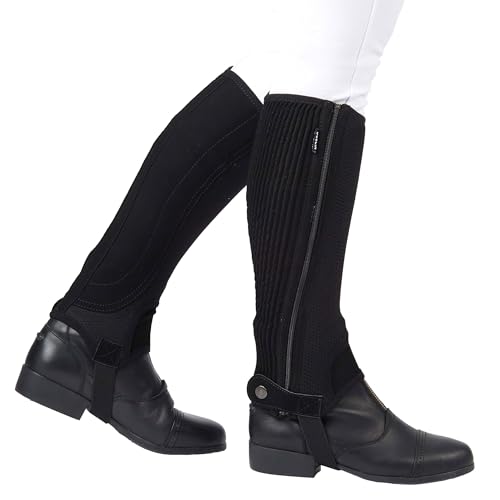
Breathable mesh construction, machine washable, zip closure. Built for summer barn conditions where a synthetic leather chap turns into a heat trap by lesson two.
Typically $55–$70
Check Price & AvailabilityMaterial: Breathable mesh | Closure: Side zip | Care: Machine washable
In Louisiana in July, a synthetic leather half chap is a sweat trap by the second lesson. The Dublin Easy-Care Mesh solves that problem with a breathable mesh construction that allows airflow through the lower leg — a real difference when temperatures climb past 90°F and the arena has no shade.
The mesh is durable enough for regular riding use, machine washable for easy cleanup after hot sweaty sessions, and the zip closure keeps it secure through active work. The trade-off is reduced protection compared to synthetic leather — mesh provides less barrier against stirrup leather friction — and it won’t perform well in cold or wet weather. Riders who need half chaps year-round should own two pairs: mesh for summer, synthetic or leather for autumn and winter. Pair with breathable riding tights for the best combination in heat.
Cons: Mesh provides less lower-leg protection than leather or synthetic; not suitable for cold or wet conditions.
Not ideal for: Year-round riders in variable climates — this is a summer specialist, not a do-everything chap.
→ Best half chap for warm climates and summer riding.
The one to own if you ride through Louisiana summers.
Also Read: Riding Socks: How to Choose the Right Pair
Also Read: How to Care for Leather Riding Boots and Half Chaps
Ariat vs TuffRider vs HORZE: Head-to-Head Comparison
These three brands cover the tiers most riders choose between. After 30 years fitting half chaps at the barn and watching what holds up through Louisiana heat, mud, and daily riding — the cost-per-season numbers below show where your money actually goes.
- Best long-term investment: Ariat Heritage Contour — full-grain leather pays for itself over 5 years
- Best value per season: HORZE Amara — low upfront cost, machine washable, holds up for 2–3 seasons
- Best for beginners or uncertain commitment: TuffRider Grippy Grain — lowest risk if you’re still figuring out whether half chaps are part of your regular kit
| Factor | Ariat Heritage Contour | HORZE Amara Adult | TuffRider Grippy Grain |
|---|---|---|---|
| Price range | ~$145–$165 | ~$45–$58 | Under $70 |
| Material | Full-grain leather — molds to leg, ages well | Amara synthetic — dirt-resistant, machine washable | Stretchy grain synthetic — reinforced inner leg |
| Maintenance | Monthly conditioning required; not washable | Machine washable — lowest maintenance | Wipe clean; machine wash if needed |
| Grip level | Excellent — leather grips stirrup leather well | Good — Amara provides adequate contact | Good — stretchy grain provides consistent contact |
| Expected lifespan | 5+ years with monthly conditioning | 2–3 seasons under regular use | 1–2 seasons under daily use |
| Best rider | Daily riders who want one pair that lasts | Regular riders who want low maintenance | Beginners, lesson students, budget-conscious buyers |
| Cost per season | ~$30–$35/season (5-year lifespan) | ~$20–$25/season (2.5-year lifespan) | ~$35–$70/season (1–2-year lifespan) |
| → Winner for | Longevity — best cost-per-season if you commit to conditioning | Maintenance — machine washable, lowest effort ownership | First pair — lowest financial risk for new or casual riders |
- Ride 3+ times/week: Ariat Heritage Contour — leather quality pays for itself over 5 years
- Ride 1–2 times/week: HORZE Amara — machine washable, low maintenance, right price
- First time trying half chaps: TuffRider Grippy Grain — lowest-risk first pair under $70
- Wide calves or failed fit history: Ovation EquiStretch II — 30+ sizing combinations
- Riding in heat or summer: Dublin Easy-Care Mesh — the only breathable option
- Buying for kids: TuffRider Children’s Washable — machine washable, right price for growing feet
Best Half Chaps for Beginners
For a first pair of half chaps, the decision comes down to one question: are you pairing them with paddock boots you already own, or buying both together? If buying both at once, spend more on the boots — boots determine safety and stirrup control. The half chaps are the add-on. Either way, measure your calf circumference before ordering anything.
For adult beginners, the HORZE Amara is the recommendation — machine washable, accurate sizing, and low enough price that if you discover the fit isn’t right after measuring, the cost of a replacement isn’t painful. For anyone who already owns paddock boots and is adding half chaps, the TuffRider Grippy Grain is the practical next step under $70.
For children in lessons, the TuffRider Children’s Washable handles everything a weekly lesson rider needs without overcomplicating the purchase. Pair with the right paddock boots and your child has a complete, safe lower-leg setup for considerably less than a pair of tall boots.
How to Measure for Half Chaps
Half chap sizing fails riders more than any other equestrian gear purchase — not because the products are poorly made, but because most buyers measure only one dimension when two are required. Calf circumference and height are both essential. Here is the two-measurement system that eliminates guesswork.
Measurement 1: Calf Circumference
This is the critical measurement. Sit in a chair with your knee bent at 90 degrees and your foot flat on the floor — the position that mimics your leg in the stirrup. Using a soft cloth tape measure, wrap it around the widest part of your calf. Do not flex the muscle. Record the measurement in inches.
This measurement determines whether the half chap will actually close and sit flush against your leg. A chap sized too small in the calf will gap at the top no matter how you adjust it. A chap sized too large will rotate, slip, or bunch. There is no workaround for a calf circumference mismatch.
Measurement 2: Height
Stand on a flat surface in the paddock boots you will pair with the half chap. Measure from the top of your paddock boot (or the floor of your ankle bone if measuring without boots) to just below the back of your knee — the point where your leg bends when you sit. This determines how tall the half chap needs to be. Most adult riders need a “tall” or “regular” height half chap, which covers the full calf. Short half chaps that end mid-calf are available but suit very few riders and provide limited lower-leg protection.
Using the Size Chart
Cross-reference both measurements against the brand’s chart — not a generic chart, the specific brand’s chart for that specific product. Different brands use different sizing systems, and a size Medium in one brand may be two sizes different from a Medium in another. The HORZE Amara includes its size chart in the product images on Amazon. Ariat publishes its size chart on their website. For Ovation EquiStretch II, the combination sizing system means selecting a height category and a calf category separately. Follow the same careful approach you’d apply to fitting riding boots — precision at the measuring stage prevents the cost of ordering the wrong size.
Half Chaps vs Tall Boots
The most common question from riders moving from lessons to more serious training: is it time to buy tall boots, or do half chaps still make sense? The answer depends on what you’re doing, not how long you’ve been riding.
Tall riding boots provide marginally more lower-leg contact and a cleaner line in the stirrup for disciplines like dressage and show jumping where leg position is evaluated. They protect the full leg from thigh to ankle, which matters in cross-country and eventing. And they’re required for most formal competition. For everything else — daily training, lessons, trail riding, barn work — a well-fitted paddock boot and half chap combination delivers the same function at significantly lower cost and maintenance.
How to Choose Half Chaps
1. Measure Before You Order — Both Dimensions
Calf circumference and height are both required measurements. Calf circumference is the critical one — it determines whether the chap closes and stays put. Height determines where it ends. Both must match the brand’s published size chart, and no other step matters until you’ve done this correctly.
If you are competing in a USDF event, you can review the official competition requirements to ensure your tack and equipment meet current standards.
2. Match the Material to Your Use
Full-grain leather is the best long-term choice for daily riders who will condition it consistently. Synthetic materials (Amara, equileather, grain synthetic) are more practical for riders who want easy care, machine washability, or lower upfront cost. Mesh is exclusively for warm weather. Understanding the tradeoffs in leather types and synthetic alternatives helps frame this decision before you buy.
3. Check Zipper Quality
The zipper fails before the chap body does on most synthetic half chaps. YKK zippers outlast generic hardware significantly — the Heritage Contour and the HORZE Amara both use YKK. On budget options where the zipper is unbranded, the realistic lifespan under daily use is one to two seasons. Factor that into the cost-per-season calculation before choosing the cheapest option available.
4. Fit to the Boot, Not Just the Leg
A half chap should cover the top of the paddock boot with a slight overlap — typically a half inch to an inch over the boot shaft. If it gaps at the ankle where it meets the boot, the half chap is either too short in height or too loose in calf circumference. If it bunches at the ankle, the height is too long for your leg. Fitting the boot and half chap together, as a system, is covered in detail at fitting half chaps to your paddock boots — read that before purchasing if you’re buying both at once.
5. Ask Your Instructor
Your instructor has watched students in every half chap available and knows which sizing runs large, which brands hold up through their specific lesson program, and whether your discipline has preferences around material or cut. Ariat is the standard recommendation at most English barn programs. For western riders and trail riders, half chaps are less common — a conversation with your instructor about whether you need them at all is worth having before purchasing.
Common Mistakes to Avoid
- Sizing by height alone: Calf circumference determines fit. A tall rider with wide calves will never get a correct fit from a chap chosen by height only. Measure both dimensions every time.
- Buying mesh for cold weather: Breathable mesh is a warm-season product. Wearing it in winter provides almost no protection or warmth — it belongs in the summer barn bag, not the winter one.
- Expecting machine washability from leather: Full-grain leather half chaps (Ariat) are not machine washable. Putting them in a washing machine destroys the leather. Wipe clean with a damp cloth only.
- Ignoring zipper quality: The zipper fails before the material does on most budget half chaps. Generic zippers on sub-$40 options often fail within a season under daily use. YKK zippers are worth paying for.
- Not pairing with the right paddock boot height: The half chap strap passes under the boot sole. If the boot shaft is very high, some half chap styles will sit too low on the leg and gap at the ankle. Fit them together, not separately.
- Assuming gapping is a defect: If your half chaps gap at the top after closing, it’s almost always a calf circumference sizing issue — not a manufacturing defect. Order the next calf size up before returning them.
FAQs on Half Chaps
What are half chaps?
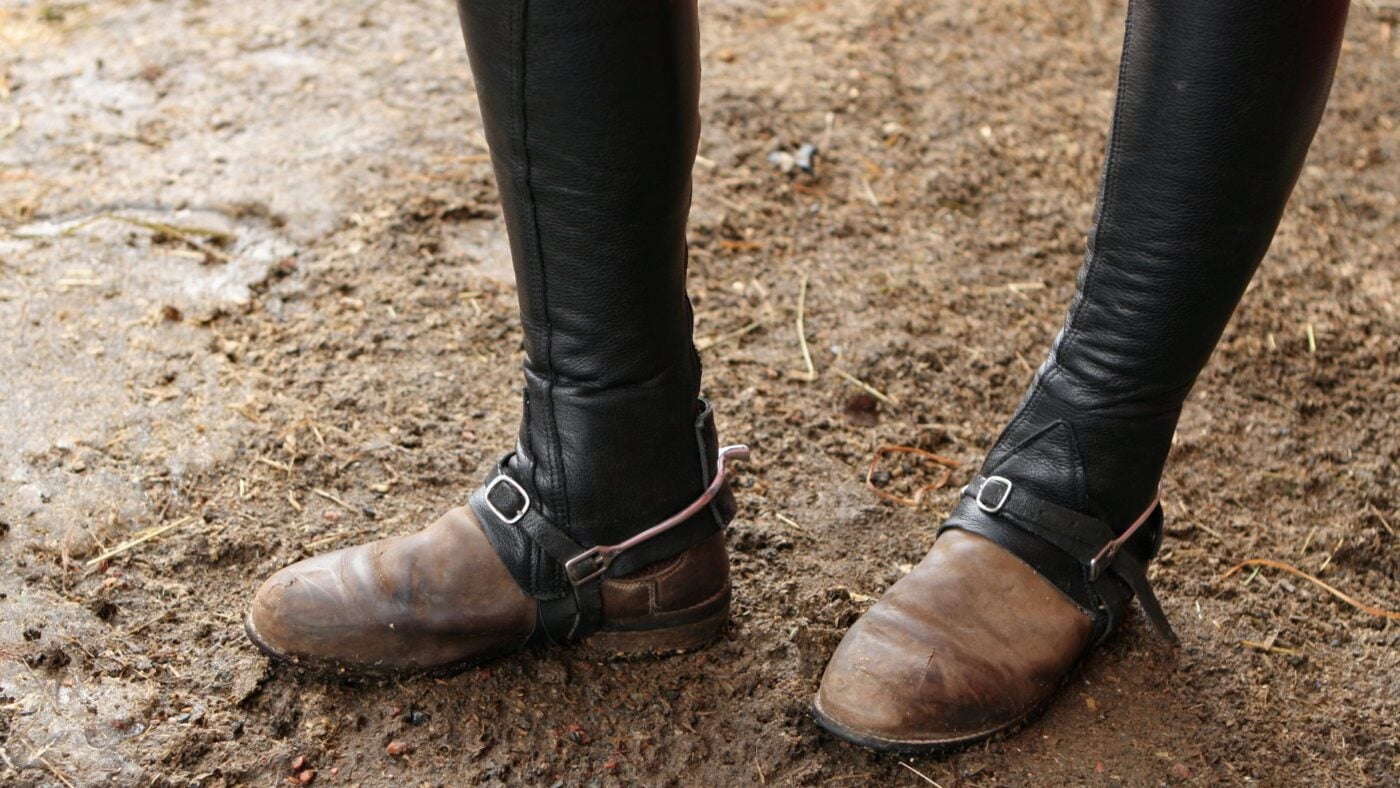
Half chaps are leg coverings worn from just above the ankle to just below the knee, paired with paddock boots. They protect the lower leg from stirrup leather friction and chafing, provide grip and contact through the calf, and — when sized correctly — create the same look and function as a tall riding boot at a fraction of the cost. They attach over the paddock boot with a strap under the boot and zip up the outer calf.
How do you size half chaps?
Two measurements are required: calf circumference (measured at the widest point of the calf with the knee bent at 90 degrees) and height (measured from the top of the paddock boot to just below the back of the knee). Cross-reference both measurements against the brand’s specific size chart — not a generic chart. Different brands use different systems; a medium in one brand may be a large in another. Never rely on general body size or clothing size to determine half chap size.
Do half chaps go over or under riding pants?
Half chaps go over riding pants, breeches, or tights — worn on the outside of the leg. The pant leg sits beneath the half chap, which reduces bunching and keeps the chap flush against the leg. Wearing smooth, fitted breeches or riding tights underneath produces the best result. Jeans work for casual trail riding but can create friction points under the chap over time.
Can you ride without half chaps?
Yes — paddock boots are safe and fully functional for riding without half chaps. Half chaps become worth adding when you want lower-leg protection from stirrup leather rub, additional calf grip for disciplines like dressage or jumping, a cleaner leg line for more structured riding, or the visual look of a tall boot without the cost. For beginner lessons, paddock boots alone are appropriate. Half chaps are an addition, not a requirement.
How do you clean half chaps?
Cleaning depends on the material. Leather half chaps (Ariat Heritage Contour) should be wiped clean with a damp cloth and conditioned monthly — conditioning monthly is what makes the 5-year lifespan realistic. Synthetic leather (TuffRider, HORZE Amara) wipes clean easily and the HORZE can go in the washing machine. Mesh half chaps (Dublin Easy-Care) are fully machine washable. Never machine wash leather; never put any half chap in a dryer regardless of material.
What is the difference between half chaps and tall boots?
Tall riding boots cover the entire lower leg from ankle to knee in a single piece. Half chaps cover the same area but are paired with a separate paddock boot — two pieces together. Tall boots provide a marginally cleaner leg line and are required for formal competition. Half chaps paired with quality paddock boots deliver near-identical function for daily training, are easier to fit, easier to maintain, and cost less overall when purchased at comparable quality levels.
Are half chaps worth it for beginners?
Yes, but not immediately necessary. A beginner rider’s first priority is a safe, properly fitted paddock boot. Once you’re riding consistently — two or more times per week — adding half chaps for lower-leg protection and grip makes a noticeable difference in comfort and control. The HORZE Amara or TuffRider Grippy Grain is the right starting point: low cost, low maintenance, and enough function to confirm that half chaps work for your riding before investing in leather.
How long do half chaps last?
Full-grain leather half chaps conditioned monthly last 5 or more years. Synthetic half chaps (HORZE Amara, TuffRider) typically last 2–3 seasons under regular use. The zipper usually fails before the material does on synthetic chaps — YKK zippers outlast generic hardware by a significant margin. Mesh half chaps last 1–2 seasons depending on washing frequency.
Do half chaps work with any paddock boot?
Half chaps are designed to pair with paddock boots — any brand’s paddock boot works with any brand’s half chap. The key is that the half chap strap passes under the boot sole, holding the bottom of the chap in place, and the chap body overlaps the top of the boot by half an inch to an inch. If the boot has a very high ankle shaft, some half chaps may sit too low on the leg — check the height measurement against your specific boot before ordering.
Can half chaps be worn in hot weather?
Standard synthetic leather half chaps can become uncomfortable in high heat and humidity. The Dublin Easy-Care Mesh half chap is specifically designed for warm-weather riding — breathable mesh construction allows airflow through the lower leg. For riders in Louisiana, Texas, Florida, or anywhere that regularly sees summer temperatures above 90°F, having a mesh pair for summer and a synthetic or leather pair for cooler months is the practical approach.
How do I know if my half chaps fit correctly?
A correctly fitting half chap closes fully without gapping at the top or pulling at the calf. When standing, it should sit flush against the leg with about half an inch to one inch overlapping the top of the paddock boot. When you sit in the saddle with your knee bent, the chap should not pull down, rotate, or bunch at the ankle. If it rotates outward when you ride, the calf sizing is too large. If it gaps at the top despite correct calf measurements, the height may be too short for your leg.
Are half chaps worth it?
Yes for riders who ride twice a week or more. Once stirrup leather friction becomes a recurring problem — inner-leg soreness, redness, or breeches twisting under the leg — half chaps solve it permanently. The HORZE Amara costs $45-55 and lasts 2-3 seasons; the math resolves itself quickly. For very casual riders who ride once a month, paddock boots alone are fine and the investment may not be justified.
- Best overall: Ariat Heritage Contour — full-grain leather, 5+ year lifespan
- Best value: HORZE Amara Adult — machine washable, accurate sizing, $45–55
- Best budget adult: TuffRider Grippy Grain — reinforced inner leg, under $70
- Best for wide calves: Ovation EquiStretch II — 30+ sizing combinations
- Best kids’: TuffRider Children’s Washable — machine washable, youth sizing
- Best entry-level: Saxon Adult Equileather — lowest adult price, basic function
- Best hot weather: Dublin Easy-Care Mesh — breathable, machine washable
Final Recommendation
The decision is clear for most riders. For anyone committing to regular riding — two or more sessions per week — the Ariat Heritage Contour is the long-term answer: full-grain leather, stretch gore panel, YKK zipper with keeper, and a track record of 5+ year lifespans from riders who’ve conditioned them consistently. For everyone else, the HORZE Amara is the best starting point: machine washable, accurately sized, and low enough in cost that getting the fit right doesn’t require a return to be painful.
If wide calves have defeated you on previous half chap attempts, go directly to the Ovation EquiStretch II — the stretch panel and 30+ sizing combinations solve the problem that standard sizing can’t. For kids in lessons, the TuffRider Children’s Washable handles everything a young rider needs without making the purchase complicated. And for Louisiana summers and comparable heat, the Dublin Easy-Care Mesh is the only option worth considering — everything else becomes a heat problem by lesson two.
Still unsure? Start with the HORZE Amara — it’s the lowest-risk way to confirm your calf sizing and get a feel for half chaps before committing to leather. At $45–55 and machine washable, the cost of getting the size slightly wrong and replacing is minimal. Once you know what fits, upgrading to Ariat is a straightforward decision.
About Miles Henry
Racehorse Owner & Author | 30+ Years in Thoroughbred Racing
Miles Henry (legal name: William Bradley) is a professional horseman based in Folsom, Louisiana. He holds Louisiana Racing License #67012 and has spent over three decades managing Thoroughbreds at premier tracks including Fair Grounds, Delta Downs, and Evangeline Downs.
Expertise & Hands-On Experience: Beyond the track, Miles has decades of experience in specialized equine care, covering everything from hoof health and nutrition to training protocols for Quarter Horses, Friesians, and Paints. Every guide on Horse Racing Sense is rooted in this “boots-on-the-ground” perspective.
30 of their last 90 starts
Equibase Profile.

Connect with Miles: