
Last updated: October 15, 2026
A solid black horse turns heads, whether it’s a Friesian under saddle, a big draft horse in harness, or a Thoroughbred walking into the paddock. But if you’re looking for a horse that’s reliably black, breed matters, and a lot of horses that look black turn out to be dark bay or seal brown up close.
Below, I’ll explain what makes a horse truly black, then break down the breeds by type: breeds that are always or almost always black, black ponies, black draft horses, and popular breeds that come in black.
Table of Contents
What Counts as a Black Horse?
A true black horse has a black body, mane, tail, and legs, with no brown on the muzzle, flanks, or elbows. Sun and seasonal coats can give a black horse a rusty tinge, but that doesn’t change its base color. Plenty of horses look black but aren’t, so here’s how to tell them apart:
| Color | What it looks like | How to tell |
|---|---|---|
| True black | Black body, mane, tail, and legs | No brown on the muzzle, flanks, or elbows, even in bright sun |
| Seal brown | Nearly black body | Tan or brown around the muzzle, eyes, flanks, and inner legs |
| Dark bay | Very dark brown body with black points | A reddish cast shows in direct sunlight |
| Sun-faded black | Black horse bleached by sun | Coat turns rusty or brownish in summer and goes back to black after shedding |
Genetically, a true black horse has at least one E allele at the Extension gene and two recessive a alleles at the Agouti gene, written a/a, according to the UC Davis Veterinary Genetics Laboratory. Extension lets the horse produce black pigment, and Agouti decides where it goes. With a/a, black covers the whole body instead of being restricted to the mane, tail, and legs, as it is in a bay horse. Those two genes explain why black shows up in some breeds far more than others, and they’re the starting point for understanding black horse genetics, coat care, and fading.
Black Horse Breeds at a Glance
| Breed | Black coat status | Type | Origin |
|---|---|---|---|
| Friesian | Black required for studbook registration | Riding and driving | Netherlands |
| Merens | Black under the breed standard | Small riding and pack horse | Pyrenees, France |
| Murgese | Black or iron gray | Riding and light draft | Puglia, Italy |
| Kladruber | Black and gray lines | Carriage horse | Czech Republic |
| Fell Pony | Black is the predominant color | Pony | Cumbria, England |
| Dales Pony | Black is the predominant color | Pony | Northern England |
| Percheron | Black and gray | Draft | France |
| Shire | Black is a recognized color | Draft | England |
| Thoroughbred | True black is uncommon | Racing and sport | England |
| Quarter Horse, Morgan, Arabian | One of many colors | Riding | Various |
Always black describes a breed standard or registered population. A horse sold under a breed name may not meet that standard, so check the papers if color matters to you.
Breeds That Are Always or Almost Always Black

Friesian
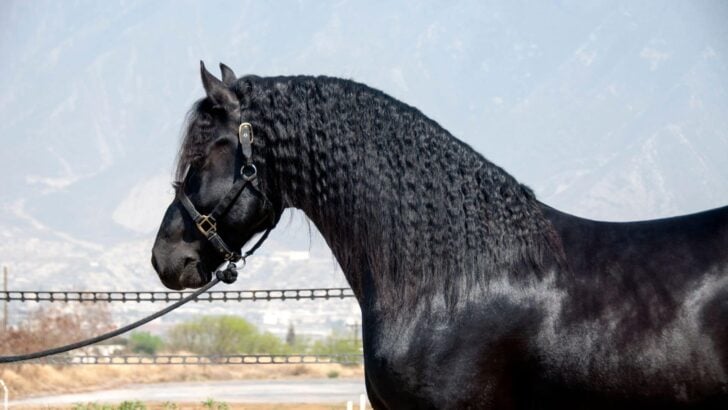
The Friesian is probably the breed most people picture when they think of a black horse. According to the Friesian Horse Association of North America, black is the only color a studbook-registered Friesian comes in. A Friesian’s coat can look brownish when it’s shedding or sun-bleached, but black is the only recognized color, and the only white marking allowed is a small star. Bred in Friesland in the Netherlands, the Friesian horse breed is known for its long, flowing mane, feathered legs, and high-stepping action in dressage and driving.
Merens
Built for the steep trails of the French Pyrenees, the Merens is a small, sturdy horse that’s black under its breed standard, with flanks that can show a slight reddish tinge. The breeding criteria say foals can be born black, silver-gray, or cafe au lait, with the foal coat disappearing after weaning, and mature horses stand roughly 145 to 155 cm, or about 14.1 to 15.1 hands, according to a European Merens breeding program. Today, Merens horses are used mostly for mountain trekking, trail riding, and driving.
Murgese
Once a farm and light draft horse on the Murge plateau of Puglia, in southern Italy, the Murgese is now used mainly for trekking and cross-country riding. Its coat is black or an iron gray with a dark head, according to an Italian rare-breeds profile of the Murgese, and males stand about 155 to 168 cm, roughly 15.1 to 16.2 hands.
Kladruber
Bred to pull the ceremonial coaches of the Habsburg court, the Kladruber was developed at the imperial stud at Kladruby nad Labem, which UNESCO added to its World Heritage List in 2019. The breed has two color lines. According to the National Stud at Kladruby nad Labem, the gray horses served the royal and imperial courts, while the black Kladrubers were used mainly by high clergy. The black line was nearly wiped out in 1931 and was rebuilt after World War II at the Slatinany stud.

Black Pony Breeds
Fell Pony
A hardy pony from the farms of Cumbria in northwest England, the Fell is predominantly black, though brown, bay, and gray are also accepted, and 14 hands is the breed’s upper height limit, according to the Fell Pony Society of North America. Fells are sure-footed ponies used for riding, driving, and trekking, and Queen Elizabeth II was the patron of the Fell Pony Society.
Dales Pony
The Dales Pony shares ancestry with the Fell but developed on the eastern side of the Pennines in northern England. Most are black, though the Dales Pony Society breed standard also accepts brown, gray, bay, and roan, with a preferred height of 14 to 14.2 hands. Dales were once used to haul lead ore and work small farms, and they’re strong ponies for their size.
Black Draft Horse Breeds

If you’re looking for a black draft horse, start with the Percheron and Shire. Several other draft horse breeds can be black, but those two give you the best odds.
Percheron
The Percheron comes from the old Perche province of western France and is primarily black or gray, according to the Cooperative Extension horse program. Percherons have a long history as medieval warhorses and farm horses, and they’re still popular for driving, riding, and as police horse breeds.
Shire
Under the Shire Horse Society breed standard, stallions must be black, brown, bay, or gray and stand at least 17 hands at maturity, while mares can also be roan and must stand at least 16 hands. A black Shire with white feathering is a classic look.

Clydesdale and Belgian
Clydesdales are best known as bay with white feathering, and Belgians are usually chestnut or sorrel, but both breeds occasionally produce black horses.
Popular Breeds That Come in Black
Black is one of several colors in these breeds, and it’s uncommon in some of them.
Thoroughbred
True black is one of the rarer colors in the Thoroughbred breed. Black is its own category among the seven Thoroughbred colors the Jockey Club recognizes, separate from dark bay or brown, and that’s where many black-looking racehorses actually end up. A Thoroughbred that looks black in the barn often shows brown around the muzzle and flanks in bright sun, which makes it dark bay or brown on its papers.

Quarter Horse
The American Quarter Horse comes in nearly every solid color, including black. You’ll see black Quarter Horses in everything from racing and barrel racing to ranch work and trail riding.
Morgan
The Morgan is a compact, versatile American breed that comes in black, bay, chestnut, and other colors. It’s used for everything from trail riding to driving and the show ring.

Arabian
The Arabian horse comes in gray, bay, chestnut, and black, and a black Arabian’s dark coat makes its refined head and high tail carriage stand out even more.
Andalusian
Most Andalusian horses are gray, but black and bay do occur. Black Andalusians are less common than gray ones.
Beyond these, black also shows up regularly in American Saddlebreds, Standardbreds, Tennessee Walking Horses, and Mustangs. In any breed, check the muzzle and flanks before calling a horse black, since seal brown and dark bay can be easy to mistake for black.
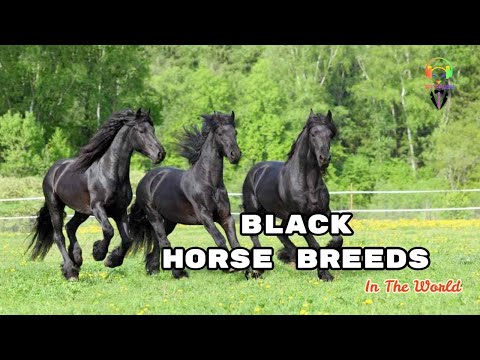
If you want a horse bred to be black, start with a Friesian or Merens. If you have another breed in mind, black may still be an option, but check the individual horse’s coat and registration papers. A horse that looks black in a barn or a photograph may turn out to be dark bay or seal brown in daylight.
About Miles Henry
Racehorse Owner & Author | 30+ Years in Thoroughbred Racing
Miles Henry (legal name: William Bradley) is a professional horseman based in Folsom, Louisiana. He holds Louisiana Racing License #67012 and has spent over three decades managing Thoroughbreds at premier tracks including Fair Grounds, Delta Downs, and Evangeline Downs.
Expertise & Hands-On Experience: Beyond the track, Miles has decades of experience in specialized equine care, covering everything from hoof health and nutrition to training protocols for Quarter Horses, Friesians, and Paints. Every guide on Horse Racing Sense is rooted in this “boots-on-the-ground” perspective.
30 of their last 90 starts
Equibase Profile.

Connect with Miles: