
Last updated: April 22, 2026
Any links on this page that lead to products on Amazon are affiliate links and I earn a commission if you make a purchase. Thanks in advance – I really appreciate it!
This guide draws on 30+ years of breeding and raising Thoroughbreds in Louisiana, including managing mares through foaling, raising foals from first breath to yearling, and handling the full spectrum of newborn health emergencies. I am not a veterinarian. Foal care decisions — particularly in the first 24 hours and around vaccination schedules — should always be made in partnership with a licensed equine veterinarian. All protocols in this guide are grounded in current AAEP guidelines, with my field experience layered in.

Foal care in the first year is the most medically intense and developmentally critical stage of a horse’s life. Get it right, and you build a foundation that lasts 20+ years. Get it wrong in the first 24 hours, and no amount of care later can fully undo the damage.
I’ve foaled out mares on cold January nights and hot, humid Louisiana spring mornings. Some foals come out textbook-perfect. Others need immediate veterinary help. What experience teaches you quickly is this: preparation and a clear protocol matter more than anything else.
This guide walks you through that protocol — newborn care, colostrum, early handling, vaccination, weaning, nutrition, and the health problems most likely to catch you off guard in year one.
- First 2 hours: Stand, nurse, and ingest colostrum — critical window for immunity
- First 24 hours: Vet exam, IgG test, navel care, and confirm manure passage
- Months 1–3: Nursing, daily handling, halter introduction, and turnout
- Months 4–6: Start vaccines, introduce creep feed, begin weaning prep
- Months 5–6: Weaning — gradual or abrupt, consistency matters more than method
- Months 6–12: Complete vaccines, establish farrier schedule, reinforce ground manners
- Key risks: Passive transfer failure, meconium impaction, rhodococcus, developmental orthopedic disease (DOD)
Table of Contents
The First 24 Hours: What to Monitor and When to Call Your Vet
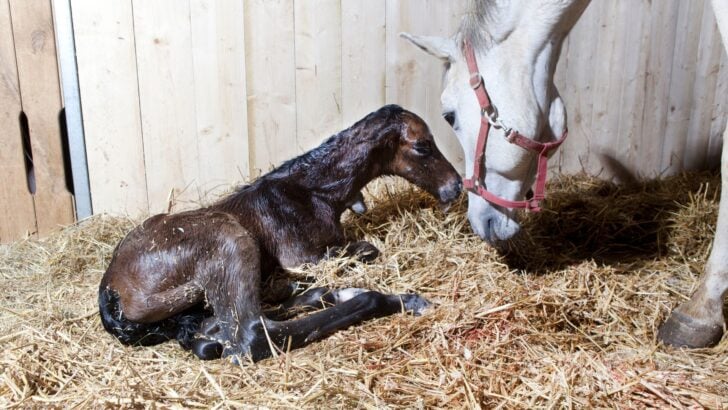
The first 24 hours of a foal’s life involve more critical decision points than any other 24-hour window in the entire first year. Most healthy foals clear these milestones without intervention. But the foals that don’t — and don’t get help promptly — often don’t survive or don’t recover fully. Know the timeline cold.
| Milestone | Normal Timing | Action if Missed |
|---|---|---|
| Stands on own | Within 1 hour of birth | Assist gently; call vet if not standing by 2 hours |
| Nurses (first colostrum) | Within 2 hours of birth | Milk mare and bottle/tube feed; call vet immediately |
| Mare passes placenta | Within 3 hours of foaling | Retained placenta is a veterinary emergency — call at 3 hours |
| Passes meconium (first stool) | Within 3–6 hours of birth | Enema (warm soapy water) if straining; call vet if no passage by 8 hours |
| Vet exam and IgG test | 12–24 hours post-birth | IgG < 400 mg/dL = failure of passive transfer; plasma transfusion may be needed |
| Navel (umbilical) dipped | Within 1 hour of birth, repeated 3–4× in first 48 hours | Use 0.5% chlorhexidine solution; do not use strong iodine — it can damage tissue |
The 1-2-3 rule: stand within 1 hour, nurse within 2 hours, mare passes placenta within 3 hours. Any deviation warrants a call to your vet. Source: AAEP Foaling Guidelines.
Navel Care
The umbilical stump is the foal’s primary infection entry point in its first days of life. Navel ill — a bacterial infection that enters through an improperly treated navel — can spread to joints, causing septic arthritis that permanently cripples a foal. This is entirely preventable with proper navel care starting immediately after the cord breaks.
- Dip the navel in a 0.5% chlorhexidine solution (diluted from 2% stock) — not the old-school strong iodine, which has been shown to cause tissue damage and delayed healing
- Repeat dipping 3–4 times per day for the first 2–3 days until the stump dries and shrivels
- Monitor the stump daily for swelling, heat, discharge, or persistent wetness — any of these warrant a vet call
- The stump should dry and fall off within 1–2 weeks; a moist or swollen stump after day 3 is abnormal
Meconium Impaction
Meconium is the dark, tar-like fecal material that accumulates in the foal’s intestines before birth. It must pass in the first few hours of life. Colt foals are more prone to meconium impaction than fillies. Signs include straining, tail flagging, lying down and getting up repeatedly, and reduced nursing interest. A warm-water enema administered gently with a soft rubber tube resolves most cases — have one ready before the foal is born.
Miles’ Take — Have your vet on speed dial before the foal hits the ground: I always schedule a foal check with my vet 24–48 hours after the birth — not if I think there’s a problem, but as a routine. The IgG test alone is worth the farm call. I’ve had foals that nursed actively and still came back with borderline passive transfer — you can’t tell by watching. The $75–$100 farm call is cheap compared to treating a foal with septic arthritis at $5,000+.
Call your vet immediately if:
- The foal has not stood within 1 hour of birth
- The foal has not nursed within 2 hours
- You are unsure if colostrum was consumed or the mare has poor milk production
- No manure (meconium) has passed within 8 hours
- The foal appears weak, lethargic, or cannot stay standing
- Labored breathing, coughing, or nasal discharge is present
- The navel is swollen, bleeding, or leaking fluid
- The mare rejects the foal or prevents nursing
- The foal stops nursing or suddenly becomes less active
Bottom line: If something feels off in the first 24 hours, don’t wait. Early intervention is the difference between a routine fix and a life-threatening problem.
Colostrum and Passive Immunity Transfer
Foals are born with essentially no functional immune system. They depend entirely on antibodies (immunoglobulins, specifically IgG) absorbed from the mare’s colostrum during the first 12–24 hours of life. This is called passive transfer, and it is the single most important health event in the foal’s first year. Without adequate passive transfer, foals are highly susceptible to life-threatening infections in their first weeks of life.
The Colostrum Absorption Window
The foal’s gut can absorb intact IgG molecules for only the first 18–24 hours of life. After that window closes, antibodies in milk are digested rather than absorbed into the bloodstream. The earlier the foal nurses, the higher its IgG levels will be — which is why getting a foal nursing within 2 hours is a medical priority, not just a management preference.
- Colostrum quality varies by mare — mares that “run milk” before foaling (dripping or streaming milk in the days leading up to birth) may have depleted their best colostrum before the foal arrives
- If a mare has run milk heavily pre-foaling, collect and freeze colostrum from a donor mare in advance, or have commercial equine plasma available as a backup
- A Brix refractometer can test colostrum quality — a reading of ≥23% Brix indicates adequate IgG concentration; below 20% is considered poor quality
- IgG testing of the foal’s blood at 12–24 hours is the only reliable way to confirm passive transfer success: IgG ≥800 mg/dL = adequate; 400–800 = partial; <400 = failure requiring plasma transfusion
Miles’ Take — The most common early mistake I see: Waiting too long to confirm the foal has actually nursed and taken in adequate colostrum. A foal that is up, moving, and attempting to nurse looks fine — but attempting isn’t the same as successfully ingesting enough. If you have any doubt, milk the mare and check colostrum quality with a Brix refractometer. When it comes to passive transfer, assume it hasn’t happened until the IgG test at 12–24 hours confirms it has.
⚠ Failure of Passive Transfer (FPT) Warning: FPT is the leading cause of infectious disease and death in foals under 30 days old. A foal with FPT may appear perfectly normal for days before rapidly deteriorating. IgG testing at 12–24 hours is the only way to know — do not skip this test. Foals with IgG <400 mg/dL need IV plasma transfusion administered by your veterinarian within the absorption window for best results.
Nursing: Months 1 Through 4

A healthy foal nurses roughly every 30 minutes in the first days of life — this frequent nursing is normal and necessary. Mare’s milk provides complete nutrition through approximately 8–10 weeks of age, after which the foal’s caloric and nutritional demands begin to exceed what milk alone can supply. From that point forward, supplemental feed becomes increasingly important.
Monitoring Nursing Frequency and Mare Milk Production
- Foals nurse 3–7 times per hour in the first week — if you observe fewer than 3 nursing attempts per hour, investigate; a foal that has stopped nursing is a medical emergency
- Check the mare’s udder: a consistently full, tight udder when the foal appears hungry suggests the foal is not successfully nursing or the mare is uncomfortable letting it nurse
- Mare milk production peaks at 6–8 weeks postpartum; mares producing 3–4% of their body weight in milk daily are within normal range for a light horse breed
- A foal that is nursing well gains approximately 2–3 lbs per day in the first month — weight tracking with a weight tape every 2 weeks is a simple way to confirm adequate nutrition
Orphan Foals and Nurse Mares
If a mare dies at foaling or rejects her foal, the options are a nurse mare, a foal-raising dairy goat (as a temporary bridge), or hand-raising on commercial milk replacer. Nurse mares are by far the best option for a Thoroughbred foal — the bonding, nutritional match, and normal behavioral development that comes from a real mare relationship cannot be replicated by bucket feeding. Nurse mare farms in Louisiana and the surrounding Southeast are available through your vet network or breed association contacts.
- If hand-raising on milk replacer, feed warm (body temperature) formula every 1–2 hours for the first week, then gradually extend to every 2–3 hours by week 3
- Introduce a companion animal early — a goat, calm gelding, or even a dog — hand-raised foals without equine companionship develop behavioral problems
- Begin introducing foal starter/creep feed by 2–3 weeks of age for orphan foals to support earlier solid food transition
Early Handling and Halter Training
The earlier you handle a foal, the easier everything is for the rest of that horse’s life. A foal imprinted and handled gently in the first days of life will be measurably easier to halter, lead, vet, and shoe than a foal left unhandled until weaning. This is not a racing-only principle — it applies to every discipline and breed.
Imprint Training (First 24–72 Hours)
Imprint training — systematic desensitization to human touch and common stimuli in the first hours and days of life — was popularized by Dr. Robert Miller and is widely used in Thoroughbred breeding operations. The basic principle is that a foal’s brain is uniquely receptive to learning in the first hours post-birth, forming permanent “this is safe” associations with stimuli it encounters repeatedly and gently.
- Handle the foal’s ears, muzzle, legs, and hooves gently within the first few hours — repeat each touch until the foal stops resisting before moving to the next area
- Touch the areas that will be relevant throughout the horse’s life: girth area, flanks, poll, inside of ears, nostrils, mouth
- Always work with the mare present and calm — a stressed mare makes imprinting more difficult and can interfere aggressively
- Keep early sessions short (15–20 minutes maximum) — the foal needs to nurse, rest, and bond with its dam between handling sessions
Halter Introduction: Week 1–2
A properly fitted foal halter should go on in the first week of life. A halter that fits correctly in week one will need to be replaced by 4–6 weeks — foals grow that fast. Never leave a halter on an unattended foal in a pasture or paddock; foals catch halters on fence posts, feeders, and their own hind feet with deadly results.
- Introduce the halter over several sessions — let the foal smell it, then rub it on its face and ears before actually putting it on
- Begin leading with pressure-release on the lead rope: apply gentle pressure, release the instant the foal steps forward or yields — this is the foundation of all future ground training
- Practice picking up all four feet by week 2 — the farrier will be there by 4 weeks and a foal that has been handled for hoof picking is much easier and safer to trim
- Tie training should not begin until the foal is reliably leading with confidence — tying a foal that hasn’t learned to yield to pressure can result in a broken neck if it pulls back hard
Miles’ Take — Handle early, handle consistently: I’ve raised foals from birth and spent years around large Thoroughbred breeding operations in Louisiana. One thing is consistent everywhere: foals handled correctly from day one — touched, haltered, led, and exposed to normal barn activity — are easier to manage at every stage. The ones left alone until weaning are harder to start, harder to shoe, harder to vet, and harder to handle for the rest of their lives. Even 15–20 minutes a day in those first couple of weeks makes a lasting difference.
Foal Vaccination Schedule: AAEP Guidelines for Year One
The AAEP vaccination guidelines for foals account for one critical variable that doesn’t apply to adult horses: maternal antibody interference. Foals born to properly vaccinated mares carry maternal IgG antibodies that protect them in early life — but those same antibodies neutralize vaccine antigens if vaccination begins too early. The result is a foal that receives vaccines but builds no lasting immunity.
To see how these foal schedules fit into a complete vaccination program, see my horse vaccination schedule guide.
Core Vaccine Schedule — Foals from Vaccinated Mares
| Vaccine | 1st Dose | 2nd Dose | 3rd Dose | Louisiana Notes |
|---|---|---|---|---|
| EEE / WEE / Tetanus | 4–5 months | 4–6 weeks after 1st | 10–12 months | Southeast foals: may begin at 2–3 months due to early mosquito season per AAEP regional guidance |
| West Nile Virus | 4–5 months | 4–6 weeks after 1st | 10–12 months | Same early-start exception applies for Gulf Coast foals; WNV transmission begins in March in Louisiana |
| Rabies | 6 months | 4–6 weeks after 1st | Annual thereafter | Wildlife contact is high in rural Louisiana — do not defer this vaccine |
| EHV-1/4 (Rhinopneumonitis) | 4–6 months | 4–6 weeks after 1st | 10–12 months | Recommended for all foals; critical for any foal that will be in a group setting or travel to events |
| Equine Influenza | 6 months (inactivated) | 3–4 weeks after 1st | 10–12 months | Intranasal MLV (FluAvert) not labeled for foals under 11 months — use inactivated for the primary series |
Source: AAEP Vaccination Guidelines and AAEP Foal Vaccination Chart. Schedules are for foals from properly vaccinated mares. Confirm all doses with your veterinarian and follow current label directions.
Foals from Unvaccinated or Unknown-History Mares
Foals born to mares with unknown vaccination history or unvaccinated mares carry lower maternal antibody levels and can begin their vaccine series earlier without interference. The trade-off is that they also have less protection from birth, making the first weeks of life higher risk.
- Begin the EEE/WEE/Tetanus and WNV series at 3–4 months of age (instead of 4–5 months) for foals from unvaccinated mares.
- The total series remains 3 doses;timing is moved earlier to close the immunity gap quickly.
- In Louisiana, where mosquito season starts early, these foals should be on the earlier end of every vaccine window given the AAEP’s explicit regional guidance for the Southeast.
Risk-Based Vaccines for Louisiana Foals
| Vaccine | Starting Age | Gulf Coast Priority |
|---|---|---|
| Potomac Horse Fever | 5 months (2-dose series, 3–4 weeks apart) | High — bayou, river, and creek-bottom properties; all south Louisiana foals |
| Botulism | 2–3 months (3-dose series, 4 weeks apart) | Moderate — foals on round-bale properties; “shaker foal syndrome” is Botulism type B |
| Strangles | 4–6 months (killed injectable); 11+ months (intranasal MLV) | Moderate–High for foals that will go to sales, events, or shared boarding |
| Leptospirosis | 6 months (2-dose series, 3–4 weeks apart) | Moderate — flooding and standing water common in south Louisiana; Lepto is spread by wildlife urine in water sources |
Risk-based vaccines should be discussed with your equine vet annually. Discuss Potomac Horse Fever vaccination with your vet before the foal’s first spring if you are anywhere near standing water in Louisiana.
Weaning: Timing, Methods, and Stress Management
Weaning is one of the highest-stress events in a foal’s first year — for the foal and the mare. Done correctly, it is a brief period of adjustment that most foals recover from within a week. Done poorly, it triggers behavioral problems, growth setbacks, and health issues that can persist for months. The timing and method both matter.
When to Wean
The AAEP and most equine veterinarians recommend weaning between 4 and 6 months of age. Earlier weaning (before 4 months) is associated with increased behavioral problems and poorer growth outcomes. Later weaning (after 6 months) is not harmful but becomes increasingly difficult as the foal grows stronger and more attached.
- The foal should be eating solid feed (hay and creep grain) reliably before weaning begins — a foal that is still nutritionally dependent on milk is not ready to wean
- Wean when the foal is healthy, not during a period of illness, vaccine recovery, or environmental stress (extreme heat, new facility, new herd)
- In Louisiana, avoid weaning in peak summer heat (July–August) if possible — heat stress compounds the nutritional and behavioral stress of weaning
- Racehorses are commonly weaned earlier (3–4 months) in commercial operations, but earlier weaning requires more aggressive nutritional support and monitoring
Weaning Methods
| Method | How It Works | Pros | Cons |
|---|---|---|---|
| Abrupt / Cold Turkey | Mare and foal separated completely; no visual or physical contact | Common in commercial operations; resolves quickly (5–7 days); efficient | More stressful in the first 48–72 hours; increased calling, fence-walking, weight loss spike |
| Gradual / Progressive | Nurse time progressively reduced; mare and foal kept in adjacent paddocks with fence contact | Lower acute stress; foal maintains social comfort; mare’s milk dries more gradually | Takes 2–4 weeks; requires more management; fence-line contact can delay full adjustment |
| Paddock Weaning (Group) | Multiple foals weaned simultaneously; removed from mares and placed in a group paddock | Foal companionship reduces stress significantly; widely used on Thoroughbred farms | Requires multiple foals of similar age; higher injury risk if foals vary significantly in size |
Group weaning — where multiple foals are weaned together without mares — consistently shows the lowest stress indicators in research. For single-foal operations, abrupt weaning with a calm equine companion in the same paddock is the most practical approach.

Managing the Weaning Period
- Ensure the weaning paddock or stall is fully foal-safe: no exposed wire, no gaps the foal can put a leg through, no sharp projections at head height
- Provide a calm older companion if possible — a quiet older mare or gelding in an adjacent pen (not the dam) dramatically reduces acute stress behaviors
- Keep feed and water easily accessible; a weaning foal may not actively seek out water as it normally would — check consumption daily
- Watch for diarrhea, weight loss exceeding 5–7% of body weight, or respiratory symptoms in the 2 weeks post-weaning — immune suppression from weaning stress increases susceptibility to respiratory disease
- For the mare: restrict water and reduce feed for 2–3 days post-weaning to help dry up milk production; monitor for mastitis (hot, painful udder with thick or bloody discharge)
Foal Nutrition: Creep Feeding Through Yearling
Nutrition in the first year has a larger impact on long-term soundness than almost any other management factor. Developmental orthopedic disease (DOD) — a group of growth-related skeletal conditions including osteochondrosis (OC), physitis, and flexural limb deformities — is directly linked to both nutritional deficiencies and excesses in the first year of life. Getting the balance right matters.
AAEP Foal Nutrition Guidelines
The AAEP foal nutrition guidelines provide the following framework for feeding through the first year:
- Provide high-quality roughage (hay and pasture) free choice from the time the foal begins eating solid food
- Begin supplemental grain concentrate at weaning, or earlier if more rapid rates of gain are desired; start at 1% of body weight per day (one pound of feed per 100 lbs of body weight)
- Divide the daily grain ration into 2–3 feedings — foals have small stomachs and should not receive large single-meal grain portions
- Weigh and adjust the ration based on growth and body condition — use a weight tape every 2 weeks; overweight foals are significantly more prone to DOD
- Ensure feeds are properly balanced for calcium, phosphorus, copper, zinc, and selenium — deficiencies in trace minerals are strongly associated with OC and other developmental conditions
- Do not overfeed: the goal is steady, moderate growth — not maximum growth rate; rapid gain is the single biggest DOD risk factor
Creep Feeding: When and How
A creep feeder allows the foal to eat supplemental grain without the mare competing for the feed. By 8–10 weeks of age, mare’s milk is no longer nutritionally sufficient as the foal’s sole food source, and creep feeding bridges that gap through to weaning. The foal will self-regulate consumption early on, eating small amounts frequently.
- Introduce creep feed at 8–10 weeks using a foal-specific or weanling formulation with correct calcium:phosphorus ratio (1.5:1 to 2:1)
- Avoid group creep feeding if possible — individual feeding prevents dominant foals from consuming disproportionate amounts
- Remove uneaten grain between feedings to prevent spoilage and mold exposure
- In Louisiana, Alicia Bermuda hay is a good local roughage base — supplement with a commercially balanced weanling concentrate rather than trying to balance trace minerals through loose minerals alone
Post-Weaning Nutrition (Months 6–12)
| Age | Daily Hay | Daily Grain Concentrate | Notes |
|---|---|---|---|
| Weaning (5–6 months) | Free choice; 1–1.5% body weight minimum | 0.75–1% body weight; weanling feed | Transition off creep feed gradually over 2 weeks |
| 6–9 months | Free choice; good-quality grass or mixed hay | 1% body weight; 2–3 feedings per day | Monitor body condition weekly; adjust grain if ribs become visible or foal becomes chunky |
| 9–12 months (yearling) | Free choice; transition to yearling hay schedule | 0.75–1% body weight; yearling feed or continue weanling | Begin transitioning to adult feed formulation by 12 months; maintain mineral balance |
Body condition scoring (Henneke scale 4–5) is the target for growing foals. A foal at 6 on the scale is too heavy. A foal at 3 is underconditioned and needs more feed. For detailed cost breakdowns, see our cost to raise a foal guide.
Hoof Care and Farrier Schedule in Year One
Hoof care in the first year is not optional — it is developmental medicine. Foals’ hooves grow fast, and improper hoof balance in the first months of life can permanently alter the alignment of the bones and joints above the hoof. Corrective farriery for angular limb deformities (ALD) and flexural deformities is most effective the earlier it is applied — the growth plates close, and windows for correction close with them.
- First trim: 4 weeks of age. Many farriers will do a light cosmetic trim to assess hoof balance and start the foal on a schedule. This visit is also an assessment — a good farrier will flag any limb deviations that need veterinary attention
- Schedule every 4–6 weeks throughout the first year — faster than the adult 6–8 week schedule, because foal hooves grow more rapidly and imbalances develop quickly
- Angular limb deformities (toed-in, toed-out, knock knees, bow legs) are common in newborns and many self-correct in the first weeks — but deviations that don’t correct by 4–6 weeks need veterinary assessment and possibly periosteal stripping or other intervention
- Flexural deformities (contracted tendons — clubfoot) range from mild to severe; mild cases often respond to hand-walking, corrective trimming, and in some cases oxytocin or oxytetracycline treatment in the first days of life — severe cases require surgical intervention
- Pick up the foal’s feet during every handling session from week one — a foal that has had its feet picked up hundreds of times before the farrier arrives is far safer to trim than one that hasn’t
Common Foal Health Problems in the First Year
Most foals make it through their first year without serious illness — but several conditions are common enough that every foal owner needs to recognize them early. Delayed treatment of the problems below is the most preventable cause of foal death and permanent injury in year one.
| Condition | Age at Risk | Key Signs | Action |
|---|---|---|---|
| Failure of Passive Transfer (FPT) | Birth – 7 days | May appear normal; detected only by IgG blood test | Test every foal at 12–24 hours; IV plasma if IgG <400 mg/dL |
| Septicemia (Blood Infection) | Birth – 30 days | Fever, lethargy, reduced nursing, hot/swollen joints | Veterinary emergency — IV antibiotics required immediately |
| Meconium Impaction | Birth – 48 hours | Straining, tail flagging, restlessness, reduced nursing | Warm-water enema; call vet if not resolved within 2 hours of treatment |
| Navel Ill / Joint Ill | Days 1–14 | Swollen navel stump, hot painful joints, fever, lameness | Veterinary emergency — IV antibiotics; prevent with proper navel dipping from birth |
| Rhodococcus equi Pneumonia | 1–6 months | Cough, fever, rapid breathing, depression — can be insidious onset | Veterinary diagnosis (lung ultrasound); prolonged antibiotic combination therapy required |
| Foal Heat Diarrhea | 7–10 days post-birth | Loose, watery stool coinciding with mare’s first post-foaling estrus | Usually self-limiting in 3–5 days; monitor for dehydration; call vet if fever, bloody stool, or not resolving |
| Developmental Orthopedic Disease (DOD) | Months 2–12 | Swollen joints, subtle lameness, growth plate enlargement | Veterinary evaluation; nutritional correction (reduce grain, balance minerals); restrict exercise in severe cases |
| Gastric Ulcers | Months 1–12 (especially post-weaning) | Poor appetite, grinding teeth, lying on back, intermittent colic signs | Veterinary diagnosis via endoscopy; omeprazole (GastroGard) treatment; minimize weaning stress |
When in doubt, call your vet. Foals deteriorate faster than adult horses — what looks like mild illness at 8 AM can be life-threatening by afternoon. Early intervention almost always produces better outcomes.
Rhodococcus equi — The Silent Killer in Hot Climates
Rhodococcus equi is a soil bacterium that causes chronic, progressive pneumonia in foals under 6 months old. It is endemic in warm, dry, dusty environments — and increasingly prevalent in Louisiana’s hot summers. Unlike most respiratory diseases, Rhodococcus pneumonia develops slowly and insidiously, often showing few early signs until the foal’s lungs are significantly compromised.
- Monthly lung ultrasound surveillance on foals from birth to 4–5 months is standard on high-risk farms — it detects Rhodococcus abscesses before clinical signs appear
- Treatment requires prolonged dual antibiotic therapy (typically clarithromycin + rifampin, or azithromycin + rifampin) for 4–12 weeks — it is expensive but effective when caught early
- Environmental management reduces exposure: minimize dust, avoid overgrazing, rotate paddocks, keep foals away from areas where adult horses have been defecating for years (soil concentrations build up over time)
Miles’ Take — The foal that looks fine may not be fine: I’ve lost foals that were nursing well at the morning check and were in a crisis by evening. Rhodococcus in particular will fool you — these foals look okay until they don’t. Any foal that seems “off” — quieter than normal, nursing less often, breathing a little faster — gets a vet call from me. The cost of a call is nothing compared to the cost of waiting 24 hours too long.
Frequently Asked Questions About Foal Care
When should a foal have its first veterinary exam?
A foal should have its first full veterinary exam within 12–24 hours of birth. This includes a physical assessment, IgG blood test to confirm passive transfer, navel evaluation, and a baseline health check. Do not wait until the foal appears ill — the IgG test must be done within the absorption window (before 24 hours) to be actionable.
When do foals start eating grass and hay?
Foals begin showing interest in hay and pasture grass as early as 1–2 weeks of age, mimicking their dam. They start meaningfully consuming solid food by 6–8 weeks. By 8–10 weeks, mare’s milk alone is no longer sufficient, and supplemental creep feed becomes important to support growth.
What is the best age to wean a foal?
Most equine veterinarians and the AAEP recommend weaning between 4 and 6 months of age. Earlier weaning (before 4 months) is linked to increased behavioral problems. The foal should be reliably eating solid feed and in good health before weaning.
How many times a day should a foal nurse?
Newborn foals nurse every 20–30 minutes — up to 3–7 times per hour in the first days. Nursing frequency gradually decreases as the foal grows. A foal that has stopped nursing or is nursing significantly less than normal needs immediate veterinary attention.
When do foals get their first vaccines?
For foals born to properly vaccinated mares, the core vaccine series (EEE/WEE, West Nile Virus, Tetanus) begins at 4–6 months of age to avoid maternal antibody interference. Foals in the Southeastern U.S. may begin as early as 2–3 months per AAEP regional guidance. Foals from unvaccinated mares start at 3–4 months. A complete 3-dose primary series is required before annual boosters.
What is failure of passive transfer and how serious is it?
Failure of passive transfer (FPT) occurs when a foal fails to absorb enough IgG antibodies from the mare’s colostrum. IgG levels below 400 mg/dL indicate failure; 400–800 is partial. FPT leaves foals vulnerable to infections, septicemia, and joint ill in the first weeks. It is diagnosed by a blood test at 12–24 hours and treated with IV plasma transfusion by a veterinarian.
How often should a foal’s hooves be trimmed in the first year?
Foals should have their first hoof trim at about 4 weeks of age and continue on a 4–6 week farrier schedule throughout the first year. Early and regular trimming is critical to correct angular and flexural limb deformities before growth plates close.
What causes foal heat diarrhea and is it dangerous?
Foal heat diarrhea occurs around 7–10 days of age, coinciding with the mare’s first post-foaling estrus. It’s usually mild and self-limiting within 3–5 days. Seek veterinary attention if the foal has fever, bloody stool, severe dehydration, or diarrhea persists.
Can a foal be left alone with the mare in a field?
Yes — once a foal has nursed successfully, passed meconium, and been examined by a vet. Turnout in a safe, well-fenced pasture promotes movement, sunlight, and social development. Ensure no barbed wire, gaps, deep water, or toxic plants are accessible.
Sources and Further Reading
- AAEP Vaccination Guidelines — Foal Vaccination Chart (2023, updated)
- AAEP — Help Your Foal Grow with Proper Nutrition
- AAEP — Help Your Mare Have a Safe Delivery
- Merck Animal Health — AAEP Foal Vaccination Schedule (2025)
- HorsesideVetGuide — Care and Management of the Growing Foal: Newborn
About Miles Henry
Racehorse Owner & Author | 30+ Years in Thoroughbred Racing
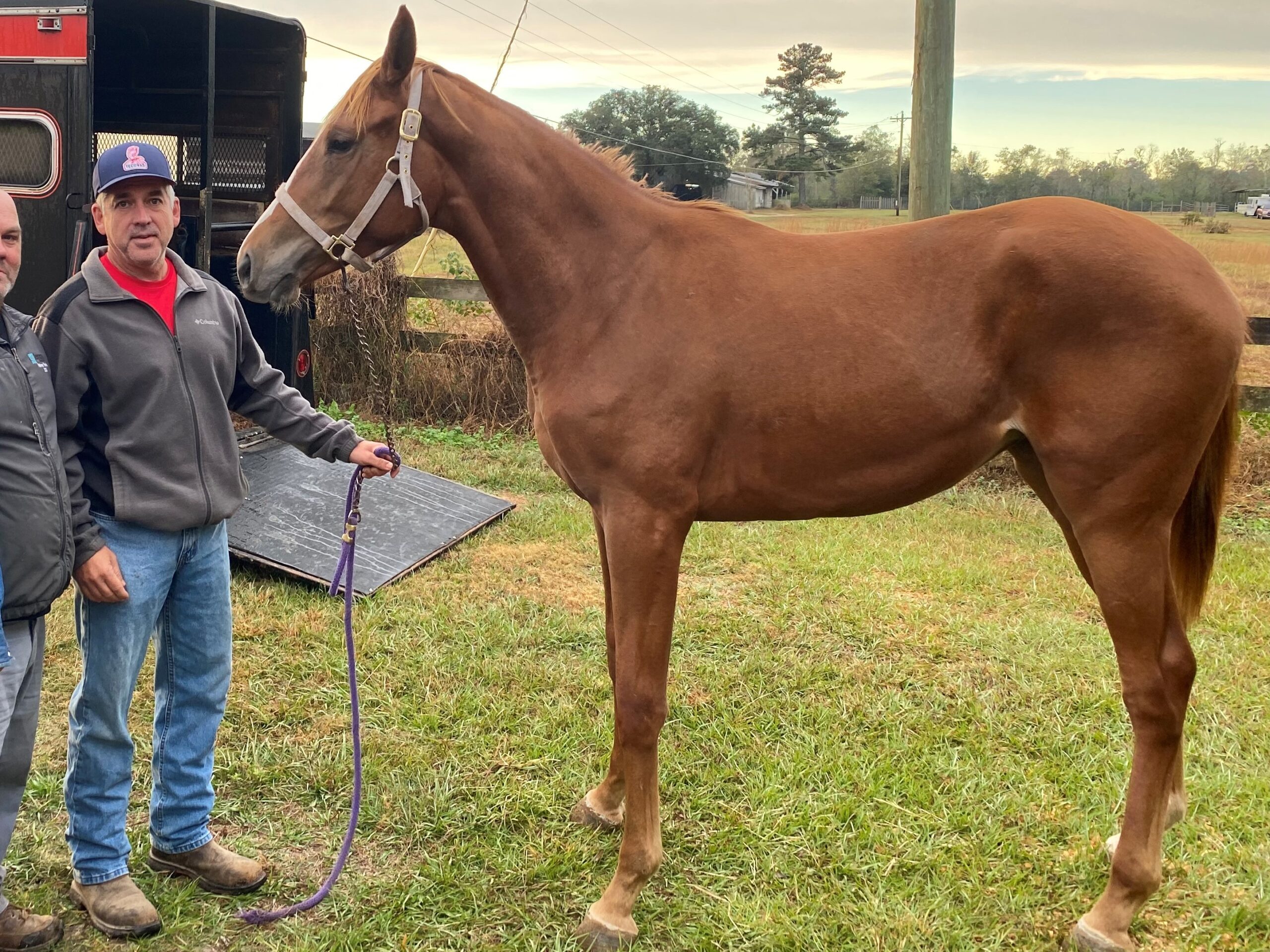
Miles Henry (legal name: William Bradley) is a professional horseman based in Folsom, Louisiana. He holds Louisiana Racing License #67012 and has spent over three decades managing Thoroughbreds at premier tracks including Fair Grounds, Delta Downs, and Evangeline Downs.
Expertise & Hands-On Experience: Beyond the track, Miles has decades of experience in specialized equine care, covering everything from hoof health and nutrition to training protocols for Quarter Horses, Friesians, and Paints. Every guide on Horse Racing Sense is rooted in this “boots-on-the-ground” perspective.
30 of their last 90 starts
Equibase Profile.

Connect with Miles: