
Last updated: April 1, 2026
Any links on this page that lead to products on Amazon are affiliate links and I earn a commission if you make a purchase. Thanks in advance – I really appreciate it!
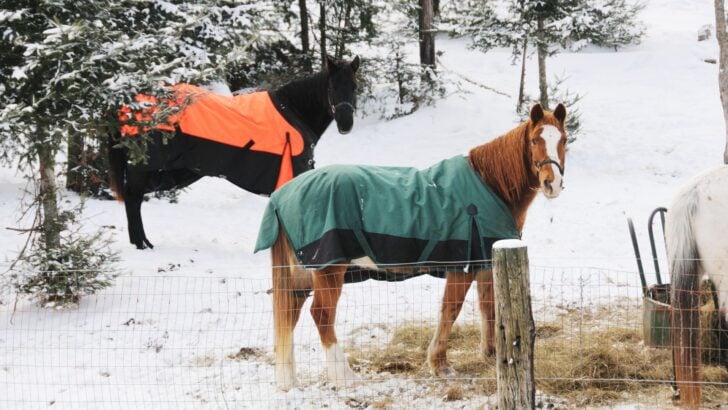
Choosing the wrong horse blanket is one of the most common — and costly — mistakes horse owners make. Too heavy and your horse sweats, risking chills, respiratory issues, and skin sores. Too light and a wet, cold night becomes a genuine health problem.
Blanketing isn’t about temperature alone — it’s about managing heat loss, moisture, and workload together. After 30 years managing racehorses in South Louisiana — where a 70°F Tuesday can turn into a 28°F Thursday overnight — I’ve made every blanketing mistake in the book so you don’t have to.
This guide gives you a complete framework for getting it right: how to choose the correct blanket weight by temperature, when turnout vs. stable blankets actually matter, how denier affects durability, and which blankets are worth buying — including the ones I’ve used on racehorses and performance horses in real Gulf Coast conditions.
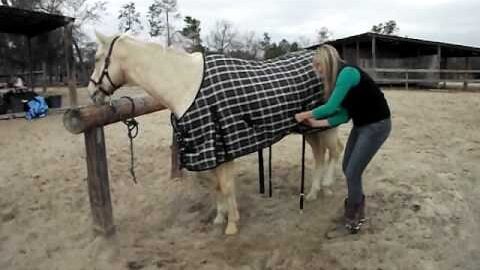
Table of Contents
When Does a Horse Need a Blanket?
Most healthy, unclipped horses with a full winter coat can tolerate temperatures as low as 18–20°F without a blanket — provided they have adequate shelter, water, and constant forage access. Horses generate significant body heat from digesting hay; keeping hay available overnight matters more than most owners realize. That said, blanketing becomes important — sometimes essential — in these situations:
| Horse Type | Blanket Needed? | Starting Temperature | Notes |
|---|---|---|---|
| Healthy adult, full coat | Usually no, down to ~20°F | Below 20°F with wind | Hay access and shelter are the priority |
| Clipped horse | Yes — always | At 50°F and below | Natural insulation removed; must blanket |
| Senior horse (15+) | Yes in most cases | At 40–45°F | Struggles to maintain body condition in cold |
| Hard keeper / thin horse | Yes | At 40–45°F | Cold stress accelerates weight loss |
| Racehorse / performance horse | Usually yes | At 45–50°F | Often clipped or thinner-coated from stall living |
| Horse without run-in shelter | Yes — turnout required | Any rain + wind below 45°F | Wet + wind = most dangerous cold combination |
Uncertain about when to blanket your horse in different climates?
Horse Blanket Weight Chart by Temperature
Blanket “weight” refers to the grams of polyfill insulation inside — not how heavy the blanket feels. A 0g sheet has no insulation; a 400g heavyweight offers serious warmth. Use this chart as your starting point, then adjust for the five variables listed below it.
| Temp (°F) | Healthy Unclipped | Senior / Thin / Hard Keeper | Clipped Horse | Key Notes |
|---|---|---|---|---|
| 50–40°F | No blanket or sheet | 50–100g light | 100–200g | Add a rain sheet if wet + windy |
| 40–30°F | Sheet or 50g | 100–200g | 200–300g | Add neck cover in driving rain |
| 30–20°F | 50–100g | 200–300g | 300–400g | Windchill pushes you one category heavier |
| 20–10°F | 100–200g | 300–400g | 400g+ or layering | Ensure constant hay and water access |
| 10–0°F | 200–300g | 400g+ or layering | 400g+ layering | Check twice daily for sweating under blanket |
| Below 0°F | 300–400g + neck cover | 400g+ layering | 400g+ layering | Monitor closely for shoulder/wither rubs |
The 5 Variables That Override the Chart
Temperature is only one input. These five variables will push you up or down a weight category every time:
- Wind: A 25-mph wind at 35°F feels like 20°F to your horse. Horses in exposed paddocks without windbreaks always need one weight category heavier.
- Rain and wet coat: A wet coat loses most of its insulating value. If your horse has no shelter from rain, prioritize a waterproof turnout regardless of temperature.
- Body condition score: A horse scoring 4 or below on the Henneke scale needs more blanket than a horse at 6+. Ribs visible = always go heavier.
- Clip level: Full clip → use the “clipped” column. Hunter clip → split the difference between clipped and unclipped. Trace clip → one weight category heavier than unclipped.
- Forage access: A horse with constant overnight hay generates 2–3°F of internal warmth from fermentation. A rationed horse needs more external insulation to compensate.
Turnout vs. Stable Blanket: Key Differences
The single most common buying mistake I see is horse owners putting a stable blanket on a horse in turnout. The difference isn’t about warmth — it’s about waterproofing and durability. A stable blanket rained on in a paddock goes from insulating blanket to water-logged cold sponge in minutes.
| Feature | Turnout Blanket | Stable Blanket |
|---|---|---|
| Environment | Outdoors — pasture, paddock, wet weather | Indoors — stall or dry barn only |
| Outer shell | Waterproof + breathable nylon (600D–1200D) | Non-waterproof; softer fabric (poly, fleece, cotton) |
| Denier (shell strength) | 600D–1200D; built for rolling and fence contact | 210D–420D; not designed for outdoor abuse |
| Fill/insulation | 0g (rain sheet) up to 400g+ (heavyweight) | 0g (cooler/anti-sweat) up to 400g+ |
| Breathability | Critical — prevents sweating under waterproof shell | Important but less critical indoors |
| Hardware | Cross-surcingles, leg straps, tail flap, adjustable chest | Surcingles; often no leg straps needed indoors |
| Durability | Built for rolling, herds, fence lines, mud | Not designed for outdoor use — will fail quickly |
| Price range | $80–$400+ (premium brands) | $50–$200 |
There is one additional category worth knowing: the combo or sheet — a 0g waterproof shell with no insulation. This is the right tool for rain-at-50°F situations, post-bath cooling, or horses that need rain protection but would overheat in a filled blanket. Every horse owner should have at least one sheet in rotation alongside their heavier blankets.
Learn why horses wear blankets and how it benefits their health.
What Is Denier? (Shell Strength Explained)
Denier refers to the thickness of individual threads in the blanket’s outer shell — the higher the number, the heavier and more tear-resistant the fabric. This matters most for horses in group turnout who roll, play rough, test fences, or interact with trees and brush. Don’t confuse denier (shell toughness) with fill weight (insulation warmth) — they are independent specs.
| Denier | Durability Level | Best For | Example Use |
|---|---|---|---|
| 210D–420D | Light | Stable blankets, quiet solo horses, indoor use | A calm horse in a clean stall |
| 600D | Standard turnout | Mild conditions, non-destructive horses | Entry-level turnout for low-intensity conditions |
| 1000D | Heavy-duty | Group turnout, rollers, horses near brush or wire | Rambo Original; most mid-range quality turnouts |
| 1200D | Ballistic | Destructive horses, rough herds, harsh terrain | Premium Rambo and WeatherBeeta ComFiTec Pro |
How to Measure Your Horse for a Blanket
An ill-fitting blanket causes shoulder rubs, wither pressure, and slipping — all of which can create open sores within 48 hours of continuous wear. Take this measurement before every new blanket purchase; horses’ body condition changes seasonally and a size that fit in October may not fit after a hard winter.
- Use a soft tape measure (or a piece of string measured afterward against a ruler).
- Start at the center of the chest — the midpoint between the front legs where the chest puffs out.
- Run the tape horizontally along the horse’s side, parallel to the ground.
- End at the center of the tail — the point where the tail meets the rump.
- Record in inches. US blanket sizes run 60″–90″ in 3″ increments. Between sizes → always go up.
| Horse Type | Sizing Note | Common Problem |
|---|---|---|
| Warmbloods / Draft crosses | Size up from measurement — wider shoulders | Blanket pulls tight across shoulders; limits movement |
| Thoroughbreds / Racehorses | Narrow shoulders; look for adjustable chest closures | Standard fit slips backward; surcingles too loose |
| Short-backed horses (Quarter Horses) | May need a shorter blanket cut | Standard length causes rubbing at the hindquarters |
| Neck cover fit | Always try on separately — doesn’t match blanket size | Ill-fitting neck cover rubs the mane and poll |
If you already know your horse’s weight needs from the chart above, these are the blankets I’d consider buying.
Top-Rated Horse Blankets for 2026
After 30+ years of going through blankets — cheap ones, premium ones, ones that lasted one winter and ones still in rotation — here are the three I recommend for 2026. These represent the best combination of durability, fit system, waterproofing, and owner-reported longevity across real working conditions.
Best Overall Turnout System1. WeatherBeeta ComFiTec Turnout Blanket

Shell: 1200D ballistic nylon | Fill options: 0g, 100g, 220g, 360g | System: Detach-A-Neck
WeatherBeeta’s ComFiTec line is the most versatile turnout system available in 2026. The Detach-A-Neck feature is the headline advantage: rather than buying separate blankets for different temperature ranges, you swap neck cover attachment based on conditions. The outer shell uses 1200D ballistic nylon — the same spec as premium Rambo models — with a waterproof and breathable laminate that prevents sweat buildup under the shell. I’ve seen these hold up through multiple Louisiana winters without delamination. The reflective strips are a small detail that matters if any of your horses are in paddocks near a road or barn aisle at night.
Cons: Neck cover sizing runs independent of blanket size — try separately before buying.
Best for: Owners who want a multi-weight system without buying multiple blankets; horses in variable-climate regions.
Best for Horses That Destroy Blankets2. Horseware Rambo Original Turnout Blanket

Shell: 1000D ballistic nylon | Fill options: 0g (lite), 100g, 200g, 400g | Closure: Wrap-around front
The Rambo Original has been the benchmark for premium turnout blankets since Horseware Ireland released it in the 1980s — and they have continued refining it without abandoning what made it iconic. The wrap-around front closure is the most meaningful design difference from every other brand on this list: it eliminates the gap at the chest where standard front buckles leave space, and it distributes pressure across the shoulder rather than at a single point. This is why horses that rub out of other blankets often do fine in a Rambo. The 1000D ballistic nylon shell is extremely tear-resistant. If you’re managing multiple horses in genuine group turnout and need blankets that won’t need replacing annually, the Rambo is the investment to make.
Cons: Premium price; sizing runs slightly narrow for very wide-shouldered warmbloods — size up.
Best for: Horses in group turnout, rollback-prone horses, and owners who want to buy once and not replace for years.
Best Value for Mild-Winter Climates3. Waterproof Turnout Blanket — Budget Pick

Shell: 600D waterproof nylon | Fill options: Multiple weights available | Best for: Zones 7–10 (Gulf Coast, South, mild winters)
Not every horse needs a $300 Rambo. If you’re in a mild-winter climate where temps rarely drop below 25°F, your horse has adequate shelter, and the main risk is rain rather than sustained hard cold, a 600D waterproof turnout handles the job at a fraction of the cost. This is my recommendation for Gulf Coast and South Texas owners who need a reliable rain sheet or light turnout for those intermittent cold snaps — not a horse in a Northern winter environment. For a backup blanket, a horse spending most of its time in a stall, or a younger owner building a first blanket kit, this is the practical starting point.
Cons: 600D shell not designed for hard group turnout or destructive horses; resealing needed after 1–2 seasons.
Best for: Mild-climate owners, backup blanket rotation, first-time buyers in warmer regions (USDA zones 8–10).
Horse Blanket Fit Checklist
Run this checklist every time you put a new blanket on a horse for the first time — and again after the first 24 hours of wear:
- ✅ Chest closure: Two fingers fit between the strap and your horse’s chest — not loose enough to catch a leg, not tight enough to restrict breathing or shoulder movement.
- ✅ Wither clearance: Slide your hand under the blanket at the withers. You should feel space without the blanket pressing down. Wither pressure causes sores within 48 hours.
- ✅ Shoulder room: Pull the blanket forward slightly — it should return freely without snagging. Tightness over the shoulder during movement = size up.
- ✅ Belly surcingles: Cross-surcingles should allow a closed fist to fit through but not loop below the stifle (a leg-catching hazard).
- ✅ Leg straps: Loop each hind leg strap through the opposite strap (forming an X) before clipping. This keeps them from swinging independently and reduces inner leg rubbing.
- ✅ Tail flap: Should sit just below the tailhead — not pulling back, not bunching at the rump.
- ✅ Overall coverage: Blanket hem should cover to just above the knee in front, to just above the hock behind. Too short = cold loins and rump.
- ✅ No twisting: After the horse walks off, check that the blanket hasn’t rotated or shifted to one side. Asymmetric wear = one surcingle too loose.
Blanket Care and End-of-Season Storage
A $250 blanket folded away wet in April won’t survive to October. Proper end-of-season care extends blanket life from 2–3 seasons to 5–7 seasons — and keeps the waterproofing functional when you need it most.
Mid-Season Cleaning
- Brush off dry mud and loose hair before washing — prevents drain clogs and protects the outer shell weave.
- Use a commercial horse blanket wash (Rambo Blanket Wash, Nikwax Rug Wash, or similar) — standard laundry detergent strips the DWR waterproofing membrane.
- Cold water, gentle cycle only. Never hot water — it degrades fill and shell bonding.
- Hang to dry completely before storage or use. Tumble drying degrades fill loft and laminate integrity.
Re-Waterproofing Treatment
Even premium turnout blankets lose their DWR (Durable Water Repellency) coating after 2–3 washes. The test: pour a cup of water on the outer shell. If it beads and rolls off, the DWR is intact. If it soaks in and darkens the fabric, the shell is no longer waterproof regardless of what the label says. Reapply with Nikwax Rug Proof or a similar DWR spray-on treatment after each washing to restore water-beading performance. This is the single maintenance step most owners skip — and the one that costs them the most in blanket replacement.
End-of-Season Storage
- Inspect before storing: Check every blanket for rips, torn straps, broken buckles, and delamination. Repair in April — a small tear left until October becomes a blowout in November.
- Store in breathable bags: Canvas or mesh storage bags only — plastic traps moisture and causes mold and mildew in the fill.
- Label everything: Write size and fill weight on masking tape inside the blanket. When you’re pulling blankets at 5 AM in October, you don’t want to be guessing.
- Cedar blocks: Place cedar blocks or horse-safe moth repellent in the storage area to protect fill from pest damage during warm months.
- Clean before storing: Never store a dirty blanket — dried mud and organic matter holds moisture and accelerates shell degradation.
FAQs: Horse Blanket Guide
At what temperature should I blanket my horse?
A healthy, unclipped adult horse with a full winter coat typically doesn’t need a blanket until temperatures fall below 40°F — and even then only if there’s wind and rain combined. Clipped horses, senior horses, and hard keepers need blanketing at 50°F or even warmer. The most important factor isn’t the thermometer alone — it’s the combination of temperature, wind, rain, and shelter access together.
Can I leave a turnout blanket on 24/7?
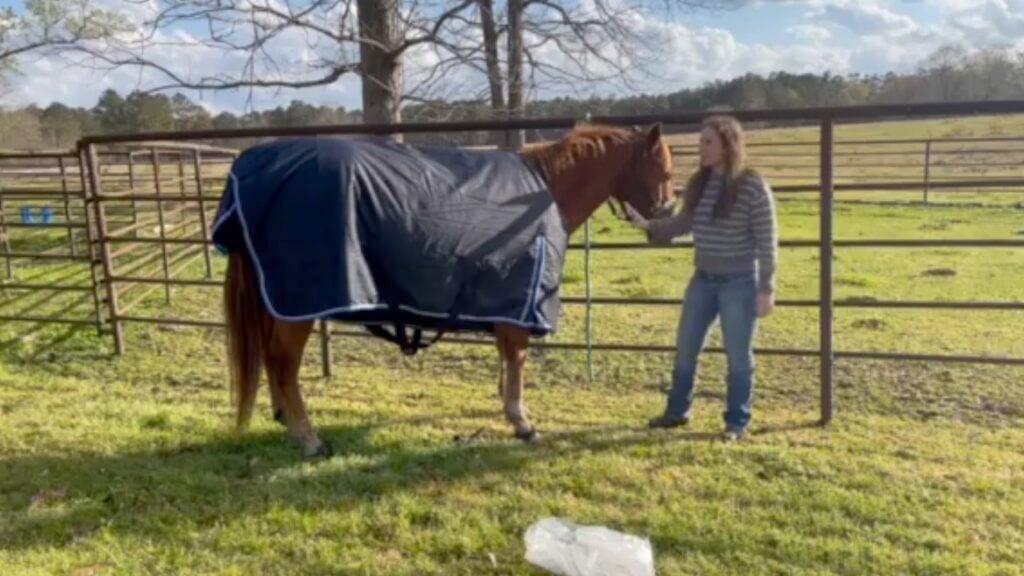
Yes, but check under the blanket at least once daily. Check that the horse isn’t sweating (a sign the blanket is too warm for current conditions), that no rubbing has started at the withers or shoulders, and that the blanket hasn’t shifted or twisted. On warm winter days above 50°F, remove the blanket and let the horse’s skin breathe for a few hours.
What is the difference between 100g, 200g, and 300g fill?
The gram number refers to the weight of polyfill insulation per square meter inside the blanket. 100g is a light layer for cool weather (40–50°F for most horses). 200g is a true midweight for colder conditions. 300g+ is a heavyweight for sustained cold, storms, or clipped horses. These aren’t perfectly interchangeable across brands — a 200g WeatherBeeta may feel different from a 200g from another manufacturer based on fill type and distribution. When in doubt, go up.
Should I blanket my horse if it’s raining but not cold?
Generally no — at temperatures above 50°F, a healthy horse with shelter can get wet and dry off without risk. The exception is a clipped horse, a thin horse, or a horse in strong wind at any temperature. A waterproof rain sheet (0g fill) is the right tool for these conditions: it blocks rain without adding warmth that would cause sweating.
How long should a quality horse blanket last?
A quality turnout blanket from WeatherBeeta, Rambo, or Schneiders should last 4–7 seasons with proper care — regular washing with blanket-specific detergent, annual DWR re-waterproofing treatment, and end-of-season repair before storage. Budget blankets typically last 1–3 seasons. The cost-per-season of a $300 Rambo over 6 seasons ($50/season) is often less than two replacement budget blankets.
What is denier and how much do I need?
Denier measures the thickness of threads in the blanket’s outer shell — higher denier means more tear resistance. 600D is adequate for low-intensity turnout. 1000D–1200D is the right spec for horses in group turnout, horses that roll hard in mud, or horses near fencing and brush. Don’t confuse denier (shell strength) with fill weight (insulation warmth) — they are completely independent specs.
How do I know if my horse blanket fits properly?
Check five points: (1) two fingers fit between the chest closure and your horse’s chest; (2) your hand slides freely under the blanket at the withers with no downward pressure; (3) pulling the blanket forward releases easily without shoulder snagging; (4) cross-surcingles allow a closed fist but don’t loop below the stifle; (5) the blanket covers from the base of the neck to the tailhead without pulling back or bunching. If any of these fail, sizing is off.
Can I use a turnout blanket in the stall?
Yes — turnout blankets work perfectly in stalls and are often a better choice than stable blankets for horses that go both in and out during the day. The reverse is not true: stable blankets should never be used in turnout because they are not waterproof and will soak through in rain, leaving the horse wetter and colder than without any blanket.
What brand of horse blanket do professional barns use?
In the racing barns I’ve been around at Fair Grounds, Evangeline Downs, and Delta Downs over 30 years, Rambo and WeatherBeeta are the most common turnout brands for horses in serious work. Schneiders is widely used for stable blankets and coolers. Budget-conscious operations use a mix of mid-range brands for backup rotation and reserve the premium blankets for horses in full turnout. The combination of a good turnout and a quality stable sheet covers most daily situations.
Conclusion
In real turnout conditions,: if you’re in genuine turnout conditions with a horse that rolls, lives in a herd, or tests fencing, spend the money on a Rambo or WeatherBeeta ComFiTec. You will not replace it for years. If you’re in a mild-climate setup or need a backup blanket, the budget pick handles those conditions well. The waterproof rain sheet (0g fill) is the one piece every horse owner should have regardless of climate — it covers the rain-but-not-cold situation that catches most owners unprepared.
Explore how horse cooling sheets help regulate temperature after exercise
Sources
- American Association of Equine Practitioners: aaep.org
- WeatherBeeta — What Blankets Do I Need: weatherbeeta.com
- WeatherBeeta — What Is Denier: weatherbeeta.com/blog/what-is-denier
- The Horse — Equine health reference: thehorse.com
- Horseware Ireland — Rambo Blanket Care Guide: horseware.com
About Miles Henry
Racehorse Owner & Author | 30+ Years in Thoroughbred Racing
Miles Henry (legal name: William Bradley) is a professional horseman based in Folsom, Louisiana. He holds Louisiana Racing License #67012 and has spent over three decades managing Thoroughbreds at premier tracks including Fair Grounds, Delta Downs, and Evangeline Downs.
Expertise & Hands-On Experience: Beyond the track, Miles has decades of experience in specialized equine care, covering everything from hoof health and nutrition to training protocols for Quarter Horses, Friesians, and Paints. Every guide on Horse Racing Sense is rooted in this “boots-on-the-ground” perspective.
30 of their last 90 starts
Equibase Profile.

Connect with Miles: