
Last updated: September 24, 2026
If the Kentucky Derby is the racing you know best, it’s easy to think all racehorses do the same job. They don’t. A horse bred to blast out of the gate in a 300-yard sprint is being asked to do something entirely different from one pulling a sulky, jumping fences, or covering 100 miles of trail.
Quick answer: Thoroughbreds dominate flat racing and steeplechase, but they aren’t the only racing breed. Quarter Horses run short sprints, Standardbreds race in harness, Arabians lead endurance and have their own flat races, and Appaloosas and Paint Horses race in smaller breed programs.
Below, I’ll cover where each breed races, what it was selected to do, how the major racing breeds compare, and what the choice means if you’re thinking about owning a racehorse.
Table of Contents
Thoroughbreds: The Flat Racing Standard
Thoroughbreds are the horses most people picture at a racetrack. They dominate North American flat racing, competing on dirt, turf, and synthetic surfaces from five-furlong sprints to mile-and-a-half tests like the Belmont Stakes. I’ve covered the history behind that in my guide to why Thoroughbreds dominate racing.
From an owner’s standpoint, though, breeding is only part of the picture. I’ve seen beautifully bred horses that never handled the demands of racing, and less fashionable ones that earned every dollar because they were sound, honest, and competitive.

Thoroughbreds also make up nearly all American steeplechase fields, where horses race over fences at distances of two miles or more. Flat racing rewards speed and position. Steeplechasing adds jumping ability, soundness, and stamina to the job.
Horseman’s Take: I race Thoroughbreds because the tracks, condition books, claiming races, sales, trainers, and purses around me are all built around them. If you want to own a horse for traditional American flat racing, start by looking at Thoroughbreds.
Quarter Horses: Built for the Sprint
The American Quarter Horse got its name from quarter-mile racing, and it’s still the specialist for explosive short-distance speed. Most races are short sprints, commonly 220 to 440 yards, though sanctioned races can run as far as 870 yards. At the shorter distances, a clean break and instant acceleration matter more than anything a jockey does later. Over longer flat-racing distances, Thoroughbreds generally have the edge, because they’re bred for sustained speed rather than first-stride acceleration.
That’s why Quarter Horse people spend so much time on the break. In a Thoroughbred race, a jockey can make up ground over several furlongs. In a 300-yard sprint, there’s no time for that. The breed’s best-known race is the All American Futurity at Ruidoso Downs in New Mexico, and Louisiana has a strong Quarter Horse program too. My Quarter Horse racing guide covers distances, records, and history.

Horseman’s Take: At Louisiana tracks that card both breeds, the feeling changes when the Quarter Horses load. A 440-yard race lasts about 21 seconds, and a poor break can end a horse’s chances almost immediately.
Standardbreds: The Harness Racing Breed
Standardbred racing is a completely different world from Thoroughbred racing. Instead of carrying a jockey, the horse pulls a light two-wheeled cart called a sulky and races at either a trot or a pace.. Trotters move their legs in diagonal pairs, left front with right hind. Pacers move the legs on the same side together. The challenge isn’t just going fast. It’s staying on gait, because a horse that breaks into a gallop loses ground and can be penalized.
The name comes from an early registration standard: horses had to meet a qualifying mile time, historically a 2:30 mile for trotters. Today’s top pacers go well under two minutes. Major harness tracks include the Meadowlands in New Jersey, Woodbine Mohawk Park in Ontario, and the Meadows in Pennsylvania. My guide to harness racing and the sulky explains how the sport works.

Many Standardbreds move on to pleasure driving, riding, or trail homes after racing, though how well each one makes that change depends on the individual horse, its retraining, soundness, and temperament.
Arabians: Endurance and Flat Racing
Arabians were built for a different job than a track sprinter. Their advantage isn’t explosive speed out of the gate. It’s the ability to keep going efficiently, handle heat, and recover when the miles start adding up. That makes them the dominant breed in endurance riding, which tests conditioning, soundness, pacing, and recovery rather than track speed.
Rides sanctioned by the American Endurance Ride Conference run from 25 to 100 miles in a day, with veterinary checks that horses must pass before continuing. Arabians and Arabian crosses are especially common at the top rides, including the 100-mile Tevis Cup across the Sierra Nevada. Arabians also have their own flat racing in the U.S., and a much bigger international program in the Middle East and Europe. If you want the breed’s background, it’s in my guide to the Arabian horse.

I’ve never competed in endurance, but I respect what those horses and riders do. A Thoroughbred running a mile and a quarter in two minutes is impressive. An Arabian covering 100 miles of mountain trail in a day, and passing a vet check at every stop, is doing something else entirely.
Appaloosas and American Paint Horses
Appaloosas and American Paint Horses have smaller breed-racing programs, usually built around short sprints. Both breeds carry a lot of Quarter Horse and Thoroughbred blood, which helps explain why their races look more like Quarter Horse racing than a mile-and-a-quarter Thoroughbred race.
Appaloosa racing runs under the Appaloosa Horse Club, and Paint racing under the American Paint Horse Association. Those races are a real part of both breed communities, but they operate on a much smaller scale than the main Thoroughbred, Quarter Horse, or Standardbred circuits. Most people know these breeds for their coats, the Appaloosa’s spots and the Paint’s two-tone patterns, more than for their racing.
Other Horse-Racing Traditions
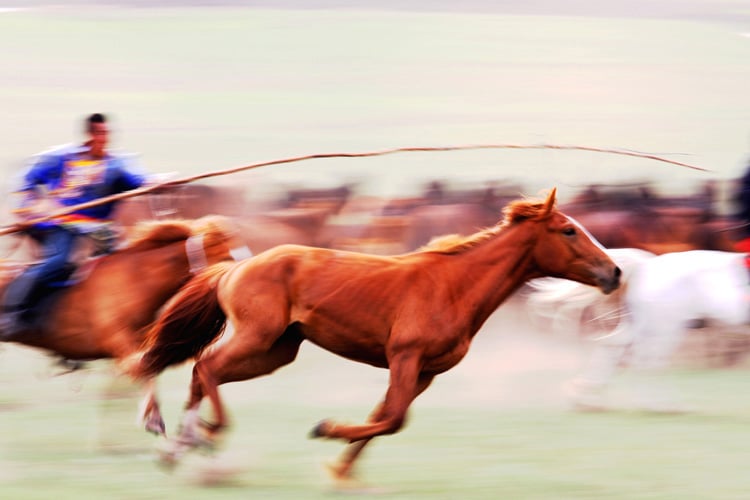
Mongolian horses are at the heart of Naadam racing, a long-distance tradition run across open steppe with young riders aboard. It’s real horse racing with deep cultural importance, just not track racing in the American sense. For background, see my article on the horses of the Mongols.
Racing Breeds Compared
| Breed | Main type of racing | Typical distances | Primary U.S. registry or organization |
|---|---|---|---|
| Thoroughbred | Flat racing; steeplechase | About 5 furlongs to 1 1/2 miles on the flat; 2 miles or more over jumps | The Jockey Club |
| Quarter Horse | Sprint racing | Commonly 220 to 440 yards; sanctioned races can reach 870 yards | American Quarter Horse Association |
| Standardbred | Harness racing at a trot or pace | Usually 1 mile | U.S. Trotting Association |
| Arabian | Endurance; Arabian flat racing | 25 to 100 miles in endurance | Arabian Jockey Club (racing); American Endurance Ride Conference (endurance) |
| Appaloosa | Breed sprint racing | Usually short breed-program sprints | Appaloosa Horse Club |
| American Paint Horse | Breed sprint racing | Usually short breed-program sprints | American Paint Horse Association |
Note: Breed registries and sport organizations aren’t racing regulators. In the U.S., state racing commissions regulate pari-mutuel racing, while registries and organizations handle registration, records, and breed or discipline programs. If you’re wondering which breed is fastest, that depends on the distance, and I break it down in my guide to the fastest horse breeds.
Why Racing Breeds Excel at Different Jobs
Racing breeds weren’t created by accident. Horsemen bred each one for a specific job, and a horse that shines in one kind of race may be poorly suited to another.
Explosive speed. Racing Quarter Horses are built to leave the gate hard and hit top speed fast. That’s why the break matters so much in a 220- or 440-yard race.
Sustained speed. Thoroughbreds are bred to gallop efficiently over a wider range of distances, from sprints to routes. Steeplechasers also need the stamina and athleticism to jump at speed.
Gait. Standardbreds are selected to hold a fast trot or pace while pulling a sulky. Staying on gait under pressure matters as much as raw speed.
Endurance. Arabians combine efficient movement, heat tolerance, and quick recovery for long-distance work. Success in endurance still depends on conditioning, terrain, pacing, veterinary management, and the individual horse, not breed alone.
Temperament. Individual temperament matters more than breed labels. Many Thoroughbreds are forward and sensitive, while others are quiet and uncomplicated. In any racing breed, the horse’s disposition, handling, training, and daily routine all affect how well it settles into the job.
Choosing a Racing Breed as an Owner
If you’re thinking about ownership, don’t start with the breed. Start with the racing you want to be part of. A Thoroughbred owner deals with different tracks, trainers, race conditions, and sales than a Quarter Horse owner, and harness racing and endurance are separate worlds again, each with its own trainers, events, and costs.
Horseman’s Take: When someone asks me about getting into racing, I first ask what kind of racing they mean. The breed determines the tracks, trainers, condition books, sales market, day-to-day costs, and purse structure you’ll be dealing with. Pick the racing world first, then work backward to the breed.
Horse Breeds That Race FAQ
Are all racehorses Thoroughbreds?
No. Thoroughbreds dominate North American flat racing and most steeplechase, but Quarter Horses, Standardbreds, Arabians, Appaloosas, and Paint Horses also race in breed or discipline programs of their own.
Which horse breed is fastest?
There isn’t one answer without naming the distance. Quarter Horses are specialists in short sprints, Thoroughbreds are bred for sustained speed over longer flat-racing distances, and Arabians are the leading breed in endurance competition.
Can Quarter Horses and Thoroughbreds race each other?
They normally race in separate divisions under different conditions. Some tracks card both breeds on the same day, but they don’t usually run against each other. Quarter Horses generally have the edge in a short sprint, and Thoroughbreds at longer flat-racing distances.
What breed is used in harness racing?
The Standardbred. Standardbreds pull a sulky and race at a trot or pace. If a horse breaks into a gallop, the driver has to get it back on gait, and the horse can lose ground or be penalized.
The right racehorse depends on the race you want to be part of. A Quarter Horse owner is getting into a sprint game, a Standardbred owner into harness racing, and a Thoroughbred owner into flat racing and steeplechase. Know the circuit first, then choose the horse that belongs in it.
About Miles Henry
Racehorse Owner & Author | 30+ Years in Thoroughbred Racing
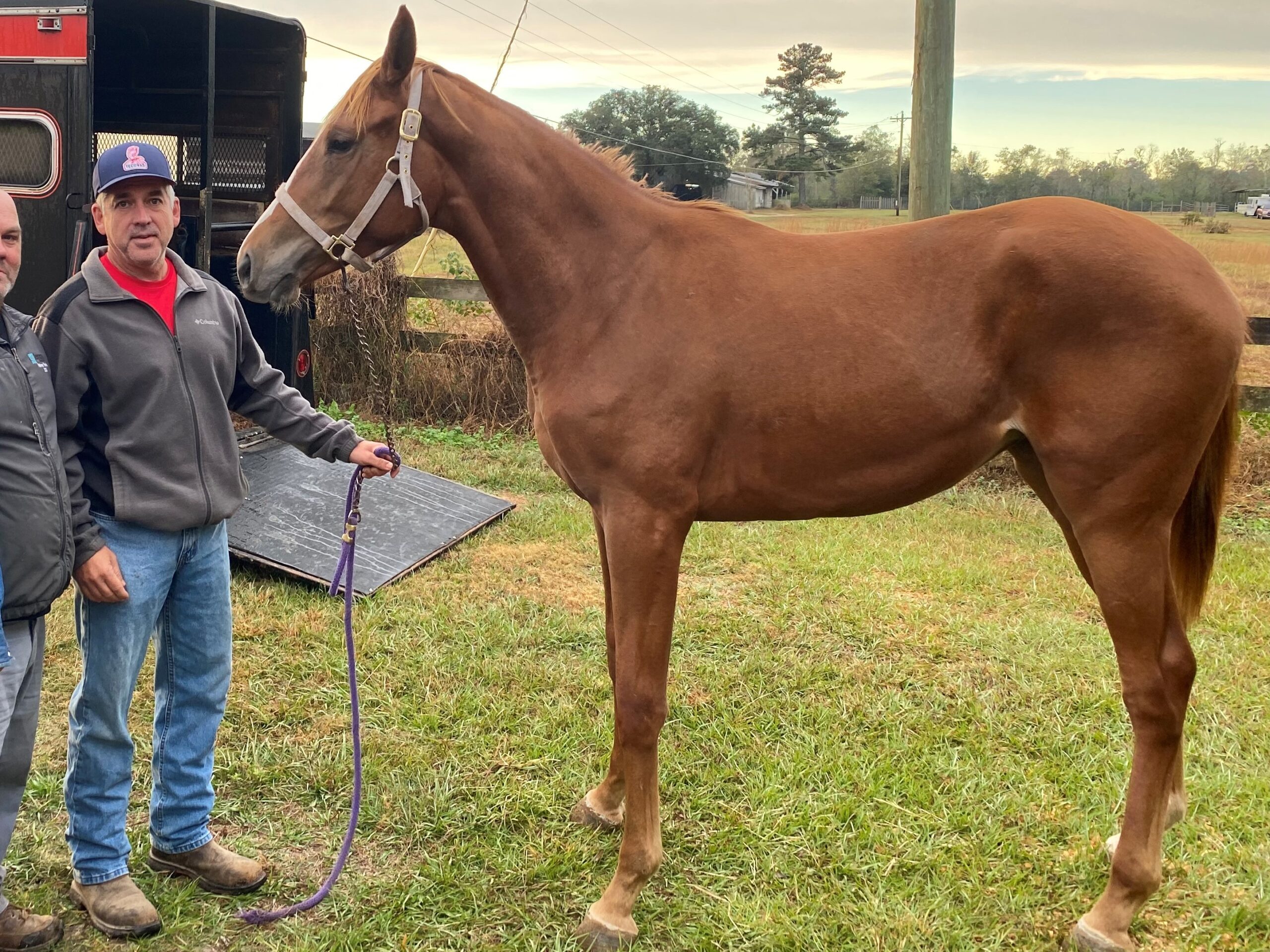
Miles Henry (legal name: William Bradley) is a professional horseman based in Folsom, Louisiana. He holds Louisiana Racing License #67012 and has spent over three decades managing Thoroughbreds at premier tracks including Fair Grounds, Delta Downs, and Evangeline Downs.
Expertise & Hands-On Experience: Beyond the track, Miles has decades of experience in specialized equine care, covering everything from hoof health and nutrition to training protocols for Quarter Horses, Friesians, and Paints. Every guide on Horse Racing Sense is rooted in this “boots-on-the-ground” perspective.
30 of their last 90 starts
Equibase Profile.

Connect with Miles: