
Last updated: July 13, 2026
I’ve managed mares that foaled at 330 days and others that went past 360 with no problems. Knowing the range matters because it sets your watch window and tells you when to involve a vet. Once active labor begins, the delivery itself usually happens within 15–30 minutes.
How long are horses pregnant? Most mares carry a foal for about 340 days (approximately 11 months), with a normal range of 320–370 days. After active labor begins, the birth itself is usually completed within 15–30 minutes.
Table of Contents
How Long Are Horses Pregnant?
A mare’s gestation period, often called horse pregnancy length, is typically 320–370 days, with the most commonly cited average around 340 days — just over 11 months. That range is wider than most people expect. Foaling several weeks before or after the average can occur and may be perfectly normal, depending on the mare and circumstances — season, breed, foal sex, and the mare’s individual history can all shift the foaling window.
| Stage | Approximate timing | Notes |
|---|---|---|
| Conception confirmed | Day 14–16 | Ultrasound can detect pregnancy at 14–16 days post-breeding |
| Early pregnancy | Months 1–3 | Embryo development; miscarriage risk highest in first trimester |
| Mid-pregnancy | Months 4–7 | Foal grows rapidly; mare’s nutritional needs increase in final trimester |
| Late pregnancy | Months 8–11 | Udder development; waxing; pre-foaling signs emerge in final 2–4 weeks |
| Normal foaling window | Day 320–370 | Average ~340 days; mares foaling outside this window or showing signs of distress should be evaluated by a vet |
| Active labor and delivery | 15–30 minutes | Stage 2 labor is fast — contact vet if foal not delivered within 30 minutes of water breaking |
| Placenta expelled | Within 3 hours | Retained placenta after 3 hours is a veterinary emergency |
Owner takeaway: Don’t circle one date on the calendar and assume that’s the delivery day. Start watching closely as the mare approaches her expected window, and pay more attention to physical changes than the calendar alone.

What Affects Horse Pregnancy Length?
When I owned my first broodmare, I quickly learned that the estimated foaling date was a planning tool, not a deadline. Several factors influence where a mare falls within the 320–370 day range, and none of them predict the exact date — only the window.
| Factor | Effect on gestation |
|---|---|
| Season of conception | Mares bred in spring often have shorter gestation than those bred in winter or late fall; day length (photoperiod) influences the mare’s reproductive hormones |
| Foal sex | Colts tend to have slightly longer gestation than fillies on average, though the difference is typically only a few days |
| Mare’s individual history | Many mares follow a consistent pattern across pregnancies — a mare that foaled at 335 days previously may do so again |
| Breed | Draft breeds often carry slightly longer; hot-blood breeds like Thoroughbreds and Arabians sometimes carry shorter |
| Nutrition and body condition | Mares in poor body condition may have longer or more difficult pregnancies; proper nutrition in the final trimester supports healthy foal development |
| Mare’s age | Older mares may be more variable; maiden mares (first foal) sometimes carry slightly longer |
Signs a Mare Is Close to Foaling
In the weeks before foaling, mares show a predictable progression of physical changes. No single sign confirms imminent labor, but several together narrow the window significantly.
Pre-foaling signs — what to watch for:
- Udder filling — begins 2–4 weeks before foaling; teats become distended as the foaling date approaches
- Waxing — waxy secretions appear on the teats 12–48 hours before foaling; one of the most reliable near-term signs
- Milk dripping — colostrum may drip or stream; foaling often within hours
- Relaxation of hindquarters — muscles around the tailhead soften and the area around the vulva loosens days before foaling
- Restlessness — looking at flank, getting up and down, sweating on the neck and flanks; similar to mild colic
- Isolation behavior — mares often separate themselves from other horses in the final hours before labor

How Long Is Horse Labor?
When calculating total labor time, most people underestimate how much happens before and after active delivery. The full process from first signs to placenta expulsion can span two to seven hours — but the actual delivery window is short.
Miles’s Take — labor timing: I remember one mare that delivered in under 10 minutes from water breaking to foal on the ground. Once stage 2 begins, be ready — and if it’s been 30 minutes with no foal, call the vet without hesitation.
What Happens During Foaling?
Equine labor unfolds in three distinct phases. Understanding what’s normal in each phase tells you when to watch quietly and when to act.
| Stage | What happens | Duration | When to act |
|---|---|---|---|
| Stage 1 | Uterine contractions begin; mare shows restlessness, sweating, flank-watching; similar to colic symptoms | 1–4 hours | Keep quiet; minimize disturbance; do not intervene |
| Stage 2 | Water breaks (allantoic fluid); mare typically lies down; foal exits in diving position (front feet first); umbilical cord intact | 15–30 minutes | Call vet if foal not delivered within 30 minutes of water breaking |
| Stage 3 | Placenta expelled; mare rests; foal begins attempting to stand and nurse | 30 min–3 hours | Retained placenta beyond 3 hours requires immediate veterinary attention |
Do Horses Give Birth Lying Down?
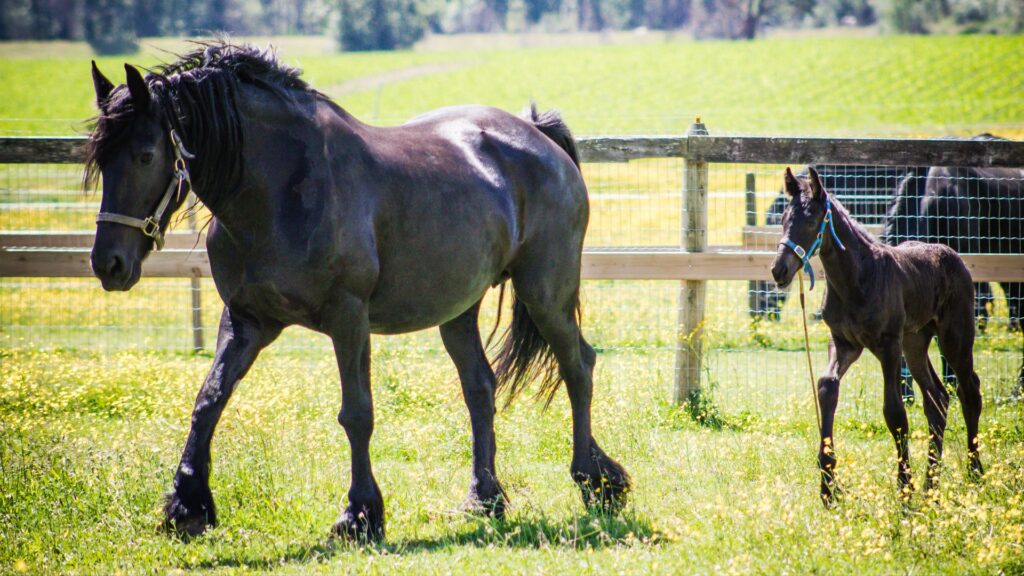
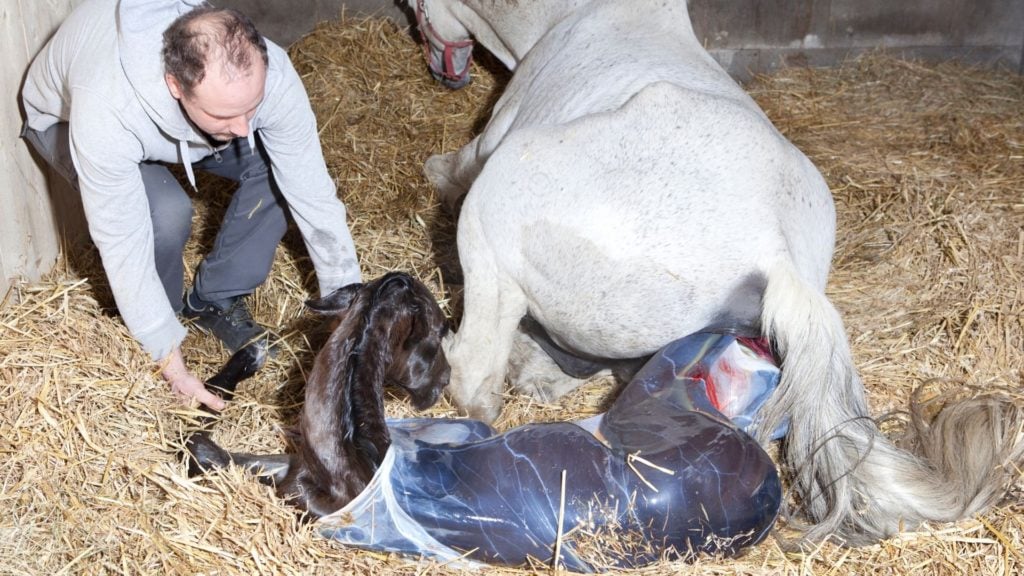
Horses typically give birth lying down on their sides, with the foal exiting in a “diving position” — front feet first, head resting on the forelegs. Lying down allows the umbilical cord to remain intact after delivery, which is important: blood continues flowing through the cord for several minutes after birth, and severing it prematurely can cause blood loss or infection.
Some mares foal standing up, though this is less common. If yours does, be ready to support the foal as it drops — a fall from standing height can injure a newborn. The umbilical cord is also more likely to sever prematurely in a standing birth.
What Time of Day Do Horses Give Birth?
Many mares foal at night — typically close to or after midnight when it’s dark and quiet. This is consistent enough that experienced breeders plan overnight watch schedules around it. In my experience, the majority of foalings I’ve witnessed have happened between 10 p.m. and 4 a.m.
The leading explanation is instinct: in the wild, nighttime foaling reduced predator exposure during the vulnerable delivery window. Researchers also believe the mare’s natural drive to seek a quiet, undisturbed environment plays a role. If your mare foals in a stall, keep lighting low — a quiet, dim environment supports a calmer delivery.
When to Call the Vet
Contact your veterinarian immediately if:
- The mare is past day 370 with no signs of impending labor
- Stage 2 labor has lasted more than 30 minutes with no foal
- The placenta has not been expelled within 3 hours of delivery (retained placenta requires immediate veterinary attention)
- The foal has not attempted to stand within 2 hours or nurse within 3 hours
- The amniotic sac is red or purple rather than white or transparent (red bag delivery — emergency)
- The mare shows signs of severe distress at any stage

FAQs: Horse Pregnancy and Foaling
How long are horses pregnant?
Most mares are pregnant for 320–370 days, with an average around 340 days (approximately 11 months). Normal variation is wide — a mare foaling two to four weeks before or after her expected date is not unusual as long as the foal is healthy.
How many months is a horse pregnant?
A horse is pregnant for approximately 11 months. The gestation period ranges from about 10.5 to 12.5 months depending on the mare, breed, season of conception, and foal sex. Most owners use 340 days as a working average when calculating an expected foaling date.
How long does it take a horse to give birth?
Once active labor (stage 2) begins with the water breaking, most mares deliver within 15–30 minutes. The full labor process from first signs to placenta expulsion can span two to seven hours. Contact your veterinarian if stage 2 lasts more than 30 minutes without delivery.
Can a horse be pregnant for 12 months?
Yes, some mares carry foals for 12 months or slightly longer. A gestation period up to about 370 days is within the normal range. Beyond 370 days, veterinary consultation is recommended to evaluate the mare and foal.
How do you calculate a horse’s foaling date?
Add 340 days to the breeding date as a starting estimate. Most owners begin close monitoring at around day 310–315 and watch for pre-foaling signs: udder filling, waxing, and muscle relaxation around the tailhead. Because normal foaling can occur anywhere from day 320 to 370, the foaling date is a window, not a specific day.
What are the signs a mare is close to foaling?
The most reliable near-term signs are waxing (waxy secretions on the teats, typically 12–48 hours before foaling), milk dripping, and relaxation of the muscles around the tailhead and vulva. Earlier signs include udder filling (2–4 weeks out), restlessness, flank-watching, and separation from other horses.
How many days is a mare pregnant before foaling?
Most mares are pregnant for 320–370 days before foaling, with 340 days (about 11 months) as the working average. The foaling window is wide — a mare that foals at day 325 or day 355 may both be perfectly normal depending on the individual horse, breed, and season of conception.
About Miles Henry
Racehorse Owner & Author | 30+ Years in Thoroughbred Racing
Miles Henry (legal name: William Bradley) is a professional horseman based in Folsom, Louisiana. He holds Louisiana Racing License #67012 and has spent over three decades managing Thoroughbreds at premier tracks including Fair Grounds, Delta Downs, and Evangeline Downs.
Expertise & Hands-On Experience: Beyond the track, Miles has decades of experience in specialized equine care, covering everything from hoof health and nutrition to training protocols for Quarter Horses, Friesians, and Paints. Every guide on Horse Racing Sense is rooted in this “boots-on-the-ground” perspective.
30 of their last 90 starts
Equibase Profile.

Connect with Miles: