
Last updated: June 22, 2026
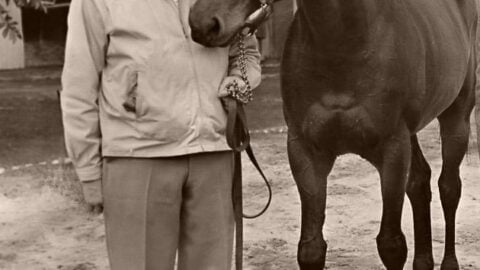
Nobody wanted Seabiscuit. Then nobody could stop talking about him. This is the complete record of how that happened.
Seabiscuit — the essential facts:
- Career record: 33 wins from 89 starts — $437,730 in earnings, the North American record at his 1940 retirement
- Grandson of Man o’ War — through sire Hard Tack; the 1938 match race was two branches of Man o’ War’s bloodline against each other
- Beat Triple Crown winner War Admiral by 4 lengths in 1938 — Pimlico track record 1:56.6, 40,000 in attendance, 40 million on radio
- Ran in claiming races as a two-year-old — available for $2,500; nobody took him
- Came back from a fractured sesamoid at age six — won the 1940 Santa Anita Handicap carrying 130 lbs, set a stakes record of 2:01.2
| Topic | Detail |
|---|---|
| Born | May 23, 1933 — Claiborne Farm, Kentucky |
| Sire | Hard Tack (son of Man o’ War) |
| Dam | Swing On |
| Career Starts | 89 |
| Wins / Places / Shows | 33 / 15 / 13 |
| Earnings | $437,730 (NA record at retirement) |
| Owner | Charles Howard |
| Trainer | Tom Smith |
| Primary Jockey | Red Pollard |
| Match Race Jockey | George Woolf (Pollard was injured) |
| Horse of the Year | 1938 |
| Hall of Fame | Inducted 1958, inaugural class |
| Died | May 17, 1947 — Ridgewood Ranch, California |
Table of Contents

Bloodlines and Early Life
Seabiscuit was foaled on May 23, 1933, at Claiborne Farm near Paris, Kentucky, bred by Ogden Phipps. His sire was Hard Tack — a son of Man o’ War — making Seabiscuit Man o’ War’s grandson. His dam was Swing On, a mare with modest racing credentials.
Hard Tack was large and difficult and never fully delivered on his potential. He passed some of Man o’ War’s physical presence to Seabiscuit — a broad chest and strong hindquarters — but Seabiscuit arrived at just over 15 hands, small for a Thoroughbred, with knobby knees and a rolling gait. The Man o’ War bloodline looked significant on paper. The horse in front of you did not look significant at all.
What the bloodline actually tells you: Man o’ War’s influence runs through a huge percentage of modern Thoroughbreds — but that genetic legacy expresses differently in every generation. Hard Tack got some of his sire’s power but not his consistency. Seabiscuit got something different again — a competitive instinct that did not show up until the right people found the right way to bring it out. Pedigree tells you the ceiling. It does not tell you what a horse will do with it. Seabiscuit’s full pedigree and record are documented at the National Museum of Racing and Hall of Fame.
Early Career: Overlooked and Overraced
Seabiscuit’s two-year-old season in 1935 was a failure by any measure. He started 35 times — an enormous workload; modern elite horses run six to ten times a year — won 5, and ran primarily in low-level claiming races. His trainer at the time, Sunny Jim Fitzsimmons, used him as a training partner for the stable’s better horses, running him frequently to sharpen those horses rather than develop him. The result was a horse who was overworked and showed no appetite for competition. He ate too much, slept too much, and appeared lethargic on the track. To most observers, he looked like a modestly bred horse with modest ability headed for a career at minor tracks.
Did Seabiscuit Run in Claiming Races?
Yes. During his two-year-old season in 1935, Seabiscuit ran in claiming races where anyone could have purchased him for as little as $2,500. He was never claimed — he stayed with his connections throughout his early career — but he ran where he could have been taken, and the market consistently passed on him. In at least one of those starts he won and set a track record, a detail that shows how thoroughly his potential was missed before Tom Smith and Charles Howard came along.
The claiming price reflected what nobody had yet figured out how to unlock, not what the horse was. He is one of several famous horses whose early careers ran through the claiming ranks without the horse being taken. Charismatic ran in $62,500 claiming races months before winning the 1999 Kentucky Derby. Ben’s Cat ran in $20,000 and $25,000 claimers before becoming a multiple graded stakes winner and Maryland fan favorite. The pattern repeats more often than most people realize — see famous horses that ran in claiming races for the full list.
The Team That Rebuilt Him
In 1936, Charles Howard purchased Seabiscuit for $8,000. Howard was a self-made California businessman who had built a fortune selling automobiles. He paired the horse with trainer Tom Smith — a former mustang breaker and ranch hand who had spent decades reading horses rather than forcing them into conventional frameworks.
Smith’s approach was straightforward: the horse had been broken down mentally, not physically. He slowed everything down. He gave Seabiscuit a pony companion named Pumpkin, whose calming presence traveled to every race. He allowed the horse to sleep and eat freely, and rebuilt his competitive interest by giving him races he could win rather than using him as a sparring partner for better horses.
Smith also found the right jockey. Red Pollard — nicknamed “The Cougar” — was a partially blind journeyman rider from Canada who had spent years in obscurity at minor tracks. His connection with Seabiscuit was immediate and showed up in the results. The three of them — Smith, Pollard, and Seabiscuit — formed something that worked.

Rise to Fame
Under Smith and Pollard, Seabiscuit won 9 of 23 starts in 1936 with steady improvement across the second half of the year. By 1937 he was a different horse — aggressive, competitive, and winning against the best on the West Coast circuit. He won 11 of 15 starts that year, including the Continental Handicap and the Brooklyn Handicap, and became the leading money earner in North American racing with $168,580 in seasonal earnings.
The national media began covering Seabiscuit the way they covered heavyweight boxing. His story mapped onto the Depression-era narrative of resilience — a horse nobody wanted, trained by a man nobody had heard of, ridden by a jockey with limited vision, owned by a self-made businessman. By 1938 the argument for a match race against War Admiral had become impossible to ignore.
The 1938 Match Race Against War Admiral
War Admiral was the reigning Triple Crown winner, undefeated in championship competition and the East Coast establishment’s choice as the best horse in the country. Seabiscuit was the West Coast challenger. The match was set for November 1, 1938, at Pimlico Race Course in Baltimore — 40,000 in attendance, an estimated 40 million listening on radio.
Red Pollard was sidelined with a broken leg; George Woolf, “The Iceman,” rode in his place. Pollard had coached Woolf specifically on Seabiscuit’s tendencies: let War Admiral set the pace, let the horse look his opponent in the eye, then ask him to run. Woolf executed it exactly. Seabiscuit broke cleanly, settled alongside War Admiral, and drew away in the stretch to win by four lengths in 1:56.6 — a Pimlico track record. War Admiral, the Triple Crown winner, was never competitive in the final quarter. Seabiscuit was named 1938 Horse of the Year.

What the Match Race Meant: The most important races are not always the ones with the fastest horses — they are the ones where the story and the performance arrive together. What gets lost in the Seabiscuit retelling is that the race was genuinely won on merit. War Admiral was a great horse. Four lengths is not a fluke.
Injury, Comeback, and the 1940 Santa Anita
In January 1939, Seabiscuit fractured a sesamoid bone in his left foreleg during a workout at Santa Anita. At the same time, Red Pollard broke his already-recovering leg in a separate accident. The owner, trainer, horse, and jockey were all broken at once. Most people in racing assumed Seabiscuit’s career was finished — he was six years old, had run 83 times, and had a serious leg injury. Charles Howard chose to bring him back.
Tom Smith managed a careful year-long rehabilitation — controlled exercise, patient monitoring, no shortcuts. By late 1939 Seabiscuit was moving soundly, and Pollard, his own leg healed, returned to ride him. On February 9, 1940, at Santa Anita Park, Seabiscuit won the Santa Anita Handicap — the race he had come agonizingly close to winning three times before. He carried 130 pounds, won by a length and a half, and set a stakes record of 2:01.2 for the mile and a quarter. He retired after that race.

What 130 Pounds Actually Means
Seabiscuit’s 1940 Santa Anita Handicap win under 130 pounds is more significant than it sounds to a modern reader. In contemporary racing, top handicap horses rarely carry more than 126 pounds, and assignments above 128 are uncommon enough that connections sometimes scratch rather than accept them. The Equibase weight scale reflects what research consistently shows: each additional pound carried reduces a horse’s effective speed by roughly one length per mile.
At 130 pounds over a mile and a quarter, Seabiscuit was conceding approximately five lengths in theoretical weight penalty to horses assigned standard weights of 112 to 115 pounds. He won by a length and a half and set a track record. That means the actual performance margin — adjusted for weight — was closer to six or seven lengths over horses carrying standard impost. That is not a soft win by a popular horse. That is a dominant performance by any measure the sport has.
For comparison, Man o’ War carried 130 pounds in multiple starts and set records doing it — but he was never coming off a fractured leg after a year away from competition. The weight-adjusted 1940 Santa Anita is, on pure merit, arguably Seabiscuit’s greatest performance and the one most likely to be underestimated by readers who see only the headline result.
Seabiscuit vs. the Racing Legends
Where does Seabiscuit fit alongside Man o’ War, Secretariat, and the horses considered the greatest in American racing history? The honest answer requires separating what he actually was from what the narrative made him.
| Category | Seabiscuit | Man o’ War | Secretariat |
|---|---|---|---|
| Career record | 33–15–13 (89 starts) | 20–1 (21 starts) | 16–3–1 (21 starts) |
| Greatest race | 1940 Santa Anita Handicap — 130 lbs, 2:01.2, came back from injury | 1920 Belmont — won by 20 lengths | 1973 Belmont — 31 lengths, 2:24 flat |
| Triple Crown | Did not compete in TC races | Did not run the Kentucky Derby | Won all three (1973) |
| Defining quality | Durability, competitive will, weight-carrying ability | Dominance under any condition | Verifiable sustained speed |
| Cultural impact | Symbol of Depression-era resilience; still recognized by non-racing fans | Foundation of the modern Thoroughbred | Greatest timed performance in racing history |
Seabiscuit’s unusually long 89-start career is itself a measure of something — consistency and soundness over five seasons that neither Man o’ War nor Secretariat was asked to demonstrate. His case is not about raw speed. It is about competitive toughness across the longest career any horse in his class put together, culminating in a weight-burdened comeback win that looks better the more closely you examine the numbers.
My Take: The horses I have respected most are not always the fastest ones. They are the horses that show up, race hard, and keep coming back. Seabiscuit’s 89-start career, his performance under 130 pounds after a year away from competition, and his four-length win over a Triple Crown winner — those are not narrative embellishments. Those are the facts. Whether he belongs in the same category as Man o’ War or Secretariat as a pure athlete is a legitimate debate. Whether he belongs in the conversation is not.
Retirement, Legacy, and Death
Seabiscuit retired to Charles Howard’s Ridgewood Ranch in Willits, California, after the 1940 Santa Anita. He stood at stud during his retirement years, siring several respectable racehorses, though none approached his level of fame. He died on May 17, 1947, at the age of 14 — the same year as Man o’ War — and was buried at Ridgewood Ranch, where a life-sized statue stands today. He was inducted into the National Museum of Racing and Hall of Fame in 1958, part of the inaugural class when the museum first opened.
His legacy outlasted his racing record by decades. People who cannot name a single Triple Crown winner know who Seabiscuit was. That kind of cultural penetration is its own measure of greatness, separate from anything the stopwatch records.

Seabiscuit in Books and Film
Laura Hillenbrand’s Seabiscuit: An American Legend, published in 2001, is the definitive account of the horse and his era. Hillenbrand spent years researching the book while managing a severe chronic illness, and that persistence shows in the depth of the work. The book spent more than two years on the New York Times bestseller list and is widely considered one of the finest sports books ever written.
The 2003 film adaptation, directed by Gary Ross and starring Jeff Bridges, Tobey Maguire, and Chris Cooper, was nominated for seven Academy Awards including Best Picture. It is reasonably faithful to the book’s essential facts — rarer than it should be in Hollywood adaptations of true stories.

Seabiscuit Horse FAQs
What was Seabiscuit’s career record?
Seabiscuit ran 89 times, winning 33 races and placing or showing in 28 others. He earned $437,730 — the North American record at his 1940 retirement. His win percentage was modest by the standards of Man o’ War or Secretariat, but his career spanned five seasons under heavy weights across tracks nationwide.
Who rode Seabiscuit in the match race against War Admiral?
George Woolf rode Seabiscuit in the 1938 match race, not Red Pollard. Pollard had broken his leg in a racing accident earlier that year. Pollard coached Woolf specifically on Seabiscuit’s tendencies — including the strategy of letting War Admiral set the early pace before asking Seabiscuit to run in the stretch. Woolf executed it perfectly.
Was Seabiscuit related to Man o’ War?
Yes — Seabiscuit was Man o’ War’s grandson through sire Hard Tack. That made the 1938 match race a contest between two branches of Man o’ War’s bloodline: War Admiral was Man o’ War’s son; Seabiscuit was Man o’ War’s grandson through a different line.
Did Seabiscuit win the Triple Crown or the Kentucky Derby?
No to both. Seabiscuit never competed in any Triple Crown race. Owner Charles Howard chose to campaign him primarily on the West Coast handicap circuit — a deliberate strategic choice, not an oversight.
How did Seabiscuit get his name?
Seabiscuit was named in reference to his sire Hard Tack — a dense biscuit historically eaten by sailors. Hard tack and sea biscuit are essentially the same thing by different names, making the connection to his sire direct.
What was Seabiscuit’s injury and how did he come back?
In January 1939, Seabiscuit fractured a sesamoid bone in his left foreleg during a workout at Santa Anita. Most observers believed his career was over. Trainer Tom Smith managed a careful year-long rehabilitation, and on February 9, 1940, Seabiscuit won the Santa Anita Handicap carrying 130 pounds and setting a stakes record of 2:01.2 for the mile and a quarter.
Did Seabiscuit ever run in a claiming race?
Yes. Seabiscuit ran in claiming races as a two-year-old in 1935, available for as little as $2,500. He was never claimed — he stayed with his connections throughout. In at least one of those starts he won and set a track record, showing how thoroughly his potential was missed before Tom Smith and Charles Howard recognized it.
How does Seabiscuit compare to Secretariat and Man o’ War?
Seabiscuit was not the fastest horse by measured speed — he set no speed records. His case rests on durability across 89 career starts, competitive toughness under heavy weights, and a 1940 Santa Anita Handicap win under 130 pounds after a year away from racing. Man o’ War’s dominance and Secretariat’s Belmont performance represent different categories of greatness. Seabiscuit belongs in the conversation for different reasons — a five-season career no horse in his class matched, and a comeback that was entirely true.
Key Takeaways: Seabiscuit
- 33 wins from 89 starts — $437,730, the North American earnings record at his 1940 retirement
- Man o’ War’s grandson through Hard Tack — the 1938 match race put two branches of Man o’ War’s bloodline against each other
- 35 starts as a two-year-old left him mentally burned out — Tom Smith’s patient rebuild was the turning point, not any single race
- George Woolf rode the match race, not Red Pollard — Pollard coached Woolf on the strategy while sidelined with a broken leg
- Won the match race by four lengths — a track record at Pimlico — the performance was real, not just the story
- 130-pound win in the 1940 Santa Anita equates to roughly a six-to-seven-length margin adjusted for weight — the most underrated number in his record
- Not the fastest horse by measured speed — his case rests on durability, toughness, and weight-carrying ability across a five-season career
- Hall of Fame 1958 — inaugural class
Seabiscuit ran 89 times, came back from an injury that should have ended him, beat a Triple Crown winner by four lengths, and carried 130 pounds to a stakes record after a year away from racing. None of that is narrative embellishment — it is the record. The story lasted because the performance was real.
About Miles Henry
Racehorse Owner & Author | 30+ Years in Thoroughbred Racing
Miles Henry (legal name: William Bradley) is a professional horseman based in Folsom, Louisiana. He holds Louisiana Racing License #67012 and has spent over three decades managing Thoroughbreds at premier tracks including Fair Grounds, Delta Downs, and Evangeline Downs.
Expertise & Hands-On Experience: Beyond the track, Miles has decades of experience in specialized equine care, covering everything from hoof health and nutrition to training protocols for Quarter Horses, Friesians, and Paints. Every guide on Horse Racing Sense is rooted in this “boots-on-the-ground” perspective.
30 of their last 90 starts
Equibase Profile.

Connect with Miles: