Pick up a racing program for the first time and you’ll run into words like maiden, bug boy, exacta, and morning line before you’ve even found the first race. A few unfamiliar words can make the whole program hard to follow.
Quick answer: Start with these six horse racing terms. A maiden is a horse that hasn’t won a race. In a claiming race, every horse is entered for a set price and can be bought. A furlong is one-eighth of a mile. Pari-mutuel betting puts all the money into a pool and pays the winners after the track’s cut. An exacta means picking the first two finishers in order. And the morning line is the track handicapper’s odds estimate before betting opens.
This glossary covers more than 100 terms used in North American Thoroughbred racing. Use the table of contents to jump to a topic, or the A to Z index at the bottom to find a specific word.
Colt: An uncastrated male horse four years old or younger. Fillies can race against colts in open company and get a weight allowance when they do.
Filly: A female horse four years old or younger. She becomes a mare on January 1 of the year she turns five.
Mare: A female horse five years old or older.
Stallion: An uncastrated male horse five years old or older. Top racehorses retire to stud, where a popular stallion can breed well over a hundred mares a year.
Gelding: A castrated male horse of any age. Geldings can’t be used for breeding, so many keep racing after horses with breeding value have retired. Temperament, soundness, and career length still depend on the individual horse.
Foal: Horse under one year old, regardless of sex. In Thoroughbred racing, all horses share a universal birthday of January 1, meaning a foal born in December is technically a yearling on January 1 of the following year.
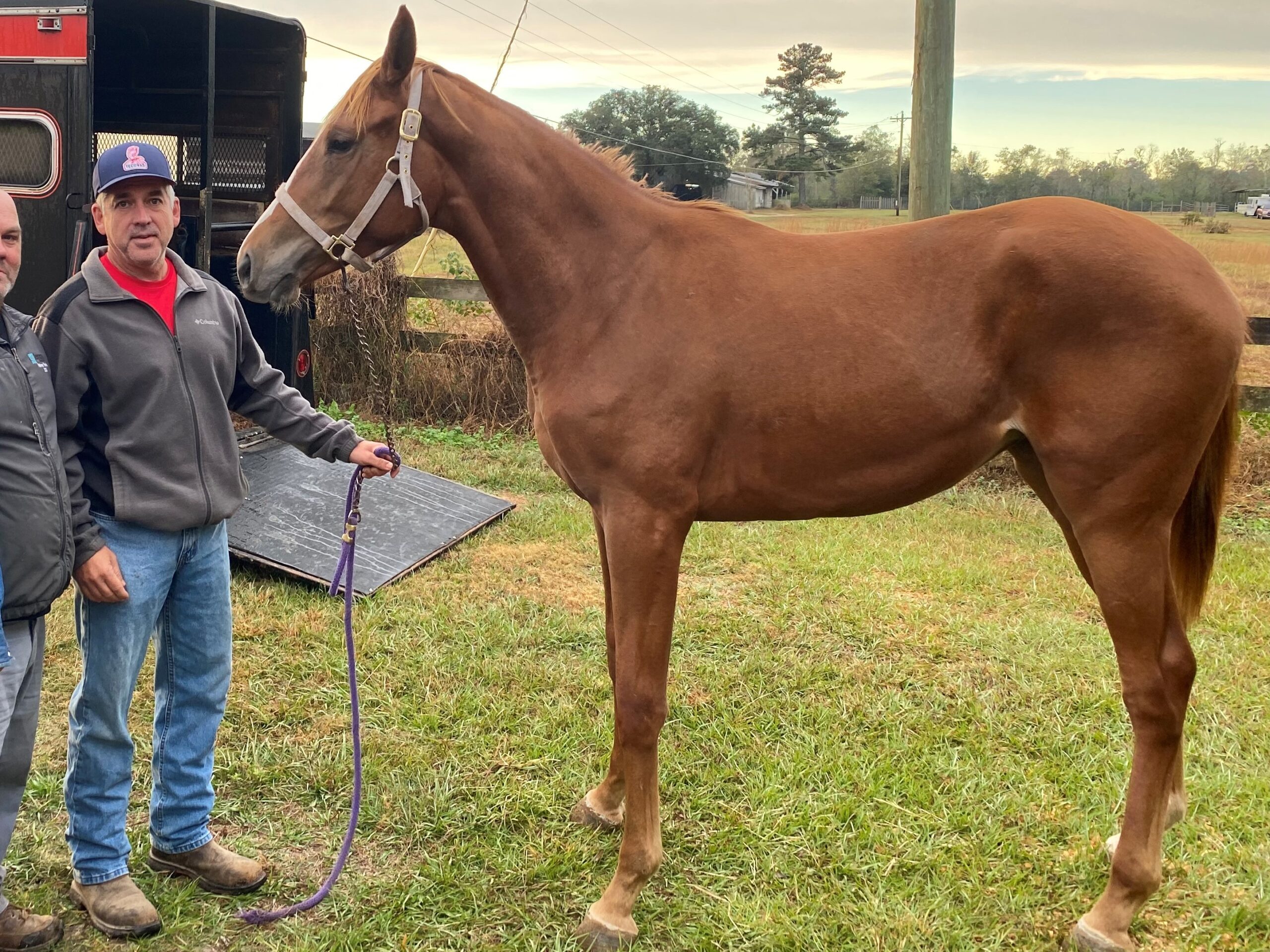
Yearling: Horse in its second calendar year of life. Many are sold at yearling auctions, where a well-bred colt or filly can bring a huge price, though most sell for far less.
Weanling: Foal that has been weaned from its mother, typically between four and seven months of age. Some are sold at weanling sales.
Maiden: Horse that has never won a race, regardless of how many times it has started. A maiden race is restricted to horses that have never won. Once a horse wins its first race, it “breaks its maiden” and is no longer eligible for maiden-restricted events.
Sire: A horse’s father. A popular sire can raise a yearling’s sale price.
Dam: Mother of a horse. The dam’s racing and reproductive record significantly influences a foal’s value. A “producer” is a mare known for having successful offspring.
Broodmare: A mare used for breeding. A proven broodmare that keeps producing winners can be worth more than she ever earned on the track.
Off-track Thoroughbred (OTTB): Thoroughbred retired from racing and transitioning to another discipline (pleasure riding, eventing, jumping, etc.). Most need time and retraining before they settle into a new job.
Race Type Terms
Race conditions decide which horses can enter and what they’re running for. Knowing the conditions and class of a race, and where it fits on the horse racing class levels, helps you judge the competition a horse is facing.
Maiden race: A race for horses that have never won. It comes in two main types, maiden special weight and maiden claiming.
Maiden special weight (MSW): A maiden race where the horses aren’t entered to be claimed. It’s the higher level of maiden race.
Maiden claiming (MCL): A maiden race where every horse is entered for a claiming price and can be claimed.
Claiming race: A race where every horse is entered for a set claiming price and can be bought by a licensed owner who submits a claim before the race, following the track’s rules and deadlines. Rules on when ownership transfers and when a claim can be voided vary by state. The claiming race guide walks through how it works.
Allowance race: A non-claiming race with conditions, such as “non-winners of two races other than maiden or claiming,” that decide who can enter. Allowance races generally sit above claiming races and below stakes.
Optional claiming race: Hybrid race where horses enter either with or without a claiming price. Horses entered with a tag can be claimed; horses entered without one aren’t for sale but must meet the race conditions.
Stakes race: A race with nomination and entry requirements, with the fees often adding to the purse. Stakes races vary in quality. Graded stakes are rated Grade I, II, or III, with Grade I the highest, and races like the Kentucky Derby and Travers are Grade I.
Handicap race: Race where the racing secretary assigns different weight to each horse to equalize chances. Better horses carry more weight; lesser horses carry less. Less common today than historically but still run at major tracks.
Starter allowance / starter handicap: Race restricted to horses previously entered for a claiming price at or below a specified amount. Sits between claiming and open allowance, gives horses a competitive alternative without the claiming risk.
Conditioned race: Race with specific eligibility conditions beyond claiming price, usually based on wins, race history, or surface. Allowance conditioned races are the most common form.
Restricted race: Race limited to horses bred in a specific state or purchased at a specific sale. Louisiana-bred races are a regular part of the cards at Fair Grounds, Delta Downs, Evangeline Downs, and Louisiana Downs.
Turf race: Race run on the grass course rather than the main dirt track. Some horses that struggle on dirt run much better on grass.
Horseman’s Take: Claiming races fill most of the cards at Louisiana tracks, and I’ve brought home my share of horses out of them. As an owner, you’re always balancing where your horse fits. Drop the price too low and you may lose a horse you want to keep. Put him in too high and you’re in a race you can’t win. It’s a lot more strategic than it looks from the grandstand.
Track, Distance, and Race-Day Terms
Track conditions and distance matter when you’re comparing a horse’s past races with today’s race. The surface can make a big difference, which is why it helps to understand how racetrack surfaces affect racehorse performance.
Furlong: One-eighth of a mile, 220 yards or 660 feet. Almost all race distances in American racing are measured in furlongs. A six-furlong race is three-quarters of a mile; the Kentucky Derby (a mile and a quarter) is ten furlongs. Workout distances are also listed in furlongs.
Pole: Distance markers placed around the track. The quarter pole is a quarter-mile from the finish; the eighth pole is an eighth of a mile out. When a caller says “at the quarter pole,” the leader is 440 yards from the wire.
Length: Roughly the length of a horse, used to measure the distance between horses at each call and at the finish.
Wire: The finish line. A horse that “hits the wire first” wins the race.
Fast: A dirt-track rating for dry, even footing.
Good: A dirt-track rating a step off fast, with some moisture in the surface.
Muddy: A wet dirt track where the moisture has soaked into the surface. Some horses, called mudders, run better on it.
Sloppy: A dirt track with standing water on top of a firmer base. Some horses handle it well and some don’t.
Heavy: A very wet, soft turf rating, the softest condition you’ll usually see listed.
Firm: A turf rating for firm footing, roughly the grass version of a fast dirt track.
Yielding: A turf rating softer than good, where hooves sink in noticeably.
Sprint: A race run at less than a mile, typically five to seven and a half furlongs in American racing. Sprint specialists often struggle when stretched to route distances. Most claiming races at regional tracks are sprints.
Route: A race run at a mile or longer. Routes require stamina and the ability to rate. Routes typically include at least two turns on an oval track.
Gate: The starting gate. “Gates well” means a horse breaks cleanly and quickly, an important attribute in sprint races where the first few strides often determine early position.
Post position: Numbered gate stall assigned to each horse by draw, Post 1 is the inside (rail) position. Inside posts have a slight advantage in sprint races; in large-field route races, extreme outside posts cover extra ground in the first turn.
Rail: Inner fence of the track, the shortest path around the oval. Track superintendents move the rail position to preserve the surface; a rail move can advantage or disadvantage certain running styles.
Post time: The scheduled start time of a race. Betting closes when the race starts.
Paddock: The area where horses are saddled and walked before a race. It’s a good place to look the horses over before you bet.
Scratch: A horse withdrawn from a race after entries are taken, either by the connections or on orders from an official such as the track veterinarian. Bets involving the horse are handled under the track’s wagering rules. Straight bets are usually refunded, while multi-race bets may involve a substitution or a consolation payout.
Also eligible (AE): Horses entered but not in the main field due to field size limits. AE horses move into the race if another horse scratches before the field is set.
Stewards: Officials responsible for enforcing the rules of racing. Stewards order inquiries, disqualify horses, and suspend riders or trainers for violations.
Inquiry: A review started by the stewards to decide whether a rule violation affected the race. The result stays unofficial while they look at it.
Objection: A claim of foul made after a race, usually by a jockey who says another horse interfered with his. The stewards review it before the result is made official.
Pony horse (lead pony): A calm, experienced horse that walks a racehorse from the paddock to the starting gate and helps keep him settled. Most racehorses get pony escorts to the gate on race day.
Photo finish: Result too close to determine by eye, the finish camera produces a still image for official determination. The tote board reads “PHOTO” until confirmed.
Dead heat: A finish where two or more horses tie for the same placing. In a dead heat for first, each horse is declared a winner, and the purse and payouts are split under the track’s racing and wagering rules.
Horse Racing Betting Terms
Horse racing uses pari-mutuel wagering, which works differently from casino games or fixed-odds sports betting. These are the horse racing betting terms you’ll hear at the window, and the beginner’s guide on how to bet on horse racing shows how to put them to use.
Pari-mutuel: A betting system where all the money bet on a given wager goes into a pool. The track takes its share, called the takeout, and the rest is split among the winning tickets. Because payouts come from the pool, the odds keep changing until the race starts.
Takeout: The percentage of each pool the track keeps before paying winners, often somewhere around 15 to 25 percent depending on the bet and the state. Exotic bets usually carry a higher takeout than win, place, and show.
Morning line: The odds estimate printed in the program, set by the track’s handicapper before betting opens. It’s a guess at how the public will bet, and your payout depends on the final odds on the tote board.
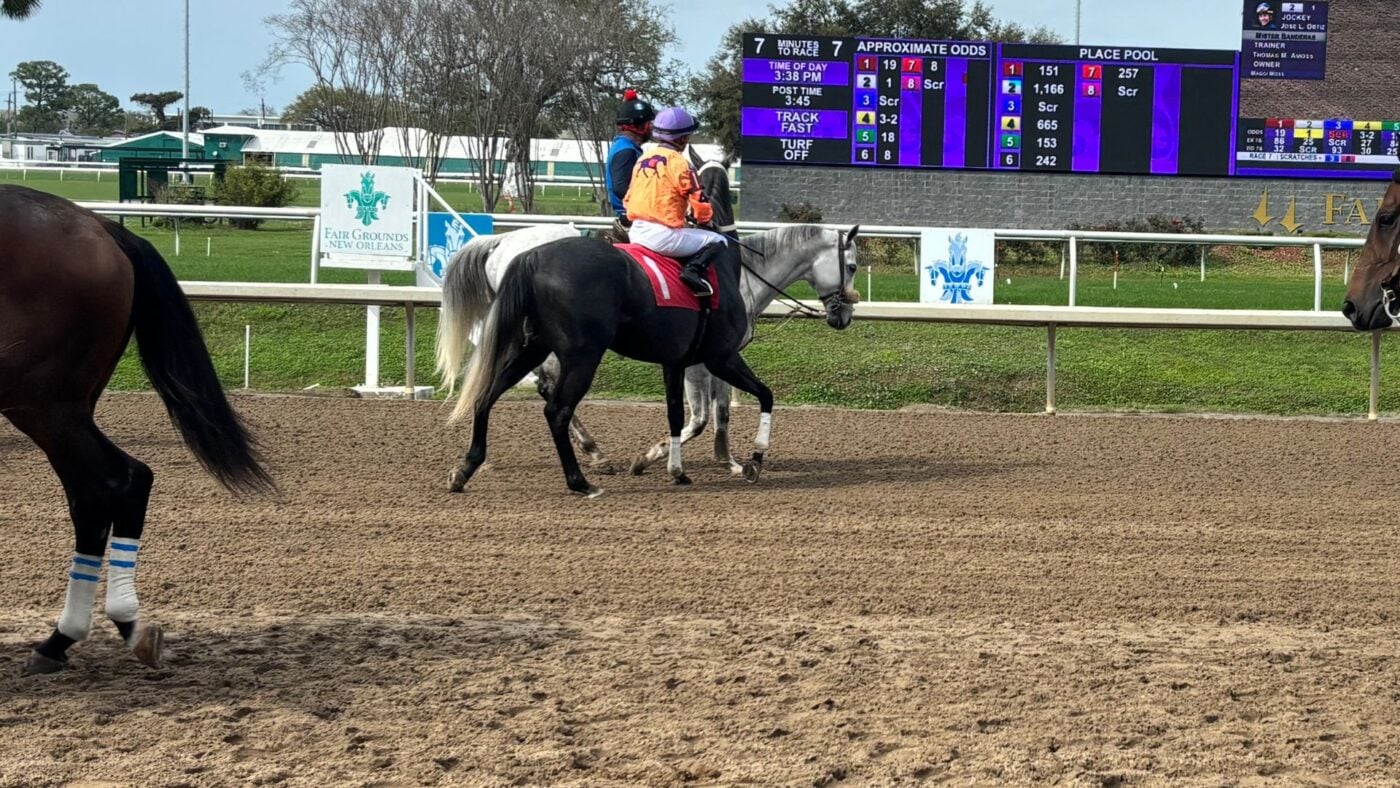
Tote board: The electronic board showing live odds and pool totals. The odds change as money comes in, right up until the race starts.
Win: Bet that pays if your horse finishes first. It’s the simplest bet in racing and usually carries the lowest takeout.
Place: A bet that pays if your horse finishes first or second. It cashes more often than a win bet, so it usually pays less.
Show: A bet that pays if your horse finishes first, second, or third. The payout depends on the pool, and on a heavy favorite it can be very small.
Across the board: Single wager covering win, place, and show simultaneously on one horse. At $2 each way, an across-the-board bet costs $6 total.
Exacta: Bet requiring the first and second place finishers in exact order. An exacta box covers both possible orders of two horses at double the cost.
Quinella: A bet requiring your two horses to finish first and second in either order. Unlike an exacta, you don’t have to pick which one wins.
Trifecta: Bet requiring the first three finishers in exact order. Can pay very large amounts in competitive fields. Trifecta boxes and wheels allow coverage of multiple combinations.
Superfecta: Bet requiring the first four finishers in exact order. Playable in ten-cent increments at many tracks. Large, competitive fields can produce six-figure payouts.
Pick 3 / Pick 4 / Pick 5 / Pick 6: Bets that require picking the winners of three, four, five, or six races in a row. When nobody hits a Pick 6, part of the pool can carry over to the next racing day.
Daily Double: Bet requiring winners in two consecutive designated races, usually the first two races of the card. Late Doubles cover later races.
Carryover: Money from a multi-race pool that nobody hit, added to that bet’s pool on the next racing day.
Favorite: The horse with the lowest odds, meaning the most money has been bet on him.
Longshot: A horse with high odds. Longshots don’t win often, but they can pay well when they do.
Overlay: A horse whose odds offer more return than you think its chance of winning justifies. If you figure a horse has a 25 percent chance and he’s 8-1, that’s value under your estimate. The hard part is getting the estimate right, and one race doesn’t prove you were right or wrong.
Underlay: A horse whose odds are shorter than you think its chance of winning justifies.
Coupled entry: Two or more horses from the same stable running in the same race and wagered as a single unit. A bet on the coupled entry wins if either horse finishes in the required position.
ADW (Advance Deposit Wagering): An account-based betting service where you deposit money before placing bets, usually through a website or app.
Handle: The total amount bet on a race or a racing card. It’s not the track’s profit.
Chalk: The favorite. “The chalk won” means the favorite won.
Odds-on: Odds below even money. At 1-2, a winning $2 bet earns $1 in profit and returns $3, including your original stake.
In the money (ITM): Finishing first, second, or third. “ITM percentage” measures how often a trainer’s or jockey’s horses finish in the top three. A trainer with 20% wins but 50% ITM puts horses in contention consistently.
Reading the tote board: Watch how the odds move in the minutes before post time, not just where they start. A horse drifting from 3-1 to 6-1 is getting a smaller share of the pool compared with the other horses, and one dropping from 10-1 to 5-1 is getting a bigger share. Neither move proves the horse is better or worse than you thought. The morning line is an early estimate, while the live odds show how the money is actually being bet.
Jockey and Trainer Terms
These terms cover the people who get a horse to the race and ride him in it. A jockey’s job goes well beyond the ride itself, and these racehorse jockey duties start long before post time.
Bug boy (Apprentice jockey): An apprentice jockey who gets a weight allowance until he or she has ridden a certain number of winners, usually 5 to 10 pounds depending on experience and state rules. The “bug” is the asterisk that marks apprentice riders in the program. Trainers often use a bug rider to get weight off a horse.
Journeyman jockey: A fully licensed jockey who has completed their apprenticeship and no longer receives the weight allowance.
Agent: A jockey’s business representative, responsible for securing riding engagements. A good agent maintains relationships with trainers and negotiates mounts. Top jockeys at major tracks have their choice of horses; lesser jockeys need their agent’s hustle to fill their book.
Valet: Track employee assigned to assist jockeys in the paddock and jockeys’ room, helping with equipment, weighing in and out, and keeping silks organized.
Silks: The distinctive colored and patterned jacket and cap worn by a jockey, representing the horse’s owner. Owners register their own colors and pattern. Silks are how viewers in the stands and on TV identify which horse is which during a race.
Riding instructions: The strategy communicated from trainer to jockey before a race, where to position, when to make a move, whether to rate the horse or let it run.
Hot horse: A horse that’s sweating heavily or acting nervous before a race. Some horses run fine that way, but others burn energy they’ll need later.
Trainer win percentage: The percentage of a trainer’s starts that ended in wins over a stated period. Check the number of starts too, since a high percentage from a handful of starts doesn’t mean much.
Equipment Terms
Equipment changes show up in the past performances, and they’re worth checking before you judge a horse’s last few races. The racehorse equipment guide goes into each piece in more detail.
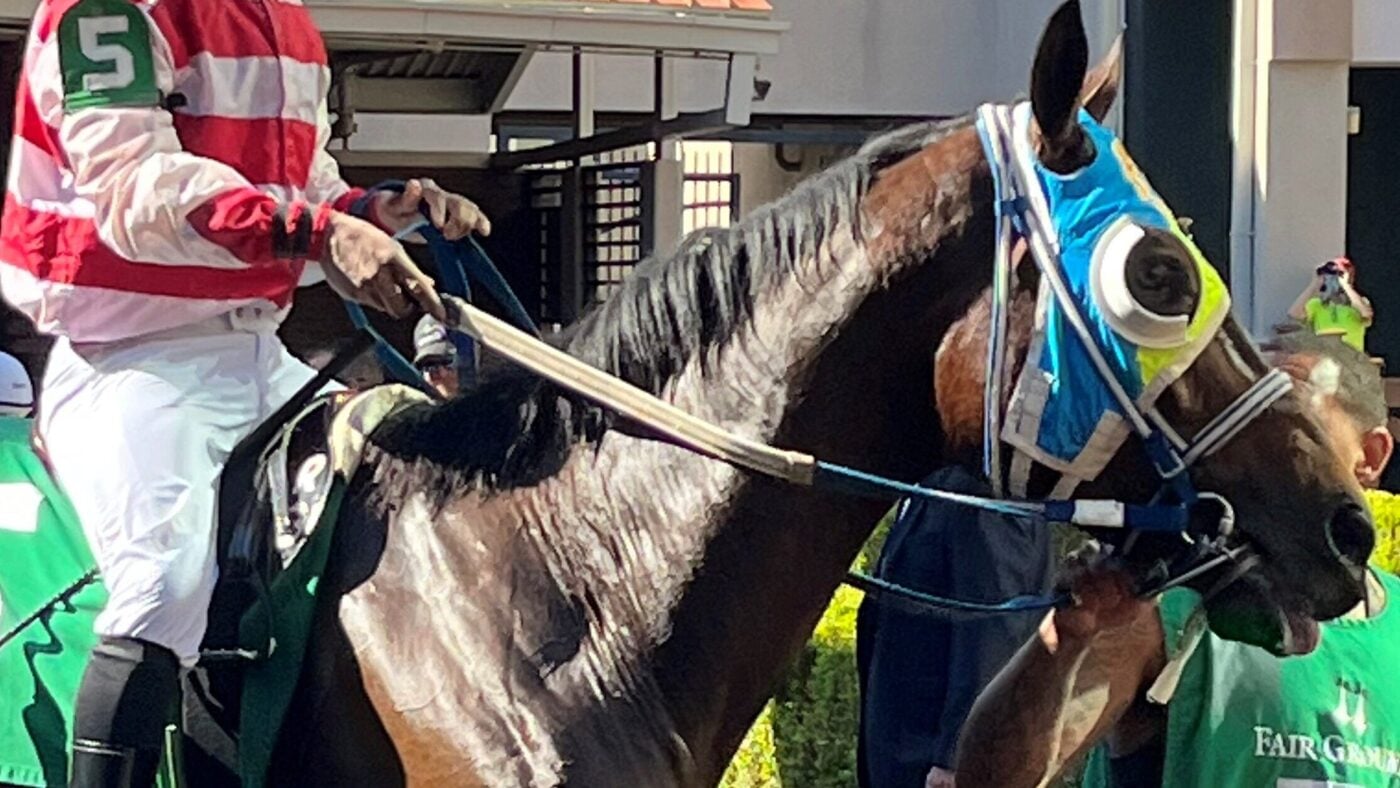
Blinkers: Cups attached to a hood that limit a horse’s side and rear vision. Trainers add them when a horse has been distracted, ducking in or out, or losing focus in the stretch, so first-time blinkers are worth noticing.
Shadow roll: A thick roll of sheepskin across the horse’s nose that blocks his view of the ground right in front of him. The main purpose of a racehorse shadow roll is to keep a horse from spooking at shadows or marks on the track.
Tongue tie: A strap or band that helps keep a horse’s tongue in place during a race so it doesn’t get over the bit. Trainers use a tongue tie on a racehorse for specific reasons, but seeing one listed doesn’t tell you how the horse will run.
Racing plates: Lightweight shoes, usually aluminum, that are much lighter than regular steel shoes. On turf, horses often wear different plate configurations than on dirt.
Bar shoes: Horseshoes with a bar across the back, providing additional support to the heel and frog of the hoof. Often used for horses with quarter cracks, bruised feet, or other hoof conditions requiring extra protection.
Martingale: A strap from the girth that limits how high a horse can carry his head. The type and purpose vary.
Figure-8 noseband: A noseband that crosses over the nose in a figure eight to help keep the horse’s mouth closed on the bit.
Ownership and Industry Terms
These terms cover the business side of racing, from sharing ownership to paying training bills, and they explain a lot about how much it costs to own a racehorse.
Owner: The person or entity that holds title to a racehorse. The owner pays the bills, including training, vet work, entry fees, and shipping, and collects the purse money the horse earns, minus the trainer’s and jockey’s shares.
Syndicate: A group of people who own a horse together. Each owner pays a share of the expenses and gets a share of any earnings.
Purse: The prize money for a race, distributed among the top finishers. The winner usually gets around 60 percent, with smaller shares down the order. Purses come from wagering and, in many states, casino or slot revenue.
Day rate: The daily charge for a horse in full training, covering stall, feed, daily care, exercise, and basic supplies. Day rates vary a lot by trainer and track, and vet bills, shoeing, and other costs come on top of it.
Claiming price: The listed price for a horse entered to be claimed. It’s separate from the purse, which is the prize money paid to the finishers.
Connections: A collective term for everyone involved with a horse, owner, trainer, jockey, assistant trainer, and groom. “The connections” made a decision means the owner-trainer team decided together.
Barn: The stable operation of a particular trainer, all horses under that trainer’s care are “in the barn.” A hot barn is one where the trainer is winning at a high rate.
Racing secretary: The track official responsible for writing the conditions for each race card, determining race types, purse amounts, weight conditions, and eligibility requirements. Also handles entries and scratches.
Condition book: The document published by the racing secretary listing races available for entry over upcoming weeks. Trainers study the condition book to identify the best spot for each of their horses.
Stakes nomination: Registering a horse for a stakes race, usually by paying a nomination fee before a deadline. A nomination doesn’t guarantee a spot in the starting gate, and entry or starting fees may also apply.
Breeding rights: The ownership of a share or entirety of a stallion’s reproductive output. When a syndicate purchases a retiring stallion, they’re typically buying “shares”, each share represents the right to one breeding per year.
Stud fee: The fee charged for a single breeding to a stallion. Stud fees range from a few thousand dollars for regional stallions to six figures for the top sires. A stallion with a valuable stud fee can earn far more in retirement than he ever earned on the track.
Past Performances and Handicapping Terms
Past performances, available in the Daily Racing Form, track programs, and most betting apps, are the main source of handicapping information. These are the terms you’ll need when you read a racing form or work with horse racing pace figures.
Past performances (PPs): The record of a horse’s recent races and workouts, printed in the program and the racing form. It’s where most handicapping starts.
Beyer Speed Figure: A number rating how fast a horse ran, adjusted for how fast the track was that day. Higher is better, so an 85 is faster than a 75. Comparing a horse’s last few figures shows whether he’s improving, slipping, or holding steady.
Pace figures: Speed ratings measured at intermediate points in a race, typically the half-mile and three-quarter-mile calls. Pace figures help identify how fast the early fractions were, which affects how closers and front-runners are likely to perform.
Class rating: A numerical representation of the quality of competition a horse has been facing. A horse running in high-grade claiming races has a higher class rating than one running in low-level maiden claimers.
Workout: A timed training run at the track, recorded by clockers and listed in the past performances with the date, distance, surface, and time. It’s one piece of information, not a guarantee the horse is ready. Learning to read horse racing workouts takes a little practice.
Breeze: A workout where the horse runs on his own without urging, marked “B” in the workout line. A “handily” work, marked “H,” means the rider asked him for more.
Layoff: A stretch of time when a horse hasn’t raced. When he comes back, his recent workouts and the reason for the break help you judge his chances.
Beaten lengths: How far a horse trails the leader at a call, or the winner at the finish, measured in lengths. A horse listed as second, beaten one length, finished a length behind the winner.
Equipment change notation: A note in the program or past performances that a horse is adding or removing equipment, such as blinkers on or off. It tells you the trainer is trying something different.
Wet-track record: A horse’s record on off (wet) tracks, shown in the past performances. It’s worth checking when the track is muddy or sloppy on race day.
Turf record: A horse’s record on grass. A horse trying turf for the first time is an unknown, while one with a good turf record has shown he handles the surface.
Jockey change: A different jockey riding the horse than in his last start. The reason may be availability, scheduling, or a decision by the connections.
Claimed out of: Notation indicating the horse was claimed from a previous owner in that race. Its first start for the new barn under new conditions is worth watching.
Bullet workout: The fastest workout at that distance at the track that day, marked with a bullet in the workout line. It doesn’t guarantee the horse will run well.
Trip: The path a horse travels during a race and the obstacles it encounters. A “good trip” means the horse got clear running room. A “bad trip”, interference, getting stuck behind horses, forced wide, may explain a poor finish and make the horse interesting next time.
Wide trip: Running several paths off the inside rail, covering extra ground throughout the race. A horse that ran four wide around both turns traveled significantly farther than the winner. Wide trips often explain losses the result line doesn’t reflect.
Bounce: A poor performance following an exceptionally good effort, the horse “bounced” off a career-best race. Not every handicapper believes in it.
Form cycle: Whether a horse’s recent races show him improving, holding steady, or declining. Speed figures over his last few starts are one common way to judge it.
Stretch run: The final straight section of the track from the last turn to the finish wire. The stretch is where races are decided, where closers make their move and front-runners try to hold on.
Handicapper: A person who analyzes races and assigns relative abilities to horses to predict outcomes.
Pace scenario: The expected early speed in a race, meaning how many horses want the lead and how fast they’re likely to go. A lone speed horse may control a slow pace, while several speed horses fighting up front can set things up for closers. It’s the heart of pace handicapping.
Track bias: A tendency for a track to favor certain running styles or paths. A speed bias favors horses near the lead, and a rail bias favors the inside. It takes a pattern across several races, not one or two results, to show a bias.
BRIS speed figures: An alternative to the Beyer Speed Figure, produced by Bloodstock Research Information Services. BRIS and Beyer figures measure adjusted race speed using different methodologies and can diverge significantly on individual performances. Timeform US provides a third variant that incorporates race shape more heavily. Many handicappers compare more than one.
Rate: The act of restraining a horse early in a race to conserve energy for a later run. Horses that can be rated typically have more tactical options than pure front-runners.
Front-runner: A horse that runs best when on or near the lead from the start. Front-runners are vulnerable when the pace is fast. They’re most dangerous in fields where no one challenges them for the lead.
Presser: A horse that runs just off the lead. Pressers often benefit when the front-runner tires, since they’re already in position to inherit the lead.
Closer: A horse that runs near the back early and makes a late run. Closers usually need a fast early pace to wear down the leaders.
Reading a past performance line: Don’t stop at the finish position. Check the speed figures to see if the horse has been competitive lately, look at the recent workouts, and compare the finish with the beaten lengths. Second by a nose and second by eight lengths look the same in the finish column, but they’re very different races.
Most Confusing Horse Racing Terms
These pairs trip up a lot of new fans because they sound alike or show up in the same place.
Commonly confused horse racing terms
Term 1
Term 2
The difference
Exacta
Quinella
An exacta needs your two horses to finish first and second in exact order. A quinella pays if they finish first and second in either order.
Maiden special weight
Maiden claiming
Both are for horses that have never won. In a maiden claiming race, every horse can be claimed. In a maiden special weight, none can.
Morning line
Live odds
The morning line estimates how the public will bet. Live odds change as wagers come in, and your payout is based on the final odds, not the morning line.
Inquiry
Objection
The stewards start an inquiry on their own. An objection is a claim of foul, usually from a jockey. Either one keeps the result unofficial until the stewards rule.
Claiming price
Purse
The claiming price is what it costs to buy a horse out of a claiming race. The purse is the prize money paid to the finishers.
Filly
Mare
Both are female. A filly is four or younger, and a mare is five or older.
A to Z Horse Racing Terms Index
Find a term fast, then jump straight to its definition.
Gambling disclaimer: Betting on horse racing involves real financial risk, and this glossary is for education only. The takeout reduces what’s paid back to winning tickets, so making money over time means finding bets that offer value after that cut. Only bet what you can afford to lose. If gambling becomes a problem, contact the National Council on Problem Gambling at 1-800-GAMBLER.
Racehorse Owner & Author | 30+ Years in Thoroughbred Racing
Miles Henry (legal name: William Bradley) is a professional horseman based in Folsom, Louisiana. He holds Louisiana Racing License #67012 and has spent over three decades managing Thoroughbreds at premier tracks including Fair Grounds, Delta Downs, and Evangeline Downs. Expertise & Hands-On Experience: Beyond the track, Miles has decades of experience in specialized equine care, covering everything from hoof health and nutrition to training protocols for Quarter Horses, Friesians, and Paints. Every guide on Horse Racing Sense is rooted in this “boots-on-the-ground” perspective. 30 of their last 90 starts Equibase Profile.