

Last updated: September 5, 2026
Any links on this page that lead to products on Amazon are affiliate links and I earn a commission if you make a purchase. Thanks in advance – I really appreciate it!
I do most of my riding in Western tack, but a good saddle pad has the same basic job in any discipline: it must fit the saddle, stay clear of the withers and spine, and be easy on the horse’s back. Dressage adds one extra consideration for riders headed to recognized shows—your pad should be white or a conservative color under USEF rules.
I’m not a dressage trainer, and I haven’t owned every pad on the market. I do know horses, tack decisions, and what happens when an owner spends money trying to solve a problem that starts with saddle fit, conditioning, or soundness. That is the lens I used in narrowing these three choices.
The best dressage saddle pads aren’t necessarily the thickest or most expensive ones. For most riders, I’d start with a pad cut correctly for a dressage saddle, a contoured spine that doesn’t pull down on the withers, and a lining that holds up to regular washing. The three below stand out for different jobs: a polished everyday and show option, a more substantial, supportive option for a rider working through back-comfort concerns with the right professional help, and a dependable competition-ready pad. For recognized shows, keep the color white or conservative – more on that below.
Comparing the Three
| Pad | Best For | What Stands Out | Watch Before Buying |
|---|---|---|---|
| WeatherBeeta Satin Luxe Air-Tec Dressage Saddle Pad | Riders wanting one polished pad for schooling, lessons, and lower-key showing | Satin outer, breathable bamboo lining, Air-Tec mesh spine, and a dressage-specific cut | For recognized shows, verify that the available color is white or clearly conservative under current USEF rules |
| Back on Track No. 1 Dressage Saddle Pad | Riders already addressing a horse’s back-comfort concerns with a qualified professional | Cotton and Welltex construction designed for breathability, shock absorption, and pressure distribution | A supportive pad cannot correct an ill-fitting saddle or replace a veterinary or saddle-fitting evaluation |
| LeMieux ProSport Suede Dressage Square | Riders wanting a traditional, competition-ready pad with familiar dressage styling | Suede top, bamboo lining, high-wither swan-neck cut, elasticated D-ring tabs, and reinforced girth protection | Compare the listed spine length and drop with your own saddle before ordering; fit varies among pad models |

Three Dressage Saddle Pads Worth Considering
WeatherBeeta Satin Luxe Air-Tec Dressage Saddle Pad

If you landed here looking for the older WeatherBeeta Regal Luxe dressage pad—the satin pad with the monogrammed crown quilting—the closest current WeatherBeeta option I found is the Satin Luxe Air-Tec. It has the same dressier satin look but adds a breathable bamboo lining and an Air-Tec mesh spine, and the dressage cut is made for the longer, straighter flap of a dressage saddle.
If you already own a Regal Luxe, I wouldn’t replace it just because WeatherBeeta updated the line – a clean, well-fitting pad matters more than having the newest model. But if you’re buying new, this is the direction I’d look. Before taking any colored version to a recognized show, check the current rulebook and your show’s requirements; white remains the no-argument choice.
Best for: riders who want one smart-looking pad for lessons, schooling, and lower-key showing.
Back on Track No. 1 Dressage Saddle Pad
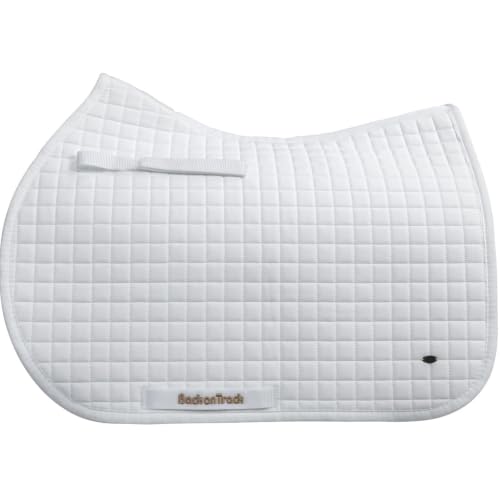
Back on Track’s dressage pad uses cotton and Welltex construction, positioned by the manufacturer for breathability, shock absorption, and pressure distribution. It may be worth considering for a horse that benefits from a more supportive-feeling pad, but I wouldn’t buy any therapeutic pad as a first fix for a sore horse. Saddle fit, teeth, feet, workload, and a veterinary evaluation come before changing pads – a sore back is a reason to look at the whole picture, not simply add more padding underneath the saddle you already have.
Best for: riders who are already working with a saddle fitter, veterinarian, or qualified bodyworker on a horse whose back comfort needs closer attention.
LeMieux ProSport Suede Dressage Square Saddle Pad
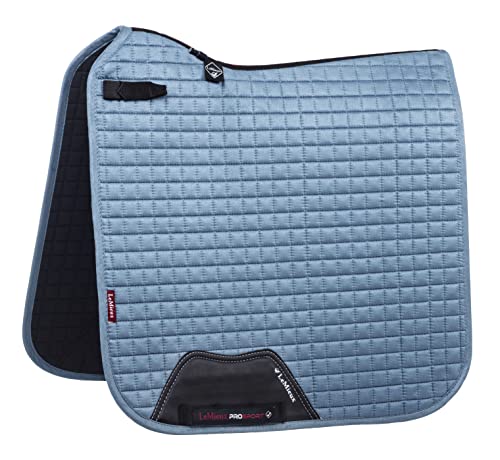
This specific LeMieux model has a suede top with a soft bamboo lining, a high-wither, swan-neck cut designed to keep pressure off the withers, elasticated D-ring tabs, and a reinforced girth protection area. The reason I like this style of pad is simple: it does its job without becoming the main event. A good show pad should disappear under the saddle – no slipping, bunching, or constant adjustment. Check the pad’s exact spine length and drop against your own saddle before ordering, since fit varies by model even within one brand.
Best for: riders who want a traditional, well-documented dressage pad with familiar show-ring styling.
What Color Saddle Pad Is Allowed for Dressage?
The current USEF guidance allows crystals or reflective material on the pad’s borders, but glitter or reflective pads themselves are not permitted. Brand marks or non-sponsor logos may be up to 50 square centimeters (about 7.75 square inches). In the competition ring and during awards, a permitted logo, monogram, or name may appear on either or both sides and may be up to 200 square centimeters (about 31 square inches). Check the current rulebook before competing, because the permitted names and logos depend on the rider’s status and the type of mark.
Leave the fluorescent colors, glitter, holographic finishes, and loud patterns for home. If you want a logo, farm name, or sponsor mark, check the current rulebook for the exact size and eligibility rules before you compete. At schooling shows and local unrecognized shows, read the prize list or ask the organizer – policies can be more relaxed, but they aren’t always identical from one show to the next.
A Saddle Pad Cannot Fix Saddle Fit
A pad should protect the horse’s skin, manage sweat, and provide the amount of cushioning that suits the horse and saddle. It shouldn’t be used to make a narrow, wide, bridging, rocking, or otherwise ill-fitting saddle acceptable. If the saddle is pinching, dropping onto the withers, leaving dry pressure spots, or making your horse sore, get the saddle assessed before shopping for a thicker pad.
What Actually Matters When Choosing a Pad
- Use a true dressage cut. The pad should follow the longer, straighter flap of a dressage saddle. A jumping or all-purpose pad may technically sit underneath, but it often leaves the flap unsupported or looks untidy.
- Protect wither and spine clearance. Pull the pad up into the gullet before you girth up. It shouldn’t be drawn tight over the withers or pressed down onto the spine.
- Choose thickness carefully. More padding isn’t automatically kinder. A thick pad can alter saddle balance or make a saddle tighter, especially on a horse with a broad back or limited wither clearance.
- Match the lining to your routine. A pad used every day needs to wash easily and dry reasonably fast. A pad used only for showing can lean more toward a crisp finish, provided it still fits correctly.
- Buy for the horse and saddle you have. Check both spine length and drop, then look at how the pad actually lies under your saddle – not just how it looks folded on a tack-shop shelf.
A More Expensive Pad Isn’t Always the Right Answer
Buying based on appearance alone, reaching for a thicker pad to mask a saddle-fit problem, or grabbing a pad shaped for the wrong saddle type are the mistakes I see most often. None of those problems get solved by spending more – they get solved by matching the right pad to the saddle and horse you actually have, and fixing the saddle-fit issue directly if that’s what’s really going on.
This short video on fitting a dressage saddle is worth watching alongside your pad choice – pay attention to wither clearance, a raised spine channel, and making sure the pad isn’t pulled tight into the withers, since those are the same things that matter when a pad is doing its job correctly.

Best Dressage Saddle Pads: FAQs
What color saddle pad is best for dressage?
White is the standard, safest choice at USEF-recognized competitions, since the rule requires white or a conservative color. Crystals or reflective material on the borders are allowed, along with a logo or monogram up to 50 square centimeters per side. Bright, patterned, glittery, or holographic pads generally aren’t considered conservative.
Can you use a black saddle pad in dressage?
At a USEF-recognized competition, a plain black pad can fall within the rule allowing white or a conservative color. White is still the traditional, no-question choice, especially for riders new to recognized competition. Avoid striped or multicolored pads, and remember that glitter and reflective pads are not permitted, although crystals or reflective material on the borders are allowed. For a schooling or unrecognized show, read the prize list or ask the organizer because local expectations can differ.
Can you use a dressage pad with an all-purpose saddle?
Usually not the best choice. Saddle pads are cut to match specific saddle shapes, and a dressage pad’s longer, straighter cut is built for a dressage saddle’s flap. An all-purpose saddle has a more forward flap, so an all-purpose pad will usually fit and look better under it.
What’s the difference between a dressage saddle pad and a jumping saddle pad?
Mainly the cut. A dressage pad is longer and straighter to match a dressage saddle’s flap, while a jumping pad is shaped for a shorter, more forward flap. Materials and thickness vary by model in both categories, but getting the shape right for your saddle matters more than the fabric.
Do I need a thick dressage saddle pad?
Not necessarily. The right pad is the one that fits cleanly under a correctly fitted saddle without reducing wither or spine clearance. A thicker pad may help in a specific situation, but it can also make a saddle tighter or change its balance. When in doubt, have the saddle fit checked before adding bulk underneath it.
Start with a pad that’s cut correctly for your dressage saddle and leaves proper clearance at the withers and spine. For recognized shows, white is the safe choice. After that, buy based on the horse’s sensitivity, your saddle’s fit, and whether you need an everyday work pad or one you can keep clean for competition.
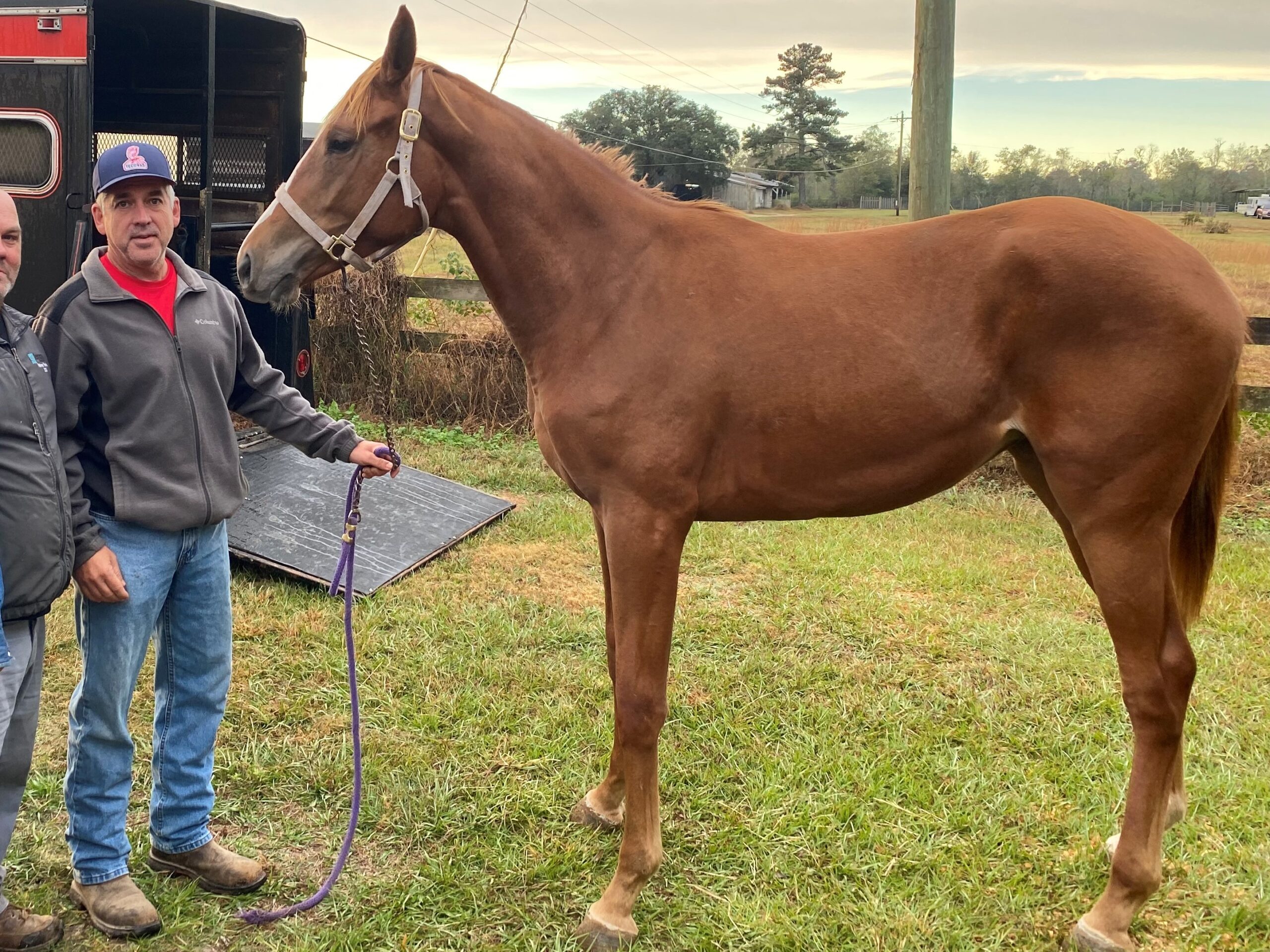
About Miles Henry
Racehorse Owner & Author | 30+ Years in Thoroughbred Racing
Miles Henry (legal name: William Bradley) is a professional horseman based in Folsom, Louisiana. He holds Louisiana Racing License #67012 and has spent over three decades managing Thoroughbreds at premier tracks including Fair Grounds, Delta Downs, and Evangeline Downs.
Expertise & Hands-On Experience: Beyond the track, Miles has decades of experience in specialized equine care, covering everything from hoof health and nutrition to training protocols for Quarter Horses, Friesians, and Paints. Every guide on Horse Racing Sense is rooted in this “boots-on-the-ground” perspective.
30 of their last 90 starts
Equibase Profile.

Connect with Miles: