Skip to Content

The Friesian Horse: Temperament, Health Risks, Cost, and Care

The Friesian Horse: Temperament, Health Risks, Cost, and Care

Last updated: May 12, 2026

By: Miles HenryFact Checked

What is a Friesian horse? The Friesian is a baroque warmblood from Friesland, Netherlands — recognized by its jet-black coat, flowing mane and tail, feathered legs, and high-stepping trot. Gentle, intelligent, and willing, Friesians excel in dressage, driving, and leisure riding. Average lifespan is 16–20 years — shorter than most breeds — due to genetic health risks every buyer must understand before purchasing.

Bottom line for buyers: Exceptional horses with real vulnerabilities. Genetic testing, KFPS paper verification, and a cardiac pre-purchase exam are non-negotiable. Budget $20,000–$50,000+ for a quality registered horse and $5,000–$15,000 per year in upkeep.

I’ve worked around Thoroughbreds, Quarter Horses, and warmbloods for 30 years in Louisiana. Friesians stand apart for their intelligence, movement, and presence — but they also require more informed management than most breeds. Before buying one, you need to understand the breed’s health risks, grooming demands, registration standards, and long-term costs.

Friesian horse breed — quick facts
Characteristic Detail
Height 14.3–17 hands (58–68 inches)
Weight 1,200–1,500 lbs (544–680 kg)
Lifespan 16–20 years — shorter than average; see health section
Origin Friesland, Netherlands
Color Solid black only (KFPS); chestnut exists but is excluded from the studbook
Temperament Gentle, intelligent, willing, sensitive, eager to please
Disciplines Dressage, driving, film, leisure riding, historical reenactment
Registry KFPS (Netherlands); FHANA (North America)
Primary health risks Dwarfism, hydrocephalus, megaesophagus, aortic rupture — restricted gene pool breed
Purchase price $8,000–$15,000 (Studbook); $20,000–$50,000+ (Star/Crown/Model); $100,000+ (elite)

About this guide: Written by Miles Henry, Louisiana horseman with 30 years of experience working with Thoroughbreds, Quarter Horses, and performance breeds. Genetic and health data sourced from the UC Davis Veterinary Genetics Laboratory, KFPS, and FHANA.

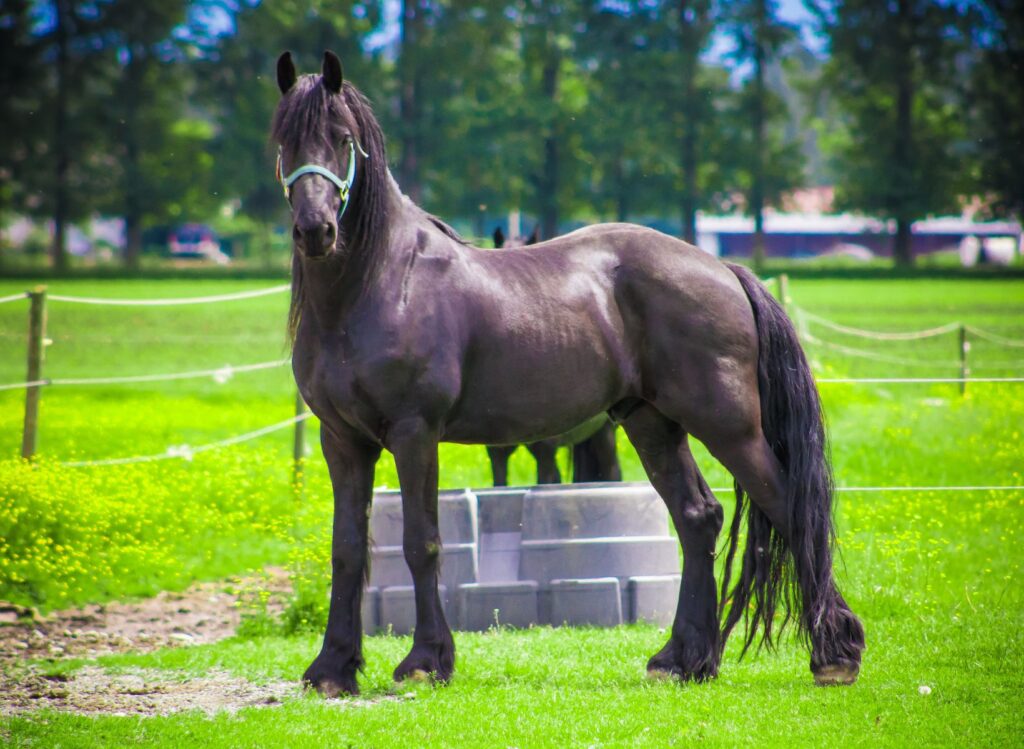
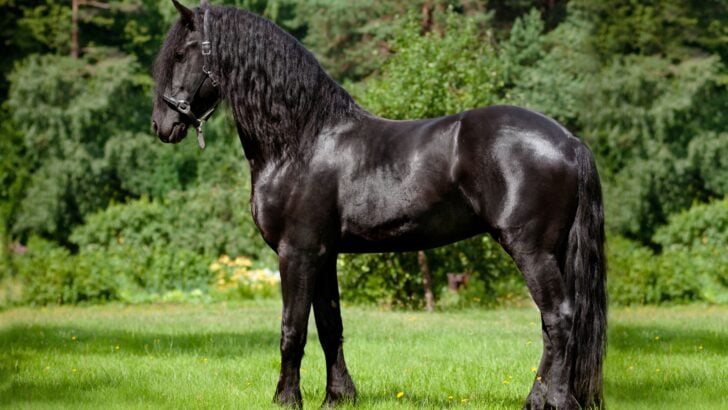
Friesian horse breed stallion standing in pasture showing jet-black coat arched neck and baroque build
Friesian stallion displaying the breed’s defining characteristics — jet-black coat, high-set arched neck, and muscular baroque build recognized in KFPS keuring evaluations worldwide.

History and Origins

Friesland, a coastal province in the northern Netherlands, has produced heavy horses since at least the 4th century. By the Middle Ages they were carrying armored knights — valued equally for strength under load and composure under pressure. Spanish occupation in the 16th and 17th centuries introduced Andalusian blood, which contributed the elevated, suspended trot still rewarded in modern dressage arenas today.

Mechanization nearly ended the breed entirely. By 1913, only three purebred stallions remained: Tetman 205, Age 168, and Ritske 202. Every Friesian alive today descends from those three horses. That single fact explains both the breed’s remarkable consistency in type and the health vulnerabilities covered later in this guide.

Worth knowing: The extreme founder effect of 1913 is not ancient history — it is the direct cause of the dwarfism, aortic rupture, and megaesophagus risks in the health section. That context makes genetic testing a requirement, not an option.

Post-WWII studbook reforms by the KFPS rebuilt the population to 45,000+ registered horses today — one of the most successful breed conservation efforts in equine history, and one that came with lasting genetic consequences buyers still navigate.

Friesian horse breed in historical warhorse context representing medieval origins and breed development
Medieval warhorse role that shaped the Friesian breed — the strength for armored riders and composure under battlefield conditions became defining traits that persist in the modern horse.

Physical Characteristics

Baroque warmblood is the accurate classification — not draft horse, despite the size. The build reflects warhorse utility refined over centuries for elegance and movement.

Five defining physical traits:

  • Coat and color: Solid jet black — the only color accepted in KFPS registration; coat color genetics in this breed are tightly controlled, and sun bleaching is a genuine management issue in hot climates
  • Mane and tail: Long, thick, and flowing — detangle by hand from the ends only; brushing from the root causes breakage, particularly in humid conditions where hair is more brittle
  • Feathered legs: Silky, abundant hair from knee and hock to hoof; traps moisture and raises dermatitis risk significantly — daily brushing and weekly skin inspection are non-negotiable
  • High-stepping trot: Elevated, suspended movement with long stride; the primary reason the breed dominates in dressage and driving evaluations
  • Arched neck and baroque build: High-set neck, muscular frame, expressive head with straight profile; stallions typically taller and more crested than mares

Feathering alert — dermatitis risk: Leg feathering traps moisture against the skin, significantly increasing pastern dermatitis (scratches/mud fever) risk. Untreated, it causes pain, lameness, and skin damage that is difficult to reverse. Drying legs after every wet turnout and inspecting under the feathers at each grooming session are essential — not optional.

Friesian horse breed in full profile showing muscular baroque build jet-black coat and feathered legs characteristic of the breed
Friesian in full profile showing the combination of baroque muscle, high-set arched neck, and abundant leg feathering — physical traits that require both admiration and active daily management.

KFPS Registry and Predicate Standards

The KFPS enforces some of the strictest breeding standards in the equine world through an annual inspection called keuring — Dutch for inspection. Movement counts double in scoring. A horse with exceptional gaits can achieve Star status even when conformation is average, which is why you will find Friesians with spectacular trots and ordinary frames commanding premium prices.

KFPS predicate system — quality rankings and buyer price guide
Predicate Requirements Price Impact
Foal Book Purebred parentage, no major defects Entry level — starting point for all registered Friesians
Studbook Solid black, physically sound, 3+ years old, minimum height $8,000–$15,000 typical range
Star (Ster) 70+ points on conformation and movement; height minimums (61.4″ mares, 62.2″ stallions) Above-average quality — premium pricing begins here
Crown (Kroon) Star + 77+ score on ridden IBOP performance test Proven rideability — $30,000–$50,000+
Model Crown + produced quality offspring Elite breeding mare — $50,000+
Preferent Produced 4+ Star or higher offspring Highest honor — proven genetic influence on the breed

What most buyers miss about predicates: A horse advertised as a “registered Friesian” with no predicate listed is Studbook or Foal Book level. Fine horses exist at that tier — but the price must reflect it. I have seen buyers pay Crown money for Studbook horses because they did not know to ask. Verify all documentation through FHANA before any offer.

Friesian horse breed mare and foal demonstrating breed characteristics evaluated in KFPS keuring inspections
Friesian mare and foal — foal book registration is the starting point; the predicate earned through keuring inspection determines breeding eligibility and resale value for the life of the horse.

Temperament and Behavior

Gentle, intelligent, eager to please. Those descriptors appear in every Friesian write-up for good reason — they are accurate. What the standard breed guides do not explain is what that sensitivity looks like day to day.

A 4-year-old Friesian gelding I worked with at a dressage clinic retained his entire routine after a two-week layoff without a single refresher. No backing up, no resistance, no confusion. Just quiet retention. That is typical of the breed. The same intelligence means erratic handling or rushed training creates anxiety faster than it would in a less sensitive warmblood. They reward patience and punish shortcuts — consistently.

One thing I tell first-time Friesian owners: do not mistake willingness for simplicity. These horses read their riders closely. When I hauled a mare to a new facility last spring, she spent the first 20 minutes cataloguing every unfamiliar sound and smell before relaxing completely. That kind of deliberate intelligence requires a handler who responds in kind.

Miles’s Training Principle: Smart enough to get bored with drilling, sensitive enough to resist under pressure. Rotate between dressage, trail, and driving work. A rushed Friesian is a resistant Friesian — a confident Friesian is one of the most rewarding horses you will ever ride.

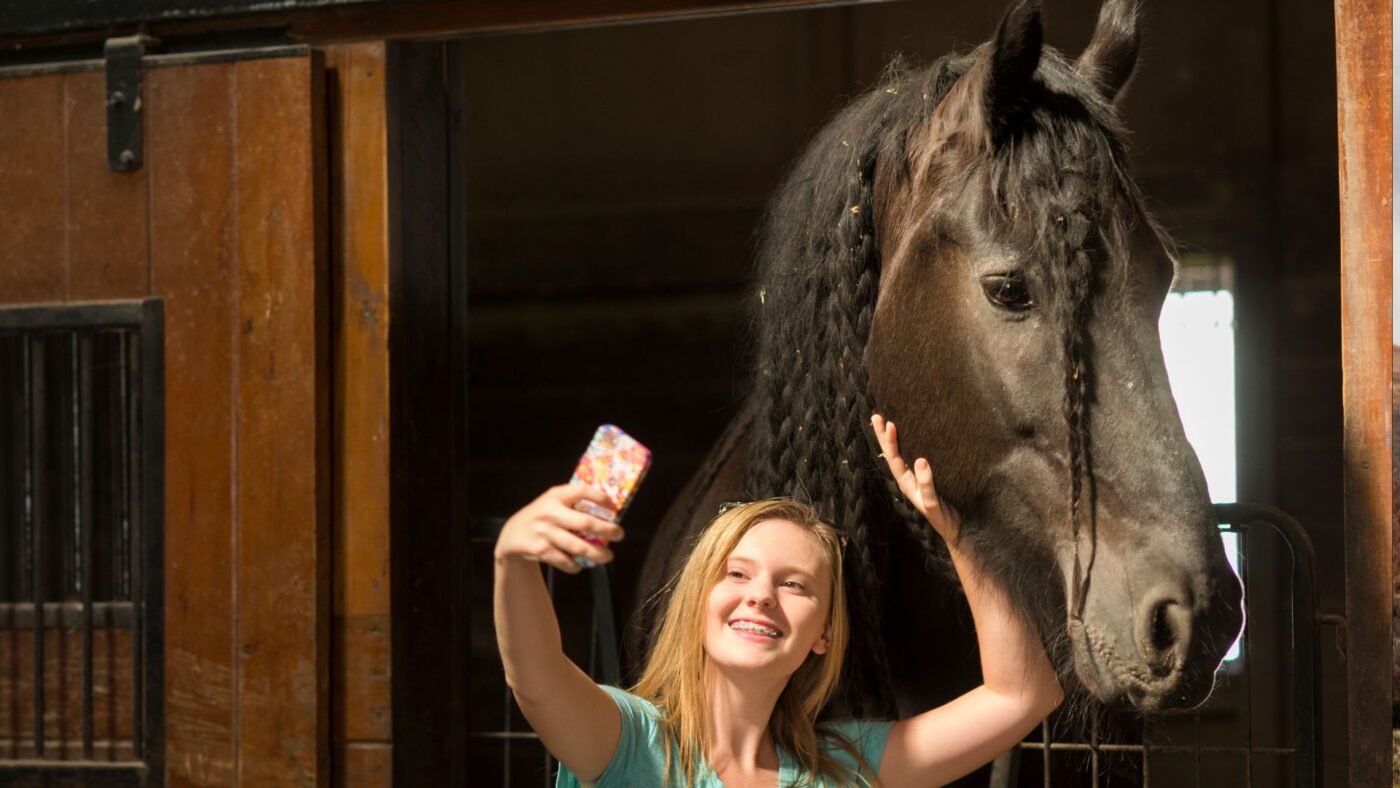
Friesian horse breed with child demonstrating the breed's gentle willing temperament and people-oriented nature
Friesian bonding with a young handler — the breed’s people-oriented temperament is a genuine trait documented across disciplines and experience levels, not marketing language.

Versatility and Disciplines

More versatile than the reputation suggests. Their historical roles as warhorses and carriage horses shaped a horse that adapts across performance and leisure demands — not a one-discipline breed despite what you might see at breed shows.

Where Friesians excel:

  • Dressage: Natural collection, elevated trot, and trainability make them competitive at classical and mid-level amateur levels; see our dressage breed guide for comparison
  • Driving and carriage work: Historically their primary role — strength, stamina, and striking appearance make them first choices for combined driving and ceremonial turnouts
  • Film and media: The jet-black coat and expressive movement have made Friesians the default warhorse on film sets for decades; demand for trained Friesian actors is consistently high
  • Trail and leisure riding: Calm, loyal, and intelligent; well-suited for confident amateurs who want a horse with presence and a steady mind on varied terrain
  • Historical reenactments: Authentic medieval heritage makes them the natural choice for mounted reenactments, parades, and living history events
Black Friesian horse breed in carriage driving harness demonstrating the breed's historic role and natural strength
Friesian in carriage driving harness — historically their most prominent working role, and still a discipline where the breed’s strength, presence, and trainability are fully expressed.

Genetic Health Risks

The restricted gene pool from the breed’s three founding stallions means four conditions appear at rates significantly higher than in other breeds. Know all four before you buy.

The four genetic health risks every Friesian buyer must know:

  • Dwarfism: Up to 20% of the breed carries this recessive gene. Two carriers produce a 25% chance of an affected foal — short limbs, enlarged head, spinal deformities. A $25 hair sample from UC Davis VGL identifies carrier status. Test before breeding — no exceptions.
  • Hydrocephalus: Cerebrospinal fluid accumulation that enlarges the skull and severely complicates foaling. Requires two carrier parents. Prenatal testing is available and strongly recommended for all breeding pairs.
  • Megaesophagus: Malfunctioning esophagus causing regurgitation, aspiration pneumonia, and weight loss. Research confirms Friesians are disproportionately affected compared to other breeds.
  • Aortic rupture: Genetic connective tissue weakness that can cause sudden death in otherwise healthy horses. Estimated 1–2% breed incidence. Primary contributor to the shortened average lifespan of 16–20 years versus 25–30 for most light breeds. Source: Utrecht University.

A veterinarian I work with in Louisiana has seen three Friesian cases in the past five years where owners presented horses with advanced megaesophagus — all purchased without health history and all showing signs that had been developing for months. None were emergency cases by the time they arrived. All were expensive to manage and one did not recover. Early detection changes outcomes dramatically.

Bottom line on Friesian health: These risks are elevated, not inevitable. Most severe outcomes are linked to uninformed breeding, delayed diagnosis, or inconsistent management — all preventable. Responsible ownership produces healthy Friesians that live full, comfortable lives.

Health management checklist:

  • Genetic testing before purchase: Request dwarfism and hydrocephalus carrier status; run UC Davis tests if not provided ($25 per test from a hair sample)
  • Annual veterinary exam: Include cardiac evaluation; ask your vet specifically about Friesian predispositions — not all equine vets are equally familiar with the breed
  • Feather inspection weekly: Check skin under feathering for moisture, odor, scaling, or heat; early pastern dermatitis is treatable in days; advanced cases mean weeks of stall rest
  • Weight monitoring: Target body condition score 4–5; use slow feeders or a grazing muzzle before laminitis risk develops
  • Veterinary insurance: Strongly recommended; see our equine insurance guide for coverage options specific to breed health risks

Grooming, Nutrition, and Daily Management

Plan for 20–30 minutes of hands-on care daily. Not grooming for appearance — grooming for health. Unchecked moisture under the feathering can lead to pastern dermatitis within days.

Daily Grooming Priorities

What cannot be skipped:

  • Feathers: Brush daily to remove trapped moisture and debris; rinse weekly — not daily, overwashing strips natural oils; inspect skin underneath at every session for early dermatitis signs
  • Mane and tail: Detangle by hand starting from the ends; never from the root; avoid tight braiding that stresses the hair shaft during humid months especially
  • Coat: Curry and brush for circulation; fly sheets in summer prevent sun bleaching — a real issue in southern climates, not just a show concern
  • Hooves: Pick and inspect daily; trim every 6–8 weeks; your farrier needs to be comfortable working around heavy feathering or appointments run long and get expensive

From the barn: Feather dermatitis moves fast. I had a horse that looked completely fine leaving the paddock on a Monday. Four consecutive rainy afternoons later, scaling and heat under both hind fetlocks. Caught early it resolved in a week — medicated wash, daily drying, nothing dramatic. Miss it by another week and you are looking at stall rest, veterinary treatment, and a horse that is sore to the touch. Check under the feathers every single session. Not when something looks wrong. Every session.

Nutrition Guidelines

Friesians gain weight fast. Faster than many owners expect. In Louisiana summers I have seen mature geldings hold ideal condition on quality coastal hay and a ration balancer alone — no concentrate at all. The primary nutritional risk is overfeeding, which leads directly to metabolic issues and laminitis. Base the diet on grass hay, a vitamin/mineral balancer, and loose salt. Add grain only for horses in consistent heavy work, using fat and fiber sources — beet pulp, flaxseed, oil — rather than high-starch feeds.

Bottom line on Friesian feeding: Weigh hay, monitor body condition score monthly, and act at 6 — not 7. A grazing muzzle introduced before the problem develops is far easier than managing a horse already heading toward metabolic trouble.

Two Friesian horses moving freely during daily turnout showing the breed's natural high-stepping gait and energy
Friesians at turnout showing natural elevated movement and energy — daily turnout is essential for this breed’s mental and physical health; stall confinement without adequate movement increases stress and metabolic risk.

Ownership Costs and Buying Guide

Significant financial commitment at every stage. The purchase price is just the entry point. Know the full picture before you fall in love with a horse you cannot sustain.

Friesian horse — annual ownership cost breakdown
Category Annual Cost (USD) Notes
Feed and forage $1,500–$4,900 Easy keepers — quality hay is the foundation; limit concentrates
Supplements $300–$1,000 Vitamin/mineral balancer; coat and feather support products
Routine veterinary care $500–$1,500+ Include annual cardiac screening; find a vet with Friesian experience
Farrier care $350–$1,200 Every 6–8 weeks; feathered legs add time and sometimes cost per visit
Grooming supplies $200–$800 Daily mane and feather care products; show grooming adds cost
Boarding $3,000–$12,000+ Highly regional; a facility experienced with feathered breeds is worth finding; see our horse boarding cost guide
Emergency / genetic health $500–$5,000+ Budget specifically for breed health risks; veterinary insurance strongly recommended
Total annual estimate $5,000–$15,000+ Higher for active show or breeding horses

Pre-purchase checklist — three non-negotiables:

  • Verify predicate and KFPS papers: Confirm level through FHANA or KFPS directly; predicate must match asking price — no exceptions
  • Request genetic test results: Dwarfism and hydrocephalus carrier status documented; if not provided, run UC Davis tests ($25 each) before any money changes hands
  • Full pre-purchase veterinary exam: Include cardiac evaluation and ophthalmic check; any murmur warrants a specialist consult given aortic rupture risk in this breed
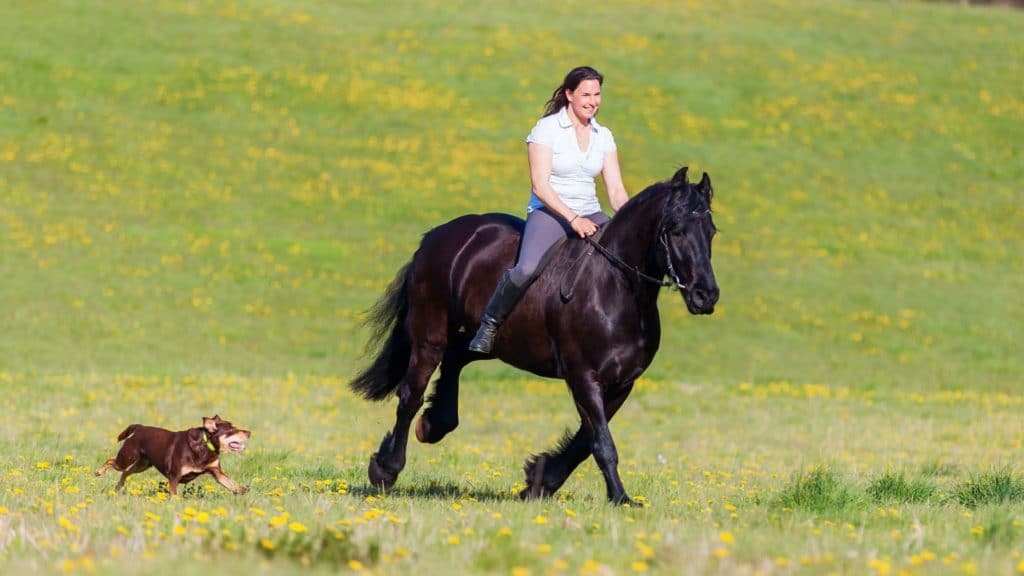
Friesian horse breed under saddle demonstrating elevated trot uphill movement and willing temperament
Friesian gelding demonstrating the elevated trot and uphill movement prized in both dressage competition and KFPS keuring scoring — the same traits that make this breed so visually distinctive under saddle.

Who Should NOT Buy a Friesian?

Most breed guides sell you on the horse. This section does the opposite. Friesians are genuinely wrong for certain buyers, and knowing that before purchase protects both owner and animal.

Do not buy a Friesian if you are:

  • Looking for a low-maintenance horse: The daily grooming demands alone — feathers, mane, tail, coat — are substantial. If your schedule allows only occasional check-ins, this is not the right breed.
  • On a tight budget: Purchase price is just the beginning. Between feather-specific farrier work, annual cardiac screening, breed health veterinary costs, and grooming supplies, annual ownership runs $5,000–$15,000 before boarding. Budget shortfalls create welfare problems.
  • Wanting an endurance mount: The baroque build and feathered legs are not suited for long-distance competition. Arabians and Mustangs are the right answer for that discipline.
  • A first-time owner buying unsupervised: The combination of price point, sensitivity, and health management complexity requires an experienced hand. A novice on a green Friesian without a knowledgeable support network is a difficult situation for both parties.
  • Uncomfortable with proactive veterinary management: Genetic testing, cardiac monitoring, and weekly feather inspection are not optional extras. Owners who prefer a reactive approach will face avoidable crises with this breed.

Are Friesians Good for Beginners?

Calm, forgiving, and eager to please — that covers the baseline disposition. Size, powerful movement, and sensitivity still require balance and confidence that true beginners typically lack. A first-time owner buying a young or green Friesian without supervision is not a good fit for either party. See our full guide to horse breeds for beginners if you are earlier in your horse ownership journey.

Friesians for beginners — honest assessment
Factor Works in Beginners’ Favor Works Against Beginners
Temperament Calm, patient, forgiving of rider errors Sensitive to inconsistency — anxiety builds with erratic handling
Size Steadier and less reactive than hot warmbloods 14.3–17hh requires physical confidence to mount and handle safely
Movement Smooth trot is comfortable once the rider finds the rhythm High head carriage and suspension can unbalance novice riders initially
Training retention Retains lessons well; consistent routines build a reliable partner Retains bad habits equally well — poor foundation is hard to undo
Financial risk $20,000–$50,000+ purchase plus $5,000–$15,000/year is serious financial exposure for a learner

Miles’s Read: A confident rider with 2+ years of experience can absolutely succeed on a well-trained Friesian. If you are newer to horses and drawn to the breed, lease before you buy. Six months on a schoolmaster Friesian will tell you everything you need to know about whether you are ready for ownership at this level.

Common Myths Debunked

Four Friesian myths worth correcting:

  • Myth: Friesians are draft horses. Baroque warmbloods — sturdy in build, but with the energy, agility, and trainability of a performance breed. For a direct comparison, see our Friesian vs Percheron breakdown.
  • Myth: Friesians can be any color. KFPS-registered Friesians must be solid black. A chestnut Friesian being sold with papers is a documentation red flag — verify directly with FHANA before purchase.
  • Myth: Friesians are only for dressage and driving. Trail, pleasure riding, film work, and reenactment roles are all active uses for the breed today. See our Friesian vs Andalusian comparison for discipline-specific differences.
  • Myth: All Friesians have serious health problems. The risks are real and must be managed — but elevated risk is not the same as certain illness. Informed ownership changes outcomes.

FAQs

How much does a Friesian horse cost?

Registered Friesians range from $8,000–$15,000 for Studbook-level horses to $20,000–$50,000+ for Star, Crown, or Model mares. Elite show and breeding stock can exceed $100,000. Predicate level is the single biggest price driver — always verify KFPS documentation through FHANA before completing any purchase.

Why do Friesians have a shorter lifespan?

The 1913 founder event — only three purebred stallions survived — created a restricted gene pool that elevated the prevalence of recessive conditions, particularly aortic rupture, which can cause sudden death. Combined with dwarfism, hydrocephalus, and megaesophagus risk, the breed averages 16–20 years versus 25–30 for most light horse breeds. Genetic testing and proactive veterinary care extend healthy years significantly.

Are Friesians good for dressage?

Yes. Naturally elevated trot, suspension, and trainability make Friesians competitive at classical and mid-level amateur dressage. Movement scores particularly well at lower levels where rhythm and suspension are rewarded. At Grand Prix level, the baroque build can limit extreme collection — but Friesians regularly compete and place at regional and national levels.

What is a keuring inspection?

Keuring is the annual KFPS inspection where certified judges evaluate Friesians on breed type, conformation, movement, and overall impression. Movement scores are weighted double. Horses receive a 1st, 2nd, or 3rd Premium designation and may qualify for a predicate based on their score. Predicate directly determines market value and breeding eligibility. FHANA hosts keuring events across North America.

Do Friesians need special grooming?

Yes — significantly more than most breeds. Feathered legs must be brushed daily, rinsed weekly (not daily — overwashing removes natural oils), and inspected underneath at every session for early dermatitis. Mane and tail should be detangled by hand from the ends, never from the root. The black coat requires shade or fly sheets to prevent sun bleaching. Show-standard grooming takes 30+ minutes daily.

Can Friesians be used for trail riding?

Yes. Calm temperament, steady movement, and willingness make Friesians solid trail horses for confident and experienced riders. They handle varied terrain well and are generally composed in new environments once properly exposed. The practical consideration: wet conditions cause feathering to accumulate mud and moisture, increasing dermatitis risk. Inspect and dry legs thoroughly after every wet trail ride.

What is the difference between KFPS and FHANA?

KFPS (Koninklijke Friesch Paarden-Stamboek) is the Dutch governing body and the only recognized purebred Friesian studbook worldwide. All registration, predicate evaluation, and stallion approval flows through KFPS. FHANA (Friesian Horse Association of North America) is the North American affiliate that coordinates KFPS-sanctioned keuring inspections and registrations for US and Canadian owners. Always verify papers through FHANA when buying in North America.

Key Takeaways: Friesian Horse Breed

  • Every modern Friesian traces to three stallions — the 1913 founder event explains both the breed’s consistency and its elevated health risks
  • Solid black only for KFPS registration — a chestnut Friesian with papers is a documentation red flag; verify through FHANA
  • Predicate level drives price — confirm Foal Book, Studbook, Star, Crown, or Model status before purchase; price must match predicate
  • Feathering is a health management issue — daily brushing and weekly skin inspection prevent dermatitis from becoming a serious lameness problem
  • Genetic testing before breeding is non-negotiable — dwarfism and hydrocephalus carrier testing costs $25 per test from UC Davis
  • These risks are elevated, not inevitable — informed ownership and proactive veterinary care produce healthy, long-lived Friesians
  • More versatile than the reputation suggests — trail, leisure, film, and reenactment are all legitimate uses for a well-trained Friesian