
Last updated: July 26, 2026
Any links on this page that lead to products on Amazon are affiliate links and I earn a commission if you make a purchase. Thanks in advance – I really appreciate it!
I’ve been around cribbers on the track and around the barn long enough to know they’re not all the same. Some stay fit, train hard, and race fine with the right program. Others fight their weight, their stomach, or the stress of stall life. The word “cribber” doesn’t tell you enough. The horse does.
Cribbing is a repetitive behavior where a horse grabs a fixed surface, flexes through the neck, and produces a repetitive grunt. Most horsemen see it as a coping behavior that can become habit-forming over time, often linked to stress, diet, or management conditions.
- Management, not a quick fix — improvement is possible, but the behavior often returns if conditions don’t change
- Different from wood chewing — cribbing involves a grab-and-neck-flex pattern, not simple chewing or destruction
- Health concerns are real — includes tooth wear, weight loss in some horses, neck muscle changes, and increased colic risk
- Individual risk varies — seen more in Thoroughbreds and warmbloods, but environment plays a major role
- What usually helps — more forage, more turnout, reduced concentrates, addressing gut discomfort, and a properly fitted cribbing collar when necessary
Sources: AAEP, UC Davis Veterinary Medicine, Ohio State Extension.
Table of Contents
What Cribbing Looks Like and What It Isn’t
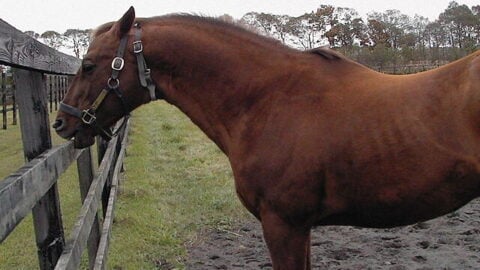
A cribbing horse grabs a fixed surface, a fence rail, stall door, or feeder edge, with its incisors, contracts the neck muscles, and pulls back with a characteristic grunt. Horses may repeat the behavior many times a day and often target the same preferred surfaces.
Cribbing is not the same as wood chewing. Wood chewing is destructive and may reflect boredom, diet issues, or lack of forage, but it doesn’t involve the same neck-flexing behavior that defines cribbing. Windsucking is related but different: the horse draws in air without first gripping a surface. For related health context, see our guide on horse ulcers.
New owner alert: if you buy or claim a horse and later discover it cribs, that matters. In private sales, undisclosed cribbing may become a contract dispute depending on the terms of the sale. In claiming races, it’s usually treated as part of the risk of the claiming process.

Early Signs a Horse May Be Starting to Crib
Most owners catch cribbing after it’s already a habit. Here’s what to watch for before that happens:
- Repeated lip or tooth contact with rails and stall doors — the horse tests the same surfaces again and again
- Targeting feed buckets, stall fronts, or fence lines at feeding time — anticipation around concentrate meals is a common pattern
- Wood chewing that starts to look rhythmic rather than destructive — especially if the horse pauses, braces, and flexes the neck
- Frequent fixation on one cribbing spot — many horses develop strong location preferences early
- More behavior during confinement or stress — travel, stall rest, and isolation often make early signs easier to see
Why Horses Crib
No honest article should pretend cribbing has one clean cause, because it doesn’t. Evidence strongly implicates reward pathways, including dopamine and endogenous opioid signaling, while also linking the behavior in some horses to gastric discomfort and stress-related coping, as summarized by UC Davis Veterinary Medicine and Ohio State Extension. That combination helps explain why the behavior can become persistent once established.
- Confinement and limited turnout — horses are built to move and forage for much of the day, and stall housing limits both
- High-grain, low-forage diets — concentrate-heavy feeding is consistently associated with higher stereotypy rates
- Early weaning — young horses weaned under stressful conditions show higher stereotypy risk
- Stress and frustration — anxious horses and high-pressure environments appear to increase susceptibility
- Possible individual predisposition — some breed lines appear overrepresented, though genetics alone don’t explain the pattern
Cribbing usually starts when a horse is dealing with a mix of stress, confinement, limited forage, or digestive discomfort, often alongside other stress behaviors like stall pacing. The horse discovers that the behavior produces a brief sense of relief, so it gets repeated. Over time, that repetition turns a temporary coping response into an established pattern that’s much harder to interrupt.
What that means in plain terms: the horse finds some kind of relief in the act, even if it’s brief, and repetition hardens it into a habit. That’s why punishment alone usually fails. You may stop the motion for a moment, but you haven’t changed the reason the horse keeps going back to it.
Owners often ask whether horses learn cribbing by watching other horses. The evidence is mixed, and current veterinary guidance doesn’t support treating cribbing as clearly contagious in the way many barns assume. Shared management conditions are probably a bigger driver than simple imitation. If several horses in one barn start showing stereotypies, look hard at how they’re being kept before blaming contagion.
Which Horses Are Most Likely to Crib
Cribbing is seen more often in Thoroughbreds, warmbloods, and some other high-strung performance populations than in draft breeds, but you have to be careful about why. Those horses are also more likely to live in stalls, eat concentrates, train under pressure, and spend long stretches in controlled routines. Some types may be genuinely overrepresented, but management is tangled all through that picture rather than genetics alone.
Within racing barns, cribbing is common enough that experienced horsemen treat it as a management issue rather than an automatic deal-breaker. Buyers still need to assess severity, current body condition, and how much day-to-day management the horse requires. Some cribbers are a nuisance. Some are high-maintenance. Some are just part of the barn and race on fine.
Evaluating a Cribbing Horse Before Purchase
Whether you’re buying a racehorse, claiming, or looking at a prospect that’s already known to crib, a few direct questions tell you far more than the label “he cribs” ever will:
- How often does he crib? Occasional versus near-constant behavior are two very different management pictures.
- Does he crib mainly after meals? A pattern tied to feeding often points toward diet and digestive discomfort as real drivers.
- Does he maintain weight and body condition? This is usually the single best real-world indicator of how much the behavior is actually costing him.
- Does he require a collar to function normally? Find out whether the collar is occasional insurance or a daily necessity.
- Have his teeth been evaluated recently? Chronic cribbers should have a dental history you can actually see, not just hear about.
- Has he had colic episodes, particularly surgical colic? Given the documented association with epiploic foramen entrapment, this is worth asking directly rather than assuming.
- Does the behavior get worse under travel, shows, or race-day stress? That tells you what to expect once the horse is in your program.
- Is the seller being straight with you about all of the above? A seller who volunteers this information without being pushed is a good sign in itself.
Owner checklist: before accepting a cribber
- Body condition is good
- Teeth have been evaluated
- Colic history is known
- Feeding program is appropriate for the horse
- Behavior is manageable without constant intervention
- The trainer or groom taking him on understands his routine and triggers
Does Cribbing Affect a Horse’s Sale Price?
Cribbing doesn’t come with a fixed dollar penalty. The effect on value depends on discipline, age, earnings, soundness, severity of the behavior, and how much management it actually requires. A proven racehorse that cribs but stays healthy and keeps racing well may retain significant value. A young prospect with severe cribbing and real health concerns behind it gets viewed very differently by most buyers.
What tends to move the number more than the behavior itself: documented severity, whether a collar or other management actually controls it, body condition, dental history, and colic history. Two horses that both “crib” can carry very different price tags once a buyer actually digs into those specifics.
How Cribbing Affects Health
This is where owners need to stay practical. Not every cribber falls apart, but chronic cribbing isn’t harmless either. The main concerns are the teeth, the neck, body condition, overlap with gastric problems, and the documented association with certain types of colic.
| Health Effect | Mechanism | Severity | Management Implication |
|---|---|---|---|
| Dental wear | Repeated pressure on upper incisors causes abnormal wear over time | Moderate to significant in chronic cribbers | Regular dental checks and closer monitoring in older horses |
| Neck muscle changes | Repeated neck contraction can create the characteristic thickened underside of the neck | Progressive in heavy cribbers | Usually cosmetic, but relevant to condition assessment |
| Weight loss and poor condition | Some horses spend less time eating and more time performing the behavior | Variable | Monitor body condition and calorie intake closely |
| Colic risk | Several studies have found an association between cribbing and increased risk of epiploic foramen entrapment, though cribbing itself is not considered a direct cause | Elevated vs. non-cribbers | Know the horse’s baseline and have a veterinary plan in place |
| Gastric ulcer co-occurrence | Stress, diet, and management factors linked to cribbing also overlap with ulcer risk | Common co-occurrence | Ulcer evaluation is reasonable in chronic or worsening cases |
Epiploic foramen entrapment: this is the colic type most closely linked to cribbing, and the association is well-documented across multiple peer-reviewed studies, not just anecdotal. It’s a serious surgical emergency, and it should be understood as a real, elevated risk rather than a simple direct-cause relationship.
How Cribbing Affects Racing Performance
Cribbing doesn’t directly make a horse slow. Performance issues arise indirectly through poorer condition, more management complexity, and interruptions from colic or ulcer problems. That’s why one cribber can earn checks and another can wear a barn out.
Horseman’s Perspective: Diamond Country, one of my current racehorses, is a cribber. She’s a filly, and a light one at that — we keep a collar on her while she’s in her stall, and that’s been enough to keep her in a good program. She keeps weight, trains normally, and the behavior has never been the thing standing between her and a race.
Compare that to Aunt Addie, another filly I’ve owned who cribbed far worse. A collar didn’t change much for her; she’d keep going regardless. That’s the real lesson: the word “cribber” by itself doesn’t tell you much. What matters is severity, whether the horse holds condition, whether a collar actually works for that individual horse, and whether the behavior is getting worse or staying stable. Two fillies, both cribbers, two completely different management pictures.
- Body condition — horses that crib heavily may be harder keepers and require closer nutritional management
- Training interruptions — colic episodes and ulcer workups can disrupt conditioning plans
- Stress load — some horses crib more in the high-pressure barn environment around training and racing; see behavior and stress in racehorses
- Extra management — trainers and grooms need to know the horse’s routines, trigger points, and collar use
Managing Cribbing: What Actually Works
The right goal isn’t magic. It’s reduction and control. The most effective plans address the horse’s environment first, then add physical prevention only when needed.
| Approach | How It Works | Effectiveness | Notes |
|---|---|---|---|
| More turnout and social contact | Reduces confinement and frustration while increasing normal movement | Often helpful; rarely eliminates behavior | Best foundation for most horses |
| Diet adjustment | Increase forage, reduce concentrate load, and keep the gut working more naturally | Moderate reduction in many horses | Important in both prevention and management |
| Treat underlying medical issues | Address gastric ulcers or other discomfort that may worsen the behavior | Helpful when a medical driver is present | Veterinary evaluation matters here |
| Cribbing collar | Makes the neck-flexing motion uncomfortable enough to reduce frequency | Often effective while worn | Must fit correctly and be checked daily |
| Surface modification | Remove or protect preferred cribbing spots | Partial | Works better with broader management changes |
| Surgery | Attempts to reduce the horse’s ability to perform the behavior | Variable and not always permanent | Reserved for severe cases after discussion with a veterinarian |
Cribbing collar fitting: the collar should sit snugly in the throatlatch groove — tight enough to engage when the horse arches its neck, loose enough not to interfere with normal breathing, swallowing, or grazing. Check daily for rubs, especially in hot weather or long-term use.

Common Misconceptions About Cribbing
- “It’s just a bad habit” — cribbing is better understood as a compulsive behavior, not simple disobedience
- “You can train it out” — training alone doesn’t resolve an established stereotypic behavior
- “Only bored horses crib” — boredom can contribute, but diet, stress, pain, and management also matter
- “A collar fixes the whole problem” — collars can reduce the motion, but they don’t fix the underlying management picture
Key Takeaways: Horse Cribbing
- Cribbing is a compulsive behavior, not a bad habit — training alone will not resolve it
- Management is the goal — some horses improve greatly, but relapse remains possible
- Health consequences matter more than stigma — teeth, body condition, ulcers, and colic risk deserve attention
- Environmental management comes first — forage, turnout, social contact, and veterinary evaluation are the foundation
- Collars help some horses — but they work best when the rest of the program is sound
- A cribbing horse can still perform — provided condition and health are managed well
FAQs: Horse Cribbing
What is cribbing in horses?
Cribbing is a repetitive behavior where a horse grabs a fixed surface with its incisors, arches its neck, and produces a characteristic grunt while pulling back. It’s classed as a stereotypy — a stress-linked, compulsive behavior — not simple bad manners or destructive chewing.
Can cribbing be cured?
Usually not in a permanent sense. Some horses improve dramatically and may enter long-term remission under better management, but recurrence is common if conditions revert. The practical goal is long-term control rather than a guaranteed cure.
Does cribbing hurt the horse?
The act itself is not usually thought to be acutely painful. The welfare concerns are the long-term consequences, including dental wear, weight loss, neck changes, and elevated colic risk.
Should I buy a horse that cribs?
That depends on severity, condition, and management demands. A horse with controlled cribbing and good body condition is very different from one whose behavior is heavy and poorly managed. A pre-purchase exam and direct questions about day-to-day management are essential.
Do cribbing collars work?
They often reduce cribbing while the horse is wearing them, but they don’t address the underlying drivers. They work best alongside more forage, more turnout, and lower stress.
Can a cribbing horse still race competitively?
Yes. Cribbing does not directly reduce speed, but poor condition, colic, ulcers, and management problems can reduce performance if they are not controlled.
What’s the difference between cribbing and windsucking?
Cribbing involves gripping a surface first, then arching the neck and grunting. Windsucking uses a similar neck action but occurs without grabbing an object.
How much does cribbing affect a horse’s value?
It depends on severity, discipline, age, and management history. In racing and performance horses, some buyers consider cribbing a manageable vice while others discount a horse’s price if it requires meaningful extra management. Documented severity and a clean colic history matter more to most buyers than the label itself.
Cribbing is one of those behaviors that gets exaggerated in sale barns and oversimplified on the internet. Some horses are badly affected by it. Some aren’t. The smartest approach is the old-fashioned one: look at the horse, look at the program, and fix what you can fix. Better forage, better turnout, less stress, attention to the gut, and a collar when needed will usually get you farther than punishment ever will.
About Miles Henry
Racehorse Owner & Author | 30+ Years in Thoroughbred Racing
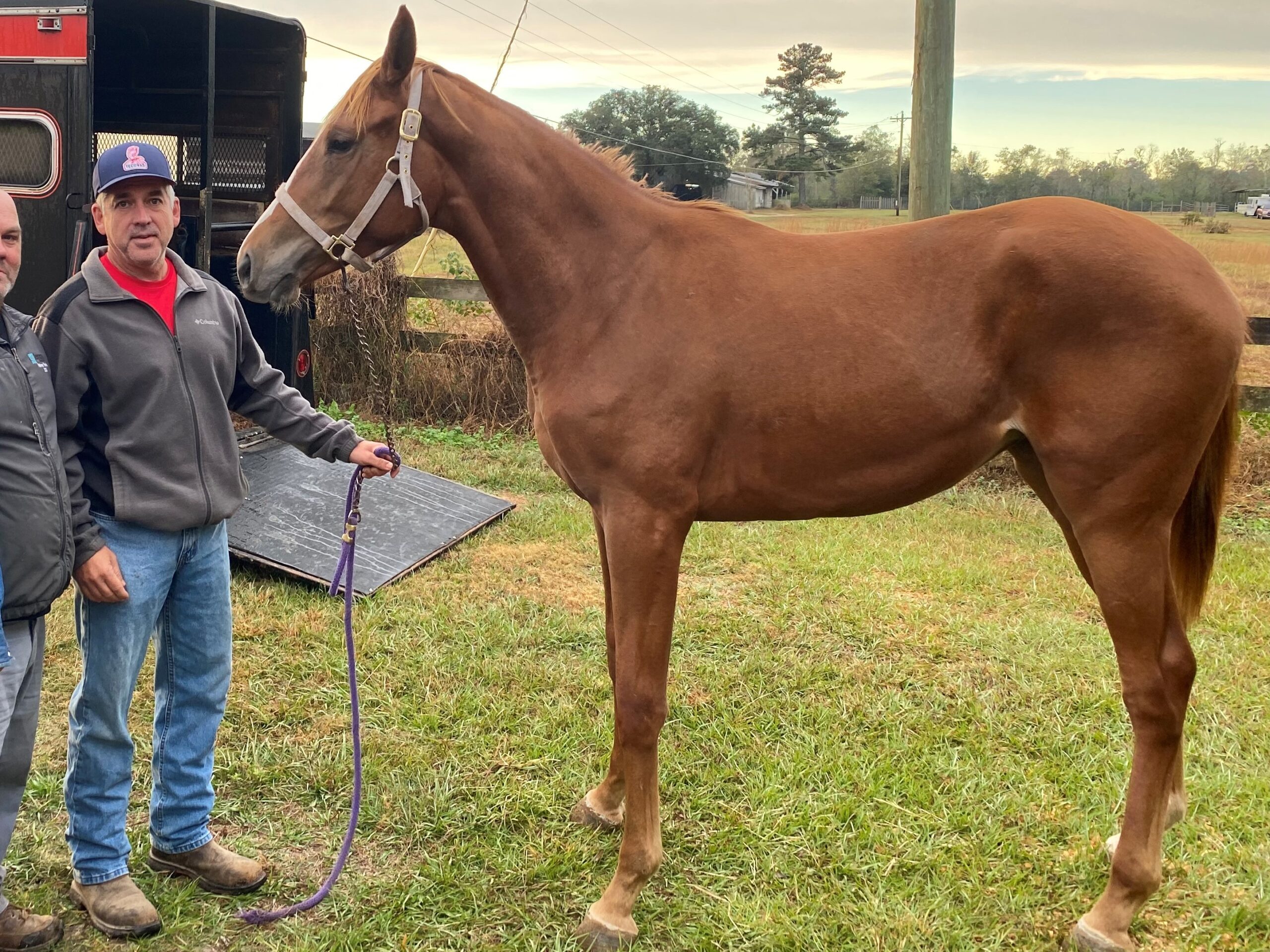
Miles Henry (legal name: William Bradley) is a professional horseman based in Folsom, Louisiana. He holds Louisiana Racing License #67012 and has spent over three decades managing Thoroughbreds at premier tracks including Fair Grounds, Delta Downs, and Evangeline Downs.
Expertise & Hands-On Experience: Beyond the track, Miles has decades of experience in specialized equine care, covering everything from hoof health and nutrition to training protocols for Quarter Horses, Friesians, and Paints. Every guide on Horse Racing Sense is rooted in this “boots-on-the-ground” perspective.
30 of their last 90 starts
Equibase Profile.

Connect with Miles: