Skip to Content

Why Racehorses Get Pony Escorts — and What Those Horses Actually Do

Why Racehorses Get Pony Escorts — and What Those Horses Actually Do

Last updated: March 17, 2026

By: Miles HenryFact Checked

If you’ve watched a horse race and noticed a rider on a stocky, calm horse walking alongside the Thoroughbred on the way to the gate, you’ve seen a pony horse at work. The name is a little misleading — a pony horse is usually a full-sized horse, not a pony. What makes it a pony horse is the job: escorting, steadying, and guiding a racehorse through the controlled chaos of race day. It’s one of the most important and least explained roles in the sport.

Quick Answer: Racehorses get pony escorts because Thoroughbreds are high-strung prey animals that can become dangerous without a calming companion. A pony horse walks alongside the racehorse from the paddock to the gate, reducing anxiety, controlling horses that want to run early, and keeping the post parade safe. At the gate, the pony helps hold the horse steady during loading — one of the most dangerous moments of race day.

I’ve been a licensed Louisiana racehorse owner (#67012) for over 30 years. I’ve watched pony horses work at Fair Grounds, Evangeline Downs, and my Folsom training center, and I’ve used them extensively in my own program. If you’ve ever wondered why do racehorses get pony escorts, the answer comes down to control, safety, and how horses naturally respond to stress. This article explains what pony horses actually do, why Thoroughbreds need them, how they’re selected, and what happens when a horse goes to the gate without one.

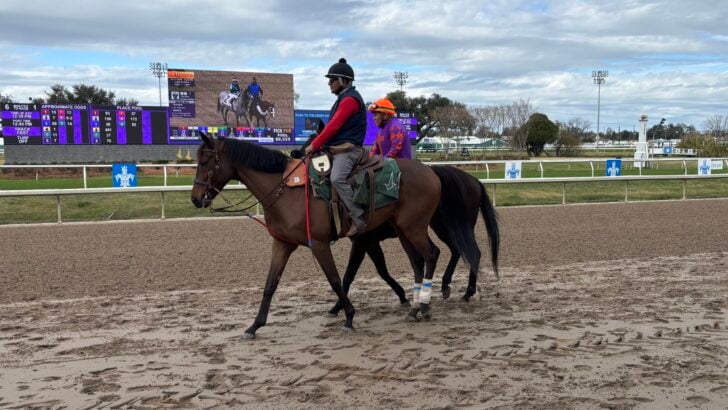
Pony horse calmly escorting a racehorse to the starting gate at Fair Grounds Race Course in New Orleans.
A pony horse guides a racehorse to the starting gate at Fair Grounds in New Orleans — this escort covers the most stressful part of race day for a Thoroughbred.

Why Thoroughbreds Need a Companion at All

Horses are herd animals. Their baseline state — the state in which they feel safe enough to eat, rest, and focus — is alongside other horses. Remove a horse from the herd and you activate a prey animal’s threat response. Heart rate rises. Attention fragments. The horse starts scanning for danger instead of concentrating on what the rider is asking. For most horses used in most contexts, this is manageable. For a Thoroughbred on race day — already wound tight by conditioning, by the crowd, by the noise of the track — it can become a safety problem.

Thoroughbreds have been selectively bred for over 300 years for speed, reactivity, and competitive intensity. Those traits make them extraordinary racehorses. They also make them harder to manage in high-stimulation environments. A Thoroughbred at the track on race day is surrounded by unfamiliar horses, thousands of spectators, loudspeakers, starting gate equipment, and the accumulated stress of a program that has been building toward this moment for months. The pony horse’s job is to provide a focal point of calm in the middle of all that.

Miles’ Take — What You’re Actually Seeing When people watch a post parade and see a pony horse walking next to a Thoroughbred, they’re often looking at the jockey and the racehorse and missing what the pony is doing. Watch the racehorse’s ear. If it’s pinned back and the horse is jigging and pulling, the pony isn’t working yet. When the pony horse settles into a rhythm and the racehorse’s ear starts flicking toward it — relaxing, tracking the companion — that’s the calming effect happening in real time. It’s subtle, but once you know what to look for, you see it every race.

What a Pony Horse Actually Does on Race Day

The pony horse’s race-day job starts before the race and ends at the gate. It covers four distinct phases, each with a different function.

Phase What the Pony Horse Does Why It Matters
Paddock to track Walks alongside the racehorse as it leaves the saddling area and enters the track First exposure to the crowd; pony provides a calm reference point
Post parade (warm-up) Escorts the racehorse past the grandstand at a controlled walk or slow jog Keeps pace manageable; prevents burning energy before the race
Gate approach Leads the racehorse directly to its assigned gate stall Reduces resistance at loading; critical for nervous or gate-shy horses
Gate hold and release Holds the racehorse steady at the gate until the assistant starter takes over; peels away at the break Prevents rearing, spinning, or breaking through the gate early
The four phases of a pony horse’s race-day role. Each serves a distinct safety and performance function.

The pony horse rider — typically an outrider or a designated track employee — controls both the pony and, through a lead shank clipped to the racehorse’s bridle, the racehorse itself. This physical connection means the outrider can redirect, slow, or restrain the racehorse if it becomes unmanageable. The pony horse functions as both an emotional anchor and a physical control mechanism.

From the barn — Diamond at the gate: Diamond Country is a mare I’ve raced at Fair Grounds, and she’s always been sharp going to the gate. Not dangerous — sharp. She wants to look at everything, jig, and get ahead of herself. The pony horse we use with her settles that. You can watch her come through the paddock gate and visibly relax when the pony comes alongside. By the time she’s loaded, she’s focused. Without the pony, she’d be at the gate having already burned 20 minutes of nervous energy. That matters in a race.

Without pony horses, the post parade wouldn’t look controlled — it would look like chaos.

Calming Nervous Horses: The Social Buffering Effect

The calming effect of a companion horse on a stressed horse has a name in the veterinary literature: social buffering. Research published in Applied Animal Behaviour Science has documented that the presence of a calm conspecific — another horse — measurably reduces physiological stress responses in horses exposed to novel or threatening stimuli. Heart rate drops. Cortisol levels moderate. The horse’s attention shifts from threat-scanning to following the companion’s behavioral cues.

The key variable is the companion’s own state. A calm horse produces a calming effect. An anxious horse amplifies anxiety. This is exactly why pony horses are selected and trained for temperament above everything else — a pony horse that spooks, jigs, or reacts to the crowd is worse than no pony horse at all. It confirms the racehorse’s threat assessment rather than overriding it.

For young horses encountering the racetrack environment for the first time, this effect is particularly pronounced. A two-year-old at its first race has no learned context for crowds, loudspeakers, or the noise of other horses breaking from the gate nearby. Everything is novel, and novel is threat-adjacent for a prey animal. A seasoned pony horse that moves calmly through the same environment provides behavioral evidence that the situation is safe — and horses read that evidence from each other faster and more reliably than they process any human cue.

Miles’ Take — The Two-Year-Old Filly I had a high-strung two-year-old filly that was essentially unmanageable going to the track her first few times. She’d been fine in training at Folsom, but the Fair Grounds environment — the noise, the other horses, the saddling paddock — turned her into a different horse. We paired her with a retired Quarter Horse mare I’ve used for years. The first session, the filly still jigged and looked around constantly. By the third session, she was walking out to the track with her head low. Nothing about the environment changed. What changed was that the Quarter Horse was telling her, through her own calm behavior, that there was nothing to worry about. That’s social buffering in practice.

Controlling Hot Horses: When the Racehorse Wants to Run Now

Not every horse that needs a pony is nervous. Some horses are the opposite problem: they’re too ready to run. These are the horses that jig sideways down the post parade, that try to break into a gallop before the jockey is ready, that arrive at the gate having already burned through half their race energy on the way there. Managing a hot horse going to the gate is one of the most physically demanding jobs in racing, and the pony horse is the primary tool for doing it.

The lead shank connecting the pony horse to the racehorse gives the outrider direct control. When a hot horse starts to escalate — pulling harder, breaking into a trot, trying to spin — the outrider can use the lead shank to redirect the energy. The pony horse itself, moving at a calm, controlled walk, acts as a physical anchor. A 1,200-pound horse moving purposefully at a walk is harder to rush than a handler on foot trying to hold a lead rope. The pony’s size and momentum are part of the control mechanism.

This matters for performance as much as safety. A Thoroughbred that walks to the gate quietly and loads calmly has more left for the race than one that spent the post parade fighting. The outrider’s ability to modulate a hot horse’s energy through the pony is directly connected to how much of that horse’s capacity reaches the starting gate intact.

From the barn — When the pony saves the race: I had a horse years ago at Evangeline Downs who was talented but nearly impossible going to the gate. He wanted to run from the moment the saddle went on. The outrider we worked with had a big, steady Quarter Horse that could physically hold him — not by brute force, but by controlling the pace and direction consistently enough that the racehorse eventually stopped fighting it. That horse won races. Without a pony that could handle him going to the gate, he’d have been too spent to run by the time the gate opened.
Racehorse Diamond being escorted to the starting gate by a pony horse at Fair Grounds — pony holds the horse steady during gate approach.
Diamond being led to the starting gate at Fair Grounds — the pony horse’s lead shank gives the outrider direct physical control during the approach.

Safety at the Gate: The Most Dangerous Three Minutes

The starting gate is the most concentrated point of danger in horse racing. You have eight to fourteen horses, each weighing around 1,100 pounds, being loaded into individual metal stalls roughly the size of a phone booth. The horses are at peak fitness, maximum stress, and surrounded by strangers — both human and equine. The pony horse’s role at the gate is specifically about managing that danger window.

The approach to the gate is where most gate-related incidents begin. A horse that sees the gate from 100 yards away and starts to balk, spin, or rear is a hazard to the jockey, to the ground crew, and to the horses already loaded in adjacent stalls. The pony horse leads the racehorse directly to its stall in a straight line, at a pace controlled by the outrider, giving the horse less opportunity to assess the gate as a threat and more behavioral cues that this is a routine, familiar situation.

Once at the gate, the outrider holds the racehorse steady from the outside while the assistant starter manages loading from the front. The pony horse’s physical presence alongside the stall provides lateral support — the horse feels contained rather than exposed. For horses that are reluctant to load, the pony horse is often used to physically lead them into the stall, walking in beside them and then stepping clear as the door closes.

What happens without a pony at the gate A horse that refuses the gate, rears while being loaded, or breaks through the front before the start is one of the most dangerous situations in racing. Jockey injuries, loose horse incidents, and gate malfunctions are all more likely when a horse arrives at the gate already stressed and uncontrolled. The pony horse doesn’t prevent every gate incident, but it significantly reduces the probability of the horse arriving at that gate in a state where an incident is likely.

After the start, the outrider peels away immediately as the field breaks. From that point, the pony horse transitions into its post-race role — waiting near the finish line to assist in catching horses that pull up far from the jockeys’ stand, or responding to loose horse situations anywhere on the track.

The Outrider: Pony Horses Beyond the Post Parade

Outriders are the riders on pony horses whose job extends beyond escort duty. They are the track’s emergency response system — the people responsible for catching loose horses, clearing the track after incidents, and managing any situation where a horse is out of control during or after a race. Understanding what outriders do clarifies why pony horse quality matters far beyond the post parade.

Outrider Responsibility When It Occurs What the Pony Horse Must Do
Post parade escort Pre-race Walk calmly at a controlled pace alongside the racehorse
Gate approach and loading assist Pre-race Lead racehorse to stall; provide lateral support during loading
Loose horse intercept During or after race Accelerate quickly to match a galloping loose horse; allow outrider to grab the reins
Jockey assist (fall or injury) After incident Approach the scene calmly; hold position while outrider assists
Track clearance After race Guide horses off the track safely after the race is complete
Fractious horse management Any point Provide physical control alongside ground crew and outrider
Outrider responsibilities during a race day. The pony horse must be capable of both calm walking and rapid acceleration — a combination that requires specific selection and training.

The loose horse intercept is the most physically demanding thing a pony horse does. When a jockey is unseated or a horse breaks loose after the finish, the outrider needs to match the pace of a horse galloping at 35–40 mph in order to get close enough to grab the bridle or reins. This requires a pony horse that can accelerate on demand and gallop safely at speed — while remaining controllable by the outrider under the stress of the intercept. The same horse that walked calmly down the post parade 20 minutes earlier now needs to run down a loose Thoroughbred. That combination of calm and capable is not common, and it’s the central challenge of selecting good pony horses.

Miles’ Take — Outriders Don’t Get Enough Credit The outriders at Fair Grounds and Evangeline Downs are some of the most skilled horse people at any track, and they’re mostly invisible to the people watching the races. When a horse gets loose after a spill and the outrider catches it before it gets to the rail at full speed, that’s a serious piece of horsemanship happening in about 30 seconds. The pony horse they’re riding has to be good enough to make that possible. A fractious, unpredictable pony horse in that situation makes a dangerous job actively hazardous.

What Makes a Good Pony Horse: Breeds and Temperament

Pony horses are selected first for temperament, second for physical capability, and a distant third for breed. The right temperament is calm, confident, and unbothered by the specific stimuli of a racetrack — crowds, loudspeakers, starting gate noise, and the unpredictable behavior of the horses alongside them. Physical capability means enough size and strength to physically influence a Thoroughbred when needed, and enough athleticism to accelerate when the job requires it.

Breed / Type Why They Work Well Considerations
Quarter Horse Calm disposition, strong build, quick acceleration for intercept work; most common pony horse in U.S. racing Ideal all-around; well-suited to both escort and outrider roles
Retired Thoroughbred gelding Familiar with racetrack environment; doesn’t startle at gate noise or crowd behavior Must be a genuinely calm individual — not all retired TBs have the right temperament
Draft cross Size and weight help manage very fractious horses; calm by nature Less agile; not ideal for intercept work at speed
Grade horse Often adaptable and level-headed; lower cost Temperament varies; requires careful individual evaluation
Paint / Appaloosa Many individuals have Quarter Horse-adjacent temperament; adaptable Same considerations as Quarter Horse; breed matters less than individual
Common pony horse types in American racing. Quarter Horses dominate the role at U.S. tracks, but breed is secondary to temperament in selection decisions.

Quarter Horses dominate the pony horse role at American tracks for good reason. Their breeding for calm responsiveness in high-stimulation environments — originally developed for cattle work — translates directly to racetrack demands. They’re strong enough to handle a pulling Thoroughbred, fast enough for intercept work, and consistently level-headed in a way that makes them reliable from one race day to the next.
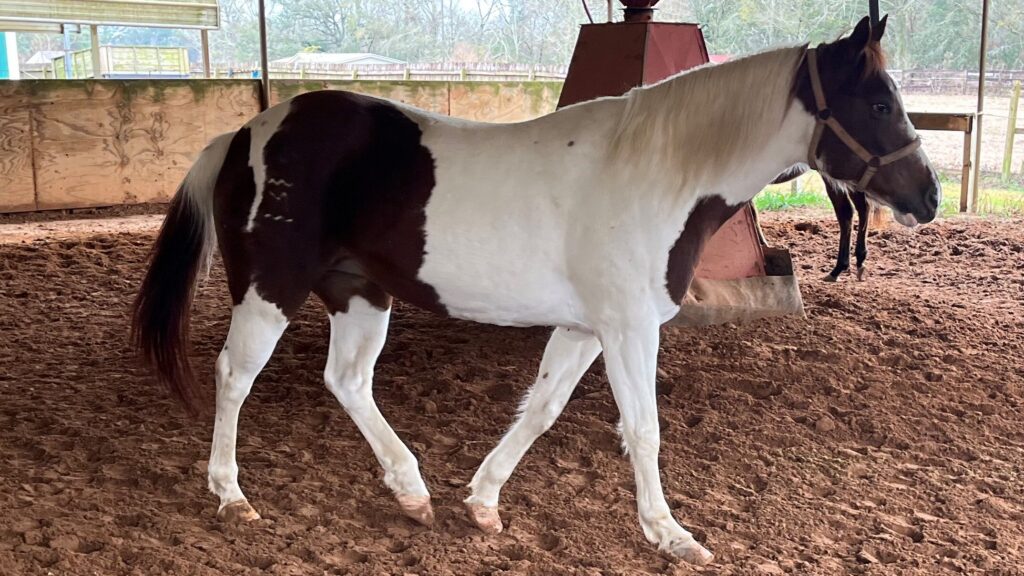
Paint mare serving as a pony horse during racehorse training at the Folsom Louisiana training center.
Our Paint mare at the Folsom training center — her background in barrel racing gave her the confidence and quick response needed for pony horse work with young Thoroughbreds.

Retired Thoroughbred geldings are the second most common pony horse type, and they bring a specific advantage: they know the racetrack. A retired TB that ran 40 races doesn’t spook at the starting gate, the rail crowd, or the paddock noise because it’s experienced all of it. That learned calm — as opposed to the natural calm of a Quarter Horse — is genuinely useful for introducing young horses to the environment. I had one retired gelding transition into a pony horse role seamlessly. His track experience was an asset every time a young horse needed to be shown that the gate wasn’t a threat.

From the barn — The Paint mare: One of the best pony horses I’ve used was a Paint mare that came out of barrel racing. She was confident, fast, and completely unbothered by anything at the track. Her barrel racing background had exposed her to tight spaces, loud environments, and quick direction changes — all of which are useful at the gate. She wasn’t the obvious choice for a pony horse, but she was one of the most effective ones I’ve had. Temperament is the variable. Breed is just where you start looking.

Pony Horses in Training: More Than Race Day

Pony horses don’t only work on race day. In training operations, they serve a daily function that shapes how young horses develop — and how they eventually handle the racetrack environment when competition begins.

At my Folsom training facility, I use pony horses to introduce two-year-olds to the track for the first time. A young horse’s first trip from the barn to the training track, past the equipment, past unfamiliar horses, and toward the starting area, is one of the most formative experiences of its early career. A good pony horse makes that trip routine. The young horse follows the pony’s lead — literally and behaviorally — and what might have been an alarming experience becomes a series of familiar cues: walk beside the pony, follow its pace, trust that the destination is safe.

Pony horses are also used in gate schooling, which is the process of teaching horses to load, stand, and break from the starting gate without incident. A young horse that has never seen a starting gate up close will often balk, spin, or refuse to enter. Walking it into the gate behind a calm pony horse — or alongside one that stands quietly at the entrance — dramatically reduces the refusal rate. The gate becomes associated with the pony horse’s calm behavior rather than with the horse’s own anxiety response.

For more on how these training phases fit into a racehorse’s full development — from breaking to race readiness — see our guide to how racehorses are trained.

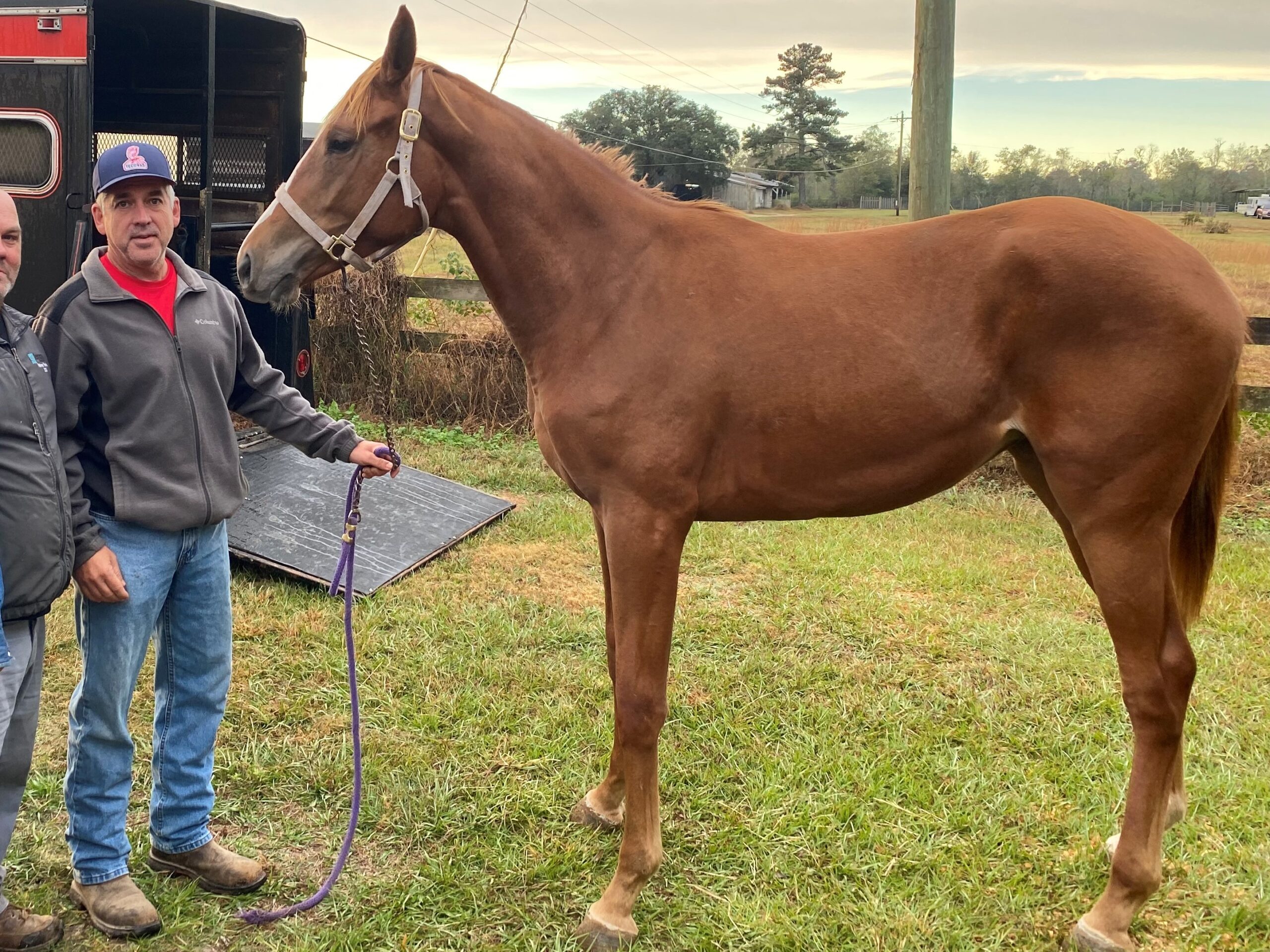
White lead pony horse waiting at the rails at the Folsom Louisiana training center for its next assignment with a young racehorse.
The white lead horse at the Folsom training center — reliable pony horses become familiar anchors for young horses throughout their early training.

The pony horse’s contribution to a young horse’s development is cumulative. Each calm trip to the track, each quiet approach to the gate, each race-day escort builds a behavioral repertoire for the racehorse — a history of experiences that says the track is navigable, the gate is routine, and the crowd is background noise. That repertoire doesn’t guarantee a calm horse on race day, but it makes a calm horse much more likely. For an overview of how racehorse behavior and equipment interact on race day, see our complete racehorse equipment guide.

FAQs: Why Do Racehorses Get Pony Escorts?

Why do racehorses get pony escorts?

Racehorses get pony escorts because Thoroughbreds are high-strung prey animals that can become dangerous in the high-stimulation environment of race day. A pony horse walking alongside the racehorse provides social buffering — the calming effect of a calm companion — that reduces anxiety, helps control horses that want to run early, and keeps the post parade and gate approach safe. The pony horse also gives the outrider physical control through a lead shank, allowing them to redirect or restrain the racehorse if it becomes unmanageable.

What is a pony horse in horse racing?

A pony horse in horse racing is a calm, trained horse used to escort racehorses from the paddock to the starting gate before a race. Despite the name, pony horses are usually full-sized horses — Quarter Horses, retired Thoroughbreds, or draft crosses are most common. The name reflects their escorting function, not their size. The pony horse is ridden by an outrider who holds a lead shank clipped to the racehorse’s bridle, giving physical control during the post parade and gate approach.

Why do racehorses need to be led to the starting gate?

Racehorses are led to the starting gate because the gate approach is one of the most stressful moments of race day for a Thoroughbred. The starting gate is unfamiliar, confining, and surrounded by noise and other horses. A horse that arrives at the gate already anxious or uncontrolled is more likely to refuse loading, rear, or create a dangerous situation for jockeys and ground crew. The pony horse leads the racehorse directly to its stall at a controlled pace, providing calm behavioral cues and physical guidance that make loading safer and more reliable.

What is an outrider in horse racing?

An outrider is a rider on a pony horse whose job is track safety and horse management. Before a race, outriders escort racehorses during the post parade and gate approach. During and after a race, they catch loose horses, assist fallen jockeys, and clear the track. An outrider’s pony horse must be capable of both calm walking during escort duties and rapid acceleration to catch a loose horse galloping at speed — a combination that requires careful selection and specific training.

What breed of horse is used as a pony horse?

Quarter Horses are the most common pony horse breed in American racing because of their calm temperament, strong build, and quick acceleration. Retired Thoroughbred geldings are also frequently used — their familiarity with the racetrack environment makes them naturally calm around starting gates and crowds. Draft crosses, grade horses, and Paints can also make excellent pony horses if they have the right individual temperament. Breed is a starting point; the specific horse’s calmness and reliability under racetrack conditions is what actually determines suitability.

Do all racehorses need a pony horse?

Not all racehorses require pony horse assistance to the same degree. Experienced, calm horses may go to the gate with minimal escort. Young horses, horses racing for the first time, and horses with known gate anxiety or hot behavior routinely use pony horses throughout their careers. The decision is made by the trainer and outriding team based on the individual horse’s behavior history. In most jurisdictions, pony horses are available for any horse that needs one.

What does a pony horse do after the race starts?

Once the starting gate opens and the race begins, the pony horse and outrider peel away from the gate immediately. From that point, the outrider positions near the finish area to respond to any post-race incidents: catching horses that pull up far from the dismount area, assisting jockeys who have been unseated, responding to loose horse situations, or managing any horse that behaves dangerously after the race. The pony horse must be able to accelerate quickly to match a galloping loose horse when needed.

How are pony horses trained for their role?

Pony horses are trained through gradual exposure to the racetrack environment — paddocks, crowds, loudspeakers, starting gate equipment, and the behavior of high-strung Thoroughbreds alongside them. They are specifically conditioned to remain calm under stimuli that would cause most horses to react. Training typically involves controlled rehearsal alongside racehorses during morning workouts before being used on race day. The outrider and pony horse also develop as a team — communication and timing between rider and horse are critical when managing a fractious racehorse or intercepting a loose one.

Conclusion

The pony horse is one of racing’s unglamorous essentials. It doesn’t appear in the race result. Its rider doesn’t get a trophy. But remove the pony horse from the picture and you create a significantly more dangerous post parade, a less controlled gate approach, and a track safety system with a critical gap in its coverage. The pony horse is the reason the post parade looks as calm as it usually does — and the reason that calm is not something Thoroughbreds would naturally produce on their own.

For anyone watching racing at Fair Grounds or any other track, the pony horse is worth paying attention to. Watch how the racehorse’s body language changes when the pony comes alongside. Watch how the outrider uses the lead shank going to the gate. Watch what happens at the break — and where the outriders position themselves after the field leaves. There’s a lot of skilled horsemanship happening in those three minutes before every race, and most of it is invisible unless you know where to look.

For more on the equipment, training, and race-day roles that shape a Thoroughbred’s performance, see our complete racehorse equipment guide, our guide to how racehorses are trained, and the Horse Racing Explained hub.

Have you watched a pony horse work at the track, or do you have a horse that needs one? Drop it in the comments — the specific situations are always more interesting than the general questions.

Sources

  • Applied Animal Behaviour Science — Social buffering in horses: pmc.ncbi.nlm.nih.gov
  • American Association of Equine Practitioners — Equine behavior and stress: aaep.org
  • The Jockey Club — Thoroughbred registration and racing standards: jockeyclub.com