
Last updated: June 12, 2026
HISA now bans race-day Lasix (furosemide) in all stakes races and two-year-old events at federally regulated tracks. Horses that previously ran on furosemide in these conditions must compete without it. For permitted claiming and allowance races, standard 250–500 mg doses remain legal with veterinary certification. Note: Further HISA rule changes may be pending — verify current status before race entry. Full details: HISA Furosemide Policy.
Walk the shedrow at Fair Grounds on a race morning and you will see it constantly — horses stopping every few minutes to urinate, grooms stepping around puddles, the ammonia smell hanging in the air. After 30 years owning Thoroughbreds in Louisiana, I still get asked the same question from first-time visitors: why do racehorses pee so much?
The short answer is Lasix. The longer answer involves basic horse physiology, high-intensity training demands, a high-protein diet, and, in 2026, a regulatory environment that is actively reshaping how that drug gets used. A racehorse without medication produces 8–12 gallons of urine daily. Add a standard racehorse furosemide dose four hours before a race and that climbs to 12–18 gallons, with 15–30 pounds of fluid lost before the gate opens. No other horse in the world — trail mount, broodmare, pasture horse — comes close to those numbers under normal conditions.
This article explains exactly why that happens, what it means for horse health, how the rules around Lasix are shifting under HISA, and — for bettors — how a horse’s urination pattern on race morning can actually tell you something useful. For the full deep-dive on furosemide, visit our Lasix in Horse Racing hub.
Without Lasix: 8–12 gallons of urine per day (normal for any horse in hard training).
With Lasix (furosemide): 12–18 gallons per day; 15–30 lbs of fluid lost in 4 hours before race time.
Primary cause: Furosemide forces rapid kidney excretion to reduce lung bleeding (EIPH) and race weight.
Other causes: High-protein diet, electrolyte supplementation, pre-race stress, intense training.
2026 rule status: Lasix banned in stakes races and 2-year-old events under HISA; legal with vet cert in claiming/allowance races.
Bettor signal: Heavy pre-race urination on a first-time Lasix horse with confirmed bleeder history is a live handicapping angle.
Table of Contents
Why Racehorses Urinate Frequently Before a Race
Before we get to Lasix, it helps to understand what is happening physiologically on any race morning, even without medication. Horses are natural-born flight animals with a nervous system tuned to threat. A race barn on stakes day — the noise, the activity, the unfamiliar horses, the test barn visits — registers as a genuine stressor. That stress response activates the sympathetic nervous system, raises cortisol and adrenaline, and directly stimulates the kidneys to increase filtration rate. Horses urinate more often when they are stressed. It is the same mechanism that makes humans need a bathroom before a big presentation.
Add the physical reality of a training regimen that keeps a horse in hard work five or six mornings a week. High-intensity galloping burns through glycogen and protein at a rate that produces substantial nitrogen waste. The kidneys have to eliminate that waste through urine. A racehorse in peak training is metabolically busier than any pasture horse, and the urinary output reflects that. Diet amplifies the effect — high-protein feeds (14–16% crude protein is standard in Thoroughbred barns) produce more urea, which drives urine volume. So even without any medication, racehorses urinate 8–12 gallons per day versus a pasture horse’s 5–8 gallons.
For more on the physical demands that drive this baseline, see our piece on racehorse injuries, types, causes, and prevention and our explainer on why racehorses sweat so much.
Why Trainers Expect Horses to Urinate After Lasix
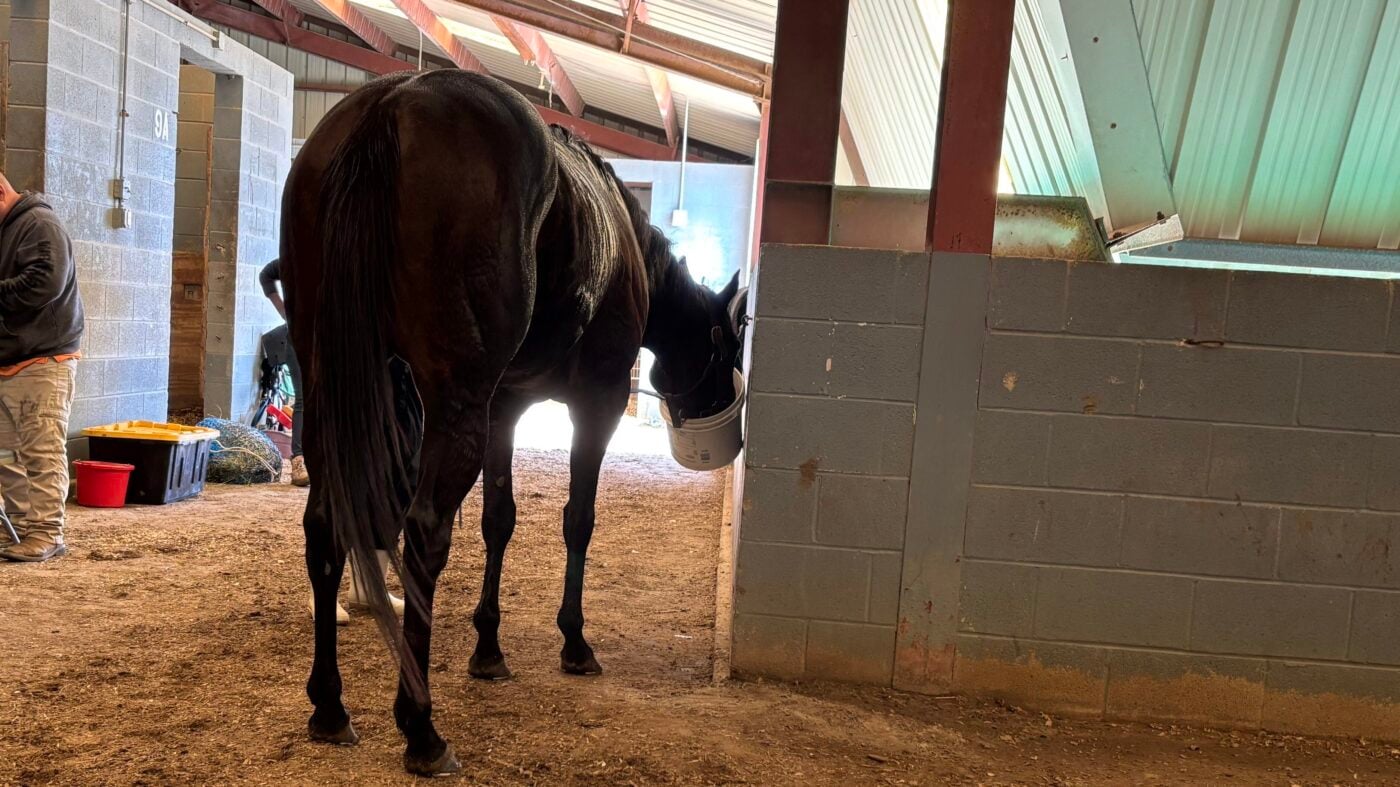
Lasix (furosemide) is a loop diuretic. It blocks sodium and chloride reabsorption in the kidneys’ loop of Henle, which forces the body to dump water rapidly through the urinary tract. A standard racing dose of 250–500 mg, administered intravenously four hours before post time, triggers 10–15 liters of urine output in just a few hours. That is on top of the horse’s normal baseline production.
Experienced trainers read this urination as a signal. Heavy, clear urination after the Lasix injection means the drug is working and the horse is processing the dose normally. Trainers at Fair Grounds and Delta Downs — the tracks where I race — will check on a horse two to three times between the Lasix injection and loading into the paddock specifically to confirm that output. A horse that is not urinating adequately post-injection is a concern: it may indicate the drug was not absorbed correctly, the horse is already dehydrated, or there is an underlying issue worth a vet call before scratching.
For context on how fluid loss connects to race performance, see our article on racehorse weight loss during a race.
If your horse has received furosemide and shows minimal urination within 90 minutes, call your track veterinarian before the horse goes to the paddock. Absent diuretic response can signal dehydration, injection error, or an underlying kidney concern. Do not assume the horse will “catch up” during warm-up.
What Is Lasix and Why Do Racehorses Receive It?
Furosemide entered horse racing in the 1970s as a treatment for EIPH in horses (exercise-induced pulmonary hemorrhage) — the condition where a horse bleeds from lung capillaries during intense exertion. EIPH affects an estimated 40–75% of racehorses to some degree, ranging from microscopic bleeding detectable only by endoscope to severe hemorrhage visible as blood from the nostrils. Horses with significant EIPH are commonly called “bleeders.”
Furosemide reduces EIPH severity by lowering pulmonary blood pressure before peak exercise. A 2024 study published in the Equine Veterinary Journal (via PMC) demonstrated a roughly 70% reduction in EIPH severity with standard furosemide dosing compared to untreated controls. Washington State University launched a $370,000 study in 2024 specifically examining whether furosemide extends racing careers — preliminary findings suggest horses on appropriate Lasix protocols race more starts per year with fewer bleeding-related scratches. See the full WSU Lasix research announcement.
Beyond EIPH, furosemide has a secondary effect that became controversial: the weight loss from fluid elimination. A horse that sheds 15–30 pounds of water weight before a race carries less mass around the track. Critics argue this performance advantage has nothing to do with treating a medical condition and amounts to a legal way to improve speed figures. That tension sits at the center of every HISA Lasix debate. You can read the full ACVIM consensus on furosemide in racehorses at PubMed (ACVIM Consensus Statement).

How Much Fluid Do Racehorses Lose After Lasix?
The numbers are significant enough that you feel them when you lead the horse. My gelding Bayou Runner — a $16k claimer at Fair Grounds — would come off Lasix looking leaner through the hindquarters, visibly less filled in the flanks. That is not imagination. Here is what the data shows:
Scroll right to view full table
| Measurement | With Lasix (Standard Dose) | Without Lasix |
|---|---|---|
| Urine output (24 hrs) | 12–18 gallons | 8–12 gallons |
| Acute fluid loss (4 hrs post-injection) | 10–15 liters (3–4 gallons) | Baseline only |
| Body weight loss pre-race | 15–30 lbs | 2–5 lbs (sweat, normal excretion) |
| Electrolyte loss (sodium/potassium) | Up to 20% depletion | Normal |
| EIPH incidence | ~15% significant bleed | ~45% significant bleed |
The electrolyte depletion is the piece that concerns veterinarians most. Sodium and potassium are critical to muscle contraction and cardiac function. A horse that loses 20% of its potassium in four hours and then goes through peak cardiovascular exertion is working with compromised electrolyte balance. Responsible trainers supplement aggressively post-race. University of Florida’s Dr. Sally DeNotta is currently studying the specific electrolyte response curves from furosemide administration to develop better post-race replenishment protocols. See the UF Veterinary Medicine research summary.
Does Frequent Urination Harm Racehorses?
Frequent urination itself is not the danger. The danger is what the urination depletes. Here is how to think about the risk layers:
Dehydration: Acute dehydration from furosemide is manageable with proper pre-race hydration protocols and post-race electrolyte replenishment. The risk escalates when a horse enters the Lasix window already somewhat dehydrated from travel, heat, or poor water intake. For a full breakdown of dehydration signs, see our article on why racehorses sweat so much and the companion weight loss during a race piece.
Electrolyte imbalance: The ACVIM Consensus Statement notes that repeated high-dose furosemide administration creates cumulative electrolyte depletion that can affect cardiac rhythm. This is the scientific basis for the welfare argument behind HISA’s restriction program — not that a single dose is dangerous, but that weekly administration across a full racing season adds up. The ACVIM peer-reviewed consensus is the best publicly available summary of the clinical evidence.
Kidney strain: Long-term high-dose diuretic use has been associated with kidney stress in multiple species. In horses, a 2024 DVM360 report cited research correlating high-dose Lasix administration with an elevated cardiac risk — a finding that reinforces the case for minimum effective dosing rather than reflexive maximum-dose protocols. This finding is from 2024 trade reporting; peer-reviewed replication studies are ongoing — see the DVM360 furosemide report and verify for updated findings.
When urination signals a problem unrelated to Lasix: Not all heavy urination is drug-related. Dark, cloudy, or discolored urine; straining to urinate; or urination frequency that continues for days after a race without Lasix in the system all warrant a veterinary call. These can indicate urinary tract infection, kidney disease, or systemic illness.
Normal post-Lasix urination is clear to light yellow and stops ramping up within 6–8 hours of the injection. Flag these for same-day veterinary evaluation: dark amber or brown urine (possible myoglobinuria or kidney stress); straining or squatting repeatedly without output (possible blockage or UTI); urine with visible blood or cloudiness lasting more than 24 hours; or elevated urination frequency 48+ hours after Lasix clears the system. This information is educational, not veterinary advice — always consult a licensed equine veterinarian for diagnosis and treatment decisions.

How Lasix Rules Are Changing in Horse Racing
The regulatory picture has shifted meaningfully. Lasix horse racing rules under HISA as of 2026 create a tiered system rather than a blanket ban or blanket permission. Here is what is currently in place at federally regulated tracks:
Stakes races and two-year-old events: Race-day Lasix is banned with no exemptions. Horses that need furosemide for EIPH management must either compete without it or scratch. This is a hard line with no veterinary certification pathway around it in these conditions.
Claiming and allowance races: Furosemide remains legal with veterinary certification. Horses must be on an approved bleeder list, with documentation from an attending veterinarian. The 2025 HISA cycle added 15% more random testing for compliance — meaning test barn visits are more frequent than they were two years ago.
Research funding: HISA committed $1.2 million in 2025 for EIPH alternative research. The WSU study and UF protocols are both beneficiaries. The long-term trajectory points toward finding non-pharmaceutical EIPH management options — nasal strips, breathing exercises, track surface modifications — so the blanket ban can eventually extend to all conditions without a welfare cost to certified bleeders.
For the complete and current furosemide policy, the authoritative source is the HISA Anti-Doping and Medication Control furosemide page. For industry stakeholder perspective on what the ban means economically, BloodHorse’s survey of New York horsemen found that a majority predicted significant field-size reductions if Lasix restrictions expand — useful context for understanding why the regulatory timeline has been incremental rather than immediate.
Lasix Pee Filter: $16k Fair Grounds Claimer
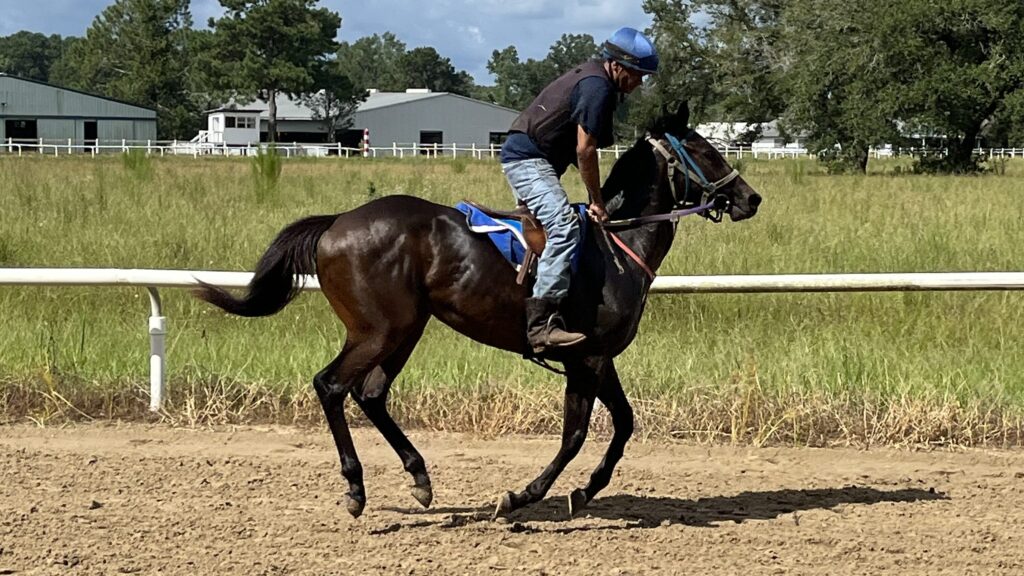
For bettors, racehorse Lasix urination patterns before a race are not just biology — they are handicapping data. The “first Lasix” angle is one of the most consistently reliable edges in claiming-level horse racing: a horse running on furosemide for the first time after a bleeder diagnosis often shows a dramatic performance improvement compared to its Lasix-free form. The mechanism is simple. If the horse had EIPH affecting its breathing in previous starts, Lasix solves that problem. The horse can now finish.
Here is how I apply a Lasix-urination filter to a hypothetical six-horse $16k claiming field at Fair Grounds. The key variables: first-time Lasix vs. established user, visible pre-race urination reported by clockers or barn staff, and whether the horse is dropping in class simultaneously. For the full handicapping methodology, see our horse racing 4-point filter and how to bet on horse races guide.
Scroll right to view full table
| Horse | Lasix Status | Pre-Race Urination | Class Move | EIPH History | Bet Signal | Verdict |
|---|---|---|---|---|---|---|
| Bayou Burner | First-time Lasix | Heavy — multiple times shedrow | Down $5k | Confirmed bleeder, prev. DNF | Drug working, class drop adds cushion | BET |
| Delta Queen | Established — 4th Lasix start | Normal volume, light yellow | Same level | Mild EIPH, managed well | Consistent responder, stable form | BET |
| Crescent Flyer | First-time Lasix | Minimal — groom not sure it voided | Up $3k | Suspected bleeder, not confirmed | Drug response uncertain, class up risky | WATCH |
| Magnolia Drive | Established — 2nd Lasix start | Normal | Down $8k | Mild EIPH | Too early to confirm response pattern; class drop intriguing | WATCH |
| River Rat | Established — 10th+ Lasix start | Dark amber — possible dehydration | Same level | Chronic bleeder, declining form | Dark urine = dehydration risk; Lasix no longer improving form | PASS |
| Sunrise Gamble | No Lasix | Normal baseline | Up $5k | None documented | No Lasix edge; class up without compelling reason | PASS |
Other Reasons Horses May Urinate Frequently
Lasix is the dominant driver at the track, but it is not the only one. Several other factors increase racehorse urination that bettors and owners should understand:
- High water consumption. Racehorses in hard training drink 10–15 gallons per day — roughly double a pasture horse’s intake. That volume has to exit. Some horses in summer heat at Louisiana tracks drink even more. More in, more out.
- High-protein diet. Standard Thoroughbred training diets run 14–16% crude protein. Metabolizing protein produces urea and creatinine, which exit through urine. A horse eating 15 pounds of concentrated feed daily generates substantially more urinary waste than a horse on hay alone.
- Electrolyte supplementation. High-salt electrolyte pastes or top-dressing stimulate thirst, which drives water intake, which drives urination. This is intentional — trainers use it to keep horses well-hydrated heading into a furosemide cycle.
- Pre-race stress and adrenaline. Race-day stress — loading, crowds, unfamiliar horses — activates the sympathetic nervous system and directly increases kidney filtration rate. A nervous horse will urinate more than a calm horse in the same field. You can observe this in the paddock: horses sweating up before saddling often urinate multiple times. Related: why racehorses foam at the mouth and why racehorses walk after a race.
- Medical conditions to rule out. Cushing’s disease (PPID), pituitary tumors, and diabetes insipidus all cause pathological polydipsia (excess drinking) and polyuria (excess urination). Uncommon in young racing Thoroughbreds, but relevant in older horses or those with unexplained weight loss alongside increased urination. A horse urinating excessively with no Lasix side effects in horses on record and no recent electrolyte supplementation needs a veterinary workup — not another bucket of water.
- Bettor note: check clocker reports. Many track clocker services and DRF workout notes log whether a horse urinated heavily during the post parade or on the way to the gate. For a first-time Lasix horse, heavy pre-race urination documented in the clocker notes is confirmation the drug worked — that is real-time data worth more than a comment in the program. Build this check into your pre-race handicapping routine alongside class and pace figures.

Frequently Asked Questions
Why do racehorses pee after Lasix?
Lasix (furosemide) is a loop diuretic that blocks sodium and chloride reabsorption in the kidneys, forcing the body to rapidly excrete large volumes of water through urine. A standard racing dose of 250–500 mg administered four hours before post time triggers 10–15 liters of urine output in a few hours — roughly 3–4 additional gallons on top of a horse’s normal daily baseline. Trainers expect and monitor this response as confirmation that the drug is working. A horse that does not urinate adequately after Lasix administration is a veterinary concern before the race.
How much weight do horses lose from Lasix?
Racehorses typically lose 15–30 pounds of body weight in the four hours between Lasix injection and race time. This loss is almost entirely water expelled through rapid urination. The weight loss is temporary — horses regain it through drinking and normal hydration within 24–48 hours of a race. However, the acute electrolyte depletion that accompanies that fluid loss (up to 20% of sodium and potassium levels) can affect muscle function and cardiac performance if not managed with proper post-race replenishment.
Does Lasix urination hurt racehorses?
Furosemide-driven urination itself is not painful and is a normal physiological response to the drug. The welfare concerns around Lasix relate to the downstream effects of rapid fluid loss: dehydration, electrolyte imbalance, and the potential for kidney strain with chronic high-dose administration. A 2024 DVM360 report cited research correlating high-dose Lasix with an elevated cardiac risk — a finding from trade reporting that peer-reviewed replication studies are still examining. Properly managed — with appropriate dosing, pre-race hydration, and post-race electrolyte replenishment — most racehorses tolerate furosemide well across a racing career. Mismanagement or overuse is where the risk concentrates.
Is Lasix banned in horse racing?
Lasix (furosemide) is partially banned in U.S. horse racing as of 2026 under HISA regulations. Race-day furosemide is prohibited in all stakes races and two-year-old events at federally regulated tracks, with no exemptions. In claiming and allowance races at those tracks, Lasix remains legal with veterinary certification documenting a legitimate EIPH (bleeding) history. Rules vary by jurisdiction — some state-regulated tracks and international racing jurisdictions have different policies. Check the HISA furosemide policy page for current federal standards and consult your track veterinarian for local rules.
Why do racehorses pee before entering the starting gate?
Racehorses urinate frequently in the paddock and post parade for two main reasons. First, if the horse received Lasix four hours earlier, the diuretic effect is still active and the kidneys are still processing the dose — the horse will continue to urinate at elevated frequency until the drug clears. Second, the stress and adrenaline of the pre-race environment — crowds, loud announcer, the presence of other horses in tight quarters — activates the sympathetic nervous system, which increases kidney filtration rate and triggers urination. This is a normal physiological response, not a sign of distress, and is actually considered a positive indicator that the horse is healthy and properly hydrated heading into the gate.

Putting It Together: What Racehorse Urination Tells You
Racehorses pee so much because nearly everything about their life — medication, diet, training intensity, stress — drives fluid through the kidneys at rates no other domestic horse experiences. Lasix is the biggest single factor. A horse on furosemide produces 50–80% more urine on race day than it would without the drug. That urination is the mechanism by which the drug prevents lung bleeding and reduces race weight, and it is why the debate around Lasix has been so persistent: the same action that may protect a bleeder’s respiratory health also produces a measurable performance benefit.
For owners, the practical lesson is straightforward: manage the fluid loss. Hydrate before, electrolyte after, watch the urine color, and keep your bleeder paperwork current under HISA’s evolving requirements. For bettors, the first Lasix angle remains one of the cleanest edges at the claiming level — heavy pre-race urination on a first-time furosemide horse with a documented bleeder history is worth a line in your handicapping notes every time.
Related reading: Lasix in Horse Racing (Hub) — Racehorse Nosebleeds and EIPH — Racehorse Weight Loss During a Race — Why Racehorses Sweat So Much — Why Racehorses Foam at the Mouth — Racehorse Injuries — Racehorse Class Levels — What Is a Claiming Race — 4-Point Filter — How to Bet on Horse Races — Why Some Racehorses Carry Weights.
4–5 hrs before post: Confirm Lasix was administered correctly (IV, not IM). Offer fresh water freely — do not restrict intake.
2–3 hrs before post: Check stall for urination. Heavy, clear output is the target. Dark amber = call your vet. No output = call your vet.
1 hr before post: Administer electrolyte paste if your vet has approved it as part of your protocol. Document what you observe for your bleeder records.
Post-race: Offer water in controlled amounts (small sips, not unlimited bucket immediately), administer post-race electrolytes per your vet’s protocol, and monitor for signs of dehydration: tacky gums, skin-tent test, elevated heart rate. See racehorse weight loss during a race for rehydration benchmarks.
This checklist reflects owner experience and published research. It is not a substitute for guidance from your licensed equine veterinarian, who knows your horse’s individual health history.
- HISA Furosemide Policy — Official race-day furosemide rules and bleeder certification requirements.
- ACVIM Consensus Statement on Furosemide — Peer-reviewed clinical guidance on furosemide in equine practice.
- WSU 2024 Furosemide Study — University research on long-term career and drug effects.
- UF Veterinary Medicine Research — Electrolyte response curves investigation.
- 2024 EIPH Study (PMC11586568) — Open-access physiological research on furosemide and EIPH.
- DVM360 Furosemide Effects Report — 2024 trade analysis. Verify annually — replace with peer-reviewed data when available.
- BloodHorse NYTHA Lasix Survey — Industry stakeholder impact analysis.
The following video presents both sides of the Lasix debate from trainers, veterinarians, and regulators — useful context for owners weighing the decision in conditions where furosemide is still permitted.


About Miles Henry
Racehorse Owner & Author | 30+ Years in Thoroughbred Racing
Miles Henry (legal name: William Bradley) is a professional horseman based in Folsom, Louisiana. He holds Louisiana Racing License #67012 and has spent over three decades managing Thoroughbreds at premier tracks including Fair Grounds, Delta Downs, and Evangeline Downs.
Expertise & Hands-On Experience: Beyond the track, Miles has decades of experience in specialized equine care, covering everything from hoof health and nutrition to training protocols for Quarter Horses, Friesians, and Paints. Every guide on Horse Racing Sense is rooted in this “boots-on-the-ground” perspective.
30 of their last 90 starts
Equibase Profile.

Connect with Miles: