Last updated: August 5, 2026
Two of my current horses wear blinkers — one to stop drifting when a horse comes alongside in the stretch, the other to break more sharply from the gate. Same equipment, completely different problems. That’s what trainers actually use blinkers for.
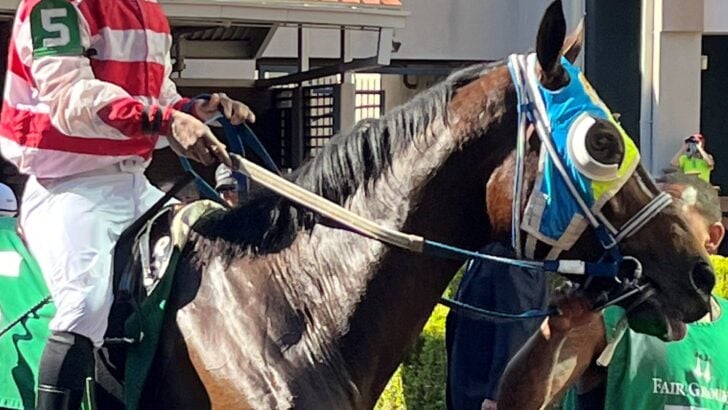
Why do racehorses wear blinkers? Blinkers are cups made from leather or synthetic material that attach to the bridle and restrict a horse’s peripheral vision. Trainers use them to reduce distractions, improve focus, straighten running lines, and help horses break more cleanly from the gate. The type of blinker — from small cheaters to full cups — determines how much vision is restricted. Blinker changes must be declared on the official program, making them one of the most meaningful equipment signals for handicappers.
- Primary purpose: Limit peripheral vision so the horse focuses on the track ahead rather than surroundings
- Common uses: Drifting, gate hesitation, loss of focus in traffic, anxiety in the paddock or post parade
- Types range from: Full cups (maximum restriction) to cheaters/French cups (minimal restriction)
- Betting signal: First-time blinkers are one of the stronger positive equipment indicators on the program
Science sources: Equine vision field of view from Iowa State University Extension — Horse Vision.
Regulatory sources: Equipment declaration rules from the British Horseracing Authority. Barn observations from Thoroughbred racing in Louisiana.
Table of Contents
What Are Blinkers?

Blinkers are cups made from leather or synthetic material that attach to the bridle and sit beside each eye. They restrict how much a horse can see to the sides and rear, narrowing its field of view toward what’s directly ahead.
Horses naturally have a panoramic field of vision — roughly 340–350 degrees — because their eyes are set wide on the sides of their head. That’s useful for detecting predators in the wild. On a racetrack surrounded by noise, movement, and other horses, it creates problems: a horse that can see nearly everything around it often reacts to things it doesn’t need to react to. Blinkers narrow that view to what matters — the track ahead and the jockey’s signals. Our racehorse equipment guide covers everything horses wear on race day and how trainers choose between them.
Why Do Racehorses Wear Blinkers?
Trainers add blinkers for specific behavioral reasons — not as a general fix. Here are the five most common situations where blinkers make a genuine difference.
Improved Focus and Concentration
A horse with nearly 350-degree vision has a lot of information coming in at once. In a race environment — crowd noise, flags, other horses moving alongside — some horses react to stimuli that have nothing to do with running fast. Blinkers reduce that input so the horse can concentrate on the task rather than its environment.
One of my colts had a habit of losing focus whenever another horse pulled alongside him in the stretch. He’d turn his head slightly, hesitate, and lose momentum right at the worst time. Semi-cup blinkers solved it. He started running straighter, stopped looking sideways, and began finishing races the way his morning works suggested he could.
Reduced Anxiety and Spooking
Horses are prey animals with strong flight instincts. A nervous horse at a busy track can be overwhelmed by everything it sees happening around it. Blinkers reduce that visual overload, which helps anxious horses stay calmer through the paddock, post parade, and gate. A horse that arrives at the gate already mentally spent has nothing left to give in the race itself.
If a horse is genuinely high-strung rather than simply distracted, blinkers are usually only part of the solution. Our article on behavior and stress in racehorses covers the broader picture of what drives anxiety and how trainers manage it.
Straighter Running Lines
Some horses drift, lug in toward the rail, or veer toward other horses mid-race. This costs ground and can interfere with other runners. In many cases, the horse is reacting to something it can see — another horse pulling up beside it, movement from the infield, or the crowd along the rail. Removing that visual trigger with a blinker cup on the appropriate side often straightens the horse out without any other change.
One of my fillies consistently ducked in when a horse challenged her late. A semi-cup blinker on the inside eye stopped it. She began holding her line and finishing races far more consistently than before.
Better Gate Performance
The starting gate is one of the most visually and aurally intense moments of a race. Horses that look around in the gate, hesitate when it opens, or break slowly are often reacting to something they can see from inside the stall. Blinkers narrow that view and help horses stay focused on breaking straight and fast when the gate opens.
One of my current horses wears blinkers specifically for the gate. He broke poorly in his first few races — not because he was slow, but because he was watching what was happening beside him instead of focusing forward. With blinkers, his early speed numbers improved immediately.
Safety on the Track
Erratic behavior in a field of horses running at 40 mph is dangerous for everyone — the horse, the jockey, and the horses around them. Blinkers reduce the chance of sudden spooking or unexpected direction changes by limiting what a horse can react to. Racing commissions recognize this, which is why blinker use is officially regulated and must be declared before each race.
Types of Blinkers Used in Horse Racing
Blinker types range from full cups that block nearly all peripheral vision to French cups (cheaters) that allow just a sliver of side awareness. Choosing the wrong type can make a horse worse rather than better — for a full breakdown with guidance on when to use each, see our dedicated article on types of blinkers used in horse racing. The table below gives a quick reference.
| Type | Vision Restriction | Best Used For |
|---|---|---|
| Full-Cup Blinkers | Maximum — blocks nearly all peripheral vision | Highly reactive or easily distracted horses; horses that need strong focus correction |
| Half-Cup (Semi-Cup) Blinkers | Moderate — allows limited side awareness | Horses that drift or lose focus in traffic without being overly reactive |
| French Cups (Cheaters) | Minimal — small slit or opening in the cup | Experienced or calmer horses needing light correction; best starting point for first-time blinker horses |
| One-Sided Blinkers | Targeted — restricts one eye only | Horses that consistently drift or lug in one direction |
| Pacifier Hood | Maximum — full head coverage with mesh eye panels | Extremely anxious horses; often removed at the gate for a final alertness boost |

I typically start with cheaters when introducing blinkers to a horse for the first time. It’s easier to move up to a more restrictive cup if needed than to deal with a horse that’s been overwhelmed by too much restriction too soon. Some horses settle immediately into full cups; others never need more than a French cup to get the result you’re looking for.
How Trainers Decide Which Blinkers to Use
The decision starts with observation. Before a trainer reaches for any equipment, they need to know exactly what the horse is doing and why. Blinkers address a specific problem — they don’t improve a horse that’s simply not fast enough, and they can make things worse if the wrong type is used on the wrong horse.
A working decision process:
- Identify the behavior first — Is the horse drifting, hesitating, looking around, breaking slowly, or losing focus in the stretch? The specific problem determines which cup type and which side to start with.
- Test in workouts before race day — A horse that reacts badly to blinkers in a morning workout isn’t going to improve in a race. A horse that responds well gives you confidence going in.
- Start conservative — Most trainers begin with cheaters or semi-cups and move to more restriction only if the lighter option isn’t doing the job.
- Watch the response closely — A horse that’s calmer, straighter, and more forward in its first blinker workout is telling you something. So is a horse that seems more stressed or confused.
- Adjust over time — Some horses need different blinkers as they develop. A young horse that needed full cups early may eventually work better in cheaters once it matures and settles.
Miles’s Take — When to Walk Away From Them: I’ve had horses where cheaters made no visible difference, and the moment we switched to semi-cups the change was immediate — straighter, more forward, better rhythm. I’ve also had one horse that got worse in blinkers no matter what we tried. He needed to see what was around him to feel confident. Taking them off was the right call. You have to be willing to try something and equally willing to admit when it isn’t working.
Blinkers are one piece of a broader headgear decision. Some horses need a shadow roll to stop shying at track markings, a tongue tie to address a breathing issue, or earplugs to manage crowd anxiety. Our full racehorse equipment guide walks through how trainers approach all of these decisions together.
Blinkers On, Blinkers Off: What It Means for Bettors
Equipment changes are declared on the official program, and blinker changes are among the most meaningful signals you can find there. When you see “blinkers on” or “blinkers off” next to a horse’s name, a trainer is telling you something about that horse — even if they don’t say it out loud.
| Change | What It Signals | What to Look For |
|---|---|---|
| Blinkers on (first time) | Trainer identified a focus or behavioral problem and is addressing it directly | One of the strongest positive equipment signals — especially if recent chart notes show drifting, hesitation, or looking around |
| Blinkers on (returning) | Horse previously wore blinkers, had them removed, and is getting them back | Look at what happened in the races without them — if the horse faded or drifted, returning to blinkers is a positive sign |
| Blinkers off | Horse may have been over-racing — burning energy early and fading in the stretch | Trainer wants the horse to relax and rate; horses that were gutsy but one-dimensional sometimes find a second gear without them |
| Blinker type change | Adjustment to restriction level — up or down | Moving to cheaters from full cups = wants more environmental awareness; moving up to full cups = focus problem still unresolved |
From the barn — a pattern worth watching: A first-time blinker horse in a claiming race is often overlooked by casual bettors, especially if the horse hasn’t run well recently. When I can see from the chart notes that the horse was wandering or hesitating in its last race and the trainer is addressing it directly, that’s worth reviewing alongside the current odds. The key is understanding what the change is trying to fix, not just noting that it happened.
Potential Downsides of Blinkers
Blinkers aren’t right for every horse. Used incorrectly, they can create new problems rather than solve existing ones. Over-restriction — full cups on a horse that only needed cheaters — can make the horse feel closed in and increase anxiety rather than reduce it. Some horses fundamentally need to see their surroundings to feel safe; restricting their vision makes them more anxious, not less. If a horse gets worse in blinkers in workouts, don’t race them in blinkers.
Overdependence is a longer-term concern. A horse that’s raced in full cups for years may struggle to perform without them, which limits your options if you ever want to adjust. Heavy restriction also reduces a horse’s ability to see a horse cutting in front of it quickly — in tight finishes and traffic-heavy races, a horse with full cups has less information about what’s happening around it. And poor fit is an issue regardless of cup size: blinkers that sit too close to the eye or rub against the face cause discomfort that overrides any focus benefit.
Properly fitted blinkers are not considered harmful and are widely accepted in racing. The concern isn’t the equipment itself — it’s using it on a horse that doesn’t need it, or using the wrong type. Used correctly, blinkers are one of the most benign interventions in a trainer’s kit.
Do Blinkers Make Horses Run Faster?
No — blinkers don’t make a horse faster. Speed comes from genetics, conditioning, and training. What blinkers do is help some horses use the speed they already have more consistently, by removing the distractions that cause them to waste energy or break their stride.
A horse that drifts two paths wide in the stretch, or hesitates when another horse comes alongside, isn’t getting slower — it’s just not running straight or committed. Blinkers fix the behavior, not the engine. When a horse runs a faster time after adding blinkers, the improvement came from better application of existing ability, not added speed.
This distinction matters when you’re watching the program. A first-time blinker horse that finishes 10 lengths back isn’t going to suddenly become a winner. But a talented horse that’s been running inconsistently — drifting, looking around, over-racing — can look like a completely different animal once that visual distraction is removed.
Secretariat and His Blinkers

Even the greatest racehorses have had blinker experiments. Lucien Laurin put blinkers on Secretariat in at least one workout during the 1973 Triple Crown season. Jockey Ron Turcotte later said the decision was made one morning when he was out of town — “I guess Lucien felt they helped in keeping Secretariat focused. I never thought he needed them; he worked great without them. As far as I was concerned, they didn’t make much difference either way.”
Turcotte’s account is instructive: Secretariat was a horse with such an even, confident temperament that the blinkers were essentially optional. Laurin tried them because focus equipment was part of his training toolkit — not because Secretariat had a documented focus problem. The horse performed brilliantly with or without them.
The lesson isn’t that blinkers made Secretariat great. It’s that even at the highest level, trainers experiment with focus equipment — and sometimes the right answer is that the horse doesn’t need it.
Key Takeaways: Blinkers in Horse Racing
- Blinkers solve behavioral problems, not talent gaps — they help horses that drift, hesitate, look around, or break slowly apply what they already have more consistently; they do nothing for a horse that simply isn’t fast enough
- Start conservative — cheaters or semi-cups first; it’s easier to increase restriction than to walk back a horse that’s been overwhelmed by full cups
- First-time blinkers are a real betting signal — look for what the chart notes show in the previous race; if the horse was wandering or hesitating and the trainer is addressing it directly, that’s targeted and worth noting
- Blinkers off matters too — a horse that was over-racing and fading can find a second gear once the blinkers come off; don’t assume removal is a negative
- Some horses need to see their surroundings — if a horse gets worse in workouts with blinkers, don’t race them in blinkers; the equipment has to suit the individual animal

FAQs: Racehorses and Blinkers
Do all racehorses wear blinkers?
No. Blinkers are used based on individual need. Many horses race their entire careers without them. Others need them from the first start. The decision comes down to how a specific horse behaves in training and races.
What does ‘blinkers on’ mean on a racing program?
It means the horse is wearing blinkers for the first time, or returning to them after racing without them. It signals the trainer identified a focus or behavioral issue and is addressing it with equipment. First-time blinkers are one of the more reliable positive signals in handicapping.
What does ‘blinkers off’ mean?
The horse previously wore blinkers and will race without them. This often signals the trainer wants the horse to relax and rate better rather than rushing to the front. Horses that over-race and fade sometimes improve significantly when blinkers are removed.
Do blinkers make horses run faster?
No. Blinkers don’t add speed — they help horses apply the speed they already have more consistently. When a horse runs a faster time after adding blinkers, it’s because the horse stopped drifting, hesitating, or losing focus, not because the equipment made it physically quicker.
Can blinkers hurt a horse’s performance?
Yes, if the wrong type is used or if the horse doesn’t respond well to restriction. A horse that becomes more anxious or confused in blinkers will run worse, not better. That’s why testing in workouts before race day is essential.
Are blinkers legal in all races?
Yes, in most jurisdictions, but their use must be declared before the race. Racing commissions regulate blinker use to maintain transparency for bettors and officials, since equipment changes can significantly affect a horse’s performance.
What is the difference between blinkers and a shadow roll?
Blinkers restrict side and rear vision to reduce distractions from the environment. A shadow roll is a sheepskin band on the noseband that blocks the horse’s downward view, preventing shying at shadows or track markings. Many horses wear both.
Do blinkers help horses at the gate?
Yes. Horses that look around inside the gate or hesitate when it opens often improve with blinkers. Limiting what they can see inside the stall helps them stay focused on breaking forward rather than reacting to adjacent horses or movement.
About Miles Henry
Racehorse Owner & Author | 30+ Years in Thoroughbred Racing
Miles Henry (legal name: William Bradley) is a professional horseman based in Folsom, Louisiana. He holds Louisiana Racing License #67012 and has spent over three decades managing Thoroughbreds at premier tracks including Fair Grounds, Delta Downs, and Evangeline Downs.
Expertise & Hands-On Experience: Beyond the track, Miles has decades of experience in specialized equine care, covering everything from hoof health and nutrition to training protocols for Quarter Horses, Friesians, and Paints. Every guide on Horse Racing Sense is rooted in this “boots-on-the-ground” perspective.
30 of their last 90 starts
Equibase Profile.

Connect with Miles: