
Last updated: April 16, 2026
A drifting horse isn’t just running crooked — it’s giving away lengths, risking disqualification, and often signaling a deeper problem most bettors miss. The same move that costs a race can also reveal exactly what will happen next time — if you know what you’re looking at.
Horses drift during races for five distinct reasons, and only one of them — visual distraction — is something blinkers can fix. I’ve watched trainers add blinkers to a drifting horse and solve it in one start. I’ve also watched the same solution accomplish nothing, because the real cause was a sore leg, an inexperienced rider, or a young horse that simply needed more time. Reaching for blinkers before diagnosing the cause is one of the most common — and costly — mistakes in training.
I’m a licensed Louisiana racehorse owner (#67012) with horses at Fair Grounds, Evangeline Downs, and Delta Downs — over 30 years watching and conditioning runners at regional tracks. Every example in this guide comes from races I’ve watched firsthand or reviewed through replay analysis on Equibase. This is not a general overview of equine behavior; it’s a practical field guide to one of the most misread problems in racing.
Table of Contents

What Does It Mean When a Horse Drifts?
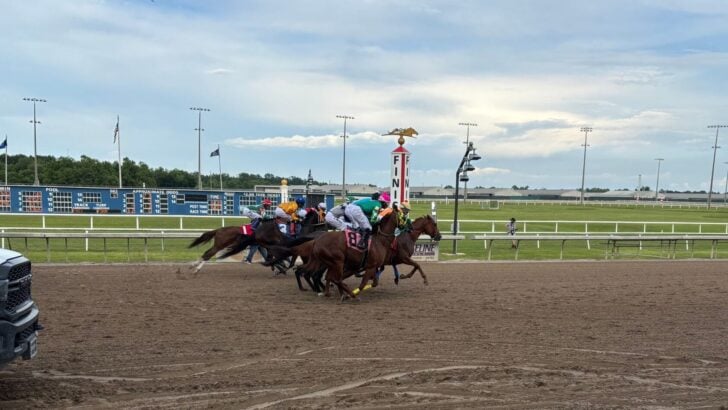
Drifting — also called lugging in or lugging out in horse racing — is when a horse runs off a straight line during a race. Instead of tracking the rail or maintaining its lane, it gradually veers toward the outside fence (drifting out) or pulls toward the inside rail (lugging in). The practical result is the same either way: the horse isn’t going where its rider is pointing it, and it’s paying for that with ground.
Mild drifting costs fractions of a second — enough to matter at the wire. A horse that runs two feet wide of the ideal path around a turn covers meaningfully more distance than one that tracks the rail. In a competitive six-furlong race, consistent drift on the turn can cost half a length or more. Severe drifting causes interference with other horses, can result in a disqualification regardless of finishing position, and in extreme cases creates real safety risk for both horse and rider.
| Term | Direction | What It Looks Like | Common Cause |
|---|---|---|---|
| Drifting out | Toward the outside fence | Horse widens its path around the turn or in the stretch, moving away from the rail | Fatigue, discomfort on the inside lead, distraction from crowd or outside movement |
| Lugging in | Toward the inside rail | Horse pulls left (on a left-hand track), forcing the rider to steady or correct | Natural lateral tendency, discomfort on the outside, rail-orientation in young horses |
| Bearing in / out | Either direction, sudden | Abrupt lateral movement, often into another horse — distinct from gradual drift | Spooking, sudden discomfort response, or loss of balance at high speed |
| Hanging | No direction — horse stops responding to urging | Horse levels off in the stretch, not drifting but not accelerating either | Fatigue, lack of desire, or a horse that has run its race by the top of the stretch |
The Five Main Causes of Drifting
Drifting has five meaningful causes in racehorses. They are not mutually exclusive — a horse can drift for two reasons at once — but each one has a distinct signature and a distinct set of solutions.
| Cause | Signature | Blinkers Help? | First-Line Fix |
|---|---|---|---|
| Visual distraction | Drifts toward movement — crowds, other horses, gaps in the rail | Yes — restricts the visual trigger | Blinkers (full cup or French cup) |
| Physical soreness | Drifts away from the uncomfortable side; tends to worsen late in a race under fatigue | No — does not address the underlying cause | Veterinary evaluation; rest; treat the underlying issue before returning to the track |
| Greenness / inexperience | Inconsistent — may drift differently each race; often self-corrects with experience | Sometimes — helps focus but can increase anxiety in some young horses | Patient schooling; controlled gate work; time on the track |
| Rider error | Drift correlates with specific jockeys; other riders don’t produce the same pattern | No — equipment cannot compensate for a rider problem | Jockey change; rider feedback and technique correction |
| Natural lateral tendency | Consistent direction regardless of race situation, fatigue level, or rider | Partial — may help slightly but rarely eliminates a true lateral tendency | Shadow roll; asymmetric blinker cup; training adjustments to build symmetry |
Cause 1: Visual Distraction
Horses can see nearly 360 degrees. That means as your horse runs down the stretch, it notices the grandstand on the left, a rival on the right, and a gap in the outer rail straight ahead. For horses who get easily distracted—or haven’t learned to ignore the chaos of a race—that’s a lot to take in. Often, the horse drifts toward whatever catches its eye, sometimes faster than you can correct it.
This is the most common reason young horses drift, and it’s exactly why blinkers were invented. By limiting side vision, blinkers reduce distractions. No more reacting to the cheering crowd, a shadow of another horse, or a tempting gap in the rail. The horse can focus straight ahead, exactly where its trainer wants it looking.
One way to tell if a horse is drifting due to visual distraction: it follows the stimulus, not a pattern. Watch the replay carefully. If a horse drifts out when another horse moves up on the outside, or toward the grandstand when the crowd cheers, that’s it reacting to its environment. That’s different from a horse in pain or with a natural lateral tendency. These horses are usually perfect candidates for blinkers—and often worth watching the first time the gear goes on.
Not all blinkers are the same. Full cup blinkers block almost all side vision and are best for horses who get seriously distracted. French cup blinkers block about half the side vision and suit horses that drift moderately—enough to reduce distractions without making them anxious. For a full breakdown of blinker types and how much vision each blocks, see our guide on why racehorses wear blinkers.
Cause 2: Physical Soreness or Asymmetry
A horse that’s uncomfortable will often drift away from the sore side. It’s a way of protecting that side by shifting weight and path. From watching horses in training and races, this pattern usually gets worse as the race goes on. A horse that runs straight for most of the race but drifts badly in the final furlong is often showing you that something is bothering it when the physical demand peaks.
Here’s why: at full speed, a Thoroughbred puts over 2,500 lbs per stride on a single forelimb — several times its body weight. Even a small imbalance in that force — from a minor leg issue, hind end asymmetry, or back strain from a poor saddle fit — can push the horse sideways. The effect isn’t always obvious at slower speeds. The track exposes the weakness first.
Subtle drifting often gives away soreness before anything else. I remember one horse with a minor bowed tendon; I first noticed it during training by how he drifted. Another horse started drifting in the turns, which made me check his back end—I found it sore. A few adjustments and some work with a chiropractor got him back to running straight quickly.
Common sources include front leg soreness (shin or joint issues), hind end asymmetry, back strain, or uneven hooves. A horse bothered in its left front, for example, will often drift right — away from the sore side — especially under maximum effort. This is a movement observation, not a diagnosis; your vet decides the exact cause. But knowing the pattern is critical.
To tell discomfort-driven drifting from distraction-driven drifting, watch several races carefully. The soreness pattern tends to stay in the same direction, worsens under pressure, and may come with other signs: a shorter stride on one side, reluctance to extend, head tilting, or a horse that mentally checks out when pushed. Distraction-driven drifting, on the other hand, changes depending on what the horse sees, not how tired it is.
Cause 3: Greenness and Inexperience
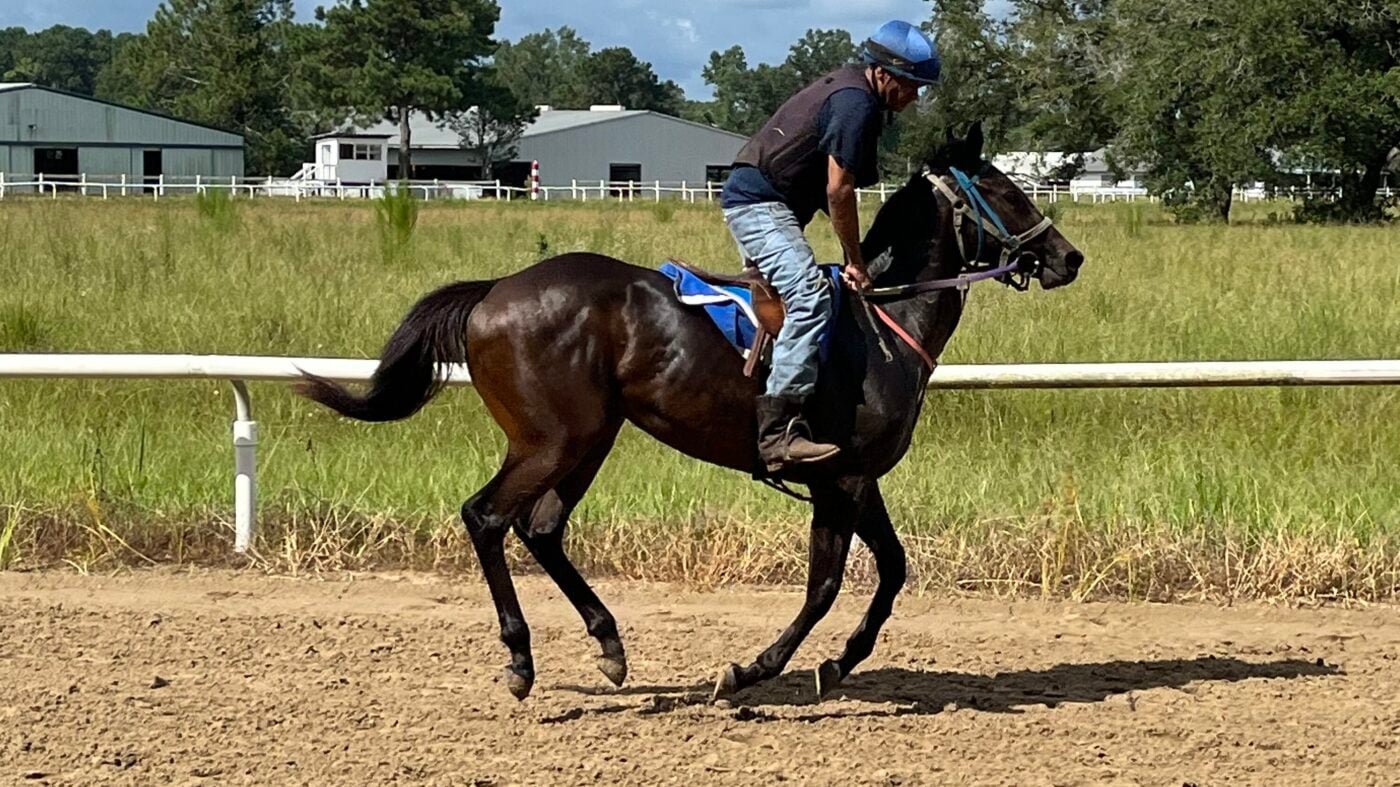
Young horses—especially first- or second-year starters—drift mostly because they’re still learning what “straight” means at full speed. A two-year-old making its third start is running 35 mph in a pack of horses with a roaring crowd. The fact that it runs mostly straight is impressive; a little drift is normal. Greenness-driven drifting is unpredictable: left one race, right the next, and maybe mostly straight in another.
The fix here isn’t gear—it’s schooling and time. Gate work, gallops along the rail, and controlled breezes alongside experienced ponies teach young horses to settle and hold a line. Most work out the kinks naturally as they gain experience, as long as the trainer doesn’t cover it up with an equipment change that just masks the problem.
Blinkers can still help green horses—not by fixing the greenness itself, but by reducing the flood of things the horse sees. A young horse overwhelmed by visual input may settle and run straighter once some of that is blocked. The question is whether the blinkers calm the horse or make it more anxious. A quick test gallop in blinkers before race day usually tells you which type you’ve got.
Cause 4: Rider Error or Imbalance
Jockeys ride with short stirrups and a forward seat, which gives them a huge influence over a horse’s balance and direction. A rider who sits slightly off-center, pulls unevenly, or shifts weight to one side will change the horse’s path—often without realizing it. Rider-caused drifting is underdiagnosed because trainers are understandably hesitant to blame their jockey.
The tell? Correlation with specific riders. If a horse drifts with Jockey A but runs straight with Jockey B, it’s usually the rider, not the horse. Watching multiple races with different riders is far more reliable than a single replay. The same horse, same track, different riders—different paths.
| What to Watch For | What It Suggests |
|---|---|
| Drifting only with one jockey | Strong hint of rider influence—check rein contact and weight distribution in the replay |
| Drift starts when the jockey drives (whip or hands-and-heels) | The driving motion is causing imbalance—rider technique issue |
| Runs straight in morning workouts but drifts in races | Difference between exercise rider and race jockey—rider is the variable |
| Corrects when jockey steadies, drifts when urged again | The horse can run straight; urging is causing the problem |
Cause 5: Natural Lateral Tendency
Some horses just have a stronger preference for one side—a natural asymmetry that shows up as consistent drifting no matter the distraction, soreness, or rider. This is rare and hard to fully correct. A horse with a true lateral tendency drifts the same way across races, riders, and fatigue levels, without any obvious external trigger.
It’s partly structural and partly habitual—built from thousands of miles on the same track. American tracks run left-handed, so a horse trained counterclockwise for years may develop a strong left-side bias that shows as lugging in races. It’s not a flaw—just how the horse’s body has learned to move.
Equipment can help manage it: a shadow roll (changes rail perception), a one-sided blinker cup (more coverage on the drifting side), and training adjustments that add right-hand turns to build balance over time. None of these are guaranteed fixes—sometimes it’s a matter of managing and accommodating, not eliminating, the tendency.
I had one horse that was a rail lover. Even from an outside post, he’d lug inside to get to it—sometimes bumping into other horses and getting taken out of the race. Luckily, most of the time we drew an inside post position, so he could stick to his preferred line without incident.
When Blinkers Help With Drifting
Blinkers are the most commonly used piece of equipment for drifting in racehorses, and when deployed for the right reason, they are one of the most reliable fixes in training. Blinkers are not a general solution — they are a targeted fix for a visual problem. When used correctly, they can change a horse’s path immediately and permanently. When used incorrectly, they waste a start and delay the real diagnosis by at least a race cycle.
| Scenario | Will Blinkers Help? | Best Blinker Type |
|---|---|---|
| Horse drifts toward grandstand noise and crowd movement | Yes — crowd stimulus is as much visual as auditory | Full cup on the crowd side; French cup if mild |
| Horse drifts when another horse pulls alongside | Yes — classic response to lateral movement in peripheral vision | Full cup or French cup depending on severity |
| Horse loses focus in the stretch and ducks toward the outside rail | Yes — attention drifts before the body does; blinkers keep focus forward | Full cup or French cup |
| Sprint (6 furlongs or less) — horse reactive at the break and in early drive | Yes — blinkers sharpen the break and reduce lateral distraction in tight early quarters | Full cup; ideal for claiming sprinters with distraction history |
| Route race (1 mile or more) — horse drifting on the second turn | Possible — blinkers may help if the cause is distraction, but monitor energy use; some horses use more nervous energy in blinkers over longer distances | French cup first; full cup only if French cup proves insufficient |
| Young horse overwhelmed by the race environment generally | Sometimes — depends entirely on whether the horse relaxes or tenses with restricted vision; test in a gallop before committing | French cup to start; monitor anxiety closely |
First-time blinkers on a confirmed distraction-drifter is one of the most reliable equipment plays in racing, both as a training intervention and as a handicapping signal. A horse that has been losing ground on every turn because it keeps watching the grandstand is about to run a fundamentally different race when that visual stimulus is removed. For more on how blinkers affect race performance more broadly, see our full guide on why racehorses wear blinkers.
When Blinkers Make Drifting Worse
Blinkers are not a universal fix, and in the wrong situation they can significantly worsen a drifting problem. The core risk is anxiety: a horse that relies on wide peripheral vision to feel oriented and safe in its environment may become more agitated — not less — when that vision is restricted. An anxious horse is harder to rate, harder to settle, and paradoxically more likely to drift because it is fighting its rider rather than working with them.
| Scenario | Why Blinkers Don’t Help | Better Approach |
|---|---|---|
| Horse drifts due to discomfort, worsening in the stretch under fatigue | The physical issue is the cause — blinkers don’t address it and the horse races on the problem another time | Veterinary evaluation before the next start; rest if indicated |
| Horse drifts inconsistently with no clear visual trigger — green or inexperienced | Blinkers may increase anxiety in a horse still processing the race environment for the first time | More schooling, gate work, and race experience; let greenness resolve; test in a gallop first |
| Horse drifts with one jockey but runs straight with another | The rider is the variable, not the horse’s vision — blinkers mask the actual problem | Jockey change; honest conversation between trainer and rider about technique |
| High-anxiety horse that relies on seeing its surroundings to stay calm | Restricting vision increases anxiety; the anxious horse fights harder, drifts more, and uses more energy before it runs a step | Shadow roll; pacifier hood; relaxation work before adding any restrictive equipment |
| Route horse with a natural lateral tendency | Blinkers don’t retrain movement patterns or biomechanical preference; horse may also tire faster in blinkers over a longer route | Asymmetric cup; shadow roll; training adjustments to build bilateral balance |
Other Equipment Used to Correct Drifting
Blinkers are the most visible tool for drifting but not the only one. Trainers have a range of equipment options depending on the specific cause and the specific horse. Understanding what each piece does — and what problem it actually addresses — matters both for owners working with their trainers and for bettors reading equipment changes in the past performances.
| Equipment | What It Does | Best For | Handicapping Signal |
|---|---|---|---|
| Full cup blinkers | Blocks nearly all lateral and rear vision — the horse sees only forward | Severe distraction drifters; horses that strongly react to lateral movement in sprints | Strong positive for first-time use on a confirmed drifter |
| French cup blinkers | Blocks roughly 50–60% of lateral vision — less restrictive than full cup | Moderate distraction; green horses; route horses where full cup may cause over-keenness | Moderate positive first time; a step down from full cup may signal trainer backing off |
| Visor | Eye cup with a small hole — allows some lateral vision while reducing full peripheral distraction | Horses that need to see rivals to stay motivated; milder distraction drifters | Positive for first use; common in UK and Australian racing; less used in the US |
| Shadow roll | Sheepskin or foam roll across the noseband — blocks the horse’s view of the ground directly in front | Horses that shy at shadows, puddles, or rail gaps at ground level | Moderate positive first time; addresses a specific visual ground-level distraction |
| One-sided blinker extension | Extra coverage on one cup only — asymmetric restriction targeted at one side | Horses with a consistent one-directional drift caused by a specific lateral visual stimulus | Positive; shows the trainer has specifically identified the direction of the problem |
| Running martingale | Limits head carriage — prevents the horse from throwing its head and losing bit contact | Horses that lose rein contact when drifting, making rider correction harder | Neutral — addresses control mechanics, not drifting itself |
For a complete guide to the full range of headgear available in racing — including visors, hoods, cheek pieces, and pacifiers — see our racehorse equipment guide.
What Drifting Means for Bettors
Drifting is one of the most useful things a bettor can find in a race replay — and one of the most underused. Most casual bettors look at finish position. Sharp bettors watch the trip. A horse that drifted badly and still finished second has run a better race than its position reflects. A horse that ran straight and finished second in a perfectly clean trip ran a completely different kind of second. The form records both as “2nd.” Only the replay tells you which was which.
| What You See in the Replay | What It May Mean | Betting Implication |
|---|---|---|
| Horse drifted 3–4 feet wide on the turn, still finished 3rd | Ran the equivalent of a length or more farther than the winner — the form understates the performance | Positive angle — watch for an equipment change next start; this horse may be meaningfully better than it looks on paper |
| Horse drifted badly in the stretch and was disqualified for interference | Official result may not reflect actual performance quality | Review carefully — if the cause was distraction, blinkers next start is worth tracking as a bet |
| Horse added blinkers after two races with visible drift toward outside horses | Trainer correctly diagnosed a distraction problem and is addressing it with the right tool | Strong positive — especially combined with a class drop or hot trainer; this is a core bet profile |
| Horse drifted late in race only, worsening under drive — repeated across two starts | From experience, late-race drift that worsens with fatigue often signals a physical issue worth investigating | Negative flag — wait for evidence of a vet check and recovery before backing this horse again |
| Horse ran with blinkers, still drifted in the same direction | Blinkers did not fix the problem — the cause was not visual distraction | Negative — the trainer’s diagnosis appears incorrect; physical or rider cause more likely |
| Blinkers removed after two starts — horse was over-keen early, then stopped | Blinkers were causing anxiety and burning energy; trainer is backing off | Watch — horse may run a more relaxed, better-paced race without restrictive equipment |
Post position is worth factoring in when handicapping known drifters. A horse with a history of drifting out that draws a wide post (7 or 8 in a nine-horse field) has less rail to drift toward and less lateral consequence when it does. A confirmed drifter-out drawing the 1 post, by contrast, faces a specific problem: it will drift into other horses immediately. At Fair Grounds and Evangeline, where fields often run to eight or nine horses in claiming company, I pay close attention to this post-versus-drift matchup in every race where a known drifter is on the card.
For bettors who read the form carefully, drifting connects directly to two of the most important signals in past performances: equipment changes and trip angles. A horse noted with “b” (blinkers) for the first time after a race in which the replay clearly shows a distraction-driven drift is exactly the kind of convergence — form signal plus replay evidence — that produces high-confidence betting opinions. For more on reading equipment change signals in the past performances, see our complete guide to reading a racing form.
FAQs: Why Do Horses Drift During Races?
Why do horses drift out during races?
Horses drift out during races for five main reasons: visual distraction from horses, crowds, or movement on the outside; physical discomfort that causes them to shift weight away from the affected side; greenness and inexperience with running in a straight line at race speed; rider error or imbalance that creates lateral pressure; and a natural lateral tendency developed through training habits or physical asymmetry. The cause determines the fix — blinkers help reliably when the cause is visual distraction, but do not address physical or rider-related drift.
What is the difference between drifting and lugging in horse racing?
Drifting and lugging describe the same basic problem — a horse running off a straight line — in different directions. Drifting typically refers to a horse moving toward the outside fence, away from the rail. Lugging in refers to a horse pulling toward the inside rail. Both cost ground and can cause interference with other horses. Bearing in or out is a related term for more sudden lateral movement, often triggered by a specific stimulus rather than a gradual drift.
Do blinkers fix lugging in horse racing?
Blinkers fix lugging when the cause is visual distraction — something on the inside is pulling the horse’s attention, and restricting that lateral vision removes the trigger. Blinkers do not fix lugging caused by physical discomfort, a natural left-side tendency, or rider pressure. A horse that lugs in consistently regardless of who rides it or how fresh it is may have a natural lateral tendency that requires a shadow roll, asymmetric blinker cup, or training adjustments rather than standard blinkers.
What causes a horse to lug in during a race?
Lugging in — pulling toward the inside rail — is most commonly caused by a natural left-side preference from years of training counterclockwise on American tracks, physical discomfort on the outside that causes the horse to shift inward, or rail-orientation in young horses that have learned to follow the inside fence in gallops. It can also be rider-related if the jockey applies stronger left-rein pressure during the drive. A shadow roll sometimes helps horses that shy at the rail itself, which can cause them to lug away and then overcorrect.
How does drifting affect a horse’s chances of winning?
Drifting directly costs ground. A horse that drifts two feet wide around a turn covers meaningfully more distance than a horse tracking the ideal path — in a six-furlong race, significant drift on the turn can cost half a length or more. Severe drifting also risks interference calls and disqualification regardless of finishing order. From an efficiency standpoint, a horse fighting its rider to drift is also not running as cleanly as one tracking straight, which compounds the ground loss with wasted energy.
Can a horse be disqualified for drifting?
Yes. A horse that drifts into another horse and causes it to alter course, check, or lose ground can be placed behind the affected horse by the stewards regardless of the official finishing order. In serious cases — where a horse bears in or out suddenly and causes a horse to fall or a jockey to be unseated — the stewards can disqualify the offending horse entirely. The standard is whether the drifting materially affected the outcome for another horse, not simply whether it occurred. Exact steward standards can vary slightly by jurisdiction
What is a shadow roll and does it help with drifting?
A shadow roll is a sheepskin or foam roll fitted across the noseband that blocks the horse’s downward line of sight, preventing it from seeing shadows, puddles, or patterns on the ground directly ahead. Some horses shy or drift at ground-level visual features — the shadow of the rail, gaps between rail sections, or water on the track surface. For these horses, a shadow roll can significantly reduce ground-level distraction and straighten their path. It does not help with drifting caused by lateral distraction, physical discomfort, or rider error.
Should I bet a horse that drifted badly last time?
Potentially yes — depending on what caused the drift and whether the trainer has responded to it. A horse that drifted due to visual distraction and now shows first-time blinkers in the entries is often a strong bet angle, especially combined with a class drop. A horse that drifted because of a physical issue and shows no equipment change or jockey switch is a horse to wait on until the underlying cause is addressed. Watching the replay of the previous race is the best way to distinguish which situation you’re looking at.
Conclusion
Drifting is a symptom, not a diagnosis. The same lateral movement in the stretch can come from five completely different causes — and each one has a different solution. Blinkers are the right fix for the right horse, and they work reliably when the cause is visual distraction. They are the wrong fix for a horse that is carrying a physical issue, fighting a rider problem, or still learning what a race actually is.
The framework for evaluating drifting is consistent whether you’re an owner sitting with your trainer, a bettor watching replays before a race, or a fan trying to understand what the stewards are deliberating. Ask what the drift looks like — when does it start, which direction, does it follow a specific trigger or worsen under fatigue? Match that pattern to the five causes. Then check whether any equipment change in the entries matches what the replay actually showed you.
After 30 years owning racehorses, I’ve learned that drifting is rarely random. It’s a signal. When you learn to read that signal correctly — whether as an owner, a bettor, or a fan — you start seeing races differently than the public does. And that difference is exactly where the edge is.
For more on the specific equipment trainers use to manage drifting and other focus problems, see our full guides on why racehorses wear blinkers, the complete racehorse equipment guide, and how to read equipment change signals in past performances.
Sources
- Equibase — Race replays and past performances: equibase.com
- BloodHorse — Thoroughbred racing reference and equipment research: bloodhorse.com
- The Horse — Equine health and veterinary reference: thehorse.com
- Racing Post — UK/International racing reference and equipment rules: racingpost.com
About Miles Henry
Racehorse Owner & Author | 30+ Years in Thoroughbred Racing
Miles Henry (legal name: William Bradley) is a professional horseman based in Folsom, Louisiana. He holds Louisiana Racing License #67012 and has spent over three decades managing Thoroughbreds at premier tracks including Fair Grounds, Delta Downs, and Evangeline Downs.
Expertise & Hands-On Experience: Beyond the track, Miles has decades of experience in specialized equine care, covering everything from hoof health and nutrition to training protocols for Quarter Horses, Friesians, and Paints. Every guide on Horse Racing Sense is rooted in this “boots-on-the-ground” perspective.
30 of their last 90 starts
Equibase Profile.

Connect with Miles: