Last updated: June 24, 2026
I replaced the last of our metal halide barn lights about five years ago. The final straw was a night when one of our horses colicked and I needed to get into the barn fast — flipped the switch and stood there waiting nearly two minutes for the lights to come up enough to see. That’s when I realized metal halide wasn’t a lighting system for a working barn; it was a liability.
LED lights replaced every fixture, and the difference was immediate — instant-on, brighter, cooler, and significantly cheaper to run. This guide covers what we use and why, organized by location: aisleways, stalls, and exterior. Some links below are affiliate links. All picks are based on performance and horse safety, not commission rate.
Horse barn lighting — what matters by location:
- Aisleways — LED high-bay or flood fixtures at 12+ feet; bright enough to groom, shoe, and check horses at any hour
- Stalls — enclosed LED fixtures mounted at 12 feet minimum; positioned at the corner or wall, not center-ceiling, to avoid shadows on the lower legs
- Exterior — dusk-to-dawn LED with photocell sensor; turns on automatically at night without any switches to manage
- Wiring — all wiring through metal conduit, run high and out of reach; horses chew exposed wire
- Avoid — metal halide (slow warm-up, slow restart), incandescent (heat, short life), any unguarded fixture within horse reach
Bottom line: For nearly every horse barn built or updated today, LED is the most practical choice — instant-on, low heat, long life, and available in every fixture type needed for stalls, aisles, and exterior. Existing fluorescent systems may still be serviceable where they’re working well, but few new installations use anything other than LED.
Table of Contents

Why LED Is the Right Choice for Horse Barns
The barn environment is harder on light fixtures than most people account for when they’re building. Dust, humidity, ammonia from urine, and horses that chew or strike anything within reach all shorten fixture life and create safety problems with the wrong equipment. LED addresses most of these directly.
| Bulb Type | Warm-Up Time | Heat Output | Lifespan | Barn Suitability |
|---|---|---|---|---|
| LED | Instant | Low | 50,000+ hours | Best choice for all barn locations |
| Fluorescent | Instant to slow (cold temps) | Low | 10,000–15,000 hours | Acceptable; performance drops in cold and humidity |
| Metal halide | 1–2 minutes on, 15+ minutes to restart | High | 6,000–15,000 hours | Not suitable — restart delay is a safety problem |
| Incandescent | Instant | Very high | 1,000 hours | Not suitable — heat and fire risk near bedding |
The metal halide restart problem is the one that catches barn owners off guard most often. These fixtures take 15 minutes or more to come back to full brightness after being switched off — which means if you cut the lights at night and then need to get back in quickly, you’re working in near-darkness. For a routine inconvenience that’s frustrating, in an emergency with a sick or injured horse, it’s dangerous. We replaced ours and haven’t looked back.
Aisleway Lighting
Aisleways need to be bright enough to groom, tack up, shoe, and examine horses at any hour. We routinely work in our aisleway before sunrise and after returning from evening races, so this isn’t a “nice to have” — it’s a daily working requirement. Our barn is designed with natural light from open gable ends, supplemented with small, powerful LED floodlights positioned high along the aisleway.
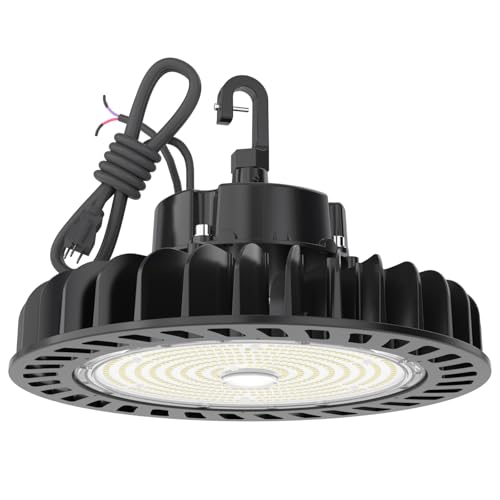
For small barns with standard ceiling heights, a good enclosed LED floodlight at each end of the aisle is often sufficient. For large barns with high ceilings — 15 feet or more — high-bay LED fixtures are the right tool. They’re engineered to push light down across wide areas from height, where a standard fixture would leave the floor dim. In large aisleways I look for an enclosed design, an IP65 or better weather rating, and enough output to illuminate the full working area from ceiling height. The HYPERLITE fixture below is one that meets those requirements and has held up well in working barn conditions.
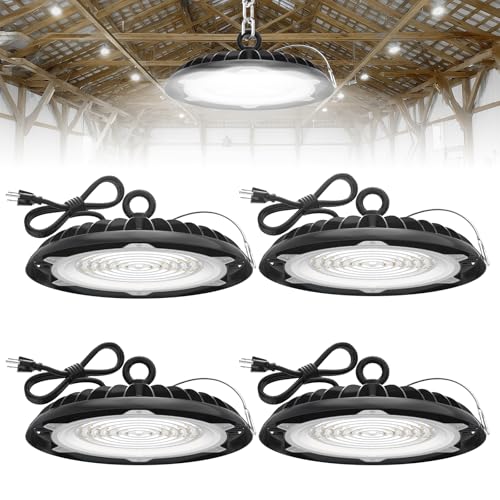
HYPERLITE 200W UFO LED High Bay Light — High-ceiling aisleway fixture for large working barns
· 200W · 30,000 lumens · 5000K daylight · IP65 waterproof · UL certified · 4-pack
Why I Like It: It throws enough light to fully illuminate a large aisleway from ceiling height without adding heat or maintenance headaches — and being instant-on means it’s ready the moment you flip the switch, day or night.

Horse Stall Lighting
Good stall lighting isn’t just about being able to see the horse — it’s about being able to see the horse’s lower legs, hooves, and coat clearly enough to catch problems early. We groom and saddle our young horses in their stalls, and early detection of heat, swelling, or cuts pays for itself quickly. A well-lit stall is one of the simplest management tools available.
Stall light placement — what works and what doesn’t:
- Mount at 12 feet minimum — any fixture within horse reach is a contact hazard, particularly when horses rear
- Corner or wall placement, not center-ceiling — center-ceiling placement creates shadows directly below the horse, which is exactly where you need to see most clearly
- Enclose or cage every fixture — a shattered bulb on a stall floor is a serious hoof laceration risk; barn-rated enclosed fixtures eliminate this
- No exposed hardware within reach — mounting brackets, conduit ends, and fixture edges at horse height are contact hazards; see the horse stall design and safety guide for the full hazard checklist
Color temperature matters more in stalls than anywhere else in the barn. For stall lighting I look for fixtures in the 4000K to 5000K range — a neutral to daylight appearance that makes it easier to evaluate coat condition, wounds, swelling, and hoof problems under artificial light. Warmer 2700K–3000K lights feel comfortable but can flatten color detail and make it harder to spot heat or subtle changes in the lower leg. If you’re choosing between two otherwise equivalent fixtures, the cooler one wins in a working stall.
How Bright Should Horse Barn Lights Be?
Most barn owners don’t need a light meter to answer this. A practical rule: you should be able to inspect a hoof, identify swelling in a leg, and read a medication label without additional task lighting. If you’re reaching for your phone flashlight to check something, the stall needs more light.
| Location | Recommended Light Level | Practical Test |
|---|---|---|
| Horse stalls | 100–200 lux | Can read a medication label and inspect the lower leg without task lighting |
| Aisleways | 150–300 lux | Can see clearly from one end to the other; no dim zones between fixtures |
| Tack and feed rooms | 300–500 lux | Can read small print on feed bags and labels without leaning toward a window |
| Wash racks | 300–500 lux | Can assess coat and skin condition clearly while working |
| Exterior walkways | 50–100 lux | Can see the ground clearly and identify a horse standing at the fence line |

LED Barn Stall Light — Enclosed fixture for individual horse stalls
· Enclosed LED design · Instant-on · Low heat output · Suitable for humid barn conditions
Why I Like It: One thing I learned after switching to LEDs is that horses don’t care nearly as much about brighter light as people do. The real benefit isn’t for the horse — it’s for the person caring for the horse. This enclosed fixture gives you enough light to actually see what you’re looking at when you’re checking legs, picking hooves, or reading a label at 5 a.m.
Horseman’s Perspective: The most common stall lighting mistake I see is center-ceiling placement. It looks logical — put the light in the middle, light the whole stall — but in practice it creates a shadow directly below the horse’s belly and down its legs, which is precisely where you’re looking when something’s wrong. Move the fixture to a corner or wall position at the same height and the light wraps around the horse instead of casting it in shadow. It takes five minutes to do differently when you’re building and is very difficult to correct afterward.
Exterior Barn Lighting
Exterior lighting does two things: it lets you see what’s happening around the barn after dark, and it deters unwanted visitors. I want the outside of our barn well-lit — not just for security, but because arriving after an evening race and needing to check on horses in the dark is a routine that happens dozens of times a year. Good exterior lighting is a daily operational necessity, not just a security measure.
Dusk-to-dawn fixtures with a photocell sensor are the right choice for exterior barn lighting. The sensor turns the light on automatically at dusk and off at dawn — no switches to remember, no lights left burning through the day. They pair well with the barn’s overall electrical management and eliminate the kind of oversight that leaves exterior lights running through Louisiana summers at full power during daylight hours.
TORCHSTAR LED Dusk-to-Dawn Barn Light — Photocell exterior fixture for barn entrances and perimeter
· 40W LED (replaces 400W incandescent) · IP65 waterproof · ETL & FCC listed · Photocell auto on/off · Aluminum housing · 50,000-hour lifespan
Why I Like It: The photocell does the work — it comes on at dusk and goes off at dawn without any input from me. After a long day at the track, the last thing I need to think about is whether the exterior lights are on. This one handles it.
Solar flood lights are a practical supplement for areas that don’t have existing wiring runs — paddock corners, gate areas, or the far end of a run-in shed. They’re not a replacement for hardwired exterior lighting at the main barn, but they fill gaps without the cost of running new circuits. Look for units with motion detection and waterproof ratings appropriate for outdoor year-round use.
Wiring and Safety
Barn wiring gets less attention than fixture selection and causes more problems. Horses and barn rodents chew electrical wiring — not occasionally, but reliably. Any wire that runs along a wall or post at any height a horse can reach will eventually be chewed. The fix is metal conduit for every run, and routing it high and out of the way. This isn’t overcaution; it’s the standard approach for any working barn.
Barn wiring requirements — non-negotiable:
- Protect wiring runs from physical damage — in our barns every exposed wiring run is in metal conduit; horses chew, rodents chew, and exposed wiring eventually becomes a maintenance or safety problem. Local electrical codes vary, but protection from physical damage should be a priority in any horse facility
- Run conduit high — above horse reach on walls, along rafters where possible
- GFCI outlets for all circuits — cuts power on ground fault; required in wet locations under electrical code
- Plan for total electrical load — barn circuits carry fans, clippers, chargers, and lighting simultaneously; size circuits for the full load, not just the lights
- New circuits require a licensed electrician — barn wiring is not a residential DIY project; the fire risk from a wiring failure in a structure full of bedding and horses is severe

The barn’s electrical system also needs to account for everything running at once — barn fans, clippers, battery chargers, and lighting can all be running simultaneously during peak barn hours. Circuits sized only for the lighting load will trip repeatedly. Plan the full load before specifying circuit capacity — a licensed electrician familiar with agricultural buildings is the right person for this calculation. The broader essential horse barn features guide covers electrical planning alongside ventilation and other infrastructure decisions.
Emergency Lighting During Power Outages
Every barn needs a backup lighting plan. Storms, blown breakers, and utility outages never seem to happen at convenient times — and trying to assess an injured horse, administer medication, or manage a foaling mare in complete darkness is a situation worth preventing before it happens.
We keep two rechargeable LED work lights and a pair of flashlights near the tack room entrance, charged and ready. They’re easy to grab on the way in during a power outage and bright enough to work by for as long as it takes. The work lights can be hung from a stall bar or set on a flat surface — they don’t require a hook or bracket to be useful. It’s a small expense that pays for itself the first time the power goes out at 11 p.m. with a horse that needs attention.
FAQs
What is the best type of light for a horse barn?
LED is the best choice for every location in a horse barn — aisleways, stalls, and exterior. LEDs are instant-on, produce minimal heat, last 50,000+ hours, and are available in enclosed barn-rated fixtures that are safe near bedding and resistant to dust and humidity. Metal halide and incandescent lights are not suitable for working barns.
How high should barn lights be mounted?
At least 12 feet in stalls, so horses cannot contact fixtures when they rear. Aisleway lights should also be mounted high — 12 feet or above — and positioned to provide even coverage across the full work area. Any fixture within horse reach is a safety hazard regardless of whether it is enclosed.
Where should lights be positioned in a horse stall?
At a corner or wall position, not center-ceiling. Center-ceiling placement creates shadows directly below the horse’s belly and legs — the area you need to see most clearly for health checks and grooming. A corner-mounted fixture at 12 feet lights the full stall without the shadow problem.
Should you leave a light on in the barn at night?
Many barn owners use low-level night lighting for safety and monitoring without issue. If you’re managing broodmares, lighting schedules matter more — horses respond to changes in day length, and artificial light exposure affects reproductive cycles. For general safety lighting, exterior dusk-to-dawn fixtures are the most practical solution: they turn on automatically, illuminate the perimeter, and don’t require any management.
Why do metal halide lights take so long to turn back on?
Metal halide bulbs require time to cool down before the arc can re-strike — this is called the restrike delay. After being switched off, they can take 15 minutes or more to return to full brightness. This makes them unsuitable for working barns where lights may need to be cycled quickly or where an emergency requires immediate full illumination.
Do I need special wiring for barn lights?
Exposed barn wiring should be protected from physical damage — in practice, metal conduit is the most reliable method because horses and rodents chew through other materials. GFCI outlets are required on all circuits in wet or damp locations under most electrical codes. New circuits should be handled by a licensed electrician: barn systems carry combined loads from fans, clippers, chargers, and lighting simultaneously, and circuits sized only for lighting will trip repeatedly.
Key Takeaways: Best Horse Barn Lights
- LED for every location — instant-on, low heat, 50,000+ hour lifespan; the only practical choice for a working barn
- High-bay LED for large aisleways — designed to push light down from height; standard fixtures underperform at 15+ foot ceilings
- Corner or wall placement in stalls, not center-ceiling — center placement creates shadows on the lower legs where you need to see most clearly
- 12-foot minimum mounting height in stalls — horses rear; any fixture within reach is a contact hazard
- Dusk-to-dawn photocell for exterior — turns on and off automatically; no switches to manage, no lights burning through the day
- Metal conduit for all wiring — horses and rodents chew; conduit is the only reliable protection
- Plan full electrical load before sizing circuits — fans, clippers, chargers, and lights all run simultaneously at peak barn hours
Get LED in from the start, mount everything at 12 feet, choose 4000K–5000K fixtures for stalls, put the exterior lights on photocell sensors, and protect all wiring from physical damage. Those five decisions cover the vast majority of barn lighting problems before they happen. The rest is matching the right fixture type to each location — which is what this guide is for.
About Miles Henry
Racehorse Owner & Author | 30+ Years in Thoroughbred Racing
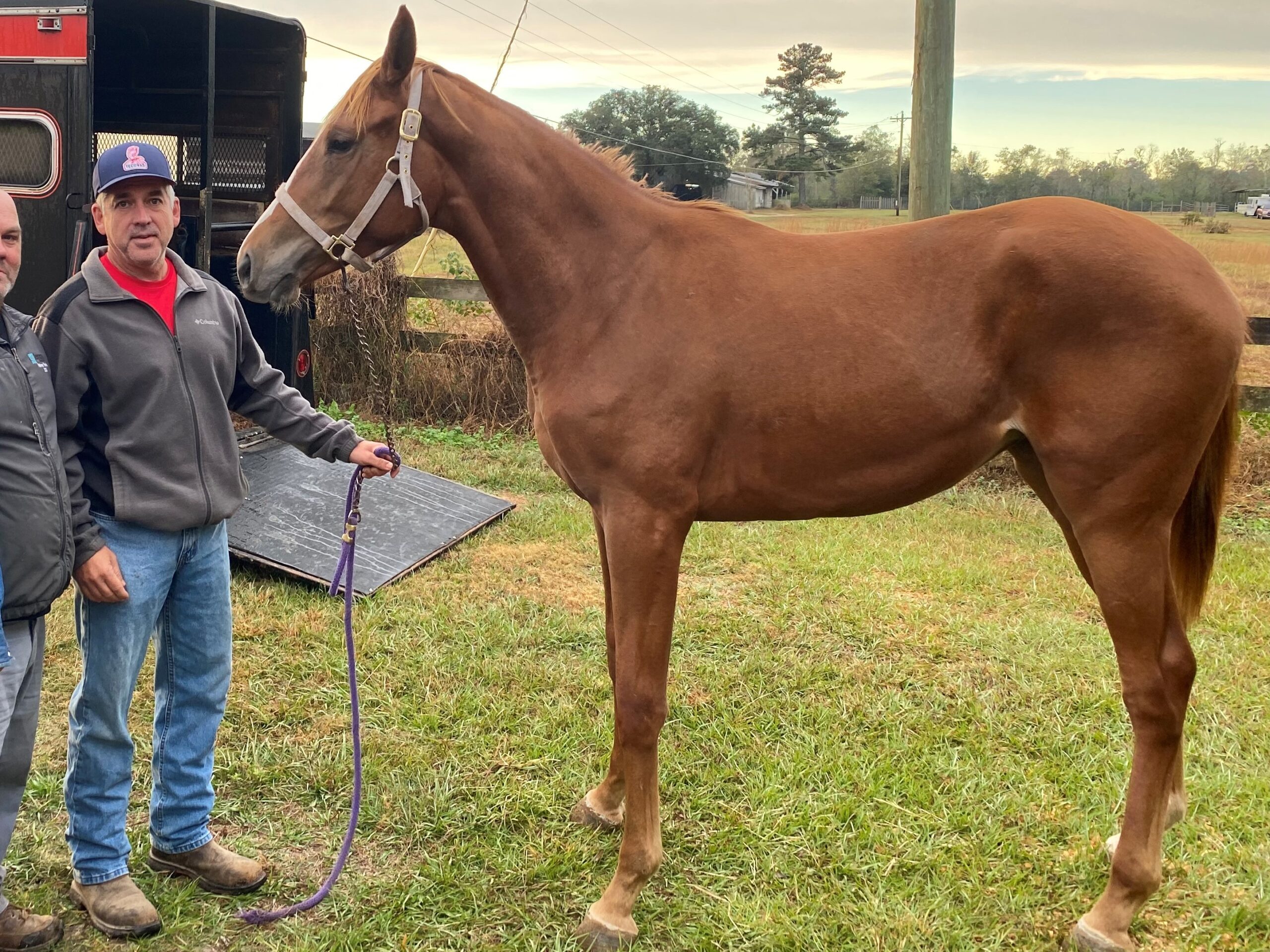
Miles Henry (legal name: William Bradley) is a professional horseman based in Folsom, Louisiana. He holds Louisiana Racing License #67012 and has spent over three decades managing Thoroughbreds at premier tracks including Fair Grounds, Delta Downs, and Evangeline Downs.
Expertise & Hands-On Experience: Beyond the track, Miles has decades of experience in specialized equine care, covering everything from hoof health and nutrition to training protocols for Quarter Horses, Friesians, and Paints. Every guide on Horse Racing Sense is rooted in this “boots-on-the-ground” perspective.
30 of their last 90 starts
Equibase Profile.

Connect with Miles: