

Last updated: April 9, 2026
Any links on this page that lead to products on Amazon are affiliate links and I earn a commission if you make a purchase. Thanks in advance – I really appreciate it!
The most important thing to understand before buying: horseflies locate horses visually and by heat, not by scent. This means scent-based deterrents — natural sprays, essential oils, homemade formulas — provide limited protection against them. Permethrin works differently: it’s a contact deterrent that reduces landing success regardless of how the fly found the horse. If you’re dealing with horseflies specifically, permethrin is the category you want.
This guide draws on real barn use across multiple Louisiana summers rather than product summaries. I’ve managed horses at Fair Grounds, Evangeline Downs, and Delta Downs for over 30 years — in conditions where fly pressure from June through September is as demanding as anywhere in the country. I have a gray mare who reacts to pyrethrin-based sprays and horses near a pond-adjacent pasture where horsefly pressure is genuinely severe. The five products below are ones I’ve used on real horses in those real conditions, and the notes reflect what I actually observed — not what the labels claim.
Table of Contents
Best Horse Fly Sprays at a Glance
| Product | Active Ingredient | Horsefly Effectiveness | Best For | Duration (Real-World) |
|---|---|---|---|---|
| Farnam Endure Sweat-Resistant | Permethrin 0.10% | Moderate — reduces landing frequency; pair with fly mask | Best overall daily spray; sweaty horses; humid climates | 3–6 hrs typical; longer on dry coat |
| Absorbine UltraShield EX | Permethrin 0.50% + Cypermethrin | High — strongest topical option; still needs physical barriers | Heavy horsefly pressure; pond/creek-adjacent pastures | 7–10 days realistic; label says 17 |
| Pyranha Wipe N’ Spray | Pyrethrin 0.10% + Permethrin 0.50% | Moderate — permethrin component helps | Face + body coverage from one product; daily versatility | 4–8 hrs typical |
| Farnam Bronco | Permethrin 0.10% + Pyrethrins 0.05% | Low–Moderate — lower concentration | Budget option; stalled horses; light fly pressure | 4–6 hrs typical |
| Absorbine UltraShield Green | Geraniol (natural-based) | Low — scent-based; not effective against horseflies | Pyrethrin-sensitive horses; house/stable fly management | 2–4 hrs; reapply more often |
Top 5 Horse Fly Sprays Reviewed
Best Daily Spray for Sweating Horses1. Farnam Endure Sweat-Resistant Fly Spray

Active ingredient: Permethrin 0.10% | Sensitivity risk: Low–moderate
Endure is the product I reach for most often in our barn, and the reason is the sweat-resistant formula. In Louisiana summer, every horse is wet by 9am. Standard sprays are gone within 90 minutes of the horse breaking a sweat. Endure uses a conditioning base that bonds to the hair shaft rather than sitting on top of it, which extends real-world protection meaningfully — three to four hours under hard sweat rather than one to two. On house flies and stable flies it’s as effective as anything in this price range. On horseflies, it reduces landing frequency but does not eliminate pressure. Pair it with a fly mask on pond-side pastures.
Cons: Higher cost than Bronco; still requires midday reapplication in peak summer.
Not ideal for: Horses with known pyrethrin or permethrin sensitivity — try UltraShield Green first.
Best Spray for Heavy Horsefly Pressure2. Absorbine UltraShield EX Fly Spray

Active ingredient: Permethrin 0.50% + Cypermethrin 0.075% | Sensitivity risk: Moderate
UltraShield EX is the highest-concentration commercial spray in wide barn use. The cypermethrin addition gives it broader knockdown than permethrin alone, and the higher permethrin concentration provides longer residual protection. For horses near the pond at the back of our property — where genuine horsefly pressure is a daily summer problem — this is the product that actually moves the needle. A careful application to a clean, dry coat can hold 7–10 days of meaningful protection. The label says 17 days; I have not seen that under Louisiana conditions. Daily vs UltraShield EX comes down to one question: is your horse in genuine horsefly territory? If yes, step up to EX. If not, Endure handles the daily management at a lower concentration and cost.
Cons: Higher sensitivity risk; toxic to aquatic life near water sources; higher cost.
Not ideal for: Horses near ponds or streams, or horses with any history of spray sensitivity — start with Endure and step up only if needed.
Best for Face and Body Coverage3. Pyranha Wipe N’ Spray Fly Protection

Active ingredient: Pyrethrin 0.10% + Permethrin 0.50% | Sensitivity risk: Moderate
Pyranha’s practical advantage is its dual-application format. Spray the body, pour some onto a cloth, wipe the face. That solves a genuine problem — getting fly protection onto the face and around the eyes without spraying directly near sensitive areas. The formula is effective on house and stable flies, and the permethrin component provides reasonable horsefly deterrence. The pyrethrin component raises the sensitivity risk slightly compared to permethrin-only products, so for any horse with a known reaction history, Endure or Bronco is the better starting point.
Cons: Pyrethrin component increases sensitivity risk vs permethrin-only products.
Not ideal for: Horses with pyrethrin sensitivity — use Endure instead.
Best Budget Option4. Farnam Bronco Equine Fly Spray

Active ingredient: Permethrin 0.10% + Pyrethrins 0.05% | Sensitivity risk: Low–moderate
Bronco is the spray I use on horses that are stalled most of the day with limited pasture exposure — the fly pressure they face is primarily house flies in the barn aisle, and Bronco handles that well at a cost that makes full-barn coverage practical. The lower concentration means a shorter protection window and less horsefly effectiveness than Endure or EX, but for horses with light outdoor exposure it’s a reliable and accessible choice that doesn’t require premium-product budgeting.
Cons: Shorter protection window; limited effectiveness against horseflies.
Not ideal for: Horses in pasture near water — will not hold up against genuine horsefly pressure. Use Endure or UltraShield EX for those horses.
Best for Sensitive Skin5. Absorbine UltraShield Green Natural Fly Spray
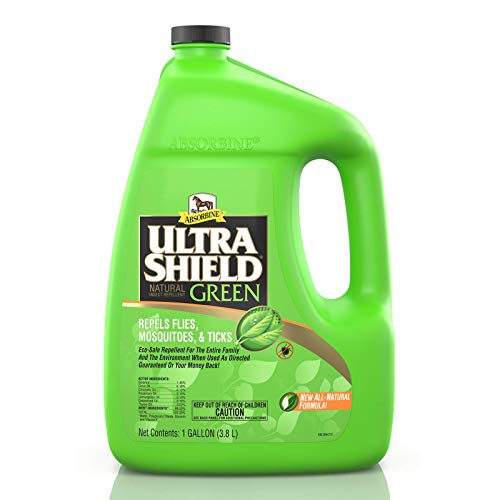
Active ingredient: Geraniol (natural-based) | Sensitivity risk: Very low
UltraShield Green is the product I use on the gray mare with pyrethrin sensitivity. It works well on house flies and stable flies, requires reapplication every two to four hours rather than daily, and has caused no skin reactions through multiple seasons. The geraniol base — a natural plant compound — deters flies through scent rather than contact toxicity, which is why it handles barn flies well and horseflies poorly. For horses in genuine horsefly environments, physical barriers become even more essential when this is your spray choice: a good fly mask is not optional.
Cons: Shorter duration (2–4 hrs); not effective against horseflies.
Not ideal for: High horsefly pressure without physical barriers — this product does not address how horseflies locate horses. See our guide on best fly masks for horses.
Permethrin vs Pyrethrin: What You Need to Know
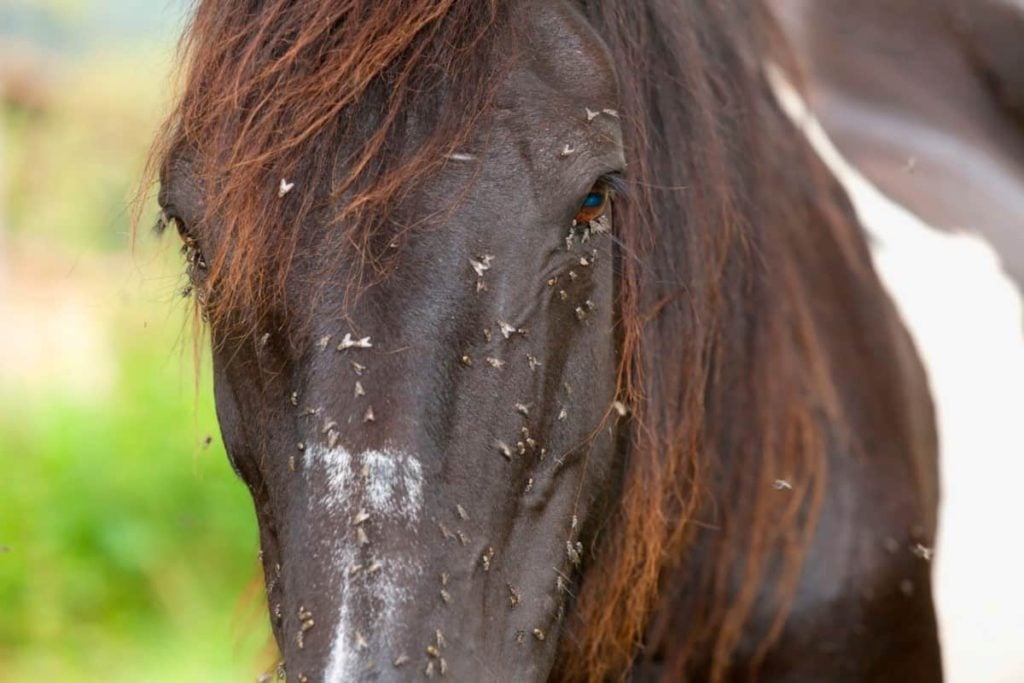
Most fly spray sensitivity reactions and product confusion trace back to the permethrin vs pyrethrin distinction. They’re related compounds that appear in many of the same products but behave differently in the ways that matter for daily barn use.
| Factor | Permethrin | Pyrethrin |
|---|---|---|
| Origin | Synthetic pyrethroid | Natural — chrysanthemum extract |
| Duration | Hours to days; stable in sunlight | Hours only; degrades quickly in sun |
| Horsefly effectiveness | Better — contact deterrent; works on landing | Weaker residual; good on contact, fades fast |
| Sensitivity rate | Lower — fewer horses react than to pyrethrin | Higher — more common cause of spray reactions |
| Aquatic toxicity | Highly toxic to fish; avoid near water | Also toxic; degrades faster |
Best Horse Fly Spray for Sensitive Skin
The sensitivity protocol is straightforward: identify which active ingredient is causing the reaction, then substitute one step at a time. Pyrethrin reaction? Try permethrin-only (Endure). Still reacting? Try natural-based (UltraShield Green). Always patch test 24 hours before full application when switching products. For horses with underlying skin conditions or a history of Insect Bite Hypersensitivity, start with UltraShield Green and reduce total spray exposure by pairing with fly masks and fly sheets — covering more of the horse with physical barriers means you need less spray overall.
When Homemade Spray Makes More Sense
For horses with pyrethrin sensitivity, horses in lower fly-pressure environments, or budget-constrained operations managing house and stable flies, homemade horse fly spray recipes — apple cider vinegar with citronella or eucalyptus — are a genuine alternative. They work reliably on barn flies, need reapplication every one to two hours, and have a much lower sensitivity risk than any commercial product. What they do not do is protect against horseflies. If that’s your primary problem, commercial permethrin is the answer regardless of cost or preference for natural products.
Safety: What Horse Owners Need to Know
- Never use near water — permethrin and pyrethrin are highly toxic to fish and aquatic invertebrates at any concentration. Keep all spray away from ponds, creeks, troughs, and drainage areas.
- Never use near cats — permethrin is severely toxic to cats. If cats share your barn, ensure complete separation during and after application.
- Patch test new products — apply to the neck or shoulder, wait 24 hours, check for redness or hives before full application.
- No direct face spray — use a cloth dampened with spray for facial application; never spray directly near eyes or nostrils.
- Rotate products periodically — fly populations develop resistance with repeated exposure; rotating between product types slows resistance buildup.
- Pregnant mares and foals — consult your vet before using any insecticide spray; some active ingredients should be avoided.
FAQs: Best Horse Fly Spray
What is the strongest fly spray for horses?
The strongest commercial horse fly spray in wide barn use is Absorbine UltraShield EX, combining permethrin at 0.50% with cypermethrin. For most horses in normal conditions, Farnam Endure Sweat-Resistant is a more practical daily choice — strong enough for reliable protection without the higher sensitivity risk of maximum-concentration formulas.
Does permethrin fly spray work on horseflies?
Yes, better than any other spray category. Horseflies locate horses visually and by heat — scent-based deterrents have limited impact because the fly has already committed to an approach before scent is relevant. Permethrin works as a contact deterrent on landing, reducing bite success even after the fly has located the horse. It reduces horsefly pressure meaningfully but does not eliminate it — physical barriers like fly masks are still needed in heavy horsefly environments.
Why doesn’t fly spray work on horseflies?
Most fly sprays rely on scent-based deterrence — essential oils, natural compounds, or pyrethrins that mask or overwhelm the fly’s olfactory cues. Horseflies locate horses primarily by visual and heat cues, not scent, so this mechanism is largely irrelevant to them. By the time a horsefly could detect spray scent, it has already visually locked onto the horse. Permethrin is more effective because it works on contact after landing, not on approach.
What is the best horse fly spray for sensitive horses?
For pyrethrin sensitivity, start with a permethrin-only product like Farnam Endure. If permethrin also causes reactions, move to a natural-based product like Absorbine UltraShield Green. Always patch test 24 hours before full application. Most horses labeled ‘can’t tolerate fly spray’ are reacting to one specific active ingredient — work through the sequence before concluding none will work.
How long does horse fly spray last?
Duration varies significantly by product and conditions. Farnam Endure lasts 3–6 hours in real barn conditions. UltraShield EX lasts 7–10 days with careful application. Bronco and Pyranha last 4–6 hours. Natural-based sprays last 2–4 hours. Heat, sweating, rain, and rubbing all shorten these windows. Always reapply after heavy exercise or rain regardless of timing.
Is permethrin or pyrethrin better for horses?
Permethrin is generally the better choice for most horses. It has a longer residual effect, is more stable in sunlight (pyrethrin degrades quickly), and causes fewer sensitivity reactions. Pyrethrin is natural-origin and degrades faster in the environment, which is an advantage near water, but the shorter duration means more frequent reapplication. Many products combine both — pyrethrin for immediate knockdown and permethrin for residual protection.
Can I use horse fly spray on a horse with rain rot?
Use caution — applying fly spray over active rain rot lesions can cause additional irritation and delay healing. Minimize spray on affected areas and supplement with fly masks and sheets. Absorbine UltraShield Green is the gentlest option if spray is necessary. Consult your vet before applying any insecticide to horses with significant skin conditions.
Is homemade fly spray as effective as commercial fly spray?
For house flies and stable flies, yes — ACV and essential oil sprays work reasonably well and require more frequent reapplication (every 1–2 hours). For horseflies, no homemade spray provides reliable protection. Homemade spray is also often the better choice for horses with pyrethrin sensitivity. Our full guide covers five tested recipes with honest effectiveness ratings.
What fly spray do professional horse trainers use?
In the barns I’ve been around on the Louisiana circuit, Endure and Pyranha are the most common daily-use products. For horses near standing water in peak summer, UltraShield EX gets used. Most professional barns also use fly masks routinely. The combination of permethrin spray plus physical barriers is the practical standard — not any single product.
Conclusion
For most horses on most days, Farnam Endure handles the job. For horses near water in peak summer, step up to UltraShield EX and add a fly mask with ear coverage. For sensitive horses, start with UltraShield Green and use physical barriers to reduce how much spray coverage is needed.
The system that works against horseflies specifically is three layers: permethrin spray on the body, a fly mask on the face and ears, and reduced standing water near turnout. Natural solutions rarely handle horseflies reliably — the biology works against them. Use permethrin, set realistic expectations around manageable pressure rather than zero flies, and pair it with the right physical barriers for your specific environment.
For the comparison between commercial and homemade horse fly spray recipes — including five DIY formulas that work well on barn flies — and our guide on why horseflies bite horses and what actually drives their behavior.
Sources
- American Association of Equine Practitioners: aaep.org
- The Horse — Equine health reference: thehorse.com
- PubMed — Equine insect bite hypersensitivity: pubmed.ncbi.nlm.nih.gov
About Miles Henry
Racehorse Owner & Author | 30+ Years in Thoroughbred Racing
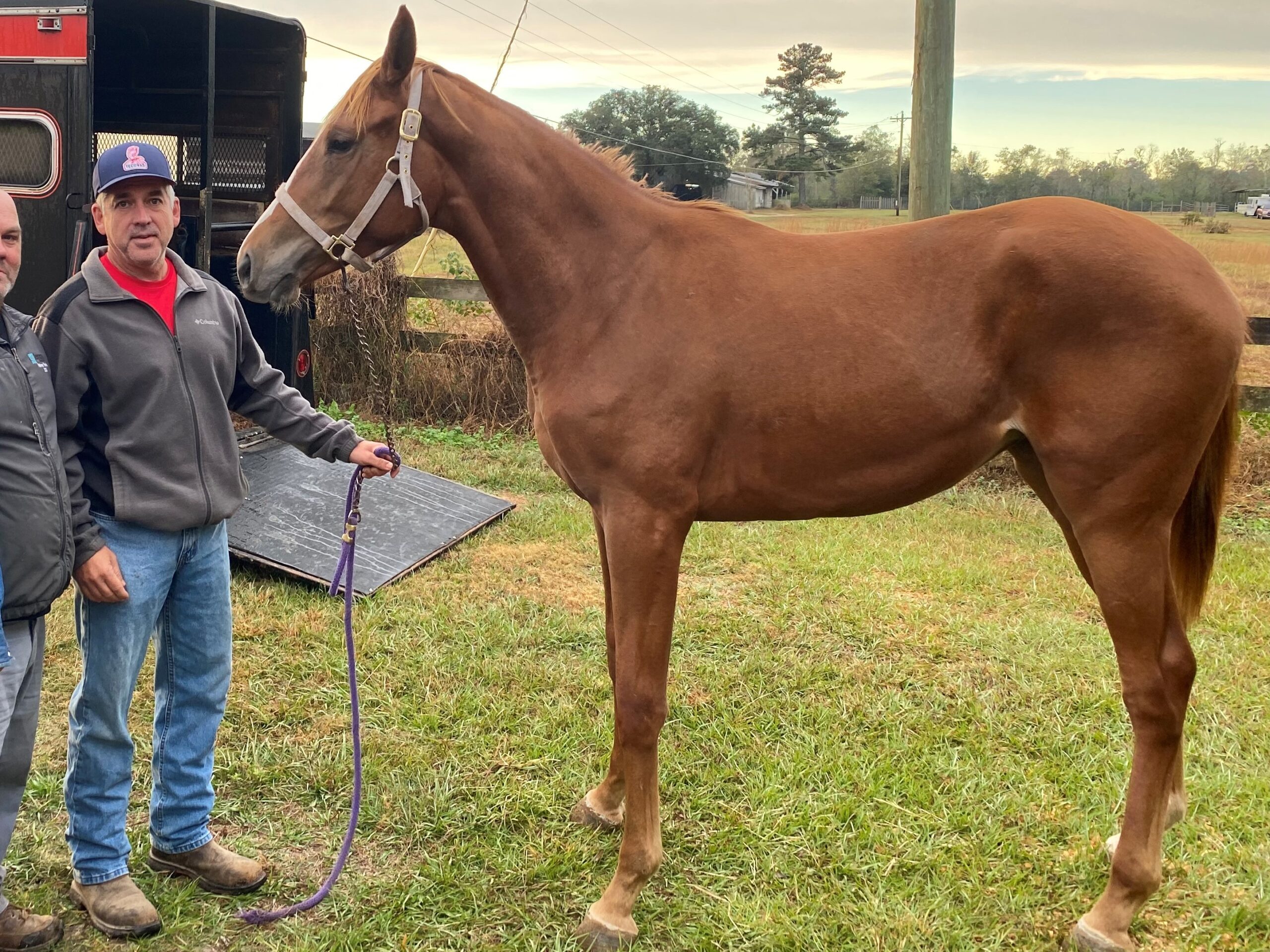
Miles Henry (legal name: William Bradley) is a professional horseman based in Folsom, Louisiana. He holds Louisiana Racing License #67012 and has spent over three decades managing Thoroughbreds at premier tracks including Fair Grounds, Delta Downs, and Evangeline Downs.
Expertise & Hands-On Experience: Beyond the track, Miles has decades of experience in specialized equine care, covering everything from hoof health and nutrition to training protocols for Quarter Horses, Friesians, and Paints. Every guide on Horse Racing Sense is rooted in this “boots-on-the-ground” perspective.
30 of their last 90 starts
Equibase Profile.

Connect with Miles: