
Last updated: August 27, 2026
Any links on this page that lead to products on Amazon are affiliate links and I earn a commission if you make a purchase. Thanks in advance – I really appreciate it!
The most important thing to understand before you spend money on any product: horseflies locate horses visually and by heat, not by scent. That single biological fact determines which methods work and which are a waste of time.
Scent-based repellents alone — sprays, hanging herbs, fly strips — have limited impact on horsefly population pressure because they intervene at the wrong point in the fly’s approach sequence. Effective horsefly control works on the environment — not just on the fly that’s already hovering over your horse.
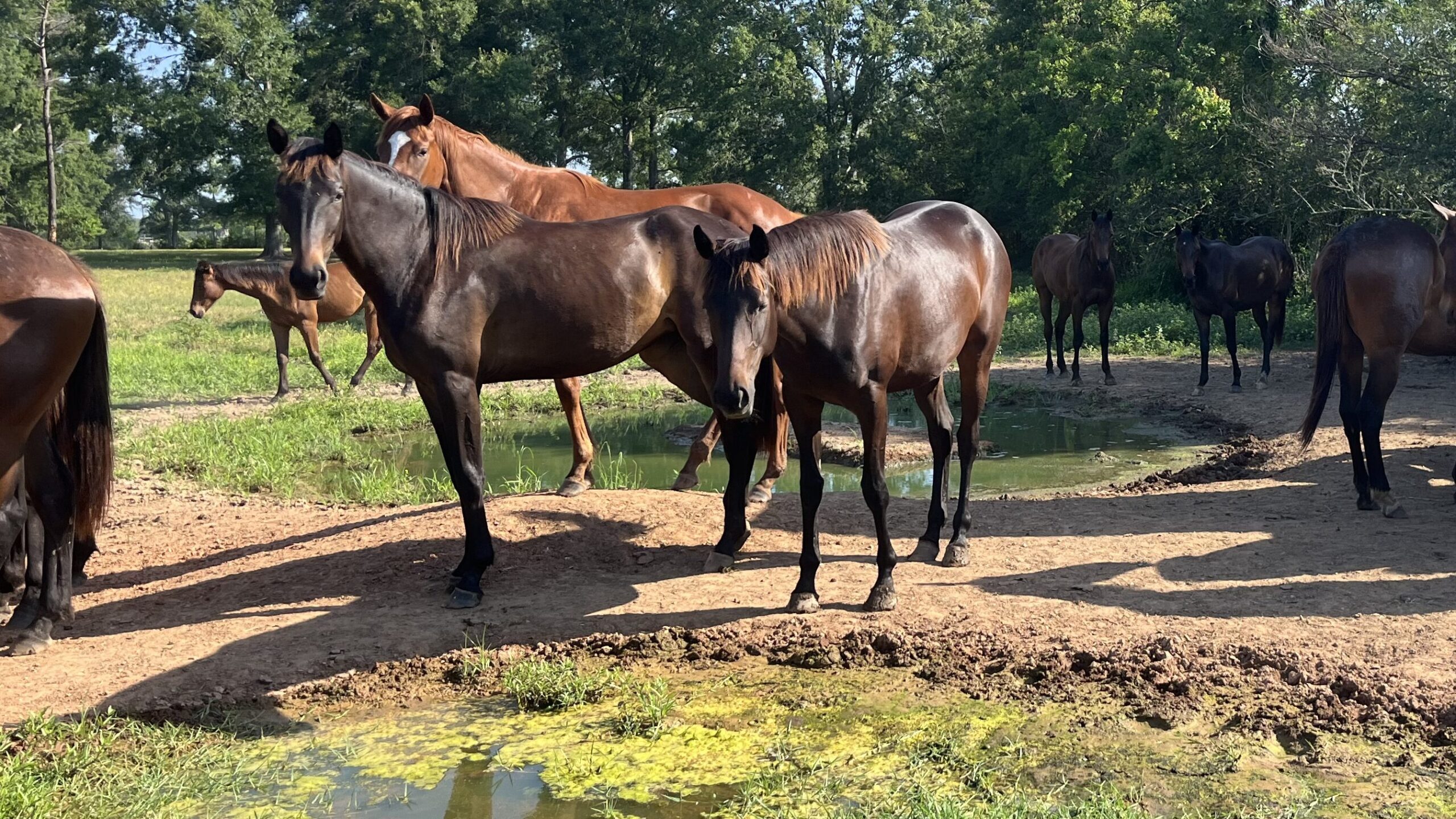
I’ve been managing horses in south Louisiana for over 30 years — Fair Grounds, Evangeline Downs, Delta Downs — and if you want to understand real horsefly pressure, come stand in our back pasture in July near the pond. The flies are relentless, they’re large, and they ignore most of what people try. I’ve made every mistake there is with horsefly control. What follows is what actually works — and just as important, what doesn’t — and why the order you do things matters.
- ✔ No standing water near barn or paddocks
- ✔ Fans running in all stalls during peak hours (10am–3pm)
- ✔ Turnout scheduled before 9am or after 5pm for high-pressure horses
- ✔ Manitoba or sticky ball trap placed between water source and pasture
- ✔ Permethrin spray applied before every turnout, reapplied after sweat or rain
- ✔ Fly mask with ear coverage on every horse that turns out
Full explanation of each layer below. Start with whichever you’re missing — every layer you add reduces pressure on the others.
Table of Contents
Why Horseflies Are Harder to Control Than Other Flies
House flies and stable flies breed in and around the barn — manure, wet bedding, feed residue. That makes them manageable through barn hygiene. Eliminate the breeding site, reduce the population. The system is imperfect but it works.
Horseflies are a different problem entirely. They breed in moist soil and vegetation near standing water — pond edges, creek banks, wet ditches, irrigation seepage. That breeding habitat is usually not on your property, or is too large to meaningfully eliminate. The adult flies can travel up to a mile from their breeding site to find a host — which is why your fly pressure often has nothing to do with conditions on your property. So the flies arriving at your barn today may have hatched in a swampy area down the road. You cannot clean your way out of a horsefly problem the way you can with barn flies.
You cannot clean your way out of a horsefly problem. That’s the mistake most people make — they treat horseflies like barn flies and wonder why nothing changes.
| Factor | House Flies / Stable Flies | Horseflies (Tabanidae) |
|---|---|---|
| Breeding habitat | Manure, wet bedding, feed waste — in and around the barn | Moist soil near standing water — often off your property |
| How they locate horses | Primarily by smell — manure, sweat, feed odors | Primarily by vision and body heat — not smell |
| Scent repellents | Moderately effective — disrupts olfactory approach | Limited — scent is not the primary approach cue |
| Best control methods | Barn hygiene, manure management, spray, traps | Fans, traps, timing, physical barriers, permethrin spray |
| Can you eliminate them? | Mostly, with consistent hygiene and spray | No — manageable pressure is the realistic goal |
Step 1: Cut Off Their Breeding Habitat
You can’t eliminate distant breeding habitat, but you can make your property less hospitable and reduce the population coming from the areas you do control.
Standing Water
Horseflies need wet soil and vegetation near water to lay eggs. Any standing water on or near your property is a potential breeding site: low spots that collect after rain, leaking water troughs, drainage areas that stay wet, pond margins with dense vegetation. The goal is not necessarily to eliminate water — horses need it — but to minimize unnecessary standing water and manage the margins of any ponds or wet areas.
- Fix leaking troughs and water lines promptly — a slow drip creates a constantly wet patch that becomes a breeding site over weeks
- Grade low spots in paddocks so water drains rather than pools
- Mow vegetation along pond edges and wet ditches — dense vegetation at the water margin is where females lay eggs and larvae develop
- Consider moving water troughs away from fence lines adjacent to wet areas — the combination of water and horse scent near a breeding site concentrates fly activity
Manure Management
Manure management matters less for horseflies than for barn flies, but it still matters — fresh, wet manure near standing water creates ideal conditions, and any factor that generally increases fly pressure around your barn raises the baseline horsefly problem. Beyond that, consistent manure removal is one of the few environmental interventions that pays dividends across all fly species simultaneously.
- Muck stalls daily and move waste to a collection point as far from the barn and pastures as practical
- Haul or compost regularly — weekly in summer, or more often if possible. Letting a manure pile grow through July and August is adding fuel to the fire
- In small paddocks, spread manure to dry it out quickly rather than letting it accumulate in wet piles — dry manure is far less hospitable to fly breeding
- Keep the area immediately around the barn clean of organic waste — feed residue, wet hay, and standing puddles all increase general fly pressure

Vegetation Management
Dense grass, brush, and tall weeds near the barn and along fence lines create shaded resting habitat for adult horseflies during the cooler parts of the day. Keeping vegetation mowed short — especially in areas adjacent to wet zones — disrupts both breeding habitat and resting habitat. It also makes it harder for flies to approach horses from cover.
Step 2: Use Fans to Break Up Their Approach
This is the most underutilized method in barn fly management and the one I’d prioritize if I could only do one thing. Horseflies are strong fliers, but they are precise in their approach — they locate the horse by visual and heat targeting and approach in a controlled pattern. Sustained air movement disrupts that approach pattern and makes it significantly harder for them to land.
If you want a measurable difference: a stalled horse without a fan will deal with repeated fly landings every few minutes during peak hours. With a fan running, that drops dramatically. It’s not subtle — it’s obvious within an hour of running them side by side. For the best barn fans for stalls and aisles, including what to look for in humid conditions, see our barn fan guide. For fan placement that also addresses ventilation and heat management, see our guide on barn ventilation and fan placement.
In humid Gulf Coast climates like south Louisiana, fans also reduce the heat-and-moisture signature that makes horses attractive targets in the first place. For stalled horses, position large box fans so air moves across the horse’s body — not just blowing toward the horse’s face. The goal is creating sustained air movement that a fly has to fight through to land anywhere on the animal. For horses at rest in smaller stalls, a fan angled from the front corner of the stall covering the horse’s body and the primary fly approach direction works well.
For pasture situations, fans obviously aren’t practical. This is where timing and physical barriers become the primary tools — covered in the next two steps.

Step 3: Time Your Turnout
Horseflies are daytime feeders with a pronounced peak activity window. They are most active when temperatures are highest and the sun is strongest — typically from mid-morning through mid-afternoon, roughly 10am to 3pm in most summer conditions. Understanding this pattern is directly actionable.
- Peak pressure hours: 10am – 3pm in hot summer weather. This is when horseflies are most actively hunting.
- Safest turnout windows: Early morning (before 9am) and late afternoon/evening (after 5pm). Horsefly activity drops sharply outside the heat of the day.
- Overcast days: Horsefly activity is significantly reduced on cloudy, cooler days — turnout timing matters less when the sun isn’t driving heat signature visibility.
- Stalling at peak hours: For horses with severe horsefly sensitivity or those near high-pressure water areas, stalling through 10am–3pm with fans running is the most effective single intervention available.
This doesn’t mean horses can’t go out during the day. It means if you’re dealing with heavy pressure and nothing else is working, timing is often the missing piece. Shifting turnout by two to three hours at each end reduces peak exposure significantly — even when nothing else in the program changes.
Step 4: Traps That Actually Work on Horseflies
Most fly traps sold for barn use — sticky traps, bait traps, light traps — are designed for house flies and barn flies. Since horseflies rely on visual targeting rather than smell, scent-based traps have no meaningful effect on them. A sticky trap baited with food attractant will catch barn flies. It will not reduce your horsefly population.
The traps that work on horseflies exploit their actual approach mechanism — visual targeting of a large, dark, heat-emitting object. Two designs have genuine evidence behind them:
Manitoba Trap (H-Trap / Box Trap Design)
The Manitoba trap is a dark sphere or box suspended above a collection funnel. Horseflies approach it visually as if it were a large dark animal, fly upward toward the light source at the top of the trap after failing to find a landing surface, and get captured. When positioned correctly — in open areas where flies are actively hunting, near the edge of the fly’s approach zone from a water source — these traps can catch substantial numbers of horseflies over a season.
Positioning matters enormously — and this is where most people get it wrong. They put traps where it’s convenient instead of where flies are actually traveling. Place Manitoba traps between the horsefly source (wet area, pond, wooded edge) and where the horses are. A trap placed inside the barn aisle catches very little — the flies are already past it. A trap placed at the fence line between the wet pasture and the horse area intercepts them in transit. If you add dry ice to the trap’s bait chamber, the CO2 increases catch rates significantly — horseflies do respond to carbon dioxide as a host indicator.
Sticky Ball Traps
A large dark ball coated with Tangle-Trap or similar sticky substance works on the same visual targeting principle as the Manitoba trap. Hung at horse-shoulder height in the approach zone, it attracts and catches horseflies that mistake it for an animal. These are inexpensive to make yourself — a black rubber ball, some Tangle-Trap, a piece of wire. They need regular recoating when they become too covered with flies and debris to remain sticky.
Step 5: Spray — What Works and What Doesn’t
Spray is the most commonly used horsefly control method — and the most misunderstood. Most people lead with it. The five steps before this one exist precisely because spray alone is not enough.
For horseflies, permethrin is the only topical active ingredient with meaningful effectiveness. It acts as a contact deterrent on landing — reducing how long a fly stays and whether it bites successfully. It doesn’t prevent a horsefly from approaching, but it significantly reduces bite success. Our full comparison of the best horse fly spray for horseflies covers the five top permethrin products tested in real Louisiana barn conditions.
| Spray Type | Horsefly Effectiveness | Best Use |
|---|---|---|
| Permethrin-based (Endure, UltraShield EX) | Moderate to High — contact deterrent; reduces landing success and bite frequency | Daily protection on horses with turnout in horsefly areas; reapply after heavy sweat or rain |
| Pyrethrin-based (Pyranha, Bronco) | Low to Moderate — shorter residual; less effective contact deterrent than permethrin | House and stable fly management; not the primary choice for horsefly pressure |
| Natural / essential oil (UltraShield Green, homemade) | Low — scent-based; does not address horsefly visual/heat approach | Sensitive-skin horses; house and stable fly management; pair with physical barriers for horsefly areas |
| Area spray (premise spray on barn perimeter) | Low to Moderate — limited residual effectiveness outdoors; UV and rain degrade quickly | Barn perimeter and stall surfaces; some reduction in general fly pressure around entry points |
For horses with pyrethrin sensitivity who can’t tolerate permethrin-based products, homemade fly spray — ACV and essential oils — handles barn flies well, but physical barriers become even more critical for horsefly protection. A sensitive horse near high horsefly pressure needs more fly mask time, not just a gentler spray.
Step 6: Physical Barriers
Physical barriers are the most reliable protection layer because they work regardless of how the fly located the horse. A fly mask doesn’t care whether the horsefly approached by vision or scent — it simply blocks access to the face and ears. This is why physical barriers are non-negotiable in serious horsefly conditions, not optional add-ons.
If you’re dealing with real horsefly pressure, physical barriers aren’t optional — they’re the difference between a horse coping and a horse that’s constantly agitated.
Fly Masks
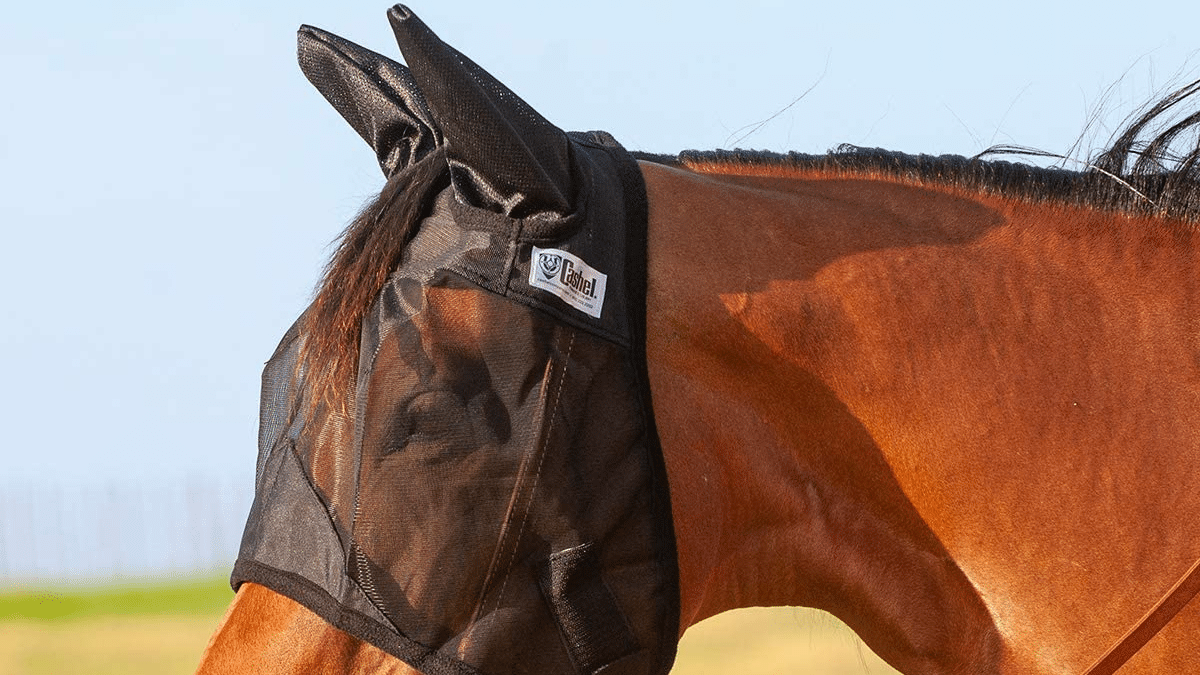
Horseflies disproportionately target the face, eyes, and ears — warm, dark areas with thin skin and good blood access. A properly fitted fly mask with ear coverage physically blocks access to the areas horseflies attack most. In high-horsefly conditions, a fly mask is not optional — it’s the difference between a horse standing reasonably settled and one throwing its head constantly and refusing to graze.
Not all fly masks are equal for horsefly protection. The mesh needs to be tight enough to prevent large flies from reaching the skin. Ear covers need to be substantial — some masks have decorative ear pockets that don’t actually block a horsefly. And fit matters: a mask that slips or gets pulled off by vegetation isn’t protecting anyone. See our guide to the best fly masks and fly boots for horses for specific recommendations and fit guidance.
Fly Sheets
A lightweight fly sheet covers the body and protects against horsefly bites on the barrel, back, and shoulders — areas where permethrin spray may have worn off during turnout. In very high-pressure conditions, a horse in a fly sheet, fly mask, and fly boots is getting meaningful whole-body protection that no spray regimen alone can match. The tradeoff is heat in warm weather — use breathable mesh sheets and monitor for sweating and discomfort.
Fly Boots
Horseflies frequently target the lower legs — they’re dark, they’re warm, and they’re exposed. Fly boots for horses provide physical protection for horses that stomp and agitate excessively from lower-leg fly pressure. For horses whose primary fly problem is leg stomping leading to tendon stress or paddock injuries, fly boots address the source rather than treating the consequence — in most cases more effectively than adjusting the spray schedule alone.
The Complete Barn Management Plan
Each layer solves a different failure point — remove one and the system weakens. Used together consistently across the season, they create manageable pressure. Here’s how they stack:
| Layer | Method | When / Frequency | What It Addresses |
|---|---|---|---|
| 1 — Habitat | Standing water reduction, manure hauling, vegetation management | Ongoing; weekly manure haul in season | Reduces breeding population; fewer flies entering the system |
| 2 — Airflow | Barn fans in stalls; airflow across horses | Continuous during stall time | Disrupts approach and landing; most effective for stalled horses |
| 3 — Timing | Early morning / late afternoon turnout; stall during 10am–3pm for high-pressure horses | Daily scheduling decision | Removes horses from peak horsefly hunting window |
| 4 — Traps | Manitoba trap or sticky ball between fly source and horses | Set up in late spring; check and maintain weekly | Reduces adult population intercepted before reaching horses |
| 5 — Spray | Permethrin-based spray (Endure or UltraShield EX for high pressure) | Before turnout; reapply after sweat or rain | Contact deterrent; reduces bite success on horses already targeted |
| 6 — Physical barriers | Fly mask with ears; fly sheet for body; fly boots for legs | Anytime horse is in fly pressure conditions | Blocks physical access regardless of approach mechanism |
How the System Works — Spatially
Work from left to right: reduce the source, intercept in transit, protect the horse, control the stall environment. Each zone handled reduces pressure on the next.
What Doesn’t Work (And Why)
Knowing what to skip saves time and money. These are the approaches that horse owners commonly try against horseflies with limited return:
- Fly strips and sticky tape inside the barn — effective for house flies and stable flies, which travel inside. Horseflies are outdoor hunters that rarely enter barn interiors. The flies on your sticky tape are almost never horseflies.
- Bait-based fly traps — attractants in commercial fly traps target house and stable flies. Horseflies don’t respond to the same cues and are almost never caught by these traps.
- Natural / essential oil sprays as primary horsefly control — effective for barn flies; not reliable against horseflies. Use them for sensitive horses and house fly management, but pair with permethrin and physical barriers where horsefly pressure is the real problem.
- Area premise spray on barn exterior — permethrin premise sprays break down quickly outdoors in UV and rain. They provide some benefit around barn entry points for a short window after application, but they don’t create the perimeter barrier that their marketing implies. Worth doing occasionally; not worth making the centerpiece of your horsefly strategy.
- Predator wasps (fly parasites) — Spalangia and Muscidifurax parasitic wasps are effective biological control for house fly and stable fly populations, which breed in manure. They parasitize fly pupae in manure piles. Horseflies breed in wet soil and vegetation near water, not in manure — fly parasites have no meaningful impact on horsefly populations.
- Dryer sheets and other folk remedies — no reliable mechanism by which these affect horseflies. The flies locate by vision and heat, not fabric softener scent.
FAQs: How to Get Rid of Horseflies Around Your Barn
What is the most effective way to get rid of horseflies around a barn?
The most effective approach combines six layers: reducing breeding habitat (standing water and wet manure near the barn), running fans in stalls to disrupt approach and landing, timing turnout to avoid peak horsefly hours (10am to 3pm), deploying Manitoba or sticky ball traps between the fly source and the horses, applying permethrin-based fly spray before turnout, and using physical barriers including fly masks, fly sheets, and fly boots. No single method is sufficient on its own. The barns that manage horsefly pressure best use all six consistently across the fly season.
What repels horseflies from horses?
Permethrin-based fly sprays are the most effective topical repellent for horseflies. They work as contact deterrents on landing rather than scent-based approach deterrents. Fans disrupt the approach and landing pattern. Physical barriers including fly masks block access entirely. Scent-based repellents including essential oil sprays and homemade formulas have limited effectiveness on horseflies because horseflies locate horses visually and by heat, not by smell.
What kills horseflies around a barn?
Manitoba traps and sticky ball traps physically capture horseflies and reduce the adult population around your property over a season. Permethrin spray kills flies on contact with the horse’s coat. There is no practical way to fully eliminate horseflies around a barn because their breeding habitat (wet soil near standing water) is typically off your property and too large to treat. Reducing population and protecting horses from bites is the realistic goal.
What time of day are horseflies worst?
Horseflies are most active during the hottest, sunniest part of the day, typically from 10am to 3pm in summer conditions. They rely heavily on visual targeting of large, warm objects, so activity correlates strongly with temperature and sunlight. Activity drops significantly in early morning, late afternoon, and on overcast or cooler days. Timing turnout to avoid peak hours is one of the most effective and zero-cost management strategies available.
Do fans help with horseflies?
Yes, substantially. Barn fans running continuously in stalls create sustained air movement that disrupts the horsefly approach and landing pattern. Horseflies are precise in their approach and flight to a host, and strong airflow makes landing significantly more difficult. In my barn experience, stalled horses with fans running are noticeably less bothered by horseflies than horses in stalls without fans. Fans are most effective for horses in stalls and have no practical application for pasture situations.
Do fly traps work on horseflies?
Only specific trap designs work on horseflies. Standard bait-based fly traps and sticky tape are designed for house and barn flies, which locate targets by smell. Horseflies locate targets visually, so only visual traps work. Manitoba traps and large dark sticky ball traps attract horseflies by resembling a large animal, then capture them. Position these traps between the fly’s source area (pond, wet area) and where the horses are, not inside the barn. Dry ice added to a Manitoba trap significantly increases catch rates.
Does standing water attract horseflies?
Yes, as a breeding site rather than a direct attractant. Female horseflies lay eggs in moist soil and dense vegetation at the edges of ponds, creeks, wet ditches, and other standing water. Larvae develop in that wet habitat before emerging as adult flies. Reducing standing water on your property and managing pond edge vegetation reduces the number of horseflies breeding locally. Adult horseflies can fly up to a mile from their breeding site, so off-property water sources still contribute to your barn’s horsefly pressure.
Why do horses stomp so much when horseflies are around?
Stomping is a horse’s primary defense response to fly pressure on the lower legs. Horseflies frequently target the lower legs because they have thin skin, good blood supply, and are dark and warm. The impact of constant stomping over a full fly season can stress tendons and cause paddock injuries in horses with severe reactions. Fly boots provide physical protection that reduces the need to stomp, and permethrin spray on the lower legs reduces landing success. See our article on why horses stomp for the full picture of stomping causes beyond flies.
Can you get rid of horseflies permanently?
No. Horseflies breed in moist habitat near standing water that is typically off your property and impossible to eliminate entirely. You can meaningfully reduce the population breeding on your property, reduce the conditions that attract them, protect horses from bites, and intercept flies with traps before they reach your horses. The result is manageable pressure rather than elimination. Any product or service claiming to permanently eliminate horseflies is overpromising.
Conclusion
You’re not going to eliminate horseflies — and chasing that goal wastes time and money. What works is reducing the population where you can, disrupting how they find your horses, and protecting the horse when they do. That’s how you turn a miserable setup into a manageable one.
The six-layer system above isn’t complicated, but it requires consistency. The barns that manage horsefly pressure well aren’t doing one thing better than everyone else — they’re doing all six things at once, every week of fly season, without waiting for conditions to deteriorate before responding. If you’re still getting hammered by horseflies, you’re missing a layer. Find it and fix it.
For the spray side of this, see the full guide to the best horse fly spray for horseflies — tested in the same Louisiana barn conditions with honest ratings on what actually moves the needle against Tabanidae. For horses with sensitivities who need a gentler option, the homemade horse fly spray guide covers what works and what doesn’t for barn flies specifically. And for the physical barrier side — which belongs in every high-pressure barn’s toolkit — the best fly masks with ear coverage and fly boots guides have specific recommendations.
Sources
- American Association of Equine Practitioners — Parasite and Pest Control: aaep.org
- LSU AgCenter — Tabanid flies and livestock pest management: lsuagcenter.com
- University of Florida IFAS Extension — Tabanidae biology and control: entnemdept.ufl.edu
- The Horse — Equine insect control reference: thehorse.com
About Miles Henry
Racehorse Owner & Author | 30+ Years in Thoroughbred Racing
Miles Henry (legal name: William Bradley) is a professional horseman based in Folsom, Louisiana. He holds Louisiana Racing License #67012 and has spent over three decades managing Thoroughbreds at premier tracks including Fair Grounds, Delta Downs, and Evangeline Downs.
Expertise & Hands-On Experience: Beyond the track, Miles has decades of experience in specialized equine care, covering everything from hoof health and nutrition to training protocols for Quarter Horses, Friesians, and Paints. Every guide on Horse Racing Sense is rooted in this “boots-on-the-ground” perspective.
30 of their last 90 starts
Equibase Profile.

Connect with Miles: