
Last updated: July 23, 2026
I’m a longtime racehorse owner who’s worked closely with track farriers and trainers on shoeing decisions, plate selection, and race-day preparation. In practice, plate choice is a small but important detail that can affect traction, comfort, and a horse’s movement. In this article, I’ll cover what racing plates are, how they differ from regular shoes, and why the setup matters when the gate opens. This guide is part of my Racehorse Equipment Guide.
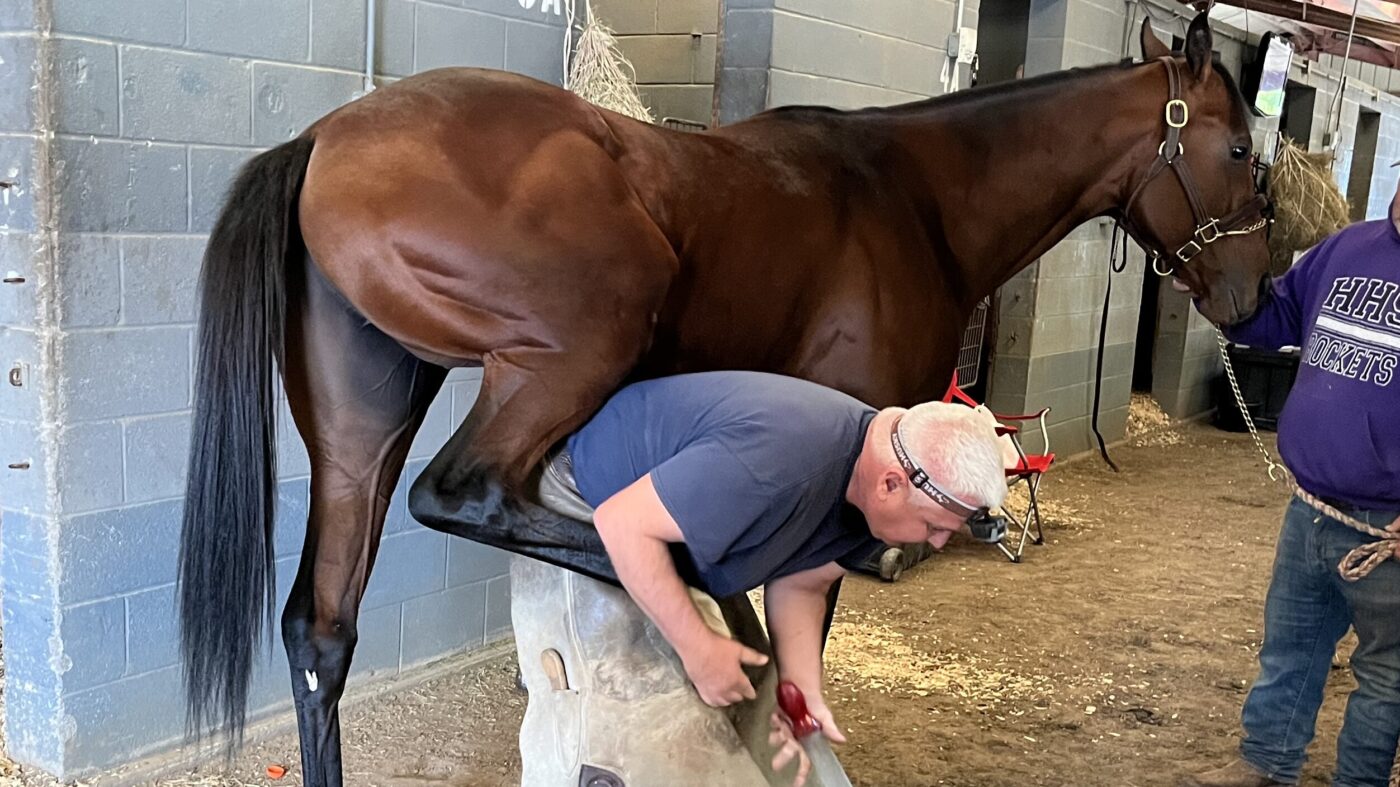
Table of Contents
What Are Racing Plates?
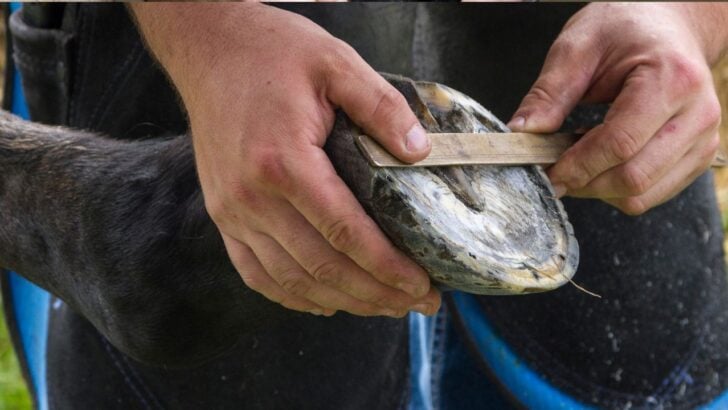
Racing plates are thin, lightweight horseshoes designed specifically for competition. They are fitted before the race — typically one to three days in advance — worn during the race, and removed afterward. The defining characteristic is weight: a standard steel training shoe weighs 14–20 ounces, while an aluminum racing plate weighs 3–6 ounces. That reduction — roughly 10–14 ounces per foot, 40–56 ounces across all four feet — is the entire reason they exist.
The plates are stamped from aluminum alloy, shaped to the horse’s hoof, and nailed on by the track farrier using the same technique as any horseshoe. They are thinner than training shoes, with a profile that sits closer to the hoof wall, and they typically have a smoother ground surface with minimal protrusion. Some designs include a toe grab — a small ridge or projection at the front of the shoe — for additional traction on dirt tracks.
| Feature | Racing Plate | Training Shoe (typical) |
|---|---|---|
| Material | Aluminum alloy (lightweight) | Steel or heavier aluminum |
| Weight per shoe | 3–6 oz | 14–20 oz (steel); 8–12 oz (aluminum trainer) |
| Profile thickness | Very thin; low profile | Thicker; more hoof clearance and protection |
| Durability | One race; replaced after | 4–6 weeks before reset |
| Cost per set (fitted) | $150–$250 | $80–$130 (regular shoeing cycle) |
| Traction modification | Toe grabs optional; surface-specific designs | Minimal modification typically |
| When fitted | 1–3 days before race; removed after | On regular shoeing cycle; worn through training |
Racing plates aren’t built to last — they’re built to win one race.
Why Weight Matters: The Physics of Racing Plates

The weight reduction from racing plates matters because of where the weight is located. Weight at the end of a limb — the distal end, in anatomical terms — requires significantly more energy to move than the same weight carried at the body’s center of mass.
A horse’s hoof is at the very end of its leg. Every gram of weight on that hoof is weight that the entire musculoskeletal chain — from the hoof up through the pastern, fetlock, cannon, knee, and shoulder — must accelerate and decelerate with every stride.
The principle is the same as the difference between swinging a heavy versus a light baseball bat. The bat’s weight at the end of the swing arc requires far more rotational energy than equivalent weight closer to your hands. A horse’s leg is operating on the same physics. Reducing distal limb weight by 10–14 ounces per foot doesn’t reduce the horse’s total bodyweight by a meaningful amount — it reduces the energy cost of each stride’s acceleration and deceleration cycle. Over a 1-mile race with approximately 1,400–1,600 strides, that per-stride reduction accumulates over the course of the race, which is why trainers and farriers consider even small changes in distal limb weight meaningful.
Research published in equine biomechanics literature supports the stride economy argument. Studies examining distal limb weight and stride mechanics in Thoroughbreds have consistently found that lighter footwear reduces the metabolic cost of locomotion — even when the total weight reduction is small in absolute terms. The effect is more pronounced at speed, because the acceleration and deceleration forces are larger at higher velocities. This is why plates are used for racing and not for the slower-paced conditioning work in training: the benefit scales with speed.
Types of Racing Plates: Dirt, Turf, and Synthetic
Not all racing plates are the same, and the choice of plate depends primarily on the surface the horse is racing on. Dirt, turf, and synthetic tracks have different traction requirements, and the plate design reflects that.
At dirt tracks like Fair Grounds, the flat aluminum plate with a small toe grab is the standard setup for most horses. The toe grab improves break-from-the-gate traction — the moment when the horse pushes powerfully off all four feet simultaneously — without significantly altering the horse’s natural stride mechanics during the race itself. Toe grab height is a genuine training decision: higher grabs provide more traction but increase the rotational force on the lower leg joints, which over time raises injury risk. The debate over toe grab height has been a persistent one in the sport, and HISA has moved to restrict the maximum toe grab height at its regulated tracks.
Turf racing requires a fundamentally different approach. Grass provides less consistent footing than a maintained dirt track, and the moisture content of the turf on any given day affects how much grip a horse needs. Turf plates with screw-in studs allow the farrier to adjust the stud size based on going conditions — shorter, blunter studs for firm turf, longer or sharper studs for soft going. This is analogous to changing cleats on a football player’s shoes based on field conditions. Because the stud selection depends on track conditions that may only be confirmed close to race time, turf plates are typically fitted the day before or the morning of the race — later than dirt plates — to allow the best stud choice based on current going.

How Racing Plates Are Fitted and When
Racing plates are fitted by a farrier — either the track farrier or the stable’s own farrier — typically one to three days before the race. The timing reflects a deliberate management decision: fitting plates in advance gives the trainer time to watch the horse move in the new shoes, identify any fit issues while there’s still time to address them, and avoid the pressure of a same-day shoeing appointment. Some trainers plate on race morning if circumstances require it, but most experienced operations plate ahead of time for exactly this reason.
The fitting process is the same as any horseshoe application. The farrier removes the training shoe, trims and balances the hoof if needed, shapes the plate to fit the individual horse’s hoof geometry, and nails it on. A skilled track farrier working on a horse with a clean, balanced hoof can plate all four feet in 20–30 minutes. The process takes longer if the horse needs corrective work, if the hoof wall is in poor condition, or if the trainer wants a specific plate modification that requires shaping.
| Stage | Timing | What Happens |
|---|---|---|
| Remove training shoes | 1–3 days before race | Farrier pulls the regular shoes; hoof is cleaned and inspected |
| Hoof preparation | Same session | Trim and balance if needed; address any wall issues |
| Plate selection | Same session | Trainer and farrier confirm plate type based on surface and horse preference |
| Fitting and nailing | 1–3 days pre-race | Plates shaped to hoof and nailed; clinches finished; horse observed in plates before race day |
| Post-race removal | After the race | Plates pulled; training shoes re-applied on next regular shoeing cycle |
Owners usually don’t choose the exact plate themselves. The decision is typically made by the trainer in consultation with the farrier, based on the horse’s hoof condition, running style, and the expected racing surface. As an owner, you’ll see the charge on your statement, but the specific plate type is a trainer-and-farrier call.
After the race, the plates are removed and the horse returns to its regular training shoes on the next shoeing cycle. The advance fitting — typically one to three days before the race — serves a practical purpose: it gives the trainer time to observe the horse moving in the plates before race day, catch any fit issues while there’s still time to address them, and arrive at the gate without the last-minute pressure of a race-morning shoeing appointment.
Racing Plates vs. Training Shoes: What Changes
The transition from training shoes to racing plates changes three things about how a horse moves: the weight it’s carrying on each foot, the amount of traction available at the ground contact point, and — in some cases — the angle at which the hoof lands and breaks over. Understanding these changes helps explain why some horses perform notably differently on race day versus in morning workouts, and why the plate choice matters beyond simple weight reduction.
It’s worth clarifying what “training shoe” means here, because practice varies. Many trainers — including in my own program — use aluminum shoes in training as well as in competition. The distinction between a training shoe and a racing plate isn’t always material versus material; it’s weight, profile, and traction design. A racing plate is the lightest, thinnest aluminum shoe in the rotation, optimized specifically for competition.
A training aluminum shoe is heavier and more protective, designed to hold up through weeks of daily work on the track. Some operations train in steel and race in aluminum; others train in heavier aluminum and race in lighter plates. The performance variable in every case is the weight difference between what the horse trains in and what it races in.
Weight reduction is the primary effect and has been covered above. Traction is the second. A standard training shoe on a dirt training track has a certain amount of grip through surface texture and shoe profile. A racing plate on the same surface has different grip characteristics — typically more forward-focused if a toe grab is present, with less lateral grip than a thicker training shoe.
Horses that are naturally balanced in their stride tolerate this change easily. Horses with gait asymmetries can sometimes respond unexpectedly to the traction change, either positively (if the plate design happens to suit their natural movement) or negatively (if it amplifies an existing imbalance).
The breakover angle — the point at which the hoof rolls forward off the ground at the end of each stride — changes when a thin plate replaces a thicker training shoe. A thin plate with a rolled toe encourages a faster breakover, which effectively shortens the time each foot is on the ground and increases stride frequency.
Some horses run better with a faster breakover; others, particularly those with existing tendon or joint sensitivities, do better with a more gradual transition. This is where the farrier’s knowledge of the individual horse matters most — the same plate that optimizes one horse’s movement can stress another’s.
Toe Grabs and Traction Modifications
Toe grabs are one of the most debated pieces of racehorse equipment because they improve traction but may also increase stress on the lower limb. The decision to use them — and at what height — is one of the more consequential plate-related choices a trainer makes.
A toe grab is a raised projection at the front of the racing plate that digs into the track surface when the horse pushes off. The grip improvement is real: horses with toe grabs break from the gate faster and maintain better purchase on a dirt track, particularly when the surface is dry and loose. Quarter horse sprint racing essentially requires them. For Thoroughbred racing, the benefit is most pronounced at the break and in the early part of the race.
The concern is biomechanical. A toe grab increases the rotational torque on the lower leg joints — specifically the fetlock and pastern — at the moment of breakover, because the toe is anchored to the ground slightly longer than it would be with a flat plate. Research conducted by the Grayson-Jockey Club Research Foundation found associations between high toe grab use and increased rates of certain lower leg injuries, particularly condylar fractures of the cannon bone. The mechanism is the increased torsional load at the fetlock during the breakover phase.
The practical effect of the HISA restrictions has been a shift toward lower-profile toe grabs and, at some stables, a move to flat plates on the front feet with small stickers or calks on the rear. Trainers who previously used high toe grabs on all four feet have had to adjust their approach, and the early data suggests injury rates have responded positively to the change — though the full picture will take years of data to confirm.
Cost, Replacement, and the Owner’s Bill
Racing plates are a per-race expense that appears on the owner’s monthly statement from the trainer. At Louisiana tracks, a full set of race plates — four shoes, fitted by the track farrier — typically costs $150–$250 depending on the plate type, the farrier’s rate, and whether any corrective work is needed at the same time. This cost is separate from the regular shoeing cycle, which runs every three to four weeks at $80–$130 for training shoes.
A horse running eight times in a year — a reasonable target for a sound, competitive claiming horse — generates $1,200–$2,000 in race plate costs on top of the regular shoeing expense. That’s a real number that belongs in the ownership budget, and one that the ownership cost article addresses in the context of annual expenses. For a complete picture of what racing costs per year at the ownership level, see our guide to racehorse ownership costs.
Can Horses Race Without Plates?
Technically, yes — barefoot racing exists and some horses compete without shoes of any kind. But it’s uncommon at established Thoroughbred tracks, and it requires regulatory approval in most jurisdictions. Louisiana, for example, requires a formal application for a horse to race barefoot, and the decision involves veterinary sign-off and track steward approval. The full picture of barefoot racing — its advocates, its limitations, and the science on both sides — is covered in our dedicated article on whether horses can race without shoes.
For most competitive Thoroughbreds at mainstream tracks, the question isn’t whether to use plates — it’s which plates, configured how, for which surface. The plate is not optional equipment in the way that blinkers or a shadow roll are optional. It’s as fundamental to race preparation as the saddle. The variables are in the type and configuration, not the existence of the shoe itself.
For more on why horses need hoof protection in the first place — the biomechanics, the surfaces, and the difference between barefoot and shod management — see our complete guide to why horses need shoes.
FAQs: What Are Racing Plates?
What are racing plates in horse racing?
Racing plates are lightweight aluminum horseshoes worn by racehorses in competition. They weigh 3–6 ounces each, compared to 14–20 ounces for a standard steel training shoe. The weight reduction decreases the energy a horse expends lifting each foot at speed, improving stride economy over the course of a race. Racing plates are fitted before the race — typically one to three days in advance — worn during the race, and removed afterward.
Why are racing plates made of aluminum?
Racing plates are made of aluminum because it is lightweight and strong enough for single-race use. Steel is more durable but significantly heavier — a steel shoe weighs 3–4 times more than an aluminum plate. Since racing plates are replaced after every race, durability beyond one performance is not the priority. Aluminum provides the minimum necessary strength at the minimum possible weight, which is exactly what a race-day shoe requires.
How much do racing plates cost?
A full set of racing plates — four shoes, fitted by a farrier — costs $150–$250 at most U.S. tracks. This is billed to the owner and appears on the monthly trainer statement. It is separate from the regular shoeing cycle, which costs $80–$130 every three to four weeks. A horse running 8 times per year generates $1,200–$2,000 in race plate costs annually, in addition to regular shoeing expenses.
What is a toe grab on a racing plate?
A toe grab is a raised ridge or projection at the front of a racing plate that improves traction when a horse pushes off the starting gate and during early acceleration. Under current HISA rules, toe grabs are effectively banned on the front feet for dirt and synthetic racing — only a 2mm full rim is allowed there. Hind limbs can still use toe grabs up to 4mm on dirt, and all traction devices are banned on turf. These restrictions followed research linking higher toe grabs to increased rates of lower leg injuries.
Do all racehorses wear racing plates?
Most racehorses competing at established Thoroughbred tracks in the United States wear racing plates. Barefoot racing is permitted in some jurisdictions with regulatory approval, but it is uncommon at mainstream tracks. The plate type varies by surface: flat aluminum plates for dirt, plates with screw-in studs for turf, and sometimes composite plates for synthetic surfaces. The decision on which plates to use is made by the trainer and farrier based on surface conditions and the individual horse’s gait and hoof characteristics.
How are racing plates different from regular horseshoes?
Racing plates differ from training shoes in weight, profile, and purpose. A racing plate is the lightest shoe in the rotation — 3–6 oz versus 8–20 oz for a training shoe depending on material. They are also thinner and optimized for specific racing surfaces rather than general durability. Some trainers use aluminum in training as well as in competition; in those stables, the distinction is between a heavier aluminum training shoe and a lighter aluminum racing plate. The weight difference, wherever it comes from, is the primary performance variable.
When are racing plates put on a horse?
Most trainers fit racing plates one to three days before the race rather than race morning. The advance fitting allows time to observe the horse moving in the new shoes, catch any fit issues before race day, and avoid last-minute complications. Turf plates are an exception — because stud selection depends on going conditions that may only be confirmed close to race time, turf plates are typically fitted the day before or the morning of the race. After the race, the plates are removed and the horse returns to its regular training shoes on the next shoeing cycle.
What are turf plates in horse racing?
Turf plates are racing plates designed specifically for grass (turf) racing. They typically feature screw-in or fixed studs that penetrate the grass surface to provide grip, since grass offers less consistent footing than a maintained dirt track. The stud size can be adjusted based on going conditions — shorter studs for firm turf, longer studs for soft going. This allows the farrier to customize traction based on the official going description on race day, similar to how soccer or football cleats are selected for field conditions.
Conclusion
Racing plates are one of the quieter details of horse racing — small, functional, and easy to overlook. But every competitive Thoroughbred at a U.S. racetrack runs in them, every trainer makes deliberate decisions about which type to use and how to configure them, and every owner pays for a new set every time their horse runs. Understanding what they are and why they’re designed the way they are gives you a more complete picture of what goes into preparing a horse for race day — and why the post-race process of removing them and returning to training shoes matters for the horse’s long-term soundness.
Racing plates are only one part of race-day preparation. Trainers also consider equipment such as blinkers, shadow rolls, and tongue ties when tailoring a horse’s setup, but every one of those decisions ultimately depends on how the horse meets the track. Getting it right is straightforward once you understand what each decision is actually doing.
For the broader context of hoof care in horses — why they need shoes at all, and what healthy hoof management looks like — see our guide to why horses need shoes. For a complete overview of every piece of equipment used on racehorses and what each one does, the Racehorse Equipment Guide is the place to start.
Have you noticed a difference in how your horse moves in race plates versus training shoes, or do you have questions about plate selection for a specific surface? Drop it in the comments.
Sources
- Grayson-Jockey Club Research Foundation — Toe grab injury research: graysonjockeyclub.org
- HISA — Equipment and toe grab regulations: hisaus.org
- American Association of Equine Practitioners — Hoof care and farriery guidelines: aaep.org
- American Farrier’s Association — Farriery standards and training: americanfarriers.org
About Miles Henry
Racehorse Owner & Author | 30+ Years in Thoroughbred Racing
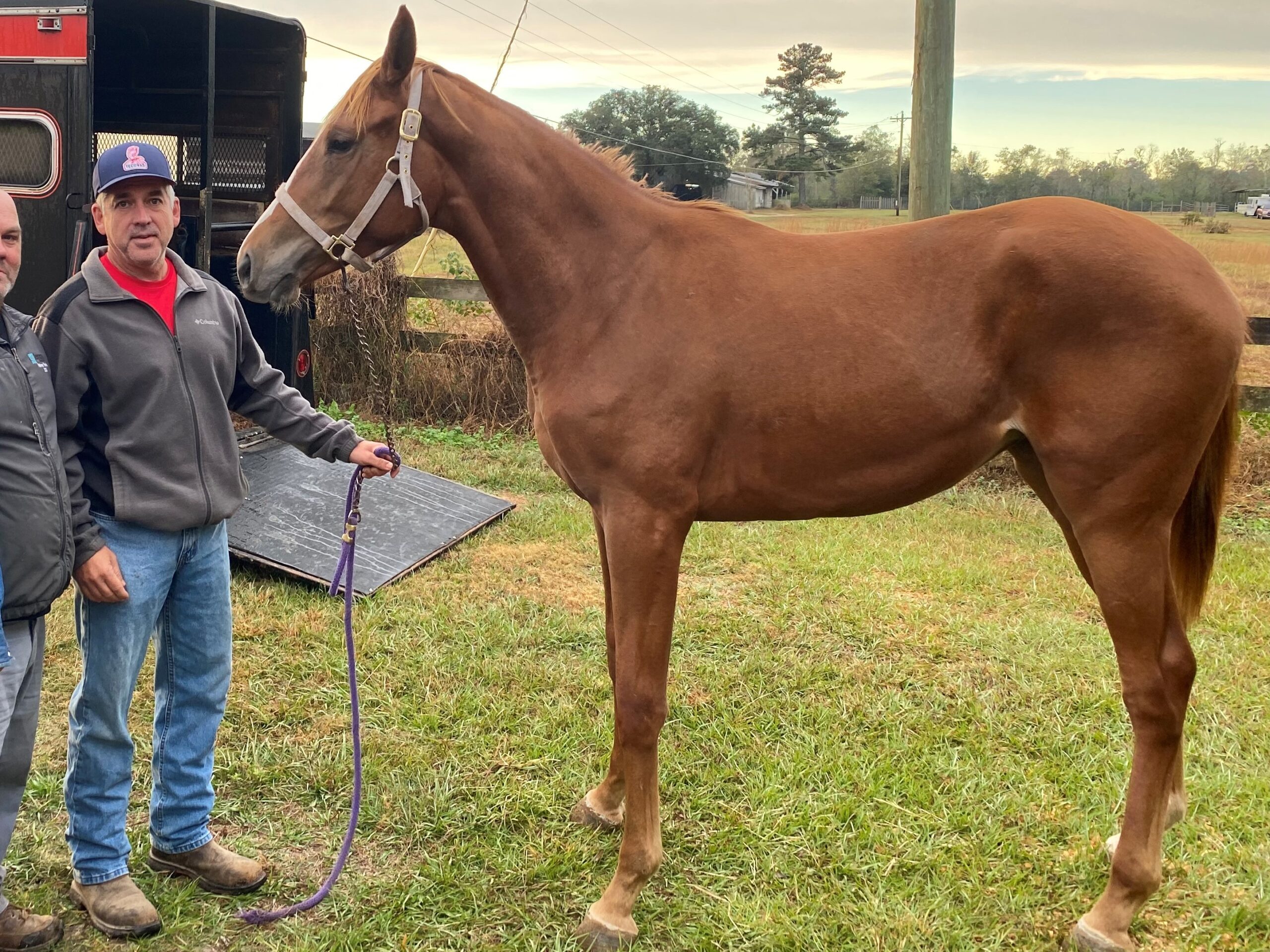
Miles Henry (legal name: William Bradley) is a professional horseman based in Folsom, Louisiana. He holds Louisiana Racing License #67012 and has spent over three decades managing Thoroughbreds at premier tracks including Fair Grounds, Delta Downs, and Evangeline Downs.
Expertise & Hands-On Experience: Beyond the track, Miles has decades of experience in specialized equine care, covering everything from hoof health and nutrition to training protocols for Quarter Horses, Friesians, and Paints. Every guide on Horse Racing Sense is rooted in this “boots-on-the-ground” perspective.
30 of their last 90 starts
Equibase Profile.

Connect with Miles: