
Last updated: April 15, 2026
The most expensive racehorse ever sold went for $70 million. That wasn’t a fluke — it was the logical outcome of a system where a single horse can generate hundreds of millions of dollars in breeding revenue over a lifetime. So why are racehorses so expensive? The answer starts with one idea: you’re rarely just buying a horse. At the highest level, buyers aren’t paying for speed — they’re paying for what that speed can produce later.
I’ve been a licensed Louisiana racehorse owner (#67012) for over 30 years, and I’ve stood at horse auctions watching buyers pay more for a single yearling than most people earn in a decade. I’ve also claimed horses for $5,000 that went on to earn back multiples of their purchase price. The racehorse market spans that entire range — from the $4,000 claimer at Evangeline Downs to the $70 million stallion prospect at Keeneland. What drives that spread is worth understanding whether you’re a buyer, a bettor, or just someone trying to make sense of a sport where a foal can be worth more than a private jet before it ever sees a starting gate.
Table of Contents
The Real Business of Racehorses: It’s About Genes, Not Just Speed
Most sports assets depreciate. A football player’s value peaks in their mid-twenties and declines from there. A racehorse’s value can actually increase after its career ends — if it wins the right races. A successful stallion doesn’t just earn stud fees once. He breeds 100 to 150 mares per year at fees that can exceed $200,000 per mare, and he does that for 15 to 20 years. The math on elite stallions is staggering: a horse standing at $200,000 per breeding, covering 150 mares annually, generates $30 million per year in stud fees alone. Over a 15-year stud career, that’s $450 million — from a horse that may have been purchased as a yearling for $1 million or less.
That is the core reason racehorses are expensive. When buyers bid millions at Keeneland or Tattersalls, they are not just buying an athlete — they are buying a genetic lottery ticket with known odds. The pedigree, the conformation, the sire’s book of business, the mare’s production record — all of these are proxies for the one question that actually drives price: will this horse produce offspring that win at the highest level?
Bloodlines: Why Pedigree Drives Price
A Thoroughbred’s pedigree is a five-generation document of athletic achievement. Every horse traces its lineage back to one of three foundation sires — the Darley Arabian, the Godolphin Arabian, or the Byerley Turk — and from those roots, certain sire lines have produced disproportionate numbers of elite horses. That concentration of talent, once established in a bloodline, tends to reproduce itself. Not always. Not predictably. But enough that buyers pay premiums to access it.
The most commercially powerful sire lines in modern racing share specific traits: speed over classic distances, soundness, and — critically — the ability to pass those traits to offspring. A stallion that wins the Kentucky Derby is valuable. A stallion that wins the Kentucky Derby and then produces offspring that win the Kentucky Derby is worth multiples more. Storm Cat, the most commercially successful sire of his era, commanded stud fees of $500,000 at his peak — the highest in history at the time — because his offspring consistently outperformed expectations across distances, surfaces, and hemispheres.
| Sire | Peak Stud Fee | Notable Offspring | Why He Was Expensive |
|---|---|---|---|
| Storm Cat | $500,000 | Giant’s Causeway, Tabasco Cat, High Chaparral | Elite speed genetics; exceptional success rate across hemispheres |
| Tapit | $300,000 | Tapiture, Frosted, Stardom Bound | Consistent classic-distance producers; high earnings per starter |
| Galileo | €600,000 | Frankel, Found, Magical, Australia | Dominant European sire; unmatched Group 1 production |
| Justify | $150,000+ | Triple Crown 2018; stud career ongoing | Undefeated Triple Crown winner; no pedigree concerns |
| Into Mischief | $250,000 | Authentic, Bolt d’Oro, Covfefe | Leading North American sire; consistent sprint-route versatility |
The dam line — the mother’s side — is equally important and often undervalued by casual observers. A mare who has already produced stakes winners is called a “black-type producer,” and her subsequent foals command premiums regardless of which stallion she was bred to. The value of a proven broodmare can exceed $5 million for a top producer, because she represents a known commodity in a business built entirely on probability.
Conformation: What Buyers Are Looking at in the Ring
Pedigree gets a horse into the auction ring. Conformation determines what buyers pay once it’s there. Conformation is the physical structure of the horse — the angles of the legs, the depth of the shoulder, the length of the back, the size and shape of the feet, the breadth of the chest, the overall proportions that predict how a horse will move, how much stress its skeleton can absorb at speed, and how likely it is to stay sound through a racing career.
The ideal Thoroughbred conformation for a classic-distance horse looks something like this: a long, sloping shoulder that allows for maximum stride length; a short, strong back that transfers power from the hindquarters; correct leg angles front and rear that reduce stress on joints and tendons; large, round feet that absorb concussion; and a deep girth that allows room for maximum lung capacity. Deviations from this ideal aren’t automatically disqualifying — plenty of champions have had structural quirks — but they reduce the probability of soundness and, by extension, the probability of a long, profitable career.
Top-level buyers hire professional bloodstock agents specifically to evaluate conformation. These agents spend careers developing the eye to spot subtle structural faults that might not affect a horse’s racing career but would compromise its value as a breeding prospect. A slight offset cannon bone. A toe that turns out more than ideal. A back that’s slightly long. None of these are necessarily race-limiting. All of them reduce breeding value because they increase the probability of passing structural weaknesses to offspring.

Stallion Value: The Multiplier That Changes Everything
The stallion market is where racehorse economics become genuinely extraordinary. A colt that wins the Kentucky Derby doesn’t just earn a share of a $3 million purse — he immediately becomes a stallion prospect worth 50 to 100 times his purchase price. The economics work as follows: a stallion standing at a fee of $100,000, covering 150 mares per year, generates $15 million annually. Over a 20-year career, that’s $300 million in stud fees, plus the ongoing value of his offspring at auction and in the breeding shed.
This is why syndicates form specifically to purchase horses they believe have stallion potential. The most famous example is Fusaichi Pegasus, the 2000 Kentucky Derby winner, who was syndicated for $60–70 million shortly after his victory. The syndicate wasn’t paying for his racing career — he raced only nine times. They were paying for what his offspring might produce over the next two decades. His stud career was ultimately disappointing relative to expectations, which illustrates the speculative nature of the market: you’re betting on genetics, and genetics are probabilistic, not guaranteed.
| Stallion Economics Scenario | Conservative | Elite |
|---|---|---|
| Annual stud fee | $25,000 | $250,000 |
| Mares covered per year | 100 | 150 |
| Annual gross stud revenue | $2.5 million | $37.5 million |
| 15-year career total | $37.5 million | $562 million |
| Breeding farm’s share (~30%) | $11 million | $168 million |
The filly side of this equation is different but equally significant. A filly who wins major races becomes a broodmare prospect — her foals will sell for premiums because her proven ability validates her genetics. A Grade I-winning mare bred to an elite stallion can produce yearlings that sell for $1 million or more, year after year, for a decade. The mare herself may be worth $3 to $10 million based purely on her production potential. Racing is the audition. Breeding is the career.
Auction Economics: How Thoroughbred Prices Are Set
The Keeneland September Yearling Sale is the largest and most prestigious Thoroughbred auction in the world. Over two weeks each September, thousands of yearlings sell for a combined total that routinely exceeds $300 million. The Fasig-Tipton Saratoga Select sale, held in August, is smaller but typically commands the highest average prices of any American sale. In Europe, Tattersalls in Newmarket runs the primary market, with Book 1 of the October yearling sale drawing the world’s most powerful buyers.
Prices at these sales are set by competition between buyers who are simultaneously evaluating the same information: the pedigree page, the physical inspection, the consignor’s reputation, the sire’s current crop results, and the mare’s production record. When two well-funded operations both want the same horse, prices escalate rapidly. The top lot at any major sale often sells for 10 to 50 times the median price of the same sale — the result of two or three serious buyers converging on a horse they each believe has exceptional potential.
| Sale | Location | When | Market Position |
|---|---|---|---|
| Keeneland September | Lexington, Kentucky | September | Largest by volume; broadest market |
| Fasig-Tipton Saratoga Select | Saratoga Springs, New York | August | Highest average prices in North America |
| Tattersalls Book 1 | Newmarket, England | October | Premier European yearling market |
| Keeneland November Breeding Stock | Lexington, Kentucky | November | Elite mares and proven producers |
| OBS March/April | Ocala, Florida | March / April | Two-year-olds in training; speed-oriented buyers |
Two-year-old in training sales add another pricing mechanism: the breeze. Horses at these sales are asked to gallop or breeze a set distance in front of buyers, and a fast time — especially a “bullet” work — can instantly add six figures to a horse’s price. Critics argue these sales reward early physical development over long-term soundness and genuine talent, but buyers continue to pay premiums for horses that can run fast in February because speed at two is still correlated with speed at three, even if imperfectly.
Racing Record and Prize Money
A horse’s potential to earn purse money is a major factor in its market value — which is why understanding how race purses are structured and funded matters even before you buy. For the full breakdown, see our guide to horse racing purse money.
A horse’s racing record affects its value in two key ways: it validates the genetic potential buyers saw at the yearling sale, and it directly impacts breeding opportunities. Winning a Grade I race proves something no paper record can — that the horse’s genetics can compete at the sport’s highest level. That proof is valuable because it transforms a theoretical breeding prospect into a proven one.
At the top level, prize money is significant but often secondary to breeding value. The Kentucky Derby offers a $3 million purse, with about $1.86 million to the winner. The Breeders’ Cup Classic pays $6 million, with $3.3 million to the winner. These are impressive sums, but a horse that wins both is worth far more as a breeding prospect. Racing covers costs; breeding is the business.
Below Grade I, prize money matters more for ownership economics. An allowance horse earning $50,000–$100,000 a year can support a small operation when training costs run $40,000–$60,000 annually. At the claiming level — where most racehorses spend their careers — margins are tighter and breeding value is rarely a factor. Here, winning percentage, claiming strategy, and race selection determine whether a horse pays its way. For a full breakdown, see our complete claiming race guide.
The Cost of Producing a Racehorse
Even before a horse ever sees a starting gate, substantial capital has been invested in its existence. The cost of producing a Thoroughbred racehorse — from breeding fee through the first start — illustrates why even “cheap” racehorses aren’t actually cheap to create.
| Cost Component | Budget Range | Elite Range |
|---|---|---|
| Stud fee (breeding) | $2,500–$10,000 | $50,000–$500,000+ |
| Mare care (pregnancy, foaling) | $8,000–$15,000 | $15,000–$30,000 |
| Foal care (year 1 at farm) | $8,000–$15,000 | $20,000–$40,000 |
| Breaking and early training (6 months) | $15,000–$25,000 | $30,000–$60,000 |
| Training to first race (4–6 months) | $18,000–$30,000 | $40,000–$80,000 |
| Total before first start | $51,500–$95,000 | $155,000–$710,000+ |
These production costs explain why even horses that sell at auction for $5,000 to $15,000 — at the bottom of the market — represent real investment. Someone paid to breed, raise, and train that horse through its first year of competition. The discount price reflects either a disappointing physical inspection, a weak pedigree, an early performance that didn’t match expectations, or an owner managing cash flow by liquidating. The cost structure doesn’t disappear just because the auction price is low. For context on the ongoing costs once a horse is in active competition, our guide to claiming race economics breaks down monthly ownership costs in detail.
What Makes a Cheap Racehorse Valuable
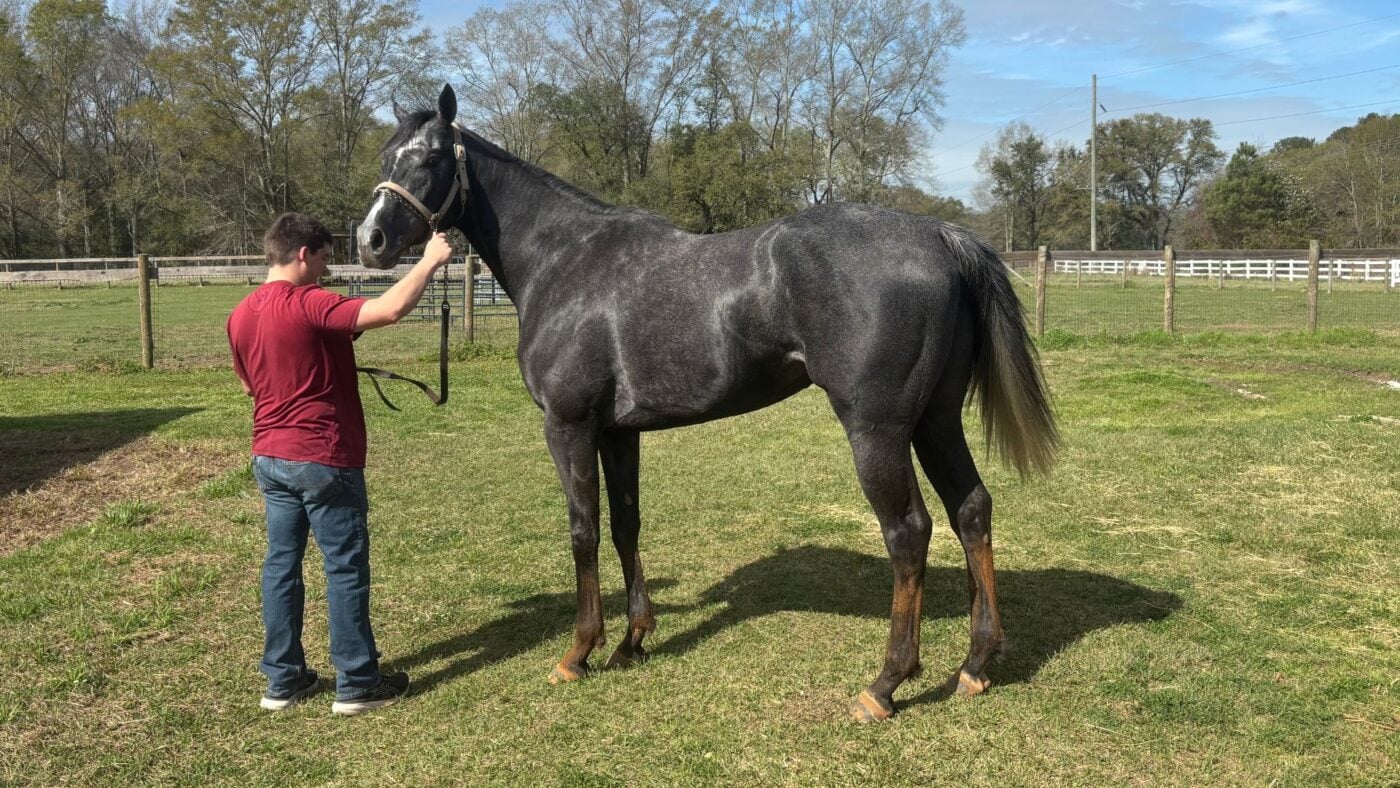
The racehorse market is not just about horses that sell for millions. It is also, and primarily, about horses that sell for thousands — and the principles that create value at the high end also create opportunity at the low end for buyers who know what they’re looking for.
A horse at a $10,000 claiming price may have better breeding than its tag suggests, a physical issue that is manageable if identified correctly, a trainer mismatch that depressed its early results, or simply a racing history at the wrong distance or surface. The claim box is where sharp owners find horses whose market value is temporarily below their actual value — and the mechanism that makes that possible is the same one that keeps the sport honest: public information. Past performances, workout times, trainer statistics, and breeding records are all publicly available. The buyer who synthesizes that information better than the market does finds value.
This is exactly the dynamic that creates the claiming game’s appeal. Diamond Country, one of the horses currently in my barn, was claimed for $5,000 at Evangeline Downs. Her dam had won over $350,000. Her breeding was better than her tag. Her work tab was solid. The claiming price reflected her inconsistent race results, not her actual quality — and the difference between those two numbers was the opportunity. She went on to break her maiden, post four consecutive second-place finishes, and earn back her claiming price several times over. For more on how to identify those horses and what to look for before submitting a claim, see our complete guide to claiming races.
Understanding how trainers think about class placement — where a horse belongs in the racing hierarchy and what a class drop or rise signals about a horse’s value — is equally important for anyone trying to identify undervalued horses. Our guide to horse racing class levels covers how to read those signals.
FAQs: Why Are Racehorses So Expensive?
Why are racehorses so expensive?
Racehorses are expensive primarily because of their breeding value, not just their athletic ability. A colt that wins major races can become a stallion worth tens of millions of dollars in breeding fees over his lifetime. Prices also reflect pedigree strength, physical conformation, and the speculative market dynamics of an industry where genetic potential is the core asset being bought and sold.
What is the most expensive racehorse ever sold?
Fusaichi Pegasus, the 2000 Kentucky Derby winner, was syndicated for an estimated $60–70 million following his racing career — the highest price ever paid for a racehorse. He was purchased for his stallion potential, not his racing record. The most expensive yearling ever sold at public auction was a colt by Galileo who sold at Tattersalls for approximately €7 million (around $9.7 million at the time). Verify current record prices at Blood-Horse or Thoroughbred Daily News, as auction records are regularly updated.
Why do thoroughbreds cost millions?
Thoroughbreds cost millions when they combine elite pedigree, correct conformation, and racing success that validates their breeding potential. The economics of stallion fees mean that a horse standing at $200,000 per breeding, covering 150 mares per year, generates $30 million annually. Buyers at major auctions are not paying for a racehorse — they are paying for a genetic asset that could generate hundreds of millions in breeding revenue over two decades.
What makes a horse valuable at auction?
The four primary drivers of auction value are pedigree (sire and dam’s racing and breeding records), conformation (physical structure predicting soundness and athleticism), consignor reputation (preparation quality and track record), and market timing (competitive bidding from multiple well-funded buyers). A horse that scores highly on all four will sell at multiples of the auction average. A horse strong on pedigree but with conformational concerns will sell at a discount relative to its bloodlines alone.
How much does a racehorse cost to buy?
Racehorse prices span an enormous range. A claiming-level horse at a regional track can be purchased for $4,000 to $25,000 through the claiming process. A mid-level yearling at a major sale typically sells for $50,000 to $300,000. Elite yearlings from top bloodlines at the Keeneland September or Fasig-Tipton Saratoga sales regularly sell for $1 million to $5 million. Stallion prospects and proven racing horses can sell for $10 million to $70 million. The annual cost of training and racing a horse runs $40,000 to $80,000 depending on the track and level of competition.
What is a stallion stud fee and why does it affect racehorse prices?
A stud fee is the price paid to breed a mare to a particular stallion. Stud fees for elite stallions range from $25,000 to $500,000 per breeding. Because a successful stallion can cover 100 to 150 mares per year for 15 to 20 years, the potential earnings from a successful stallion career dwarf what any horse can earn in prize money. This breeding economics calculation is the primary driver of high racehorse prices — buyers are purchasing lottery tickets on future breeding value, not just athletic performance.
Do racehorses make money for their owners?
Most racehorses do not generate a profit for their owners when all costs are included. Training fees, veterinary care, entry fees, and transportation typically run $40,000 to $80,000 per year, while most horses earn significantly less in prize money. The Thoroughbred Owners and Breeders Association estimates that fewer than 30% of racehorses earn back their training costs. Successful owners either operate at a scale where the occasional big earner offsets many losers, or they have breeding operations where the racing component serves a different purpose than pure profit.
Why are Kentucky Derby horses so expensive?
Kentucky Derby horses are expensive because winning the Derby is the single most valuable credential a stallion prospect can have in North American racing. A Derby winner immediately commands stud fees of $100,000 or more and generates hundreds of millions in potential breeding revenue. Before the race, horses with Derby prospects trade at premiums because buyers are acquiring an option on that outcome. After a Derby win, the value crystallizes almost instantly — syndication discussions typically begin within hours of the finish.
Conclusion
Racehorses are expensive because the sport is not really about horse racing. It’s about genetics, probability, and a centuries-old system for identifying and propagating athletic ability. Racing is the audition. Breeding is the business. The price of any individual horse reflects someone’s best estimate of where that animal sits in a genetic hierarchy that was built over hundreds of years and is worth billions of dollars annually.
At the top of the market, buyers are making speculative bets on breeding value that can pay off at extraordinary multiples or disappoint entirely — Fusaichi Pegasus being the most famous example of the latter. At the bottom, buyers like me are looking for horses whose market price temporarily understates their actual quality. The mechanism is different. The underlying logic — find horses worth more than you’re paying — is exactly the same.
To understand the full economics of horse ownership at the working level of the sport — from claiming race strategy to monthly costs and what horses actually earn — see our complete claiming race guide and our guide to horse racing class levels. For a complete overview of how the sport works from the starting gate to the breeding shed, the Horse Racing Explained hub is the place to start.
Have you ever wondered what a specific horse was worth, or been surprised by an auction price that seemed impossible to justify? Drop it in the comments — the specific cases are always more interesting than the general principles.
Sources and Further Reading
- The Jockey Club — Breeding statistics, stallion registers, and foal production data: jockeyclub.com
- Blood-Horse — Auction results, stallion fees, and racing industry reporting: bloodhorse.com
- Thoroughbred Daily News — Sale results, breeding market analysis: thoroughbreddailynews.com
- Keeneland — Official auction results and sale history: keeneland.com
- Thoroughbred Owners and Breeders Association — Ownership cost data and industry statistics: toba.org
Note: Stud fees, auction records, and sale prices cited in this article reflect historical figures and conditions as of the author’s knowledge. Verify current figures at Blood-Horse, Thoroughbred Daily News, or the relevant auction house before making any financial decisions.
About Miles Henry
Racehorse Owner & Author | 30+ Years in Thoroughbred Racing
Miles Henry (legal name: William Bradley) is a professional horseman based in Folsom, Louisiana. He holds Louisiana Racing License #67012 and has spent over three decades managing Thoroughbreds at premier tracks including Fair Grounds, Delta Downs, and Evangeline Downs.
Expertise & Hands-On Experience: Beyond the track, Miles has decades of experience in specialized equine care, covering everything from hoof health and nutrition to training protocols for Quarter Horses, Friesians, and Paints. Every guide on Horse Racing Sense is rooted in this “boots-on-the-ground” perspective.
30 of their last 90 starts
Equibase Profile.

Connect with Miles: