
Last updated: June 23, 2026
Any links on this page that lead to products on Amazon are affiliate links and I earn a commission if you make a purchase. Thanks in advance – I really appreciate it!
I first started paying attention to barn air quality after dealing with persistent coughing in two Thoroughbreds that didn’t respond to typical treatments. When we finally measured the environment, ammonia levels were around 15 ppm in a poorly ventilated barn with hay stored overhead.
Once we improved ventilation and brought ammonia down to roughly 3 ppm, the coughing resolved within weeks. That experience made one thing hard to ignore: in many barns, respiratory issues are driven less by disease than by air quality that hasn’t been measured.
Barn air quality comes down to three forces working together — or against each other: exchange rate (how fast fresh air replaces stale air), contamination load (how much dust and ammonia the barn is generating), and floor load (what the surface beneath the horses is doing to air quality at ground level). Every section of this guide maps to one of those three. When all three are working in the right direction, the environmental conditions that drive chronic barn cough are reduced significantly. Worth noting: most chronic barn air problems involve at least two of the three systems failing at once — which is why fixing ventilation alone sometimes produces only partial improvement.
Horse barn air quality — what actually matters:
- Target 6–8 air changes per hour (ACH) — calculate using the CFM formula rather than estimating; undersized ventilation is a common barn design error.
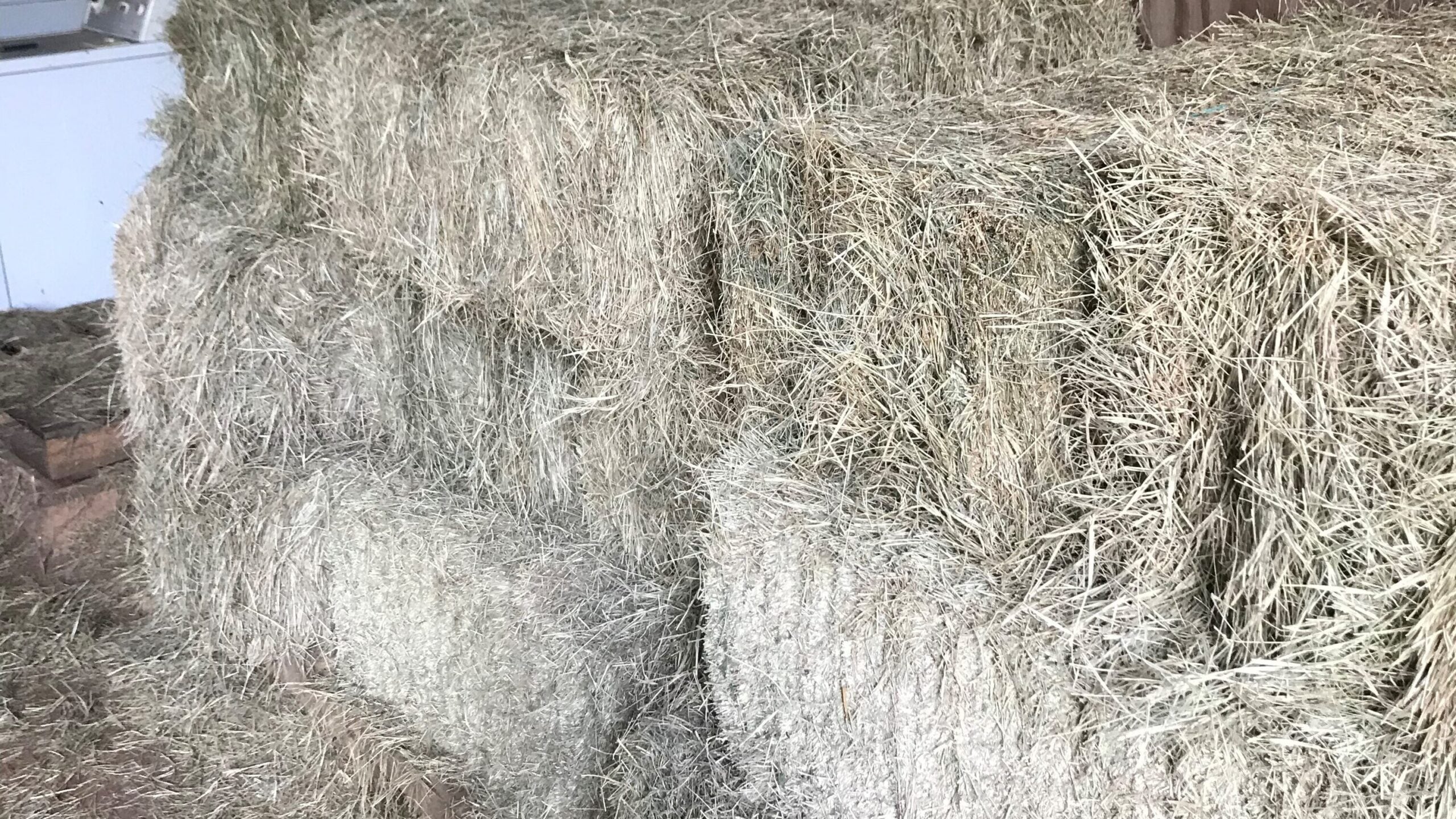
- Move hay storage outside — overhead hay is a significant dust source; stall particulate levels increase substantially when hay is stored above horses and allowed to shed dust downward continuously.
- Orient the barn with prevailing winds — check NOAA wind data before construction; in favorable configurations, correct orientation can significantly reduce mechanical fan requirements.
- Concrete plus rubber mats — performs well for ammonia control, dust suppression, and durability across climates; commonly recommended as a starting point in equine facility design.
- Avoid sealing the barn in winter — 4 ACH is a practical target even in cold weather; adjustable vents that can be partially closed are the right approach, not sealed ones.
- Test, don’t assume — the overnight water dish test is free and identifies ammonia problems immediately.
Bottom line: In many barns with chronic coughing or performance loss, environmental design is a major contributing factor — often the first place worth investigating, before treatment, supplements, or changing the horse.
Table of Contents
The Three Respiratory Threats Poor Air Quality Causes
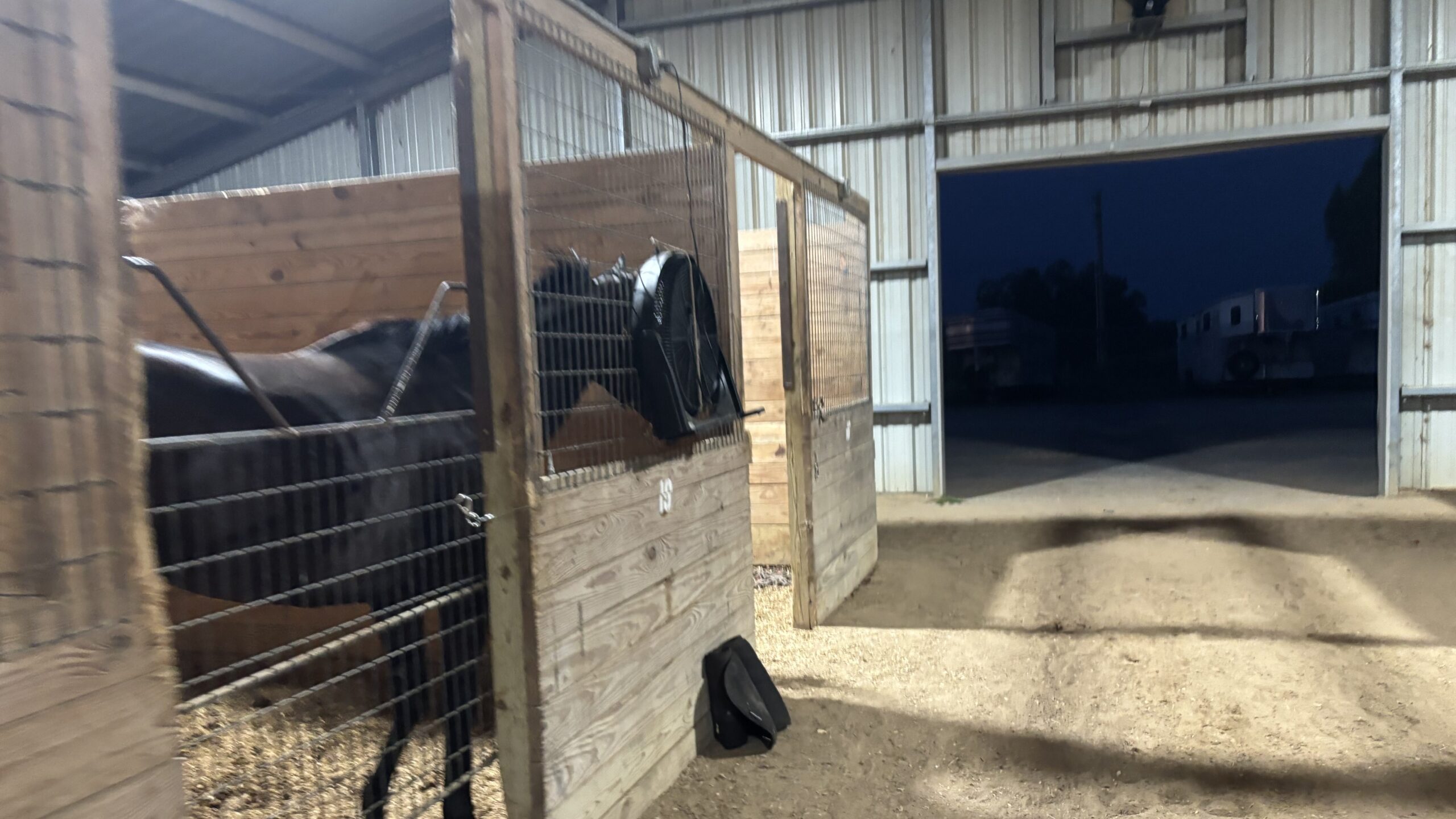
Poor air quality doesn’t just cause coughing — over time it can reduce athletic capacity and drive up veterinary costs in ways that are easy to misattribute. Three conditions come up repeatedly in the context of barn air. They are distinct clinically, and a veterinarian is needed for diagnosis — but all three are worsened by the same environmental factors: ammonia, dust, and inadequate air exchange.
Recurrent Airway Obstruction (RAO), also called heaves, is a chronic condition linked to long-term exposure to airborne dust and fungal spores — particularly from overhead hay storage. Inflammatory Airway Disease (IAD) is a lower-grade chronic inflammation that shows up as a persistent cough or subtle performance loss; horses with IAD often appear otherwise healthy, which makes it easy to miss. Exercise-Induced Pulmonary Hemorrhage (EIPH) is multifactorial, but elevated baseline airway inflammation is a contributing factor — and poor air quality raises that baseline. None of these conditions is caused exclusively by barn design, but all of them are made worse by it, and in many cases improving the barn environment meaningfully reduces their severity.
What poor air quality typically costs:
- Veterinary treatment for respiratory illness in horses is estimated in published literature at roughly $2,400–$8,000 per affected horse per year — reported ranges vary widely depending on severity, region, and how long the problem goes unaddressed
- Training setbacks and reduced performance add costs that vary by use but are real in any competitive context
- Bedding replacement runs faster in poorly ventilated barns — contaminated bedding means more frequent full changes regardless of how much you spend on bedding quality
Step 1: Climate-Specific Barn Design
A barn built for Arizona’s dry heat will trap dangerous humidity on the Gulf Coast. Every design decision — fan placement, wall materials, orientation, drainage — needs to start with the climate’s primary challenge, not a generic template. In Louisiana, the problem is 90% humidity and heat. In Minnesota, the problem is sub-zero winters that tempt owners to seal the barn tight. In the desert Southwest, it is dust. The solutions are genuinely different, and what works in one climate can make things worse in another.
| Climate Zone | Primary Challenge | Essential Design Responses |
|---|---|---|
| Humid (Gulf Coast, Southeast) | 90%+ humidity, storm exposure, heat buildup | Mechanical fans targeting 6–8 ACH • North-south orientation • Concrete floors plus rubber mats • Ridge vents plus aisle exhaust |
| Cold (Northern Plains, Northeast) | Sub-zero winters, snow loads, temptation to seal | Insulated walls with adjustable vents — kept partially open, not sealed • Minimum 4 ACH maintained in winter • Heated water systems |
| Dry (Southwest) | Dust storms, extreme heat, low humidity | MERV 11 air filtration • Strategic shade to reduce heat load • Gravel base or concrete to suppress dust generation |
| Pacific Northwest | Constant moisture, mold risk, limited sun | Dehumidification systems • Mold-resistant wall materials • Superior floor drainage design |
Barn orientation is one of the highest-leverage decisions in design — and it is free to get right at the planning stage. Use NOAA wind data to align your barn with prevailing breezes. In favorable conditions with consistent winds averaging 8 miles per hour or more, natural ventilation can provide 2–3 air changes per hour on its own; in those situations, reported reductions in mechanical fan requirements can range from 30–50%. A barn oriented perpendicular to prevailing winds may need meaningfully fewer fans than one built without regard to wind direction. That orientation decision pays back in electricity and equipment wear for the life of the facility.
Step 2: Horse Barn Ventilation — How to Calculate What Works
Most barns end up under-ventilated because airflow gets guessed instead of designed. The AAEP recommends 6–8 air changes per hour (ACH) as a working target to keep ammonia below safe levels under normal conditions. The formula is not complicated, but you have to use it.
One thing worth understanding before running the numbers: most barn ventilation systems fail not because they are undersized, but because they exhaust into the same space they draw from. Air has to leave the building — not just move through it. A fan pushing air around a sealed ridge is recirculating the problem. Get the exhaust path right first, then calculate fan size.
CFM Required = (Barn Volume × Target ACH) ÷ 60
CFM is cubic feet per minute — the airflow rating on fan specifications. Barn volume is length times width times ceiling height. Target ACH is the number of times per hour the barn’s full air volume is replaced: 6 for most conditions, 8 for hot humid climates, and 4 as a practical floor in winter. Real-world ventilation is affected by wind, stack effect, and air leakage, so treat the formula as a baseline sizing method rather than a precise specification — but it is far more reliable than guessing.
| Barn Dimensions | Volume (cu ft) | Target ACH | CFM Required | Fan Recommendation |
|---|---|---|---|---|
| 20 × 24 × 10 ft | 4,800 | 6 | 480 CFM | One 24-inch circulation fan |
| 30 × 40 × 12 ft | 14,400 | 6 | 1,440 CFM | Two to three 24-inch fans |
| 40 × 60 × 14 ft | 33,600 | 6 | 3,360 CFM | Four to five 24-inch fans |
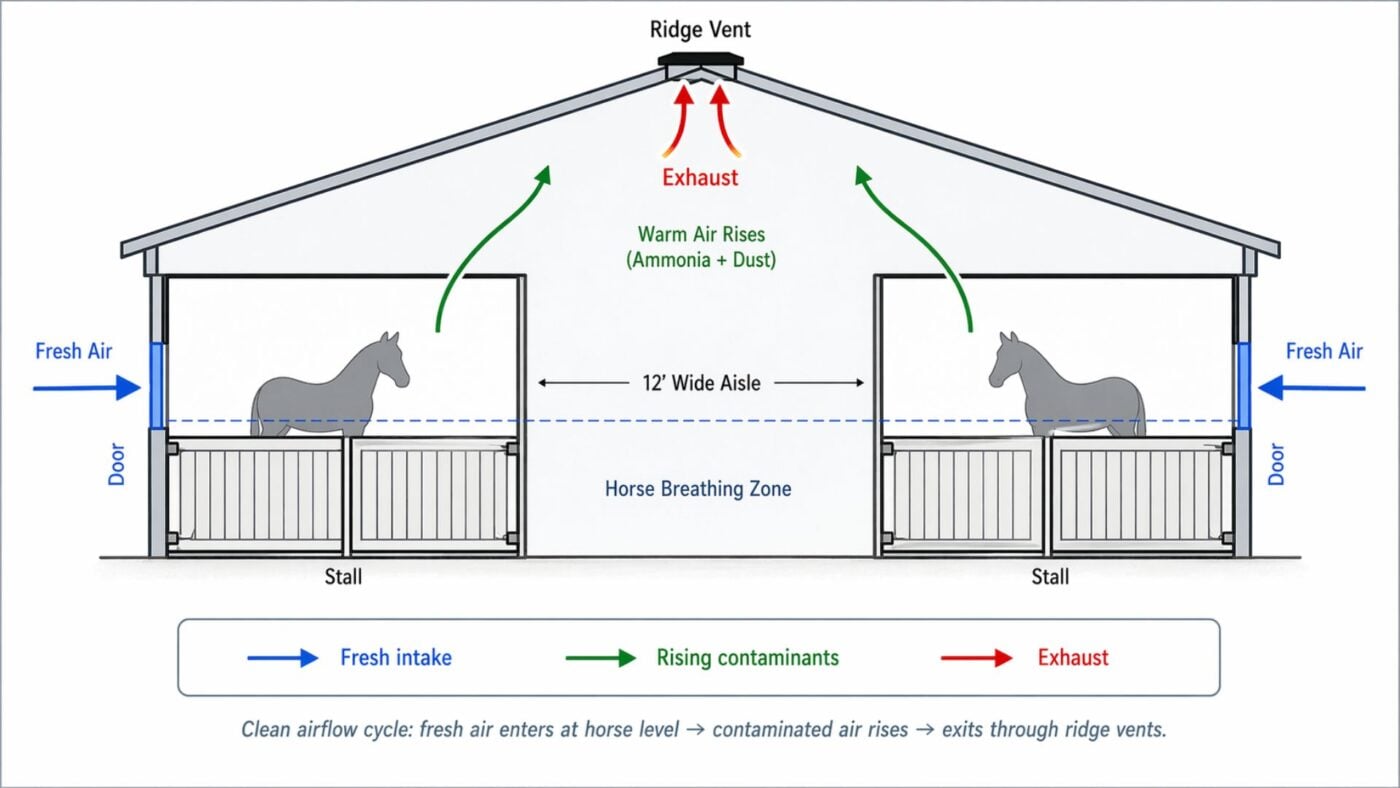
Before sizing fans, maximize free natural airflow through structural design. Stack effect ventilation works by letting warm, contaminated air rise through ridge vents while cooler fresh air enters at horse level below. Install ridge vents at a minimum of 1 square foot per horse — a commonly used rule of thumb, not a code requirement, and a reasonable starting point for most barn sizes. Position windows on opposing walls, mounted 6–8 feet high to stay above horse reach. In still or humid climates, mechanical fans supplement this — they do not replace it. See the airflow and fan sizing breakdown for product recommendations by barn type.
Horseman’s Perspective: When I first started troubleshooting the ammonia problem in my 4-stall barn, I added fans before I fixed the ridge. The fans moved the air around faster but the ammonia readings barely changed. The contaminated air had nowhere to go — it just recirculated. Adding 10 square feet of ridge venting dropped the ammonia faster than any fan had. Get the exhaust path right before you worry about fan size.
Step 3: Barn Layout for Optimal Air Movement
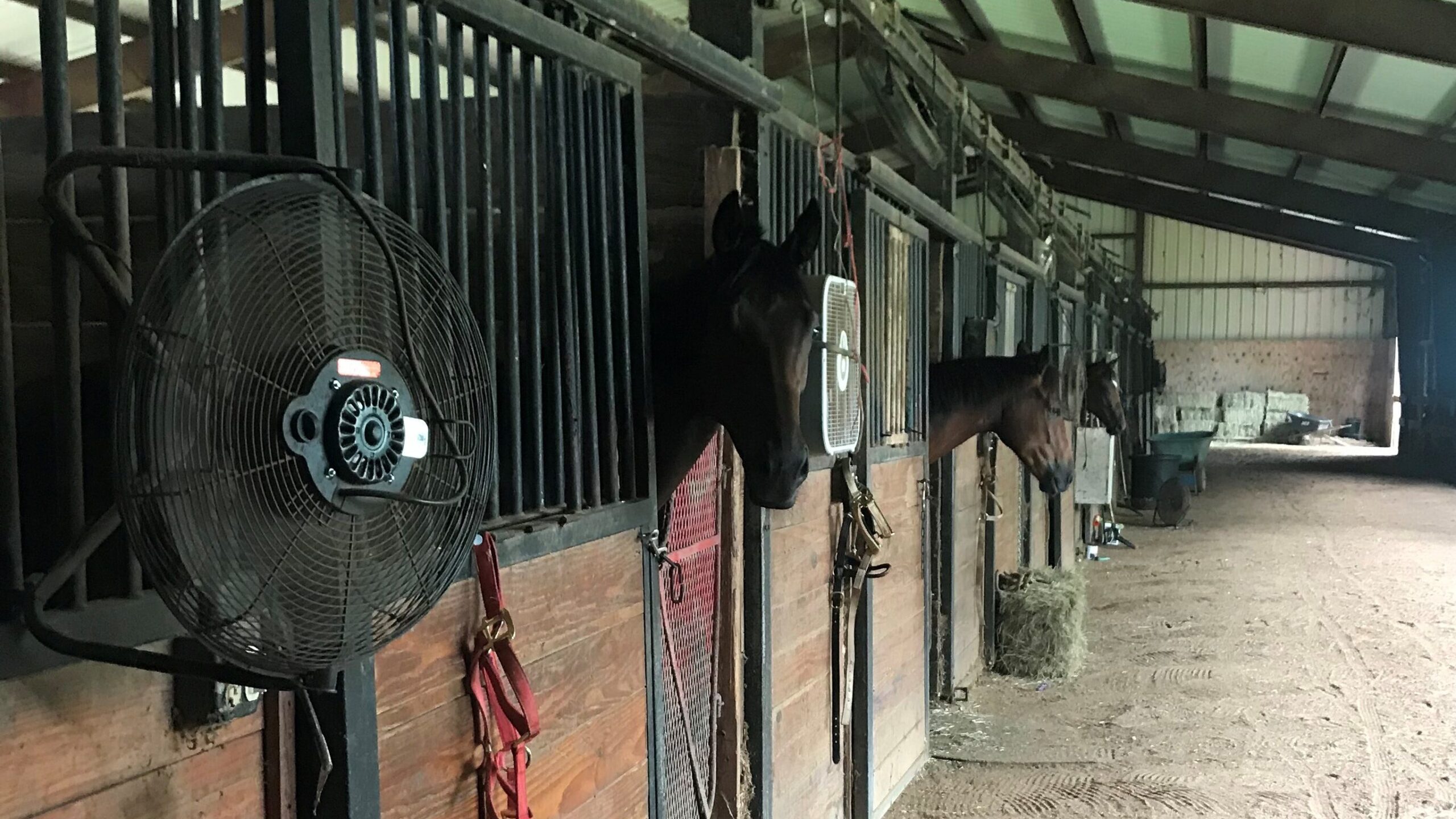
Even correctly sized ventilation systems fail when barn layout creates dead air zones. These are areas — often at the far end of a long aisle, in corner stalls, or directly below hay storage — where air does not move regardless of what the fans are doing. The design elements below work together to keep air moving through the breathing space where horses spend most of their time.
| Design Element | Recommended Specification | Air Quality Impact |
|---|---|---|
| Ceiling height | Minimum 10 feet, ideal 12 feet | Contaminated air rises above the horses’ breathing zone; low ceilings trap it at head height |
| Aisle width | 12 feet | Reduces dust concentration significantly and improves circulation between stalls |
| Stall doors | 4-foot Dutch doors | Upper half open for ventilation and social contact while lower stays closed; meaningfully reduces trapped dust |
| Hay storage | Separate external building only | Removes the primary overhead dust source — stall particulate levels can increase dramatically when hay is stored above |
| Barn orientation | Long axis perpendicular to prevailing wind | In favorable wind conditions, natural cross-ventilation can meaningfully reduce mechanical fan requirements — reported reductions range from 30–50% in well-sited barns |
Horseman’s Perspective: Moving hay from the barn loft to a separate shed was the change that made the contamination-load concept concrete for me. The hay had been shedding dust and mold spores directly into the stalls every time it was moved or settled — and no amount of ventilation improvement was going to overcome that source. If a barn has persistent air quality problems and hay stored overhead, that is the first variable I would look at before adding fans or changing bedding.
Step 4: Flooring and Bedding That Fight Contamination
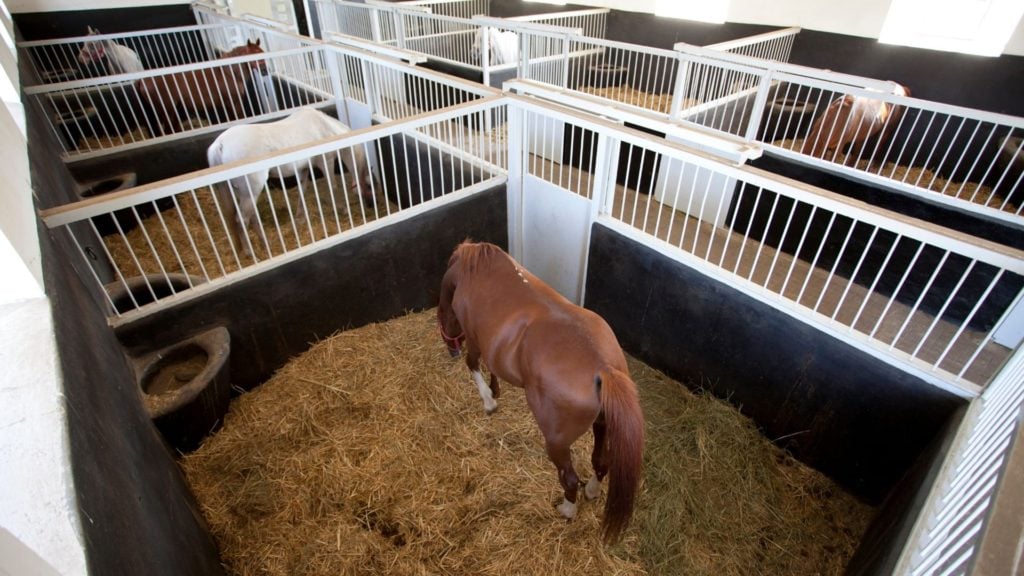
Correct ventilation cannot fully compensate for materials that continuously generate dust or trap ammonia at floor level. A barn with excellent airflow and dirt floors will still have elevated ammonia because the urine soaks into the ground and cannot be removed. Flooring and bedding choices have direct, daily impact on the air the horse breathes — and on how hard every other system in the barn has to work.
| Flooring Type | Dust Control | Ammonia Control | Humidity Resistance | Notes |
|---|---|---|---|---|
| Concrete plus rubber mats | Excellent | Excellent | Excellent | Strong performer across all air quality metrics — easy to disinfect, durable in all climates, no ammonia absorption into the surface |
| Packed gravel | Poor | Fair | Good | Adequate drainage but generates dust and is difficult to fully disinfect |
| Dirt or clay | Very poor | Poor | Poor | Traps urine, generates dust when dry, promotes ammonia buildup — avoid in new construction |
Bedding matters as much as the floor beneath it. Fine shavings generate significantly more airborne dust than large-flake shavings — and fine shavings on a dirt floor can contribute to significant ammonia accumulation, particularly in poorly drained conditions, regardless of what fans are running above. Large-flake pine shavings are the practical choice for most operations. Hemp bedding is naturally antimicrobial and very low dust, with higher upfront cost but lower volume needed. Adding Sweet PDZ pellets under the bedding absorbs ammonia at the source rather than relying entirely on ventilation to remove it. For a full comparison of bedding options, see the horse stall bedding guide. For flooring product and installation details, see the horse barn flooring guide.
Retrofitting an Existing Barn
A full rebuild is rarely necessary. Most existing barns can achieve significant air quality improvement through phased retrofits sequenced by cost and impact. In most cases ventilation has the fastest payback and is worth addressing first — it produces measurable results quickly and makes every subsequent improvement more effective.
| Phase | Estimated Cost | Key Actions | Expected Impact |
|---|---|---|---|
| Phase 1 — Ventilation | $1,500–$3,000 | Add ridge vents (minimum 1 sq ft per horse), install circulation fans per CFM calculation, seal air short-circuit leaks at eaves | Immediate ammonia reduction; fastest return on investment of any retrofit action |
| Phase 2 — Flooring | $3,000–$6,000 | Pour concrete over dirt floors, install rubber mats, add drainage slope if needed | Eliminates ammonia absorption at floor level; reduces dust at horse height |
| Phase 3 — Layout | $2,000–$5,000 | Build external hay storage structure, raise ceiling where feasible, convert stall doors to Dutch doors | Removes the largest dust source; improves air circulation through individual stalls |
What the retrofit actually looked like on our farm: Starting point was a 4-stall barn with dirt floors, 8-foot ceilings, no ridge venting, and 15 ppm ammonia. Two horses had persistent coughs that had not responded to any management changes over months.
Month one: 10 square feet of ridge vents added ($1,000). Ammonia dropped to 10 ppm. Coughing frequency reduced but not eliminated.
Month three: Ceilings raised to 12 feet and concrete plus rubber mats installed ($6,000 total). Ammonia hit 3 ppm. Both horses stopped coughing within two weeks. Bedding replacement frequency dropped — my estimate was around 30%, though that will vary by barn and management.
Total investment: $7,000. Reduction in veterinary costs in the following year: approximately $2,800. The barn has stayed at or below 3 ppm since.
Air Quality Testing and Monitoring
Design improvements only work if you confirm they are achieving target air quality levels. Ammonia becomes detectable to the human nose at around 5–10 ppm — but respiratory irritation in horses begins at lower sustained levels, which is why smell alone is not a reliable monitoring method. By the time you notice it strongly, the horses have been in it for hours.
Target air quality ranges:
- Ammonia — below 3 ppm is a common target; 3–7 ppm warrants investigation; above 15 ppm is a signal to act promptly — increase ventilation, identify the source, and limit horse exposure until levels drop
- Air movement at horse level — 1–3 mph is ideal; still air is a problem regardless of fan count
- Dust — no visible particles in normal light; visible haze means the ventilation or bedding needs attention
- Humidity — 40–70% is the target; consistently above 80% requires active dehumidification
Testing methods by cost: The simplest screen is free — place a shallow water dish in each stall overnight. A strong ammonia smell in the morning is a rough indicator that levels are elevated, likely above 10 ppm. It is a screening tool, not a measurement — useful for catching serious problems, not for tracking precise thresholds. For quantitative monitoring, a basic ammonia detector provides actual readings. A digital hygrometer is worth having in humid climates to track whether humidity is staying in a workable range. Smoke pen kits are inexpensive and useful for confirming that ventilation is reaching the intended areas — they visualize air movement patterns and reveal dead zones that CFM calculations alone do not catch.
Testing schedule: check for visible dust and smell for ammonia daily; test ammonia levels with a detector weekly in any stall that has had bedding issues; clean fan blades and check motor operation monthly — dust on fan blades cuts efficiency more than most owners realize. For power outages, open all doors and windows immediately to maximize passive airflow. A generator capable of running essential fans is worth having for extended outages; never use propane or gas generators inside or near barn air intakes.
The University of Tennessee Extension has useful research on ammonia reduction in horse barns with specific threshold data for performance and health effects.

Common Design Mistakes
These are the errors I see most often — and the ones I made myself before understanding what was actually driving the problem.
The five most costly barn air quality mistakes:
- Sealing the barn for warmth. Even in winter, barns need a minimum of 4 ACH to prevent ammonia from reaching harmful levels. A sealed barn in cold weather is a slow respiratory emergency. Install adjustable vents that can be partially closed — never fully sealed.
- Storing hay overhead. Convenient for the person, harmful for the horses. Hay stored above stalls sheds dust and mold spores continuously as it is moved or settles. Moving it to an external structure is one of the most effective layout changes most barns can make.
- Ignoring wind direction during construction. A barn built without checking prevailing winds needs significantly more fan power to achieve the same airflow as one correctly oriented. Check NOAA wind data before breaking ground — orientation is free to get right and expensive to correct later.
- Guessing at ventilation instead of calculating it. “It seems like there’s enough airflow” is not a design standard. Use the CFM formula. A barn that ends up undersized on fans runs them harder, costs more to operate, and still does not protect the horses adequately.
- Fine shavings over dirt floors. Fine shavings absorb urine poorly on an unsealed surface, generate significant dust, and allow ammonia to accumulate at floor level — the combination can undermine ventilation improvements made elsewhere in the barn.
Barn Air Quality Checklist
Walk through this checklist to assess your barn’s current status. Any unchecked item is worth investigating — most of them are testable without spending anything, and the ones that fail tend to cluster around the same root cause.
Barn air quality — pass/fail checks:
- ☐ Ammonia stays under 3 ppm at dawn — before stalls are cleaned; test with the overnight dish or a detector
- ☐ Ventilation is calculated, not guessed — CFM formula run for your barn’s actual volume; target 6–8 ACH
- ☐ No hay stored above or adjacent to stalls — all hay in a separate external structure
- ☐ Air is moving at horse head height — hold your hand at that level; still air is a problem regardless of fan count
- ☐ No visible dust haze in afternoon sunlight — check through an open stall door with light angled in
- ☐ Ceiling height clears 10 feet — measure floor to lowest structural member; 12 feet is better
- ☐ Flooring is concrete with rubber mats — no exposed dirt or clay in any stall
- ☐ Vents are adjustable, not sealed — minimum 4 ACH maintained even in winter
- ☐ Ridge venting is in place — minimum 1 square foot per horse; air must exit at the top
- ☐ Fan blades cleaned in the last 30 days — dust buildup cuts efficiency faster than most owners expect
When something feels off — check in this order:
1. Exchange rate first. Is air actually moving at horse head height? Hold your hand there. Still air is the most common starting point for every other problem. Fix the exhaust path (ridge), then the intake (windows, doors), then add mechanical fans if the calculation says you need them.
2. Contamination load second. What is generating the dust and ammonia? Overhead hay storage is the most common culprit in an otherwise adequate barn. Fine bedding on a poor floor is the second. Neither is fixed by adding fans.
3. Floor load third. What is the floor doing to the air? Dirt and clay absorb urine and release ammonia continuously regardless of how well the rest of the barn is managed. If exchange and contamination are addressed and ammonia remains elevated, the floor is usually the remaining variable.
FAQs About Horse Barn Air Quality
What is a safe ammonia level in a horse barn?
Below 3 ppm is a commonly cited target for good barn air quality. Between 3–7 ppm warrants investigation into bedding and ventilation. Above 15 ppm is a signal to act promptly — increase ventilation, identify the source, and reduce horse exposure until levels drop. Levels above 25 ppm are acutely irritating to respiratory tissue and should not be sustained.
How many air changes per hour does a horse barn need?
The AAEP recommends 6–8 air changes per hour (ACH) as a working target to maintain ammonia below safe levels under normal conditions. In winter, 4 ACH is a practical minimum even when vents are partially closed for warmth. Use the CFM formula — barn volume times target ACH divided by 60 — as a baseline sizing method rather than a final specification; real-world results vary with wind, stack effect, and building leakage.
What is the best ventilation system for a horse barn in a humid climate?
In humid climates like the Gulf Coast or Southeast, combine ridge vents (minimum 1 sq ft per horse as a rule of thumb) with mechanical fans sized for 6–8 ACH. Align the barn with prevailing breezes using NOAA wind data — in favorable wind conditions, correct orientation can meaningfully reduce fan operating requirements, with reported reductions ranging from 30–50% in well-sited barns. Natural ventilation alone is rarely sufficient in high-humidity environments; mechanical fans are necessary to supplement it.
How do I test barn air quality without expensive equipment?
Place a shallow water dish in each stall overnight. A strong ammonia smell in the morning is a rough indicator that levels are elevated — treat it as a screening signal, not a measurement. It is useful for catching serious problems but not for tracking precise thresholds. For quantitative monitoring, a basic ammonia detector provides actual readings. A digital hygrometer tracks humidity. Smoke pen kits visualize air movement patterns and reveal dead zones that calculations alone do not catch.
Can I improve an old barn’s air quality without rebuilding?
Yes. Most barns can be significantly improved through phased retrofits. Start with ventilation — ridge vents and fans sized by the CFM formula — for the fastest return on investment. Then improve the flooring with concrete and rubber mats. Then address layout by moving hay storage outside. Rebuilding is rarely necessary unless the structure itself is unsound.
Why does my horse cough in the barn but not outside?
In most cases, barn cough traces back to elevated airborne dust or ammonia in the enclosed environment rather than infectious disease. The most common sources are overhead hay storage, fine bedding on poor-drainage floors, inadequate air exchange, and under-ventilated barns. A veterinarian should rule out infectious causes, but if the cough disappears outside and worsens inside, the environment is worth investigating first. Start by moving hay storage outside, improving ridge ventilation, and switching to large-flake shavings on a solid floor.
What barn layout reduces dust the most?
Shedrow-style barns with stalls opening directly outside are optimal — each stall front opens to fresh air, eliminating trapped zones entirely. For enclosed barns, use 12-foot aisles, Dutch doors, external hay storage, and ceilings at 10 feet or higher. Shedrow designs can reduce dust levels substantially compared to traditional enclosed barns with no direct outside stall access.
Is overhead hay storage safe for horses?
No — it is a significant air quality problem. Hay stored above stalls sheds dust and mold spores continuously as it is moved or settles, and those particles fall directly into the breathing zone below. Moving hay to a separate external structure removes a contamination source that ventilation alone cannot fully compensate for.
What causes poor air quality in horse barns?
The three primary drivers are ammonia buildup from urine decomposing in bedding and flooring, airborne dust from hay and shavings, and inadequate air exchange that allows both to accumulate in the breathing zone. Secondary contributors include overhead hay storage, sealed or under-ventilated barns, fine bedding on dirt floors, and insufficient ceiling height. In most cases these are design and management variables — which means they are addressable without rebuilding.
Key Takeaways: Horse Barn Air Quality
- Three forces drive barn air quality — exchange rate, contamination load, and floor load; most chronic problems involve at least two of the three failing at once
- Fix the exhaust path before sizing fans — ridge vents open the path for contaminated air to leave the building; fans without an exhaust path recirculate the problem
- Use the CFM formula as a baseline — barn volume times target ACH divided by 60; adjust for wind, leakage, and stack effect in practice
- Move hay out of the barn — overhead hay sheds dust and mold spores directly into stalls below; ventilation cannot fully compensate for that contamination load
- Keep vents adjustable, not sealed — 4 ACH is a practical target even in cold weather; a barn sealed for warmth accumulates ammonia regardless of how well it was built
- Test before assuming the ventilation is working — the overnight dish is a free screen; an ammonia detector gives you numbers to act on
Walk through the barn at 6 a.m. before any stalls are cleaned and hold your hand at horse head height. Still air and ammonia smell are both diagnostic — they tell you which of the three forces is failing and roughly where to look. The fix is usually simpler than the symptom suggests: a ridge vent, a repositioned fan, hay stored somewhere other than above the horses. In most cases, barn air problems are design and management problems. That means they have design and management solutions — and none of them require rebuilding from scratch.
About Miles Henry
Racehorse Owner & Author | 30+ Years in Thoroughbred Racing
Miles Henry (legal name: William Bradley) is a professional horseman based in Folsom, Louisiana. He holds Louisiana Racing License #67012 and has spent over three decades managing Thoroughbreds at premier tracks including Fair Grounds, Delta Downs, and Evangeline Downs.
Expertise & Hands-On Experience: Beyond the track, Miles has decades of experience in specialized equine care, covering everything from hoof health and nutrition to training protocols for Quarter Horses, Friesians, and Paints. Every guide on Horse Racing Sense is rooted in this “boots-on-the-ground” perspective.
30 of their last 90 starts
Equibase Profile.

Connect with Miles: