
Last updated: May 26, 2026
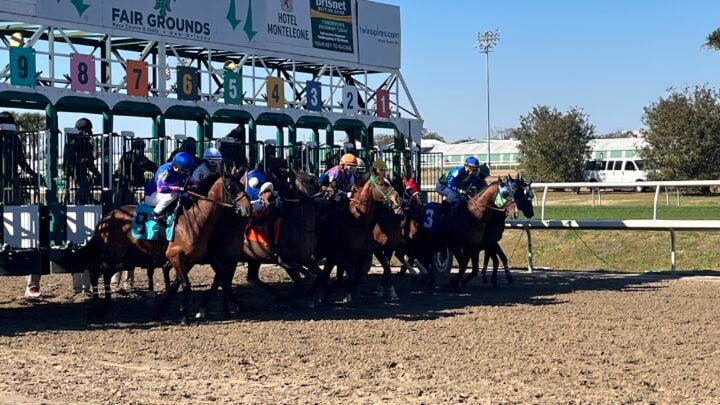
Post position can make or break a horse’s chances in a race. The gate draw directly influences strategy, pace dynamics, and betting value across dirt, turf, and synthetic surfaces — and it’s one of the most underused angles in handicapping. My sprinter’s wire-to-wire win from post 1 at the Fair Grounds showed me firsthand how much ground-saving matters on tight turns. Over 30 years of racing Thoroughbreds in Louisiana, I’ve seen the gate draw reward good horses and punish better ones.
Horse racing post positions — key numbers:
- Dirt sprints (5–7F): Inside posts 1–3 win at 35–38% — ground-saving on tight turns is the primary advantage
- Dirt routes (1M+): Middle-to-wide posts 5–10 win at ~16% — enough distance to overcome early ground loss
- Turf races: Middle posts 5–8 win at 17–18% — inside turf positions risk traffic in the run to the first turn
- Large fields (12+): Posts 4–7 win at ~22% — avoids both rail traffic and extreme outside ground loss
- Kentucky Derby: Post 5 historically leads at ~10.5% win rate per Courier-Journal 2025
Download the Post Position Cheat Sheet PDF for a quick reference card you can use at the track.

Table of Contents
What Are Horse Racing Post Positions?
Post position is a horse’s assigned starting spot in the starting gate, numbered from the inside rail outward — post 1 is closest to the rail, the highest number is furthest out. Positions are assigned randomly through a draw conducted by racing officials, which ensures fairness but means horses and trainers have no control over where they start.
The draw matters because starting position determines how far a horse must travel to reach the rail, how much early traffic it will face, and what tactical options its jockey has in the opening furlongs. A speed horse drawing post 1 in a sprint can lead and save ground. The same horse drawing post 10 must either use energy cutting across to the rail or run wide the entire trip — both costly. Understanding the relationship between distance and post position is one of the fundamentals of handicapping.
Why Post Position Matters
Post position shapes race outcomes through three variables: track geometry, running style, and distance. These interact differently at every track, which is why national averages are a starting point — not a conclusion.
| Post Range | Typical Advantage | When It Helps | When It Hurts |
|---|---|---|---|
| Inside (1–3) | Saves ground on the rail | Short turns, small fields, speed horses | Risk of getting boxed in behind slow pace; traffic if field bunches |
| Middle (4–7) | Tactical flexibility — can go either way | Most field sizes and distances | Few inherent drawbacks; most balanced post range |
| Outside (8+) | Clear running lanes, no traffic | Wide turns, closers, large fields | Loses significant ground on the first turn; costs energy early |
Running style is the other variable. Speed horses in posts 1–4 in a sprint can clear to the rail immediately and control the pace. The same early-speed horse in post 8 of a six-furlong race has to either sprint laterally toward the rail — burning early energy — or run wide the whole way. Closers, conversely, can benefit from the wider posts in routes because they avoid the early traffic that bunches near the rail. The interaction of style and post is why a surface change also changes how post position plays out — turf fields tend to bunch more severely going to the first turn than dirt fields do.
Win Rate Statistics by Race Type
The statistics below reflect historical win rate patterns for post ranges across race types. These are tendencies — not guarantees — and should be adjusted for track-specific geometry, field size, and daily bias before being applied to any individual race. Sources: Thoroughbred Daily News surface analysis; Equibase historical data.
| Race Type | Most Favored Posts | Avg. Win Rate | Key Reason |
|---|---|---|---|
| Dirt Sprints (5–7F) | Posts 1–3 (inside) | 35% – 38% combined | Ground-saving on tight first turn; speed horses reach rail cleanly |
| Dirt Routes (1M+) | Posts 5–10 (middle/wide) | ~16% | Distance compensates for ground loss; inside horses risk traffic |
| Turf (all distances) | Posts 5–8 (middle) | 17% – 18% | Avoids both rail squeeze and extreme outside ground loss |
| Large Fields (12+ runners) | Posts 4–7 (middle) | ~22% | Middle posts avoid worst of both inside traffic and outside ground loss |
| Wet Tracks (dirt) | Posts 1–3 (inside) | Elevated vs. dry | Inside rail often has firmer footing on wet tracks |
| Synthetic (all) | More even distribution | Closer to random | Consistent surface reduces rail advantage seen on dirt |

Track Bias: How to Identify It in Real Time
Track bias is when a particular part of the racing surface — usually the inside rail or outside path — is consistently faster than the rest on a given day. A strong inside bias can make post 1 unbeatable in a sprint; a strong speed bias can make front-runners nearly impossible to catch. Daily bias overrides historical post statistics when it’s present, which is why checking bias before you bet is more valuable than memorizing win rate tables.
- After Race 1: Is the rail consistently faster? Did the inside horse save ground and win easily, or did it get caught wide and lose?
- After Race 2: Are speed horses holding their leads to the wire, or are they getting caught in the stretch?
- After Race 3: Are closers making up meaningful ground in the stretch, or is the pace playing into speed horses’ hands?
If the first two or three races show a consistent pattern — inside dominant, speed holding, closers gaining — trust it for the rest of the card. A bias that shows up in races 1 and 2 is real. Mixed results mean use standard post analysis.
Track profiles from Equibase provide historical data on how specific tracks play by surface and distance — useful for establishing a baseline before you arrive at the track to observe the day’s conditions.
The 3-Question Post Position System
After 30 years of watching races from the rail and the box, I’ve simplified post position analysis to three questions that can be answered in 90 seconds. Answer all three before placing any bet where post position is relevant.
Question 1: Does the running style match the post?
- Speed horse in posts 1–4 (sprint) — good match
- Closer in posts 5–10 (route) — good match
- Speed horse in post 8+ (sprint) — significant problem
- Closer in posts 1–3 (route) — risky; may get squeezed early
Question 2: What is the field size?
- 6–8 horses — post matters less; reduce its weight by roughly half
- 9–11 horses — standard post impact; apply historical rates normally
- 12+ horses — posts 4–7 gain extra value; extreme inside and outside both carry elevated risk
Question 3: Is there a track bias today?
- Inside winners dominating the early card — bet inside posts aggressively regardless of historical statistics
- Speed horses dying in the stretch — favor outside closers
- Mixed results — use standard post analysis from the tables above
For more on how to apply these principles within a full betting framework, see the advanced betting strategies guide and the best bet in horse racing breakdown.
Post Position and Betting Value
Post position matters most as a tiebreaker and a value tool — not as a standalone handicapping factor. The hierarchy is: class and ability first, pace scenario second, post position third. A horse with a 10-point speed figure advantage over the field will overcome a bad post in most races. A horse within 3–5 points of the field’s top figures where the post is genuinely unfavorable is a legitimate reason to downgrade.
Where post creates the best betting value is when the public underestimates a post advantage or overestimates a post disadvantage. A horse in post 2 in a six-furlong sprint with early speed will often be correctly bet down by the crowd. The same horse in post 8 may be dismissed — but if it has enough speed to cross to the rail before the turn, the ground loss is manageable and the odds are better. Similarly, a horse in post 11 on the turf at a track with wide turns may be dismissed by casual bettors when middle posts would have been genuinely harmful but an extreme outside has clear running room throughout. For a deeper look at finding value from these angles, see the beginner’s betting guide and the overview of horse racing classes.

FAQs About Horse Racing Post Positions
What is post position in horse racing?
Post position is a horse’s assigned starting spot in the gate, numbered from the inside rail outward. Post 1 is closest to the rail; the highest number is furthest out. Positions are assigned randomly through a draw. The post affects how much ground a horse must cover, what traffic it faces early, and what tactical options the jockey has in the first turn.
Which post position wins the most in horse racing?
It depends on race type. In dirt sprints (5–7 furlongs), inside posts 1–3 win at a combined 35–38% rate. In dirt routes (1 mile or more), middle-to-wide posts 5–10 win at roughly 16%. On turf, middle posts 5–8 win at 17–18%. In large fields of 12 or more, posts 4–7 provide the best balance between rail advantage and traffic avoidance.
Does post position matter in the Kentucky Derby?
Yes. The Derby’s 20-horse field and tight Churchill Downs turns make post position more impactful than in a typical 8-horse race. Post 5 has historically won most often at approximately 10.5% per Courier-Journal data. Extreme outside posts — 17 through 20 — have very poor historical records because of the ground loss getting to the first turn from that far out.
How does track bias affect post position?
Track bias is when a section of the surface — usually the inside rail — is consistently faster on a given day. A strong inside bias can make posts 1–3 almost unbeatable regardless of running style. Checking the first 2–3 races of a card for consistent patterns — inside horses winning, speed holding, or closers gaining — is more valuable than any historical post statistic for that day’s betting.
Which matters more: post position or speed figures?
Speed figures matter more. A 10-point speed figure advantage typically overcomes a poor post in most race scenarios. Post position is most valuable as a tiebreaker between evenly matched horses, or as a value tool when the public misprices a horse because of its gate assignment.
Should I bet a horse with a bad post if it’s the best horse?
If the horse has a clear 10+ speed figure advantage over the field, yes — class typically overcomes position. If the margin is within 5 points, a genuinely bad post draw — speed horse in post 10 of a sprint, for example — is a legitimate reason to downgrade. The question to ask is whether the horse has the tactical ability to overcome the geometry problem the post creates.
Do post positions matter less in turf racing?
Turf racing has a more complex post dynamic than dirt. Middle posts 5–8 tend to perform best because the inside on turf is often contested heavily going to the first turn, while extreme outside posts lose too much ground. Unlike dirt sprints where inside dominates clearly, turf post analysis requires more attention to field size and turn geometry at the specific course.
How do wet tracks affect post position advantage?
Wet tracks often increase the inside post advantage on dirt because the inside rail tends to have firmer footing than the wider, more churned-up going. This can temporarily make the statistical advantage of posts 1–3 more pronounced than on a dry, fast track. Checking early races on a wet card for rail bias is particularly important.
Do post positions matter less in big races with elite horses?
Elite horses adapt better to difficult posts than average claiming horses, and top jockeys make better tactical adjustments. However, post still matters even at the top level — in any race with 10 or more runners on a track with tight turns, the geometry problem created by an extreme outside post is real regardless of the horse’s class. Even the best horses benefit from good draws.
- Dirt sprints favor inside posts — posts 1–3 win 35–38% combined; ground-saving on tight first turns is the primary driver
- Routes and turf favor middle posts — enough distance or wider turns to neutralize the rail advantage; inside horses face more traffic risk
- Track geometry overrides national statistics — always adjust for the specific track before applying general post win rates
- Daily bias overrides everything — check the first 2–3 races before betting; a real bias that day is more predictive than any historical table
- Running style must match the post — a speed horse in post 8 of a sprint is a structural problem regardless of class
- Speed figures outrank post position — use post as a tiebreaker and a value tool, not a primary handicapping factor
- Large fields (12+) favor middle posts 4–7 — avoids both inside traffic chaos and outside ground loss
For the full handicapping picture, the racetrack surfaces guide covers how dirt, turf, and synthetic change the competitive dynamics beyond post position alone.
About Miles Henry
Racehorse Owner & Author | 30+ Years in Thoroughbred Racing
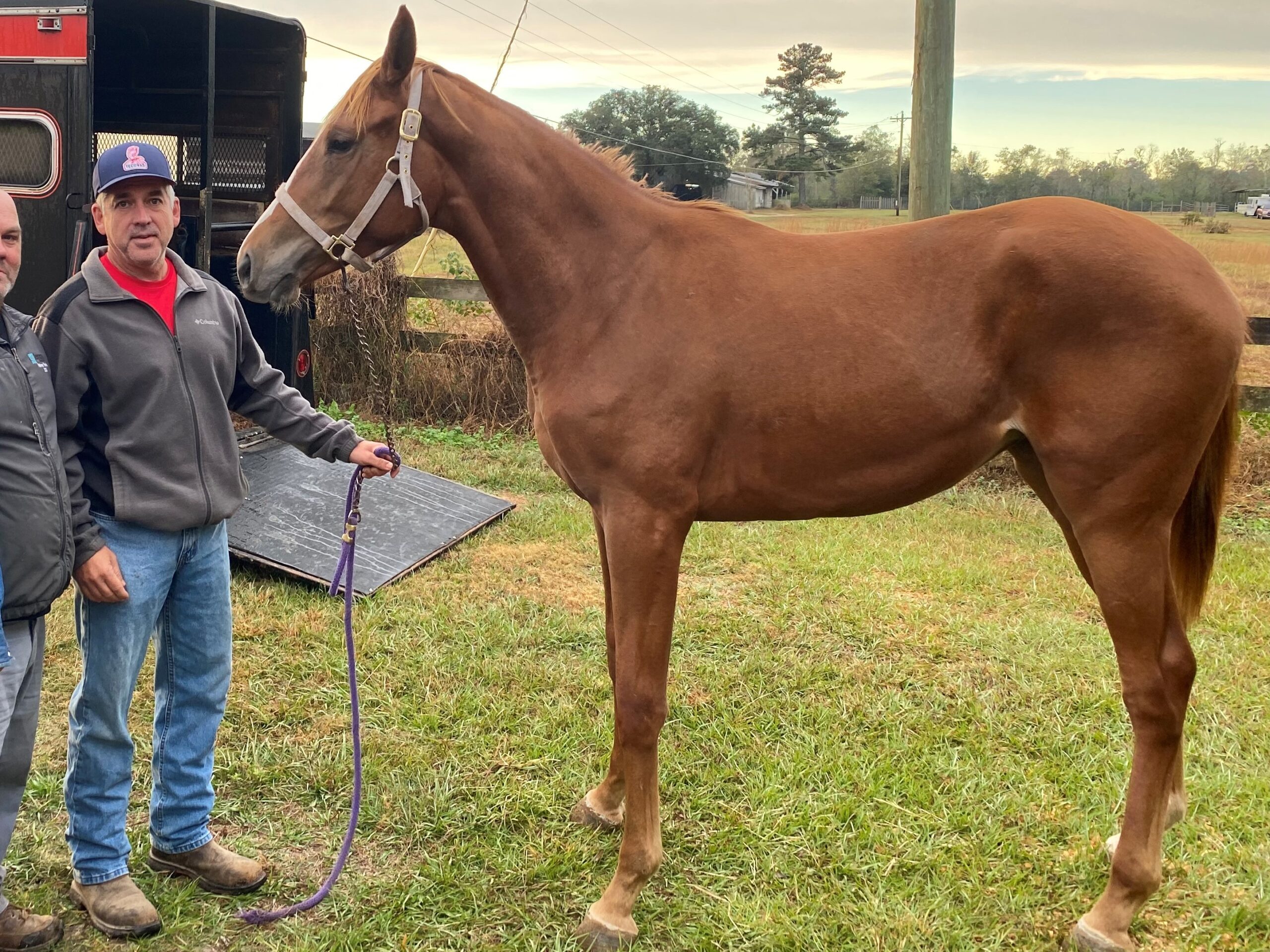
Miles Henry (legal name: William Bradley) is a professional horseman based in Folsom, Louisiana. He holds Louisiana Racing License #67012 and has spent over three decades managing Thoroughbreds at premier tracks including Fair Grounds, Delta Downs, and Evangeline Downs.
Expertise & Hands-On Experience: Beyond the track, Miles has decades of experience in specialized equine care, covering everything from hoof health and nutrition to training protocols for Quarter Horses, Friesians, and Paints. Every guide on Horse Racing Sense is rooted in this “boots-on-the-ground” perspective.
30 of their last 90 starts
Equibase Profile.

Connect with Miles: