

Last updated: August 13, 2026
Betting on horse races becomes much easier once you understand three things: how the bets work, how to evaluate a race, and how to protect your bankroll. Most beginners focus only on picking horses, then lose more money than they expected because they bet too much or chase losses.
How to bet on horse racing: Start with a small Win bet on a race you have time to study. Use recent form, class, trainer statistics, and live odds to narrow the field, then keep records and watch the replay whether you win or lose.
- Start with: A $2 Win bet – it forces a clear opinion and teaches the basics before you move to exotics.
- Use: The 4-Point Filter to identify one or two horses worth a closer look.
- Bet size: Keep a single bet to 1-2% of your dedicated bankroll; with $100, that means $1-$2.
- Avoid at first: Trifectas, superfectas, and Pick 4, Pick 5, and Pick 6 wagers.
- Start with races you can read: Claiming and allowance races often provide more usable form than stakes races with deeper, less familiar fields.
Gambling disclaimer: Horse racing wagering involves significant financial risk – only wager money you can afford to lose. Gambling laws and tax regulations vary by state. If gambling becomes a problem, contact the National Council on Problem Gambling at 1-800-522-4700.
I’ve seen people cash their first ticket in 10 minutes – and I’ve seen others lose a week’s bankroll in an afternoon. The difference isn’t luck.
Table of Contents
How to Place Your First $2 Win Bet
| Step | What to Do | Beginner Tip |
|---|---|---|
| 1. Choose a race | Pick a race with established horses and enough recent form to study. | Allowance and stakes races can be more formful than claiming races; avoid races with many first-time starters, long layoffs, or unknown variables. |
| 2. Scan the horses | Look at each horse’s last race date, last finish position, and the trainer’s win percentage. | Look for recent activity, competitive recent form, and a trainer whose horses are currently running well. |
| 3. Pick 1–2 contenders | Apply the 4-Point Filter, covered in the handicapping section below. | If more than two horses pass the filter, compare their odds and focus on the one offering better value. |
| 4. Choose Win to start | Select “Win” as your bet type. | Win bets force a clear opinion. Place and Show may feel safer, but their lower payouts make profitability more difficult. |
| 5. Bet $2 | Place a $2 Win bet at the track window or through a legal wagering app. | A $2 Win bet is widely available, though minimums vary by track, wager type, and platform. |
| 6. Watch and learn | Watch the race and note where your horse was at the gate, on the turns, and in the stretch. | Win or lose, the replay teaches you more than the result alone. |
| Field | Your Entry | What It Means |
|---|---|---|
| Track | Fair Grounds | The racetrack where the race is being run |
| Race | Race 5 | The race number on the day’s program |
| Amount | $2 | Your wager – a common minimum for Win bets; minimums vary by track, wager type, and platform |
| Bet type | Win | Your horse must finish first to collect |
| Horse number | #7 | The program number of your selected horse – not the saddle cloth color |
| Total cost | $2.00 | Deducted from your account or paid at the window immediately |
At a track window, say it aloud in this order: “$2 Win, horse number 7, Race 5, Fair Grounds.” The teller repeats it back – always confirm before walking away. On a wagering app like TwinSpires or FanDuel Racing, the same fields appear as dropdowns. The basic fields are similar across legal platforms, though the screen layout and available wagers vary.

Win, Place, Show, and Exacta Basics
| Bet Type | What You Need | Typical $2 Payout | Best For |
|---|---|---|---|
| Win | Your horse finishes 1st | $6-$30+ | When you have a strong opinion on one horse – the foundation bet type |
| Place | Your horse finishes 1st or 2nd | $4-$12 | Solid horse at short odds; want a safety net |
| Show | Your horse finishes 1st, 2nd, or 3rd | $3-$7 | Learning days; rarely worth the low return |
| Exacta Box | Pick 1st and 2nd in any order (costs $4 for $2 base) | $20-$150+ | Two horses clearly outclass the field |
| Trifecta | Pick 1st, 2nd, and 3rd in exact order | $100-$2,000+ | An advanced wager to avoid until you have a tracked Win record – see our exotic bets guide for the full breakdown |
For a beginner, Win betting is enough. It teaches you to estimate a horse’s chance, compare that chance with the price, and track whether your opinions are improving. Do that before trying to predict the first two or three finishers. For every bet type beyond these, including Pick 4s, Pick 5s, and superfectas, see the full horse racing bets guide.
Horseman’s Perspective – why I bet Win 45% of the time: The Win bet forces discipline. If you’re not confident enough in a horse to bet it to win, you probably shouldn’t be betting it at all. A lot of bettors reach for the Place or Show bet as a safety net when they’re unsure – but at the typical payout, you need to be right far more often than you’d expect to show a profit on Place bets. I’d rather pass a race I’m uncertain about than take a worse bet on the same horse.
How Pari-Mutuel Odds and Value Work
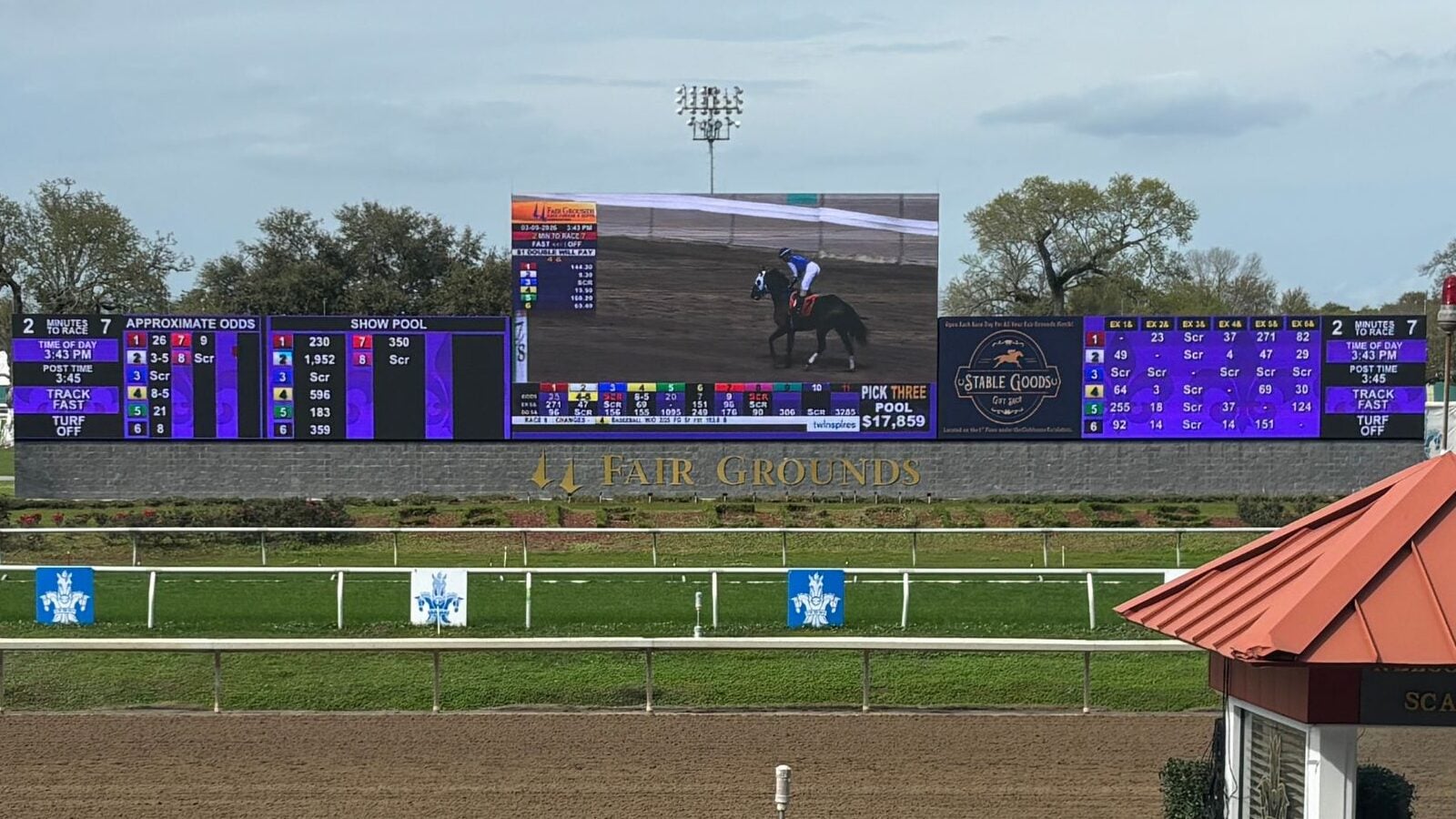
Horse racing uses pari-mutuel wagering – you’re betting against other bettors in the same pool, not against the track or a bookmaker. The track takes a percentage off the top (the “takeout,” typically 15-25%), and the remaining money is divided among winning tickets. Odds aren’t fixed in advance – ignore the morning line, which is just the track handicapper’s pre-race estimate. The only odds that matter are the live odds on the tote board, which change right up until the gate opens based on where actual money is going.
| Final odds | $2 Win ticket returns | Approximate break-even win rate |
|---|---|---|
| 1-2 | $3.00 | About 67% |
| Even money | $4.00 | 50% |
| 6-5 | $4.40 | About 45% |
| 2-1 | $6.00 | About 33% |
| 5-1 | $12.00 | About 17% |
| 10-1 | $22.00 | About 9% |
Historical data shows favorites win roughly one-third of U.S. Thoroughbred races. That makes the favorite the most likely winner in a race, but not an automatic good bet at the final price. At final odds of 6-5, a horse must win about 45% of the time for a bettor to break even at that payoff. The pool takeout is already reflected in the payout, so it is not an additional deduction.
From the rail – reading late money: When I’m at Fair Grounds and I see a horse that opened at 8-1 sitting at 5-2 at post time, I want to know why. Late odds movement shows where money is entering the pool – it doesn’t prove someone knows something I don’t, but it’s context worth having. Late money on a horse that also fits my handicapping criteria is worth a second look. Late money on a horse that doesn’t fit anything else gets a pass either way.
For the full breakdown of how odds and payout structures work, see our guide on how horse racing odds work.
A Simple Beginner Handicapping Process
Past performances, published by Equibase and available in any racing form or app, contain more information than any beginner needs. After tracking what works and what doesn’t over many years, I’ve simplified my own process to four factors, worth checking in order. A horse that checks several boxes earns a closer look – not an automatic bet.
The 4-Point Filter – my starting screen for beginner-friendly claiming and allowance races, not a betting system or a guarantee of profit:
- 1. Recent Race Window: Did the horse race within the last 14-45 days? This is a useful starting point, but a layoff isn’t automatically negative – some horses run their best fresh, and a trainer’s record with layoffs can matter more than a fixed number of days.
- 2. Recent Form: Did this horse finish 1st, 2nd, or 3rd last time out? A recent top-three finish can show current competitiveness, but check the field quality, margin, trip, and pace it faced.
- 3. Trainer Win %: Is the trainer winning at 15% or higher over the last 60-90 days? That’s my personal starter threshold, not a universal standard – the median trainer win rate at most U.S. tracks runs 8-12%, so 15%+ generally reflects an active barn, but compare the specific trainer against the meet and circuit.
- 4. Class Check: Is this horse running at the same class level or dropping – not a steep rise? A class drop deserves attention, but it’s not automatically a green light – I want to know whether the horse is returning to a level where it’s been competitive, whether the trainer has a pattern with this move, and whether the horse still looks sound and willing in the paddock and warm-up.
Beyond the filter: Beyer Speed Figures (published in the Daily Racing Form) show how fast a horse ran adjusted for track conditions – look at the trend across the last three races. A horse showing 78-82-86 is improving; one showing 90-84-79 is declining.
Here’s how it works in practice. Race 5 at Fair Grounds, 7 furlongs on dirt, $35,000 claiming. Horse #3 last raced 23 days ago, finished 2nd, trainer wins at 14%, running at the same claiming level – checks 3 of 4 boxes, trainer just misses the threshold. Worth noting but not the clear pick. Horse #7 last raced 15 days ago, finished 1st, trainer wins at 22%, dropping from a $50,000 claiming race to $35,000 – checks all four boxes, and the class drop is worth a closer look at the paddock and past performances. Check the Beyer figures to confirm the speed advantage, then look at the odds. If #7 is at 3-1 or better, the bet may make sense. If #7 is at 3-5 because everyone else sees the same setup, the value is gone.
The process, start to finish: screen the race with the four factors, check the horse’s recent speed and race context, compare the contender against the live odds, decide to bet or pass, then log the result and watch the replay regardless of outcome. That last step is what actually builds judgment over time.
What I Check at the Track Before I Bet
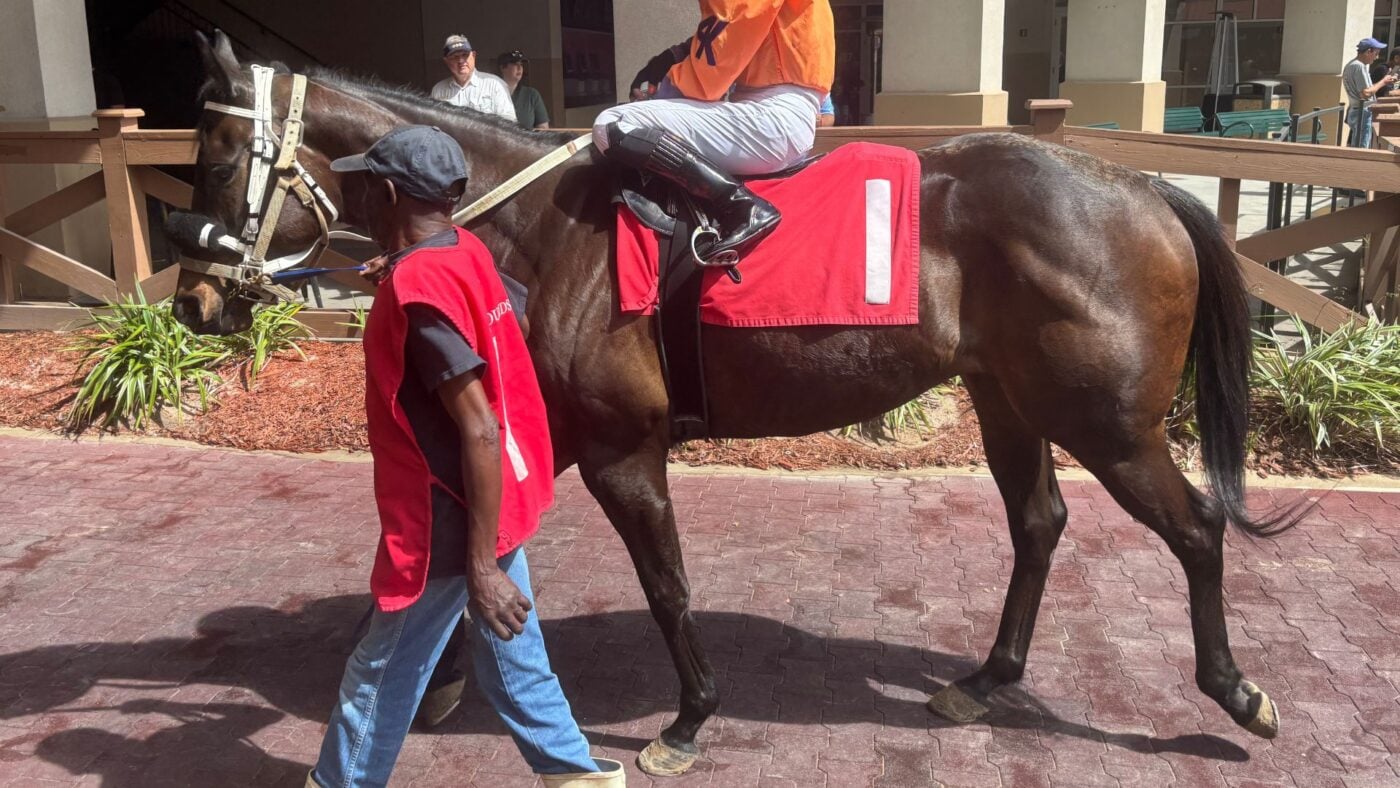
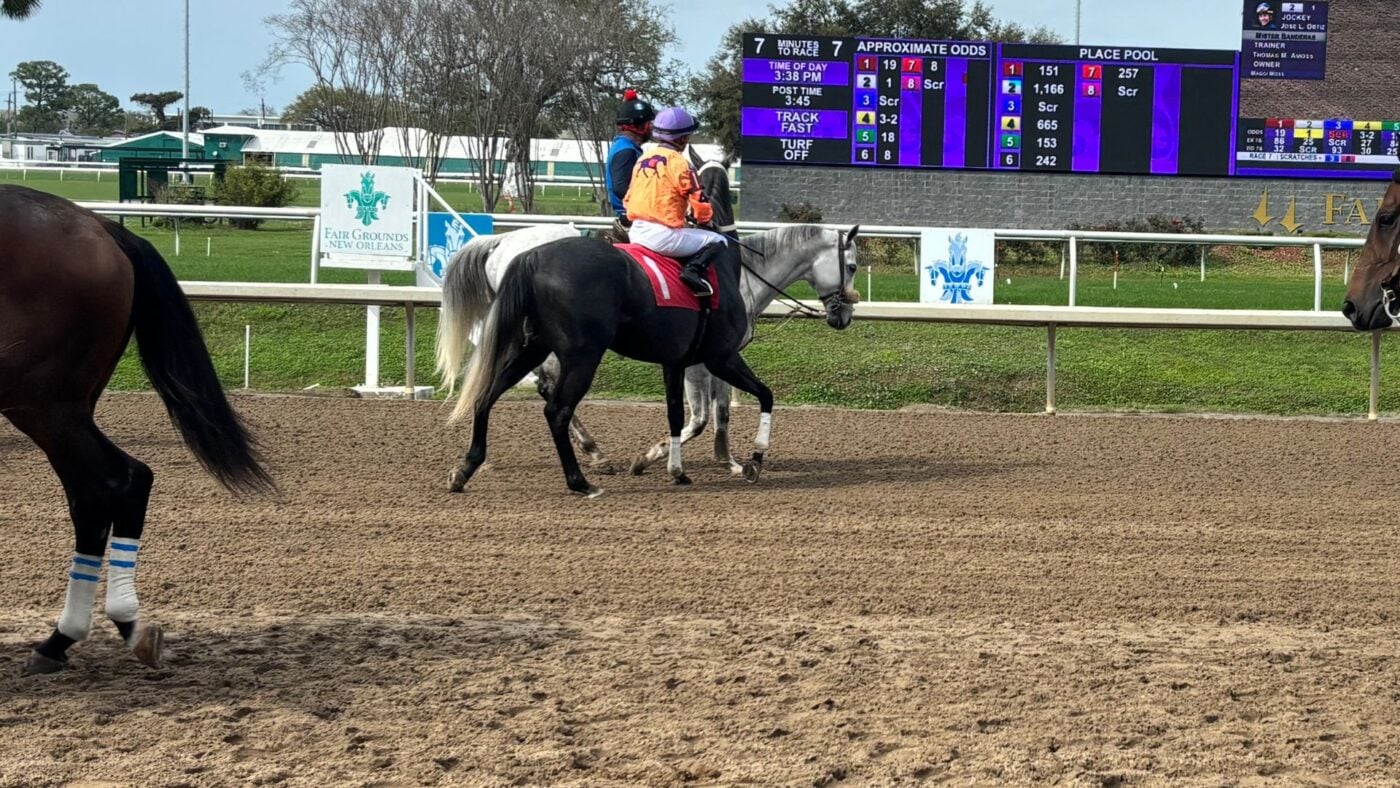
The program gets me interested. The tote board, paddock, warm-up, and race conditions decide whether I actually wager. Owning horses and watching bettors from the rail over the years, I’ve noticed the things most people think matter – post position in a short field, the morning line odds, a horse’s name – rarely do.
Two things I watch that most bettors skip: equipment changes and paddock behavior. Adding blinkers to a horse that’s been running without them is worth noting when it fits the horse’s running pattern and trainer history – it’s usually a deliberate response to something the horse has been doing, like ducking in or out or losing focus in the stretch, though not every equipment change is positive. Equipment notes are listed in small print in the past performances, and most bettors never read them. For more, see the complete racehorse equipment guide.
From the rail – what I actually watch in the paddock: Before every race I’m betting, I watch the horses in the paddock – not coat condition, that’s too subtle for most people to read reliably. I watch how they’re moving, whether they’re relaxed or burning nervous energy, and how they behave when the jockey goes up. A horse that’s jigging, sweating excessively, and fighting the outrider has already spent something it might need in the stretch. A horse that walks out calm and moves freely from the shoulder – that horse is ready. This doesn’t override the numbers, but it confirms them. Or it doesn’t, and I drop the bet.
Bankroll Rules and Common Mistakes
Bankroll management is more important than handicapping skill for a beginner. You can be wrong about horses half the time and still profit if your bet sizing is disciplined. You can be right about horses 60% of the time and still go broke if you bet too much per race. Four rules cover most of it.
| Rule | What It Means | Example ($100 bankroll) |
|---|---|---|
| Set aside money you can afford to lose | Your betting account is money you can lose completely without consequences | Fund it once; never add more from bill money |
| Keep individual wagers small | Never bet more than 1-2% of your total bankroll on a single race | Maximum $1-$2 per race on a $100 bankroll |
| Do not chase losses | Doubling bets after a loss to “get even” is the fastest route to zero | Next bet is always the same size as planned, not larger |
| Pass races when the price or setup doesn’t make sense | Passing a race is a valid strategy – you don’t have to bet every race on the card | Watch without a wager rather than force a bet |
Start with a bankroll of $50-$100 and place $2 bets – that gives you 25-50 learning bets before you’ve risked anything significant. The goal in the first six months is not profit; it’s building the judgment that eventually produces it. My personal stop rule is three straight losses in a session – it gives me a hard break before frustration turns into chasing. Your exact stop point may differ, but set it before you begin and honor it.
From the rail – my worst bankroll failure: I broke the 1-2% rule once early in my betting career. I had a strong opinion on a horse, bet much more than I should have, and it finished fourth. The financial loss was manageable. The psychological damage took two months to recover from – I was chasing that loss in subsequent bets, sizing up when I should have been sizing down, and I turned a manageable loss into a bad month. The rule exists for psychological reasons as much as mathematical ones. Break it once and you’ll understand why.
My 7-Year Betting Record
I share this because it answers the most useful question any beginner should ask before taking advice from anyone on horse racing: does this person actually track results over time? These are approximate figures from my personal records – recreational wagering, not audited. I’m not a professional handicapper, and most bettors applying this or any approach won’t replicate it. This is included to show what process consistency looks like over a long sample, not to imply typical outcomes.
Important: These are my own unaudited recreational wagering records, shared as an example of tracking results – not as proof that a method will work for someone else. Past results do not predict future outcomes, and most bettors lose money over time.
| Period | Total Wagered | Total Returned | Net Result | ROI |
|---|---|---|---|---|
| Year 1 | $1,800 | $1,460 | -$340 | -18.9% |
| Year 2 | $2,100 | $2,100 | Break-even | 0% |
| Year 3 | $2,300 | $2,553 | +$253 | +11% |
| Years 4-7 | $6,200 | $7,667 | +$1,467 | +11.8% |
| Total (7 Years) | $12,400 | $13,780 | +$1,380 | +11.1% |
The most important data point in that table is Year 1. Every serious bettor loses money while learning. The question is whether you lose $340 on $1,800 wagered – manageable – or whether you lose $3,000 on $5,000 wagered because you bet too much per race while learning. Discipline in Year 1 is what makes Year 3 possible.
FAQs: How to Bet on Horse Racing
How much money do I need to start betting on horse racing?
A modest learning bankroll – often $50 to $100 for someone making $2 bets – can help limit exposure while you build judgment. Never fund a betting account with money you need for bills or savings.
What is an exacta in horse racing?
An exacta requires you to pick the first and second place finishers in exact order. An exacta box covers both possible finishing orders – a $2 exacta box on two horses costs $4. For beginners, the exacta box is the recommended stepping stone beyond straight Win bets.
How do I read a racing form?
Reading a racing form starts with three numbers: Beyer Speed Figures, class direction, and jockey and trainer win percentages at the current meet. Everything else – pace scenarios, post position analysis, pedigree for turf – comes later, once you’re comfortable with the basics.
Where can I legally bet on horse racing?
Legal wagering in the United States is available through Advance Deposit Wagering (ADW) apps in most states, as well as licensed racetracks and off-track betting facilities. Major ADW platforms include TwinSpires, FanDuel Racing, and TVG, though legal availability varies by state, age, and platform – verify access with your state regulator and the operator directly before signing up.
What is pari-mutuel betting in horse racing?
Pari-mutuel betting is the system used in horse racing where all bets of the same type are pooled together, the track deducts its percentage (the takeout, typically 15-25%), and the remaining money is divided among the holders of winning tickets. Your payout isn’t determined until post time – it depends on how much total money was bet on your horse relative to the whole pool, which is why odds change right up until the gate opens.
Key Takeaways: How to Bet on Horse Racing
- Start with $2 Win bets – master this before touching exotics or multi-race bets
- Horse racing uses pari-mutuel wagering – odds are set by betting pools and change until post time; the track keeps 15-25% before paying winners
- The 4-Point Filter narrows a field in about 10 minutes – it identifies contenders worth a closer look, not automatic bets
- Keep bets to 1-2% of your bankroll – discipline in Year 1 is what makes long-term improvement possible
- Passing a race is a valid strategy – bet only when the filter, the odds, and the context align
Once you understand a simple Win-bet process, learn more about race-class levels, pace, and exotic wagers in the related guides below. Don’t try to master all of them on your first day at the races.
About Miles Henry
Racehorse Owner & Author | 30+ Years in Thoroughbred Racing
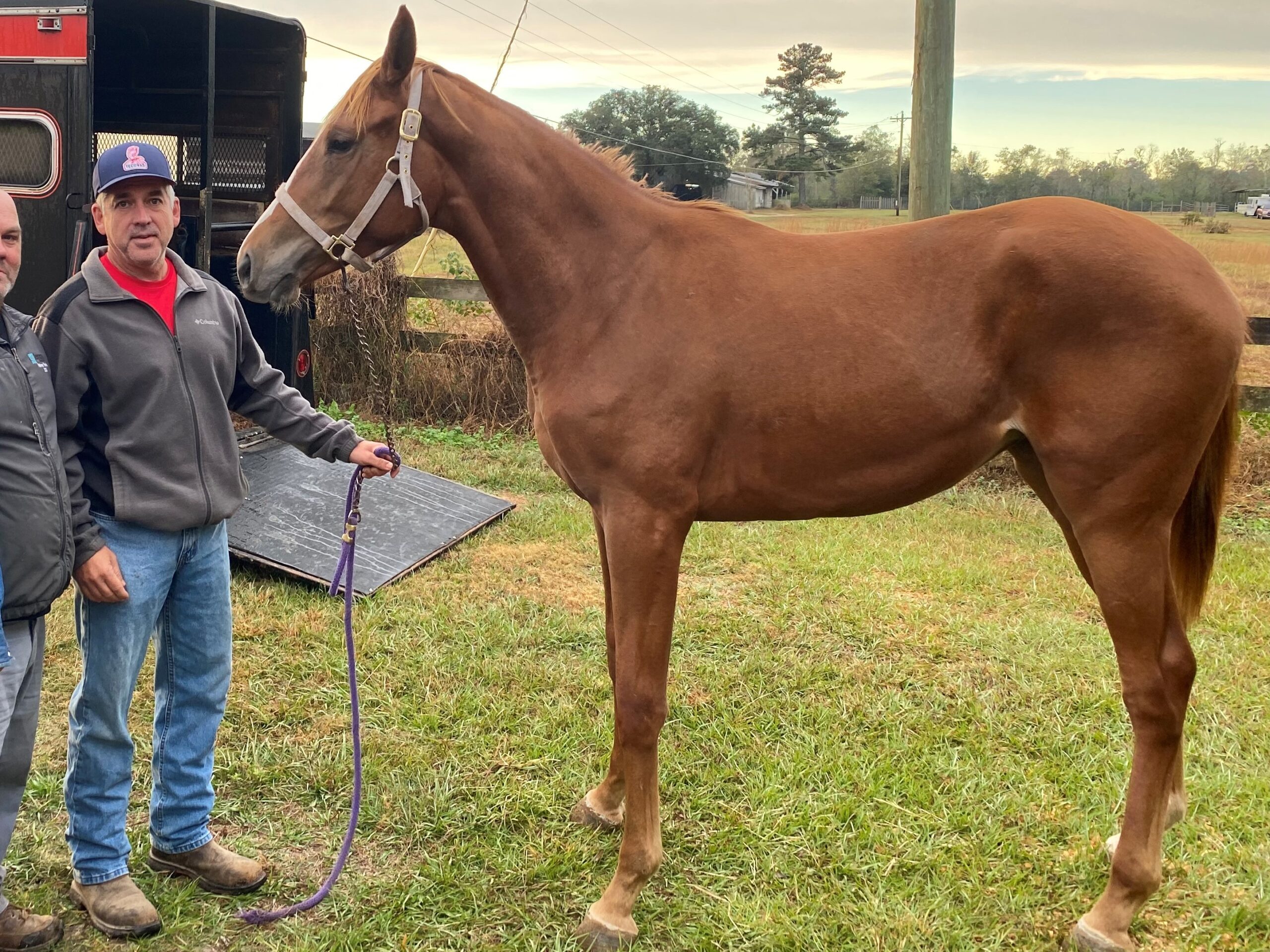
Miles Henry (legal name: William Bradley) is a professional horseman based in Folsom, Louisiana. He holds Louisiana Racing License #67012 and has spent over three decades managing Thoroughbreds at premier tracks including Fair Grounds, Delta Downs, and Evangeline Downs.
Expertise & Hands-On Experience: Beyond the track, Miles has decades of experience in specialized equine care, covering everything from hoof health and nutrition to training protocols for Quarter Horses, Friesians, and Paints. Every guide on Horse Racing Sense is rooted in this “boots-on-the-ground” perspective.
30 of their last 90 starts
Equibase Profile.

Connect with Miles: