
Last updated: July 20, 2026
Racehorses break down for several reasons. Here are the most common ones:
- Usually not sudden: Catastrophic injuries are often the final stage of stress injuries that built up over weeks or months before race day.
- Main drivers: Pre-existing stress injuries, insufficient recovery time, hard or inconsistent track surfaces, and conformational vulnerabilities that concentrate force on specific structures.
- Warning signs show up first: Subtle stride changes, new heat in a limb, and performance drops often appear before a catastrophic injury — and acting early prevents many breakdowns.
One of the first breakdowns I witnessed up close at Delta Downs involved a horse that looked sound in the mornings, warmed up fine, and was still running well when his right front leg gave out. The cannon bone snapped, and the vet’s assessment was that he’d likely been carrying a stress fracture for weeks.
Watching that horse break down changed the way I evaluate soundness. Today I pay close attention to subtle changes in stride, attitude, or limb heat because catastrophic injuries are often preceded by small warning signs. This guide explains how those injuries develop and what owners, trainers, and racing fans should know about preventing them.
Sources Behind This Guide: Data drawn from the Jockey Club Equine Injury Database, AAEP lameness guidelines, Merck Veterinary Manual, UC Davis Center for Equine Health, and HISA safety reports. Always consult a licensed equine veterinarian for medical decisions about your horse.
Educational disclaimer: This guide is written for owners, trainers, bettors, and fans who want to understand racehorse breakdown risk. It is not veterinary advice. Only a licensed equine veterinarian can diagnose lameness, order imaging, or clear a horse to race. If your horse shows any warning signs described here, consult your veterinarian before the next training session — not after.
Table of Contents
What Is a Racehorse Breakdown?
A racehorse breakdown is a serious leg injury that leaves the horse unable to bear weight safely. Most happen at racing speed, but the trouble usually starts well before race day. By the time the leg gives out, the damage has usually been building for a while.
The most common breakdown injuries involve the cannon bone, fetlock, sesamoids, or suspensory apparatus. Bowed tendons and cannon bone stress injuries often build slowly before they fail.
That is why early detection matters. You want to catch a problem before one more work or one more race turns it into a catastrophe. Most horses tell you something if you are paying attention, but not all of them do. That is why you never trust your eyes alone when something feels off.

How Breakdown Injuries Progress
Breakdowns usually do not happen all at once. They build through a few warning stages, starting with small signs that are easy to miss and ending with a complete failure of the bone, tendon, or support structure.
| Stage | What’s going on | What you may notice | What to do |
|---|---|---|---|
| Stage 1 — Early warning Small problem starting |
A little wear and tear is building after hard work, but the horse may still look mostly sound. | Mild heat, a little soreness after training, or a horse that just does not feel quite right. | Back off, give the horse time, and watch closely before putting him back into full work. |
| Stage 2 — Injury building Stress damage taking shape |
The problem is bigger now. A stress injury or soft-tissue injury may be developing. | Low-grade lameness, repeated heat or filling, sensitivity in one spot, or a slight change in stride. | Scratch the horse, stop pushing, and have your veterinarian take a look before doing more. |
| Stage 3 — Serious risk Horse should be out |
The leg is compromised enough that one more hard effort could turn it into a full breakdown. | Clear lameness, visible swelling, obvious heat, or a horse reluctant to put weight on the limb. | Pull the horse out of training immediately and get a full veterinary workup. |
| Stage 4 — Catastrophic Complete breakdown |
The bone, tendon, or supporting structure has failed under load. | Sudden non-weight-bearing, visible deformity, severe pain, or the horse pulling up or going down. | Get emergency veterinary help right away and keep the horse as still as possible. |
Why Do Horses Break Down During a Race?
The question “why do racehorses break their legs during a race?” is a bit misleading — the race is usually when a hidden problem finally gives way. At 35 to 40 mph, a horse’s cannon bone and fetlock take a heavy load with every stride. When the leg has already been weakened by small injuries that built up over time, failure can come fast.
That is why trainers, veterinarians, and riders watch closely for warning signs before a horse ever reaches the starting gate. Heat, filling, stride changes, and a dip in performance often show up before a serious injury becomes obvious.
The Most Common Causes of Racehorse Breakdowns

Most breakdowns are built, not sudden. The same few problems keep showing up, and horsemen learn to respect them fast.
- Old stress injuries. A lot of breakdowns start with damage that was already there and never fully healed.
- Too much work, not enough recovery. Horses need time between hard efforts, and pushing too soon is where plenty of trouble begins.
- Bad surfaces. Hard dirt jars the legs, and deep or uneven footing makes every stride cost more.
- Conformation flaws. Some horses are built in a way that puts extra pressure on the same spots every time they run.
Miles’s Take — how I read legs in the claiming box: Conformation is my first filter in claiming races. I’ve passed on plenty of horses because one foot turned out, and you could see the problem started at the knee. One mare at the Fair Grounds had that look, so I let her go. A few starts later she broke down. If the legs make me uneasy in the paddock, I pass.
Common Injuries Linked to Breakdowns
Horses rarely break down without showing smaller injuries first. The ones that end badly usually give off warning signs before they get there, and it helps to know where those problems tend to start.
For more detail on any specific injury, see the linked guides below.
| Injury | Typical cause | Key risk factors | Prevention |
|---|---|---|---|
| Cannon bone stress fracture | Repeated high-speed loading without enough remodeling time | Frequent hard works, short rest between races, firm track, young horses pushed quickly | Moderate workloads; enough time between starts; advanced imaging when performance drops |
| Condylar fracture | Stress line in the lower cannon bone propagates under race load | High speeds, firm track, previous lameness, suspensory weakness, certain conformations | Watch fetlock soreness closely; image any new heat or joint effusion; scratch on suspicion |
| Bowed tendon (SDFT tendinopathy) | Cumulative overstretching of tendon fibers during gallops and races | Deep or uneven footing, long pasterns, fatigue, inadequate conditioning | Gradual conditioning; avoid deep holding tracks; stop at first heat or bow |
| Suspensory ligament failure | Overload of suspensory fibers and sesamoid support at high speed | Straight hock or fetlock angles, heavy body on light bone, repeated racing on hard surfaces | Campaign horses with conformation in mind; rest after tough efforts; image early if the suspensory feels sore |
| Fetlock arthritis / joint inflammation | Ongoing concussion and hyperextension at the fetlock joint | Hard tracks, frequent starts, poor hoof balance, long campaigns without a break | Balanced shoeing; scheduled breaks; joint therapy under vet supervision when needed |
| Overreach / lower-limb interference | Hind hoof strikes the heel or pastern of the front foot at speed | Fatigue, deep footing, unbalanced shoeing, long toe | Bell boots; balanced shoeing; correct long-toe, low-heel syndrome |

How Trainers and Vets Prevent Breakdowns
In a good barn, prevention is a daily job. Trainers, vets, farriers, grooms, and riders all play a part in catching trouble early and backing off before a small problem turns into a bigger one.
| Prevention strategy | What it looks like in practice | Why it works |
|---|---|---|
| Workload planning | Moderate gallop days, spaced breezes, enough rest between races, and not rushing a horse back before he is ready. | Gives bones and tendons time to recover while keeping the horse fit. |
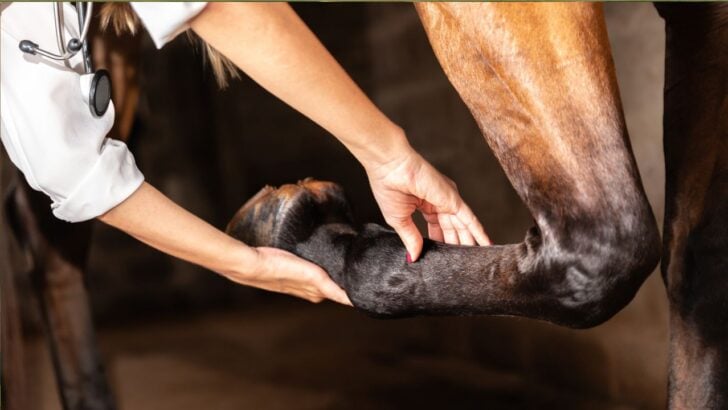
| Daily soundness checks | Jogging horses in the shedrow, flexing joints, feeling tendons, and watching them walk off after every work. | Catches stride changes, heat, or swelling before they turn into obvious lameness. |
| Veterinary imaging | Pre-race inspections, lameness workups, radiographs, ultrasound, and PET scans for suspicious cases (AAEP guidelines). | Shows trouble you cannot see by eye and helps make the scratch call before race day. |
| Hoof balance and shoeing | Trainer and farrier going over radiographs, keeping angles consistent, and using the right race plates. | Balanced feet keep the joints, tendons, and ligaments from taking extra strain every stride. |
| Track surface management | Monitoring cushion depth and moisture, adjusting for weather, and keeping harrowing consistent (HISA standards). | More even footing lowers the chance of a bad step or extra load on the legs. |
| Planned rest periods | Breaks between meets, farm time, and backing off when soreness starts to show. | Lets small damage heal before it turns into a bigger problem. |
| Data-driven risk profiling | Vets reviewing training and race records, gait-monitoring sensors, and injury databases (Equibase). | Helps flag horses that need a closer look or should not go to the gate. |
When we start young horses in training, we watch their legs closely every day. If there is even a little heat, especially in a young horse, we back off right away. That is how you keep a small issue from becoming a big one.
Early Warning Signs Owners Should Watch For
No system catches every problem, but many breakdown horses show small warning signs days or even weeks before a serious injury. As an owner, you do not need to be the trainer or vet to notice when something is off — you just need to know what is worth acting on.
Six warning signs that warrant a veterinary call before the next session:
- Uneven stride or head bobbing. Short-strided on one leg, carrying the head differently than normal, or showing a faint dip at the bottom of the stride.
- New heat, filling, or sensitivity. Warmth or puffiness around a joint, tendon, or suspensory; flinching when you run your hand down the limb; a spot that was not there yesterday.
- Performance dip without clear cause. A horse that was finishing strongly starts getting tired early, stops trying when asked, or runs below recent form without explanation.
- Stiffness leaving the stall. Walks out tight or reluctant, then warms out of it — especially if it happens more than once in the same week in the same leg.
- Attitude changes. A normally eager horse pins its ears, resents saddling, or balks heading to the track. Pain changes personality.
- Post-race soreness. Noticeably stiff or sore the morning after a race, especially in the same leg on more than one occasion.
Miles’s Take — the rule I use at the barn: If a horse shows new heat in a leg and a performance drop in the same week, I treat it as a vet case until proven otherwise. Not a “watch and see.” A vet case. The cost of a call you did not need is a farm visit. The cost of one you needed but did not make is a horse. I learned that the hard way at Delta Downs, and I do not need to learn it again.
There will always be another race. A horse that cannot walk to the paddock next month is not a sound investment today. Only a licensed equine veterinarian can diagnose the specific cause — these observations are a trigger to seek evaluation, not a substitute for it. If you are applying these principles to a claiming decision specifically, see our guide to evaluating horses in claiming races.

Quick-Reference Risk Factors and What They Mean
Some breakdown risks show up over and over again, even across different horses and different barns. This quick-reference table pulls those patterns together so owners can connect the dots faster.
| Risk factor | Early warning signs | Primary prevention action |
|---|---|---|
| Accumulated bone stress (stress fracture) | Performance decline without clear cause; subtle stride shortening on one limb; mild heat over the cannon bone after work | Bone scan or MRI before returning to racing; allow enough recovery time between starts |
| Tendon overload (SDFT) | Heat and filling behind the cannon bone; bow forming; flinching when the tendon is palpated | Routine ultrasound in season; rest at the first sign of heat; avoid deep holding tracks |
| Suspensory ligament strain | Fetlock dropping slightly lower than normal; resistance in the post parade; bilateral hind lameness in older horses | Ultrasound for any proximal suspensory soreness; no racing while compensating |
| Hard or inconsistent track surface | Horse shortens stride on a particular track; joint effusion after racing on a firm surface | Check surface firmness before workouts; scratch when conditions are extreme |
| Overtraining / short recovery | General fatigue late in races; stiffness leaving the stall the morning after; attitude changes | Allow adequate recovery between starts; back off intensity at the first sign of soreness |
| Conformation vulnerability | Asymmetric shoe wear; uneven weight-bearing in the stall; gait dip visible at the jog | Flexion tests at pre-purchase; baseline radiographs; avoid vulnerable horses on hard tracks |
| Pre-existing injury (racing through damage) | Horse “always a little off” in the same limb; recurring heat in the same spot; reluctance to extend | Full lameness workup before each campaign; never race a horse the vet has flagged without imaging clearance |
Key Takeaways — Why Racehorses Break Down
- Most breakdowns build over time. The final failure is usually the end of a stress injury that started long before race day.
- The same few problems show up again and again. Old injuries, too much work, not enough recovery, bad surfaces, and conformation all play a part.
- Warning signs are usually there. Heat, filling, stride changes, performance drops, and attitude changes often show up before the break.
- Good horsemanship still matters. Watching closely, backing off when needed, and not racing through a problem can prevent a lot of breakdowns.
- Young horses deserve extra caution. Even slight heat is enough reason to back off and give them time.
- Track surface can change the risk. Hard, tight, or uneven footing puts more stress on the legs every time the horse leaves the ground.

Frequently Asked Questions
What is the most common injury in racehorses?
The most common injuries are bowed tendons (SDFT tendinopathy), suspensory ligament strains, stress fractures of the cannon bone, and condylar fractures of the fetlock. These typically result from high-speed exertion, repetitive stress, and inadequate recovery time. Most are preceded by detectable warning signs — heat, filling, or subtle lameness — before the injury becomes catastrophic.
Can a racehorse recover from a bowed tendon?
Yes, for mild to moderate cases — mild bows may heal within 6 months, severe cases can take a year or longer. Stem cell therapy, shockwave therapy, and controlled exercise programs improve recovery rates. A cold, well-set bow with clean follow-up ultrasound imaging is often less serious than the claiming market assumes: the imaging matters more than the visual appearance.
How can you tell if a horse is at risk of injury?
The clearest early signals are subtle lameness at the jog, new heat or filling in a limb, performance decline without explanation, attitude changes (resistance to saddling, reluctance to work), and post-race stiffness in the same leg on multiple occasions. If two or more of these signs appear in the same limb in the same week, a veterinary evaluation should happen before the next training session — not after. Only a licensed equine veterinarian can diagnose the specific cause.
What role does track surface play in racehorse injuries?
Track surface is one of the most significant modifiable risk factors. Hard, compacted dirt increases concussion at every stride; deep or holding tracks increase tendon strain; inconsistent surfaces can turn a routine stride into a dangerous overload. HISA’s surface monitoring standards have contributed to measurable reductions in injury rates since 2023.
Why are some racehorses more injury-prone than others?
Genetics, conformation, training history, and racing frequency all influence risk. Horses with offset knees, long pasterns, upright fetlock angles, or straight hocks concentrate stress on specific structures. These traits are identifiable through pre-purchase or pre-claim evaluation, and proper conditioning and conformation-aware race placement can mitigate some of the disadvantage, though not eliminate it.
What happens to a racehorse after a catastrophic breakdown?
The outcome depends entirely on injury severity. Catastrophic fractures of the cannon bone, condyle, or suspensory apparatus typically require humane euthanasia at the track because the injury cannot be treated without prolonged suffering and the prognosis for survival is extremely poor. For less severe cases — a significant tendon rupture or a fracture that can be surgically stabilized — some horses survive with intensive care, though returning to racing is rarely possible. Survivors are often retired to pasture, breeding, or light riding if the injury permits.
How do trainers prevent racehorse breakdowns?
Through daily workload management, observation, and veterinary oversight. Trainers space works and race starts to allow bone and tendon remodeling; grooms and exercise riders report any change in stride, attitude, or limb heat immediately; farriers maintain hoof balance. Most catastrophic breakdowns trace back to one of these steps being skipped or delayed.
Is there a race distance or condition that carries higher breakdown risk?
Research points to conditions more than specific distances. Maiden claiming races carry elevated risk because horses are often younger, less conditioned, or carrying undisclosed problems. Hard, firm surfaces increase bone stress at any distance. Short sprints at maximum effort concentrate loading on the cannon bone and fetlock quickly; longer races on tiring tracks shift risk toward tendons and suspensory structures as fatigue accumulates. The consistent factor across most catastrophic breakdowns is horses racing with pre-existing stress injuries — the distance determines where failure occurs, but the injury was developing before the gate opened.
Why do racehorses break their legs so easily?
They don’t, under normal conditions — the real issue is extraordinary racing forces meeting pre-existing, undetected damage. A Thoroughbred’s cannon bone and fetlock absorb enormous repeated loading at 35–40 mph, and when that structure already has accumulated micro-damage from insufficient recovery time, the resulting fracture is catastrophic because the forces involved are so extreme. See the causes section above for the full mechanism.
About Miles Henry
Racehorse Owner & Author | 30+ Years in Thoroughbred Racing
Miles Henry (legal name: William Bradley) is a professional horseman based in Folsom, Louisiana. He holds Louisiana Racing License #67012 and has spent over three decades managing Thoroughbreds at premier tracks including Fair Grounds, Delta Downs, and Evangeline Downs.
Expertise & Hands-On Experience: Beyond the track, Miles has decades of experience in specialized equine care, covering everything from hoof health and nutrition to training protocols for Quarter Horses, Friesians, and Paints. Every guide on Horse Racing Sense is rooted in this “boots-on-the-ground” perspective.
30 of their last 90 starts
Equibase Profile.

Connect with Miles: