
Last updated: October 12, 2026
Any links on this page that lead to products on Amazon are affiliate links and I earn a commission if you make a purchase. Thanks in advance – I really appreciate it!
Someone at the barn swears her horse moves better under a treeless saddle. The next person tells you they’ll wreck a horse’s back. If you’re dealing with a hard-to-fit horse or you’re just tired of hauling a heavy saddle around, you need a clear answer before you write the check.
Here’s what the research tells us, where treeless saddles can make sense, and what I’d check before riding in one.
Table of Contents
What Is a Treeless Saddle, and Why Does the Tree Matter?
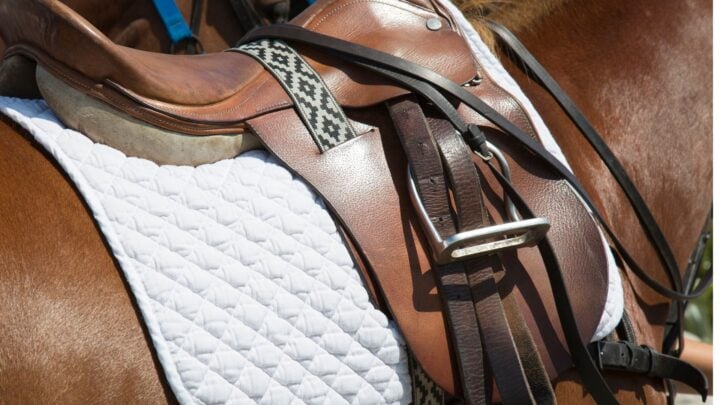
A conventional saddle is built on a tree, a rigid frame that spreads the rider’s weight across the muscles on either side of the horse’s spine and holds the saddle up off the spine itself. A treeless saddle leaves that frame out.
Many treeless designs keep a lightweight pommel and cantle, often fiberglass, with a leather or synthetic seat and foam padding, and no other rigid structures force the saddle to keep its shape. That lets the saddle bend to more back shapes and gives you a closer feel of the horse. It also means there’s less built-in structure to spread your weight and keep the saddle clear of his spine, so the saddle’s construction and its padding system both need checking with you aboard.
The word “treeless” gets stretched, too. Some saddles sold as treeless list a flex tree in their specs, which is a different design. If you’re shopping, read the construction details on any model before you compare the best treeless saddles side by side.
Are Treeless Saddles Bad for Horses? What the Research Shows
There isn’t much research, and what there is doesn’t settle the question for every saddle. At Michigan State’s McPhail Center, Clayton compared a custom-fitted treed saddle with one treeless model on eight horses. The same 125-pound rider rode each horse at a slow sitting trot without stirrups, and neither saddle had a pad. That’s one treeless model and one light rider, which limits what the results tell us about other treeless designs, riders, and riding conditions.
The total force on the horse’s back was about the same in both saddles, since it was the same rider. What changed was how that force was spread. The treed saddle’s contact area averaged about 1,340 square centimeters, while the treeless saddle averaged about 1,153, and the treeless saddle concentrated pressure under the rider’s seat bones, over the long back muscles. It also had more sensors above the pressure level Clayton linked to possible saddle sores. As The Horse reported, she concluded that the tree spreads force over a larger area of the horse’s back, which is the job it’s built to do. That’s reason to be careful, not proof that every treeless saddle makes a horse sore.
Other tests are harder to sum up. A University of Zurich team tested wooden-tree, flexible-tree, and treeless exercise saddles on racehorses at the trot, canter, and gallop. At the trot, tree type made little difference, and all three saddles showed high pressure toward the back of the saddle, which the lead researcher put down mostly to the rider’s position. Horse Canada also describes a 2007 Society of Master Saddlers test in the UK in which all four treeless saddles pressed on the spine under the rider. No special fitting was done for that one, and the brands weren’t named, so it’s a red flag rather than the final word.
None of these studies looked at every saddle-and-pad combo out there, and Clayton’s ran without pads at all. What they do show is that taking out the tree doesn’t automatically take pressure off the horse’s back.
Pressure tests aren’t the whole picture, either. Horse Canada interviewed endurance riders who reported good back scores on long rides in treeless saddles. Those results show some horse-and-saddle combinations can work, but they don’t tell you how another model will fit your horse.

Treeless Saddle Pros and Cons
| Factor | Pro | Con |
|---|---|---|
| Fit | Flexes to fit a wider range of back shapes, which helps with hard-to-fit horses | A poor fit can still create pressure points; flexible doesn’t mean it fits |
| Spine clearance | The saddle and pad design can leave a channel over the spine | Clearance depends on the construction and pad, so it has to be checked with you aboard |
| Saddle weight | Much lighter to lift and carry than most treed saddles | A lighter saddle can still concentrate pressure |
| Rider feel | Can give a close-contact feel | Some riders may miss the support of a more structured saddle |
| Uses | Used for trail, pleasure, and endurance riding | Not suited to roping |
The light weight is a big reason some riders switch. Several of the riders Horse Canada interviewed chose treeless saddles partly because joint, elbow, or shoulder problems made a heavy saddle hard to lift. That’s a fair reason to look at one, but it’s a benefit for the rider, not proof the saddle is easier on the horse. There’s also a broader debate over whether saddles are bad for horses in general, and it comes back to the same thing: fit.
Which Horses and Riders Suit a Treeless Saddle?
A treeless saddle is more likely to work when the horse, the rider, and the riding all line up:
- Hard-to-fit horses: Horses with wide shoulders, unusual backs, or a shape that treed saddles haven’t fit are the most common reason people try treeless. Some riders in Horse Canada’s reporting found one after shimmed treed saddles failed, but one saddle fitter tried 15 treeless brands before finding one that worked for a single horse.
- Balanced riders: Think about how securely you sit and how the saddle behaves when you shift your weight, because a treeless saddle may give you less support than you’re used to. Rider weight matters too, though there isn’t one cutoff that applies to every design. Clayton noted that a heavier rider would put more force through the saddle than her 125-pound rider did, and saddle maker Bob Hickman says heavier riders get too much flex in the middle, which lifts the front and back of the saddle.
- Type of riding: Trail and pleasure riding are common uses, and some endurance riders have done well in them over long distances. Hickman calls treeless saddles poor working saddles, though, and a treeless saddle with a horn still isn’t made for roping.
Be more cautious in these cases:
- High withers or a prominent spine: These horses need close attention to clearance. Don’t assume a flexible saddle will clear the withers and spine once your weight’s in it. Even a treeless saddle maker told Horse Canada that a horse with a prominent spine may need a tree. Some high-withered horses do go well in one, but have the saddle-and-pad setup checked with you riding in it.
- Sway backs: A flexible saddle can follow a dipped back better than a tree that bridges it, and some owners of sway-backed horses have found treeless saddles that fit. That doesn’t mean every sway-backed horse will go well in one, so check the fit on your horse rather than going by the back shape alone.
- Beginners: If you’re still finding your balance, a treeless saddle won’t give you the same structure a tree does. That doesn’t rule one out, but think about how securely you sit and how the saddle behaves under you before you choose one.
- Horses with back problems: If your horse already has back pain or a spinal issue, talk with your vet and a saddle fitter before switching. A new saddle isn’t a treatment for a back problem nobody’s diagnosed.
Can the Right Pad Make a Treeless Saddle Easier on Your Horse?
It can help, but it can’t rescue a saddle that doesn’t fit. Many treeless saddles need a purpose-built pad, often with a channel over the spine and pockets for inserts, so follow the saddle maker’s instructions for that model. Horse Canada also cites Dr. Jeff Thomason of the Ontario Veterinary College, who says pads can even out pressure but cannot compensate for poor fit. Don’t count on a thicker pad to solve a pressure problem or stop a saddle from rocking.
The pad you already own may not be suitable, either. Our guide to saddle pad types explains the different options, but follow the treeless saddle maker’s requirements and have the complete setup checked with you aboard.
How to Tell If a Treeless Saddle Is Bothering Your Horse
Your horse will usually tell you if a saddle is making him sore, so pay attention in the first few weeks with any new setup. Saddle fitter Mike Scott points to these signs of a saddle fit problem:
- Uneven sweat patterns: Dry patches in an otherwise wet sweat pattern are worth a closer look, but they don’t prove a poor fit on their own. The rider’s position or the horse’s back can cause them too.
- Hair and rub marks: Hair that’s rubbed the wrong way, breaking off, twisting, matting, or turning white can point to pressure or friction damage.
- Saddle movement: A saddle that shifts or rolls can rub and create pressure in new places. If yours won’t stay centered, have a fitter who knows that design find out why before you keep riding in it.
- Soreness when you groom: If he flinches or dips away when you brush his back, take note.
Watch how he acts when you saddle him, too. Faster breathing, snapping, or pinned ears at the girth are red flags worth having checked. A change in how he moves can be a sign too.
One fitter in Horse Canada’s reporting suggests a 10- to 14-day trial. Check your horse after every ride, and stop using the saddle if you notice pain, rubbing, or changes in how he moves or acts. Have those signs looked at by your vet or saddle fitter rather than riding through them. A trial gives you time to judge the setup, but it doesn’t guarantee a good fit.
About Miles Henry
Racehorse Owner & Author | 30+ Years in Thoroughbred Racing
Miles Henry (legal name: William Bradley) is a professional horseman based in Folsom, Louisiana. He holds Louisiana Racing License #67012 and has spent over three decades managing Thoroughbreds at premier tracks including Fair Grounds, Delta Downs, and Evangeline Downs.
Expertise & Hands-On Experience: Beyond the track, Miles has decades of experience in specialized equine care, covering everything from hoof health and nutrition to training protocols for Quarter Horses, Friesians, and Paints. Every guide on Horse Racing Sense is rooted in this “boots-on-the-ground” perspective.
30 of their last 90 starts
Equibase Profile.

Connect with Miles: