
Last updated: July 18, 2026
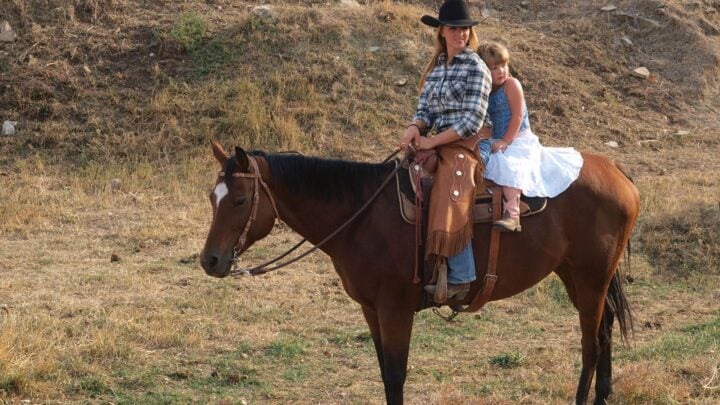
My grandson asked me a while back if he and his sister could ride double on their horse. I remember doing the same thing as a kid, and I remember my dad scolding me for it — which is what got me thinking about what actually makes riding double safe or risky, beyond just “my dad said no.” I’ve spent more than 30 years around Thoroughbreds and other breeds, from Louisiana racetracks to farm life. Questions like this are rarely about whether a horse can do something — they’re about whether it should be asked to.
Can two people ride a horse? Yes, but it’s not something to do casually. The commonly cited guideline is that a horse can carry about 15–20% of its own body weight, and two riders together often push past that limit fast — especially two adults. Riding double works best with one adult and one small child, a calm and well-conditioned horse, a short duration, and a slow pace. Two full-grown adults riding double for any real distance is genuinely risky for the horse.
Table of Contents
Can Two People Ride a Horse?
Physically, yes — a horse’s back can support two riders in the sense that it won’t collapse under them. Whether it should is a different question, and it comes down almost entirely to combined weight. The commonly cited guideline is that many horses can comfortably carry around 15–20% of their body weight, rider and tack included — but that’s a starting point, not a fixed rule. The real limit depends on the individual horse’s build, fitness, bone structure, age, and conditioning; a fit, well-built horse and an unfit one of the same weight don’t have the same actual capacity. For the full breakdown of where that guideline comes from, see our guide to how much weight a horse can carry, or the deeper dive on how strong a horse really is.
Two adults together routinely blow past that number. A 1,000-pound horse tops out around 150–200 pounds of total load — one average adult alone can approach that before you add a second rider. That’s why riding double works so much better as one adult plus one small child than as two adults: the math simply works out differently.
| Horse Size | Approx. Body Weight | Safe Combined Rider Weight (15–20%) |
|---|---|---|
| Average riding horse (~15 hh) | 1,000–1,100 lbs | 150–220 lbs |
| Larger horse (~16 hh) | 1,200–1,400 lbs | 180–280 lbs |
| Draft or draft-cross | 1,600–2,000+ lbs | 240–400 lbs |
Two average-sized adults alone will often land at 300+ pounds combined, before tack — which is why riding double with two grown adults isn’t recommended except briefly, at a walk, in an emergency. One adult and one child is a completely different equation, and it’s the scenario riding double actually works well for.
When Two People Should Not Ride the Same Horse
Weight math aside, some situations rule out riding double entirely, regardless of how the numbers work out:
- The horse is young, green, or still in early training
- The horse is recovering from an injury or showing any back soreness
- The horse is older and already carrying less well than it used to
- The terrain is steep, uneven, or otherwise demanding
- Either rider can’t balance and stay secure independently
- The horse is showing strain during the ride — a shortening stride, pinned ears, or a hollowing back are all signs to stop, not push through
- The horse is already stressed, spooked, or in an emergency situation — adding a second rider in that moment adds risk, not safety
Safety Rules for Riding Double
If you’re going to ride double, these are the rules that actually matter:
- Don’t overload the horse. Run the math above before you get on — combined rider weight is the single biggest factor
- Choose the right horse. Calm, well-trained, mild-mannered, and in good condition. A green or high-energy horse is a poor candidate
- Skip the spurs. The rear rider’s legs often sit differently than normal, and spurs increase the odds of unintentionally jabbing the horse’s flank
- Stick to a controlled setting. Familiar, enclosed, soft footing — not an unfamiliar trail or rough terrain
- Keep the pace slow. Walk or trot only. A fall at speed with two riders is a different level of risk than a fall with one
- Wear real safety gear. Helmets for both riders — research consistently shows they reduce the severity of head injuries in a fall — and clothing that won’t flap and spook the horse
- Make sure at least one rider is experienced. Two beginners riding double together is a genuinely bad combination
Who Should Ride in Front?
An Adult and a Child
For a controlled ride with a young child, many experienced riders put the child in front and the adult behind. It’s generally the safer setup — a western saddle horn gives a young rider something secure to hold — and it’s a genuinely good teaching arrangement. The exact setup still depends on saddle type, the child’s size, and how well-trained the horse is, but child-in-front is the right default to start from. The child can feel how you shift your weight to communicate with the horse and watch your hands on the reins, which builds real feel faster than being led from the ground.
Two Adults
If two adults are riding double despite the recommendation above, putting the heavier rider in front is generally the better option — saddle type, horse build, and each rider’s balance all factor in too, but as a default, it puts the lighter rider over the horse’s loin, the weaker, less-supported section of its back, which is the better place for less weight, not more.
Horseman’s Perspective: When my kids were young, we used a buddy seat attached to my saddle any time they rode with me — simple, secure, and it kept them comfortable without me second-guessing the setup. Years later I tested a Tough-1 tandem saddle with my 70-pound grandkid, and it worked well for a short ride, though I wouldn’t push it much further than that. The lesson that’s stuck with me across both: riding double is fine for what it actually is — a short, controlled, slow-paced way to share a horse with a kid — and it stops being fine the moment you try to stretch it into something more.
The Tandem Saddle I Use for Riding Double
A dedicated tandem or buddy saddle is worth it if you ride double regularly. It gives the second rider real stirrups and a stable seat instead of balancing on the cantle, which matters more than people expect once a ride goes past a few minutes.
Tough 1 Ride-Behind Tandem Saddle
Built from sturdy Cordura nylon with real stirrups, so the second rider can adjust their balance instead of just holding on — a real step up from just sitting a child behind you on a pad or blanket, which gives them nothing to brace against if the horse makes a sudden move. It attaches to any western saddle, and to English saddles that have D-rings. Dimensions are 24 x 18 x 18 inches at just under 4 lbs, and it takes up enough space on a horse’s back that it’s built for a full-size horse — not a pony or donkey. No listed weight limit, but fit varies by rider size; it worked well for my grandkid at 70 lbs, while a friend found it a bit small for her average-sized 8-year-old and better suited to her 5-year-old.
What I noticed testing it: stability was the real win — my grandson had a stable seat and real stirrups instead of just gripping my waist. I’d stick to what worked for us: short, slow, familiar-ground rides, not long trail outings. And a tandem saddle doesn’t change the underlying math — run the combined weight numbers from earlier in this guide regardless of what setup you’re using.
Pros: sturdy and durable, easy to fit, versatile across saddle types, good value.
Cons: could use more padding for longer rides.
Below is a video showing what riding double actually looks like in practice, child in front:

Key Takeaways
- Combined weight is what actually matters — not whether the horse “looks big enough”
- One adult plus one child is the setup riding double is actually built for — two adults is a much harder ask on the horse
- Child in front, adult behind, for teaching and safety alike
- Keep it short, slow, and in a controlled setting — riding double isn’t the time to test a horse’s limits
Sharing a horse with a grandkid for a slow ride around a familiar pasture is a good, memorable thing. Treating a horse like a vehicle built to carry extra passengers is where the trouble starts — the difference between those two is really what this whole guide comes down to.
FAQs: Riding Double on a Horse
Can two people ride a horse?
Yes, with real limits. A commonly cited guideline is that many horses can carry roughly 15-20% of their body weight, including rider and tack, but the actual amount depends on the individual horse’s build, fitness, and conditioning. Two riders together — especially two adults — need to stay well under that combined threshold. One adult and one small child works well; two full-grown adults is genuinely risky for the horse over any real distance or speed.
Is it safe to ride double on horseback?
It can be, if you follow the basics: don’t overload the horse, use a calm and well-conditioned horse, keep the pace to a walk or trot, stay in a controlled setting, and have at least one experienced rider on board. Skip it if the horse is green, high-energy, or already carrying a heavy single rider comfortably.
Can two adults ride on one horse?
They can, but it’s not recommended except briefly. Two average adults combined often exceed a horse’s safe carrying capacity before tack is even factored in. If it’s necessary, putting the heavier rider in front is generally the better option, the pace stays slow, and the ride stays short.
Can a horse carry three riders?
Riding three people on one horse is generally not recommended — weight distribution, balance, and control all get much harder to manage, even in the rare situations where very small children might technically fit within a large horse’s carrying capacity. Stick to two riders at most.
What is the best saddle for riding double?
A dedicated tandem or buddy saddle, like a ride-behind tandem attachment, gives the second rider real stirrups and a stable seat instead of balancing on the cantle. For short rides with a small child, a western saddle with a horn or a simple pad works fine too.
About Miles Henry
Racehorse Owner & Author | 30+ Years in Thoroughbred Racing
Miles Henry (legal name: William Bradley) is a professional horseman based in Folsom, Louisiana. He holds Louisiana Racing License #67012 and has spent over three decades managing Thoroughbreds at premier tracks including Fair Grounds, Delta Downs, and Evangeline Downs.
Expertise & Hands-On Experience: Beyond the track, Miles has decades of experience in specialized equine care, covering everything from hoof health and nutrition to training protocols for Quarter Horses, Friesians, and Paints. Every guide on Horse Racing Sense is rooted in this “boots-on-the-ground” perspective.
30 of their last 90 starts
Equibase Profile.

Connect with Miles: