
Last updated: June 20, 2026
There are eight blinker types used in horse racing, and choosing the wrong one is one of the most common equipment mistakes in claiming barns. A full cup on a horse that only needed a French cup can make it over-keen and anxious. A French cup on a horse that needs maximum restriction leaves the drift unresolved. The type matters as much as the decision to use blinkers at all.
What are the types of blinkers in horse racing? The eight types are full cup (~85–90% restriction), semi-cup (~60–70%), French cup (~30–40%, most common in US), cheater cup (minimal, ~10–15%), extension or run-out (one eye only, for directional drifters), visor (cup with a small hole, for horses that need some lateral awareness to stay competitive), winkers (fleece strips on cheekpieces, common in UK and Australian racing), and pacifier hood (pre-race calming only – not worn during the race itself). The right choice depends on the severity of distraction, whether the drift is directional or general, and whether the horse needs some visual contact with rivals to stay motivated.
Sources: Type specifications from the Daily Racing Form and Thoroughbred Owners of California. Barn examples from Thoroughbred racing at Fair Grounds, Evangeline Downs, and Delta Downs.
Table of Contents
Quick Visual Reference: All Types at a Glance
| Type | Appearance / Coverage | Restriction Level |
|---|---|---|
| Full cup | Large cup covering nearly all lateral vision | Maximum (~85–90%) |
| Semi-cup | Cup covering roughly half the lateral view | Moderate (~60–70%) |
| French cup | Small quarter-cup covering ~¼ of lateral view | Mild (~30–40%) |
| Cheater cup | Narrow strip, minimal coverage | Minimal / psychological (~10–15%) |
| Extension / run-out | Large cup on one eye only (usually outside) | One-sided |
| Visor | Cup with small hole in back allowing sliver of light | Moderate, with lateral awareness |
| Winkers | Fleece tubes on cheekpieces, below the eyes | Rear vision only (~20–30%) |
| Pacifier hood | Full head coverage with mesh eye panels | Pre-race calming only — not worn in race |
Full Blinker Type Comparison
If you only read one table in this guide, make it this one. It shows every type, how much vision each blocks, where you’ll see it, what it’s for, and what the trainer is telling you when they use it for the first time.
| Type | Vision Blocked | Common In | Best For | Main Risk | First-Time Signal |
|---|---|---|---|---|---|
| Full cup | ~85–90% | US dirt racing | Severe distraction; strong lateral reactions | Over-restriction → anxiety, over-keen | Strong — trainer skipped the conservative step |
| Semi-cup | ~60–70% | US dirt racing | Moderate distraction; horses that drift but don’t fully panic | May be insufficient for severe cases | Solid — live play after French cups failed |
| French cup | ~30–40% | US racing — most common | Mild distraction; first-time introduction; route horses | Too little restriction for strong reactors | Moderate — strongest with clear replay evidence |
| Cheater cup | ~10–15% | US racing — experienced horses | Psychological cue; horses that know the equipment | Negligible visual effect | Weak standalone — mainly context |
| Extension / run-out | One eye only | US dirt racing | Strong one-directional drift to the outside | Overuse without clear directional replay evidence | Strong for confirmed outside-drifters |
| Visor | ~50–60%, small hole | UK, Australia, Ireland | Sulkers; horses that need rivals in view to stay motivated | Hole misaligned → effect lost | Moderate — positive for sulkers |
| Winkers | ~20–30%, rear only | UK, Australia, harness | Mild rear restriction; horses unsettled by what approaches from behind | Limited effect for lateral distractors | Mild — note as context on UK/Australian cards |
| Pacifier hood | Full coverage, mesh | US pre-race only | Extremely anxious horses burning energy before the gate | If left on at the gate, horse enters over-restricted | Positive context — horse fresh at gate after removal |
Full Cup Blinkers

Full cup blinkers block nearly all lateral and rear vision. Most designs include small holes or slots toward the back of the cup, letting the horse detect a rival approaching from behind without the full lateral view that causes distraction.
Use when: The horse has a strong, repeated reaction to lateral movement confirmed across two or more replays — severe drift toward horses pulling alongside, strong crowd reactions, or focus lost multiple times in a single race. Full cups should be earned by a clear failure of lighter options, not assumed as the starting point.
Avoid when: Mild distraction only; young horse new to blinkers; horse needs rivals in sight to stay competitive; route horse with no prior blinker experience.
Miles’s Take — Full Cups Are a Strong Program Signal: When I see full cups on a horse for the first time, I pay close attention. It tells me the trainer either tried lighter equipment and it wasn’t enough, or they’ve seen something in training that convinced them the horse needs maximum restriction from the start. Either way, it’s a specific, serious problem — different from a horse wearing cheaters as a habit. Full cups first time, with a class drop, is one of my strongest bet profiles in claiming races.
Semi-Cup Blinkers
Semi-cups cover roughly half the lateral field, leaving the horse with moderate peripheral awareness. They’re the most versatile option — effective for gradual inattention or mild drift without the anxiety risk of full cups.
From the barn — most-used type: Semi-cups have given me the most consistent results. They handle the most common problem — a horse drifting toward company and losing ground on the turn — without making the horse anxious. A gelding at Evangeline had been drifting on the far turn in every race. Semi-cups straightened him out in one start. We never needed to go to full cups.
French Cup Blinkers
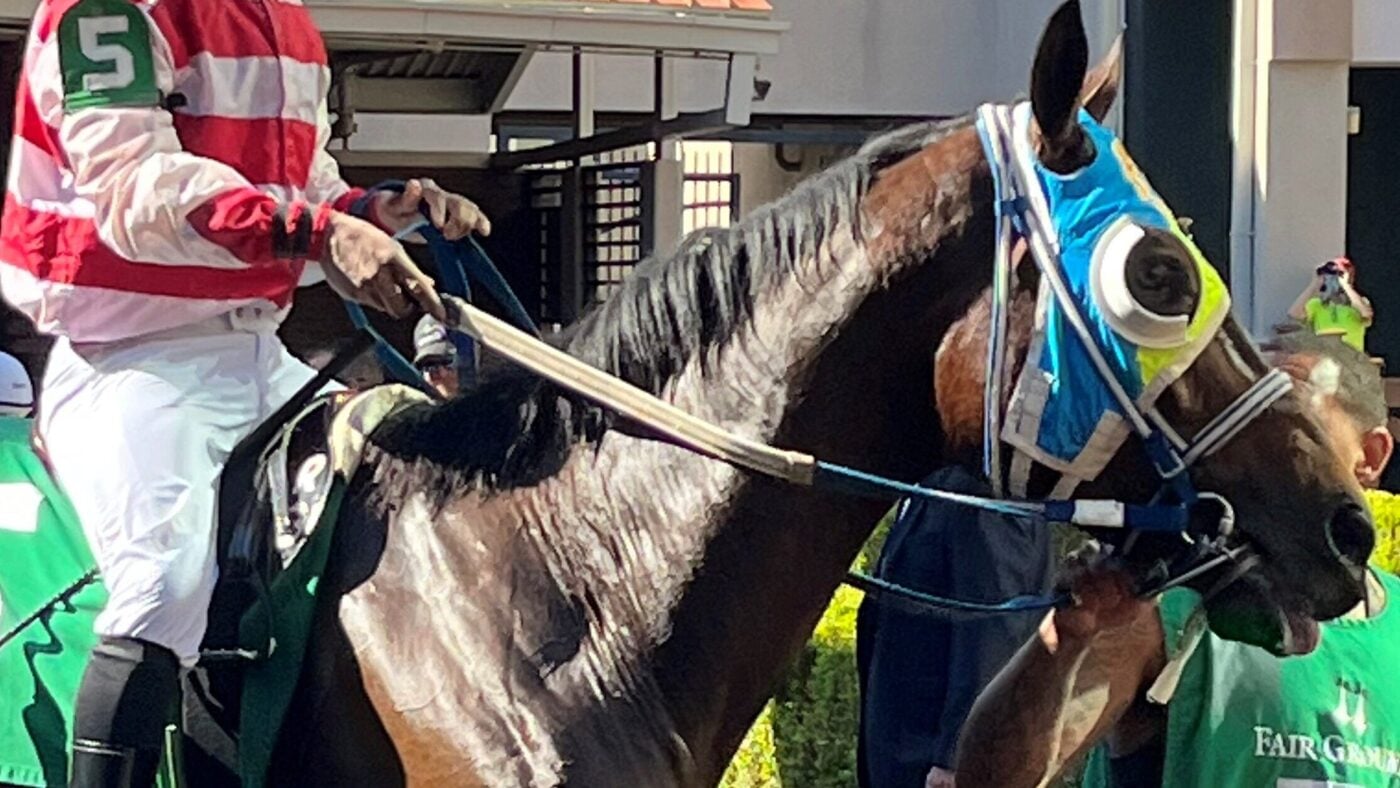
French cups — also called quarter-cups — block roughly 30–40% of lateral vision. They’re the standard first-time blinker choice in American racing: the restriction is real but mild enough that most horses accept it without becoming anxious. If French cups don’t produce a noticeable improvement, that tells you either more restriction is needed or the problem isn’t visual distraction at all.
They’re also the most appropriate choice for route horses, where full restriction risks making the horse over-keen in the first half of a long race.
French cups are the right starting point when:
- Introducing blinkers to a horse for the first time
- The distraction is mild — horse drifts occasionally but doesn’t react dramatically
- The horse is running a route (1 mile or more)
- A horse in semi or full cups is being stepped back down after showing anxiety
- The trainer wants a diagnostic start — if French cups don’t help, the cause likely isn’t visual
Full Cup vs French Cup: The Key Choice
The choice between these two is one of the most consequential decisions a trainer makes when adding blinkers for the first time.
| Full Cup | French Cup | |
|---|---|---|
| Vision blocked | ~85–90% — horse sees only directly ahead | ~30–40% — horse retains considerable peripheral awareness |
| Best horse | Strong, repeated, visually triggered distraction — replay evidence across 2+ races | Mild distraction; first-time introduction; route horses; diagnostic start |
| When to start here | When lighter options have already failed, or replay evidence of severe distraction is overwhelming | Default first choice — start here and step up only if insufficient |
| Main risk | Over-restriction: anxious horse, faster early fractions, poor finish | Under-restriction: horse still distracted, no meaningful improvement |
| Betting signal | Strong — trainer has serious evidence; skipped the conservative step | Moderate — diagnostic; strongest when replay confirms a clear trigger |
| Sign it’s wrong | Faster early fractions than before; stops badly in stretch | Horse still drifts; step up to semi-cup |
Cheater Cup Blinkers

Cheater cups block maybe 10–15% of lateral view — minimal physical restriction. What they’re doing is psychological: a horse conditioned to race in blinkers associates the feel of the equipment with focus. The cheater maintains that cue without meaningful restriction. Most commonly seen on experienced horses stepped down from fuller cups as they matured, or used by trainers testing whether the horse still needs the equipment at all.
Miles’s Take — What Cheaters Tell You: When a trainer puts cheaters on a horse that’s been in full or semi cups, they’re usually doing one of two things: stepping the horse down because the restriction was making it anxious, or testing whether the horse still needs the equipment at all. A horse that runs just as well in cheaters as it did in full cups probably didn’t need the restriction — it just needed the psychological association of wearing the equipment.
Extension Blinkers (One-Sided, for Drifters)
Extension blinkers — also called run-out blinkers — add extra coverage on one side only, usually the outside (right) eye on a left-hand American track. The horse sees normally to the inside but has near-total restriction on the outside — the direction it’s been drifting toward. This targeted approach addresses a directional problem that bilateral cups can’t fix as precisely.
From the barn — Whirlaway and the directional fix: Whirlaway, the 1941 Triple Crown winner, wore a one-eyed blinker over his right eye because he habitually bore out on the far turn. Trainer Ben Jones blocked the outside view — the thing Whirlaway was drifting toward — and the fix worked immediately. The logic applies the same way to any claiming horse with a consistent directional drift that correlates with what it sees on that side.
From the barn — Four races, one lesson at Fair Grounds:
Race 1 (no blinkers): Drifted right on far turn at same spot every lap. Finished 4th. Replay showed him looking at a gap in the outside rail.
Race 2 (semi-cups): Slight improvement — drift reduced but not eliminated. Same rail-gap reaction, same location.
Race 3 (full cups): Ran faster early, finished empty. Over-keen. Bilateral restriction wasn’t solving a directional problem — it was adding anxiety.
Race 4 (extension on right eye only): Tracked straight through both turns. Won by 1½ lengths.
Two starts wasted on bilateral cups for a directional, location-specific problem. The extension was the right tool from race one — we just didn’t see it until the third replay.
Extension misuse: Extensions get misused when applied to horses that drift for non-visual reasons — physical issues, natural lateral tendency. The drift will continue, the trainer burns a start, and the real cause gets another race of delay. Confirm via replay that the outside drift is triggered by something the horse can see before reaching for this equipment.
Visor
A visor looks like a standard cup but has a small hole drilled in the back, allowing a sliver of lateral light through. The horse can detect movement to its side without seeing it clearly — enough to maintain competitive awareness without the full distraction risk.
Best for horses that sulk — that slow down or stop trying when they can’t see rivals. Some horses are motivated by competition; removing that view entirely demotivates them. More common in UK, Irish, and Australian racing than in the US. On a UK or Irish racecard, “V” indicates a visor.

| Standard Cup | Visor | |
|---|---|---|
| Vision blocked | 50–90% depending on cup — no lateral light passes through | Similar coverage but small hole allows limited lateral light |
| Effect | Removes lateral distraction completely at covered angle | Reduces distraction while maintaining minimal rival awareness |
| Best horse type | Distracted or frightened by lateral movement | Sulkers; reluctant runners who need rivals in sight to compete |
| Racecard notation | “b” in US past performances | “V” on UK/Irish racecards; occasionally noted in US programs |
Winkers
Winkers are tubes of fleece on the cheekpieces — not cups. They limit rear vision without blocking the lateral view. Common in UK, Australian, and harness racing; noted “W” or “Wnrs” on UK/Irish racecards.
The horse that benefits is one unsettled primarily by what approaches from behind — tightens when it hears hoofbeats gaining but runs cleanly when it can see its surroundings. Winkers address the rear-vision trigger while leaving lateral awareness intact.
Miles’s Take — Know Your Terminology on Simulcasts: If you bet horses on UK or Australian simulcasts, knowing the difference between blinkers, visors, and winkers matters. A “V” on a UK racecard isn’t the same as a “b” in American past performances. A horse in a visor is getting something meaningfully different from a horse in full cups. If you treat them the same, you’re misreading the equipment change.
Pacifier Hood
A pacifier hood is a full-coverage hood with mesh eye panels — pre-race equipment, not racing equipment. It’s included here because it’s commonly confused with blinkers and often used alongside them, but it comes off before the horse loads into the gate. Its purpose is to calm an extremely anxious horse through the paddock, post parade, and loading process.
From the barn — watch the hood removal at the gate: I’ve had horses that would sweat through a post parade without a pacifier hood and arrive at the gate mentally spent. With the hood on, they walk calmly and load quietly. When it comes off at the gate they’re fresh and alert — that energy difference matters in a race. If you’re in the paddock and see a nervous horse in a pacifier hood, watch the gate crew pull it off. The horse that walks in fresh and breaks cleanly was often the one nobody was watching during the parade.
Diagnosing the Problem Before Choosing a Type
The right blinker type follows the diagnosis — it doesn’t replace it. These are the most common replay patterns and what each one points to. Run through this before reaching for any equipment.
| Replay Pattern | Likely Cause | Suggested Equipment |
|---|---|---|
| Drifts only when a rival appears alongside | Visual trigger confirmed | Bilateral cups — start with French |
| Drifts at the same spot every race | Fixed visual feature (rail gap, shadow, crowd section) | Extension if always outside; shadow roll if ground-level |
| Drifts late only, worsens with fatigue | Physical issue or stamina | Vet check — not a blinker problem |
| Slows or checks out when clear, no rivals nearby | Sulker | Visor — not full cups |
| Inconsistent drift — different direction each race | Greenness | Time and schooling, not equipment |
| Drift persists despite blinkers already on | Equipment didn’t address the actual cause | Re-evaluate physically — the trigger is not visual |
Which blinker type for this horse?
Is the horse drifting?
 ├── One direction only (usually outside) → Extension blinker
 └── General / both directions
      ├── Mild, occasional → French cup
      ├── Moderate, consistent trigger → Semi-cup
      └── Severe, strong reaction across 2+ races → Full cup

Does the horse sulk or stop competing without rivals in sight?
 └── Yes → Visor (not full cups)

Is the horse anxious in the paddock and post parade?
 └── Yes → Pacifier hood pre-race (remove at gate)

Is the drift worsening under fatigue with no visual trigger?
 └── Yes → Vet check first — this is not a blinker problem
Mistakes and When to Switch Types
Most blinker mistakes come from the same root cause: reaching for equipment before completing the diagnosis. One step catches most of them before race day — test in a morning gallop. A horse that relaxes and gallops straight is telling you the equipment works. A horse that fights the rider is telling you it’s wrong. That gallop costs nothing.
| What You’re Seeing | What It Usually Means | Adjustment |
|---|---|---|
| First-time blinker horse; faster early fractions; finishes empty | Started with too much restriction — full cups on a horse that needed French | Step down one level; default to French cup on next introduction |
| Extension added; drift continues same direction, same severity | Drift isn’t triggered by outside view — physical cause or greenness | Confirm directional visual trigger via replay before re-applying; consider vet check |
| Drift worsens late, correlates with fatigue not visual triggers | Physical issue — not a blinker problem | Vet first; equipment change only delays the right answer |
| Improved in starts 1–2; drift returning by starts 4–5 | Novelty effect worn off; horse adapted to restriction | Step up one restriction level, or investigate whether a non-visual cause is now emerging |
| In full cups; progressively harder to rate; faster early splits | Over-restriction — horse fighting rider early | Step down to semi or French; compare fractional times before and after |
| Improved in French cups; residual drift remains | Current restriction helps but doesn’t fully solve the problem | Step up to semi-cup |
| Young horse matured; races straight; no distraction signals | Blinkers may no longer be needed; original greenness resolved | Trial in cheaters or without blinkers in a low-stakes spot; remove if form holds |
| Drift changed direction — was right, now left | New cause emerging; previous trigger addressed, different issue surfacing | Re-evaluate via replay before changing equipment; new direction may indicate a physical cause |
Miles’s Take — The Novelty Effect Bettors Underestimate: Blinkers often work best in the first one or two starts — not because the equipment permanently changed the horse, but because the horse hasn’t adapted to it yet. By starts four and five, that novelty has faded. This is why the first-time blinker angle is strongest in starts one and two, and why a horse that showed big improvement initially but is fading back by start five probably needs a type adjustment — not just more patience.
The mistake that costs the most time: The worst version isn’t one bad start — it’s a three- or four-start delay because the trainer keeps cycling through equipment types while the horse has a front leg issue the vet hasn’t looked at. French cups, then semi-cups, then full cups, then back to French cups. The diagnosis has to come before the equipment. Every time.
What Blinker Type Changes Mean for Bettors
Most bettors notice when blinkers go on or come off. Fewer pay attention to what type is being used and whether the type has changed. That’s the missed edge specific to this article — type changes carry information about what the trainer learned from the previous start. For general first-time blinker betting signals, see our blinker performance guide.
Common betting mistake — treating all “blinkers on” the same: French cup first time = trainer diagnosing a mild focus problem conservatively. Full cup first time = trainer has seen something serious and skipped the cautious step. These are not the same signal. A horse going straight to full cups is a stronger play than one getting French cups — because the trainer is telling you they have clear evidence of a severe problem, not just a hunch. Reading the type is as important as noticing the change.
| Equipment Change | What the Trainer Is Communicating | Betting Implication |
|---|---|---|
| No blinkers → French cup (first time) | Mild focus problem identified; conservative, diagnostic approach | Moderate positive — watch replay to confirm a visible trigger |
| No blinkers → full cup (first time) | Serious, well-diagnosed distraction; trainer skipped conservative step | Strong positive — back at fair odds; trainer has clear evidence |
| French cup → semi or full cup | French cups helped but didn’t fully solve the problem; escalating appropriately | Positive — first start in upgraded cups is live |
| Full cup → semi or French cup | Horse was over-keen or anxious; stepping back restriction | Watch — check whether early fractions drop; more relaxed race possible |
| Standard cups → extension blinker | Directional drift that standard cups weren’t addressing precisely enough | Positive for confirmed outside-drifter |
| Any blinkers → no blinkers | Either blinkers creating anxiety, or original problem resolved | Watch — if early fractions drop, horse may run a better-paced race |
From the barn — the escalation pattern at Louisiana tracks: The sequence I pay most attention to: horse runs poorly, drifts in replay (no blinkers) → French cups added → slight improvement but drift continues → upgraded to semi or full cup with a class drop. That third start, in upgraded blinkers at a softer level, is when I get interested. The trainer diagnosed correctly, tried the conservative fix, confirmed it was partly working, and is now putting the horse in a spot to win with the right tool. That’s systematic horsemanship — and it shows up in results.
Key Takeaways: Types of Blinkers in Horse Racing
- Start with French cups — unless replay clearly proves you need more restriction; they’re diagnostic as much as therapeutic
- Step up only after failure — not as a first guess; full cups are earned by a clear failure of lighter options
- Extension = one-direction drift — bilateral cups won’t target a directional problem as precisely; confirm via replay before using
- Faster early fractions = too much restriction — the over-keen pattern is the clearest signal to step down
- Fatigue drift = vet, not blinkers — drift worsening late with no visual trigger is a physical problem; equipment change delays the right answer
FAQs: Types of Blinkers in Horse Racing
What is the most common type of blinker used in horse racing?
French cup blinkers are the most commonly used type in American horse racing. They block roughly 30–40% of lateral vision and are the standard starting point for first-time blinker horses. Their moderate restriction works for most mild-to-moderate distraction problems without the over-restriction risk of semi or full cups.
What is the difference between full cup and French cup blinkers?
Full cup blinkers block roughly 85–90% of lateral and rear vision, leaving the horse with only what’s directly ahead. French cup blinkers block roughly 30–40%, leaving the horse with considerable peripheral awareness. Full cups are for horses with severe, repeated visual distraction problems. French cups are the default first choice for mild distraction and first-time introductions. Start with French cups unless the replay evidence is unambiguous about severe distraction.
What are extension blinkers used for?
Extension blinkers — also called run-out blinkers — add extra coverage on one eye only, usually the outside eye on a left-hand track. They’re used specifically for horses with a strong, consistent drift to the outside. By blocking the outside view while leaving the inside view intact, they remove the visual trigger for the directional drift without over-restricting both eyes. Whirlaway’s one-eyed blinker setup is the most well-known historical example.
What is a visor in horse racing?
A visor is a blinker cup with a small hole cut into the back, allowing a sliver of lateral light through. Unlike a standard cup that blocks the view entirely, a visor lets the horse detect movement to its side without seeing it clearly. Visors are used for horses that sulk or slow down when they can’t see rivals — horses that need some competitive awareness to stay motivated. Visors are more common in UK, Irish, and Australian racing than in US racing.
What are winkers in horse racing?
Winkers are tubes of fleece or synthetic material attached to the cheekpieces of the bridle, sitting below and behind each eye. They restrict rear vision without blocking lateral vision the way cups do, making them a milder option than any cup style. Winkers are common in UK, Australian, and harness racing. They’re useful for horses primarily unsettled by what approaches from behind rather than from the side.
What is the difference between blinkers and a shadow roll?
Blinkers restrict the horse’s lateral and rear vision — they address distraction from the side and behind. A shadow roll is a sheepskin or foam roll across the noseband that restricts downward vision, preventing the horse from shying at shadows or ground-level distractions like puddles and rail gaps. Many horses wear both. Blinkers and a shadow roll address different visual fields and can be used together without conflict.
How do I know if my horse needs full cups or French cups?
Start with French cups unless the replay evidence is unambiguous about severe distraction. French cups are the diagnostic first step — if they don’t improve focus, you learn either that more restriction is needed or the problem isn’t visual. Moving straight to full cups risks making a mild problem worse. The exception: if a horse has shown dramatic, repeated, visually triggered reactions across multiple races, full cups from the start is defensible.
What does it mean when a horse changes blinker types?
A blinker type change in the past performances tells you what the trainer learned from the previous start. Stepping up (French to semi, semi to full) means the current restriction helped but wasn’t enough. Stepping down (full to semi, semi to French) means the horse was over-keen or anxious. Switching to an extension means the trainer identified a specific directional drift that standard bilateral cups weren’t addressing precisely enough.
Blinkers don’t fix horses — they expose whether you understood the problem in the first place.
About Miles Henry
Racehorse Owner & Author | 30+ Years in Thoroughbred Racing
Miles Henry (legal name: William Bradley) is a professional horseman based in Folsom, Louisiana. He holds Louisiana Racing License #67012 and has spent over three decades managing Thoroughbreds at premier tracks including Fair Grounds, Delta Downs, and Evangeline Downs.
Expertise & Hands-On Experience: Beyond the track, Miles has decades of experience in specialized equine care, covering everything from hoof health and nutrition to training protocols for Quarter Horses, Friesians, and Paints. Every guide on Horse Racing Sense is rooted in this “boots-on-the-ground” perspective.
30 of their last 90 starts
Equibase Profile.

Connect with Miles: