

Last updated: July 30, 2026
What is an allowance race? An allowance race is a non-claiming race where eligibility is based on written conditions tied to a horse’s racing history. Horses cannot be purchased out of an allowance race, and the race is usually run for higher purses than claiming company.
- Condition codes: N1X, N2X, and N3L are the main allowance codes.
- Class position: Allowance races sit above claiming and below stakes.
- Purpose: They protect developing horses while moving them up the ladder.
Think of allowance company as the proving ground after a horse has shown enough ability to move beyond maiden or lower-level conditions. A Maiden Special Weight winner often gets its first test against winners in N1X allowance company, while a horse coming out of maiden claiming company may have a different path depending on its value, form, and connections’ goals. This is where owners and trainers start finding out what they actually have — whether a horse is developing toward stakes competition, has found its level, or belongs in a different condition.
About this guide: This article combines firsthand experience entering horses in allowance races at Fair Grounds, Delta Downs, Evangeline Downs, and Louisiana Downs along with official condition-book terminology and racing records from Equibase and The Jockey Club.
Table of Contents
Allowance Race vs Claiming Race vs Stakes Race
The American Thoroughbred class ladder runs from maiden races at the bottom through claiming, allowance, and up to stakes at the top. Allowance races occupy the critical middle layer — above the commercial claiming market and below elite stakes competition. Most horses that develop into serious runners spend the core of their careers in allowance company, either ascending toward stakes or finding a level where they compete successfully without the constant claiming risk that defines the lower tiers.
Horseman’s Perspective: The allowance tier is where you find out what you actually have. A horse can win maiden and even some claiming races on raw talent and favorable pace. Put that same horse in N1X allowance company and the competition gets real — better horses, sharper trainers, fewer soft spots in the field. I’ve had horses that looked like they were developing into something special right up until their first N1X allowance start. Some of them passed the test. A few told me the truth about where their ceiling was. Either way, the allowance tier gave me the answer faster than any other level would have.
| Level | Horse For Sale? | Eligibility Basis | Typical Purse Range | Who Belongs Here |
|---|---|---|---|---|
| Maiden | MSW: No / MCL: Yes | Never won a race | $20,000–$60,000 | Unproven horses making their first starts |
| Claiming | Yes — any licensed owner | Entered at a purchase price | $8,000–$50,000 | Horses priced for their current commercial value |
| Allowance | No | Written conditions based on win history | $30,000–$100,000+ | Developing horses above claiming level; protected from purchase |
| Stakes | No | Nomination and eligibility standards | $100,000–$20M+ | Elite horses with championship credentials |
The key distinction between allowance and the levels on either side: allowance horses are protected from being claimed, but they haven’t earned championship status. A claiming horse is explicitly priced for sale. A stakes horse has proven it belongs at the top. An allowance horse sits in the development zone — its connections believe it is good enough not to sell, but haven’t yet proven it belongs with the elite.
How Allowance Conditions Work
Every allowance race is defined by a written condition that specifies exactly which horses may enter. The condition isn’t a price tag — it’s a filter based on racing history. A horse either meets the condition or it doesn’t, and the condition book at each track lists which allowance conditions will be offered each week of the meet.
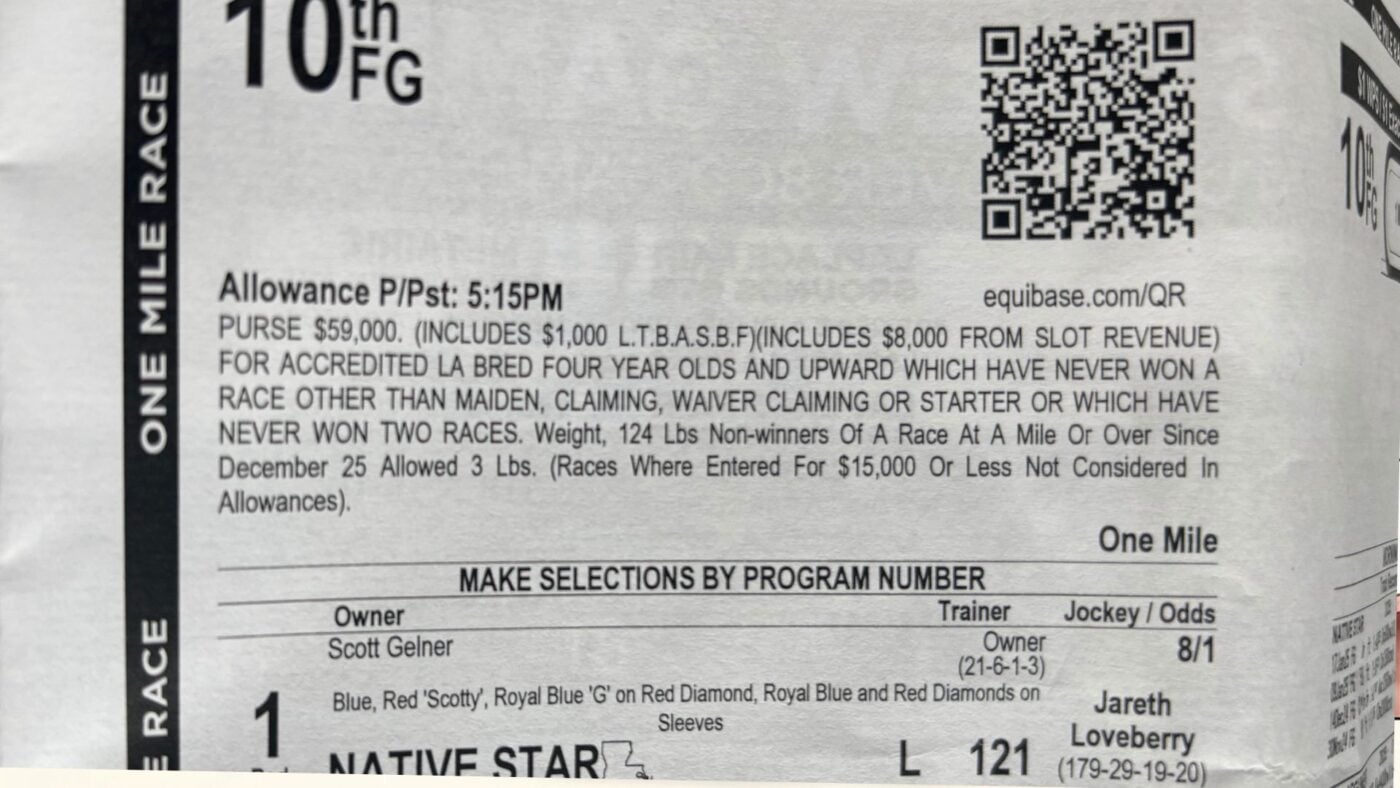
A full allowance condition reads something like this:
Sample allowance condition:
“Allowance. Purse $42,000. For three-year-olds and upward which have never won two races other than maiden, claiming, or restricted.”
Breaking this down:
- “Three-year-olds and upward” — age restriction; no two-year-olds
- “Never won two races” — horses that have won zero or one qualifying race are eligible; horses with two or more qualifying wins are not
- “Other than maiden, claiming, or restricted” — the critical phrase. Wins in maiden, claiming, and restricted races do not count against eligibility. Only wins in open allowance or stakes company count. A horse that won ten claiming races but zero allowance races still qualifies as N1X for this condition.
The phrase “other than maiden, claiming, or restricted” is the single most misunderstood element of allowance conditions. It means the conditions filter by type of win, not total wins. A horse that has won twenty races in maiden and claiming company but has never won an open allowance race is still eligible for a first-level allowance under the standard N1X condition — assuming no other restrictions such as earnings caps or state-bred exclusions apply. The condition book is asking: how many times has this horse proven itself in open, non-purchase company?
The Condition Codes Explained: N1X, N2X, N3L, N3X
Condition codes are shorthand used by racing secretaries, trainers, and handicappers to quickly categorize allowance eligibility. You’ll see these codes in the condition book, on Equibase, and in Daily Racing Form past performances. Understanding them lets you read a condition in seconds rather than parsing the full legal text each time.
| Code | Full Meaning | Who Qualifies | Competitive Level |
|---|---|---|---|
| N1X | Non-winner of one race other than maiden or claiming | Horses that have never won an open allowance or stakes race | Entry-level allowance — first step above claiming/maiden |
| N2X | Non-winner of two races other than maiden or claiming | Horses that have won no more than one open allowance race | Second-level allowance — horses that have passed the N1X test |
| N3X | Non-winner of three races other than maiden or claiming | Horses that have won no more than two open allowance races | Third-level allowance — competitive with stakes-quality horses |
| N3L | Non-winner of three races lifetime | Horses with fewer than three wins of any kind in their entire career | Varies — can include horses moving from claiming; total career wins matter |
| N2L | Non-winner of two races lifetime | Horses with fewer than two career wins total | Often softer than N1X; includes horses just above maiden level |
| OC (Optional Claiming) | Allowance condition with an optional claiming price | Meets the written condition; may or may not carry a claiming tag | Hybrid — some horses protected, some available for purchase |
N1X vs N3L — the critical difference:
- N1X counts only allowance and stakes wins — a horse with 15 claiming wins and 0 allowance wins qualifies as N1X
- N3L counts all wins of any type — a horse with 2 claiming wins qualifies as N3L because it has fewer than 3 lifetime wins regardless of type
- N3L conditions often produce softer fields at regional tracks because they include horses just stepping up from one or two wins in any company
- N1X conditions can produce surprisingly tough fields at major circuits because experienced claiming horses with many wins still qualify if those wins were in claiming company
The ladder works sequentially in most careers. A horse typically runs N1X first after breaking its maiden or winning a claiming race. If it wins, it becomes an N2X horse. Win again, it becomes N3X. After multiple allowance wins, the horse is either pointed toward stakes or, if it can’t compete at that level, dropped back to claiming company. This progression is why allowance form is so valuable — each win tells you the horse has beaten real competition in open, protected company.
Horseman’s Perspective — N1X at Delta Downs vs N1X at Saratoga: The code is the same but the race is completely different. An N1X at Delta Downs often fills with horses that have been grinding through claiming company and one or two solid claiming wins. An N1X at Saratoga can be packed with lightly raced horses from top barns that have done nothing but win a maiden special weight in impressive fashion. The same eligibility code produces wildly different competitive environments depending on the circuit. Read the condition; then read the track. Both matter.
Allowance vs Optional Claiming Races
Optional claiming races — often listed as “OC” in the condition book — are a hybrid format that combines allowance conditions with an optional claiming price. Horses that meet the written allowance condition can enter without a claiming tag and cannot be purchased. Horses that don’t meet the condition can enter if they agree to be sold at the stated claiming price. Both groups run in the same race.
A typical optional claiming condition reads: “Allowance/Optional Claiming $25,000. For three-year-olds and upward which have never won two races other than maiden or claiming, OR which have not won a race since [date].” The first group (N2X eligibles) enters without a tag. The second group (horses that haven’t won recently) enters at the $25,000 claiming price. The “OR” is the key word — either qualification gets a horse into the race, but through different doors.
Betting warning — optional claiming fields are mixed: In an OC race, some horses are protected (no claiming tag) and some are available for purchase. The ones running with a tag have typically been entered there because they don’t meet the allowance condition — often meaning they’re coming off a win that would disqualify them from the pure allowance, or they’re quality horses whose connections are willing to accept some claiming risk for the right purse opportunity. Always check the past performances to determine which horses in an OC field are protected and which carry a tag — the competitive dynamics are different for each group.

What Allowance Races Mean for Owners
For owners, the allowance tier represents the most consequential placement decisions in a horse’s career. Three situations come up repeatedly:
Graduating from maiden or claiming company. Once a horse wins its maiden or a claiming race, the next question is whether to stay in claiming company or take a shot at N1X allowance. The right answer depends on how the win looked — a dominant maiden win with improving figures suggests N1X; a grinding maiden win in a soft field might suggest another claiming race first. Moving up too soon to N1X and getting beaten badly can affect a horse’s confidence and takes a race off its eligibility. Moving too slowly wastes time in weaker company and lower purses.
A typical decision point: picture a 3-year-old colt who breaks his maiden by daylight at Fair Grounds. His connections have three real options. He could run back in a claiming race, cheap and safe, but he’s now exposed to being bought away from them. He could try an N1X allowance, protected from claiming but facing genuinely tougher company. Or, if the condition book has one, he could go into an optional claiming race — allowance purse money with some claiming risk attached, a middle path. Which one is right depends entirely on how that maiden win actually looked, not just that it happened.
Protecting a horse from claiming risk. An owner who has a horse that can compete in allowance company but is worried about losing it in a claiming race has allowance conditions as their protective option. Allowance horses cannot be claimed. This protection comes at a cost — allowance fields are tougher — but for a horse with real potential, the protection is often worth accepting the tougher competition.
Navigating the condition book gap. A horse that wins an N1X race is now an N2X horse — which means it no longer qualifies for N1X conditions. If N2X races don’t appear frequently in the condition book at the current track, the horse may face weeks without a suitable race. This eligibility gap is one of the most common problems I see owners encounter — winning a race and then having nowhere to go. Planning the condition book sequence before targeting a race is essential; see the complete condition book guide for how to read the full sequence before committing to an entry.
Horseman’s Perspective — the eligibility gap in practice: I once pointed a horse at an N1X race at Evangeline, he won it cleanly, and then I realized there wasn’t an N2X race scheduled for the remaining three weeks of the meet. We had to either ship to another track or wait for the next meet to start. That’s a real cost — dayrate, shipping, or a fitness gap from sitting too long. Now I look at the full condition book before I make an entry, not just the current week. If winning a race creates a gap, I factor that into whether we run there or ship somewhere with a fuller condition sequence.
Betting Allowance Races
Allowance races are among the most interesting betting opportunities on any card — and among the most misread by the public. Several specific angles matter more in allowance company than in claiming or stakes races.
| Situation | What It Often Means | Betting Implication |
|---|---|---|
| First allowance start (N1X) after claiming wins | Horse has proven it in purchase company; connections believe it belongs in protected company | Watch the workout pattern — sharp works post-claim suggest the barn is confident; flat works suggest they’re testing rather than targeting |
| Horse dropping from allowance to claiming | Couldn’t compete at N1X or N2X level; connections looking for a win or accepting the risk of losing the horse | The “allowance drop” — classically one of the sharpest spots in racing if the horse showed ability in allowance company. Check whether it was beaten by class or by trouble |
| First N2X start after winning N1X | Horse has passed one test; connections are now testing the next level | How it won the N1X matters. A dominant front-running win may face a tougher pace scenario at N2X. A closer coming from behind at N1X may benefit from stronger pace at N2X |
| Lightly raced horse in N1X | Often a developing horse from a top barn that won its maiden impressively | Watch for underlays — the public often overcorrects for a flashy maiden win and bets these horses too low. The N1X field is tougher than the maiden field was |
| Horse moving from N1X to OC | Won the N1X but won’t risk losing the horse in a straight claiming race; OC gives purse opportunity with some claiming exposure | Note which horses in the OC field are protected vs tagged — different risk profiles compete in the same race |
The single most valuable allowance betting angle is the allowance drop — a horse that has run credibly in N1X or N2X company and now drops to a claiming price. These horses often carry legitimate allowance form into a weaker field and are bet by public players who see only the class drop as a negative signal. If the horse’s allowance efforts showed real ability — competitive margins, improving figures, pace-pressed runs rather than easy leads — the drop is opportunity, not red flag. The connections may have decided the horse isn’t a graded stakes runner but can still win in claiming company.
Four questions to ask before betting any allowance race:
- Does this horse’s best form actually fit the condition? A horse that has won three stakes races technically qualifies as N3X but may have been away for a year — current form matters more than peak eligibility
- Is this a first-level allowance with a soft field or a loaded one? N1X at a minor track is very different from N1X at Keeneland or Fair Grounds — the same code produces wildly different competitive quality by circuit
- What does the class move tell you about trainer intent? A horse being pointed at an N1X for the first time after three claiming wins is being tested, not coddled — the trainer is making a statement about where he thinks the horse belongs
- Who’s protected and who carries a tag in OC races? The split between protected and tagged horses in an optional claiming race changes the field dynamics significantly and is one of the most underanalyzed aspects of race handicapping
Allowance Races by Region and Track Level
The allowance tier is not uniform across the country. The same condition code produces a very different race depending on which circuit you’re at. Understanding the regional variation is one of the most useful things a bettor or owner can internalize.
Major circuits (Saratoga, Keeneland, Churchill Downs, Santa Anita): N1X conditions at these tracks regularly attract horses from top national barns with strong maiden wins and impressive morning works. The minimum quality in these fields is genuinely high — a horse that wins an N1X at Saratoga in July has beaten a field that would be competitive in small stakes at most tracks. Purses at these levels can reach $80,000–$100,000 for a non-graded allowance race.
Regional circuits (Fair Grounds, Turfway, Gulfstream Park West, Remington): N1X conditions are competitive but more accessible. Fields typically mix developing horses from regional barns with some horses shipping from major circuits for softer spots. Purses run $35,000–$60,000. The best horses at these circuits are often legitimate stakes contenders within their regional championship picture.
Smaller tracks (Delta Downs, Evangeline Downs, Mountaineer, Finger Lakes): N1X conditions often fill with a mix of solid claiming graduates and a few horses dropping from tougher company. Fields can be thinner and softer than the condition code implies. Purses run $15,000–$35,000. A horse that dominates these allowance conditions may still face a significant step up when it tries allowance company at a more competitive circuit.
Horseman’s Perspective — shipping to find the right allowance spot: I’ve shipped horses from Louisiana to other circuits specifically because the right allowance condition wasn’t available at home during the current meet. A horse that wins an N1X at Fair Grounds in January might wait three weeks for an N2X to come up. That same horse can sometimes find an N2X at Turfway or Oaklawn within a week, at a comparable purse, with a shorter layoff. The condition code matters. The circuit matters. The timing matters. Getting all three right is what a good condition book read looks like in practice.
Where Starter Allowance Races Fit
Starter allowance races are a protected non-claiming format that sits between claiming and open allowance, and they’re frequently confused with standard allowance races. The distinction matters for both owners and bettors.
A starter allowance condition restricts entry to horses that have previously started for a claiming price at or below a specified amount, typically within a set time window. A common example: “Starter allowance for horses that have started for a claiming price of $20,000 or less since [date].” Any horse that meets that criterion can enter — and crucially, the horse cannot be claimed out of the race. It’s an allowance format, not a claiming race, even though the eligibility is defined by claiming history.
This distinction matters practically. A horse that has been grinding in $12,500–$20,000 claiming company and showing real form might not yet be ready for open N1X allowance competition — the field quality is different and the horses it would face have often never run in claiming company at all. The starter allowance gives those horses a protected spot where they can compete against similar backgrounds without facing a lightly-raced horse that won a maiden special weight in dominant fashion and has never been in a claiming race in its life.
Starter allowances appear most frequently at smaller regional tracks where the condition book has room for this middle tier. They’re less common at major circuits like Saratoga or Keeneland, where the claiming-to-open allowance jump is more compressed. If you’re managing a horse at a track like Delta Downs or Evangeline and it’s doing well at the $15,000–$20,000 claiming level, a starter allowance is often the right next step before testing open N1X company. The purse is typically better than the claiming level it came from, the horse can’t be taken away, and the field is likely drawn from horses with comparable claiming backgrounds rather than elite maiden graduates.
Key Takeaways: Allowance Races
- Allowance races sit between claiming and stakes — the development layer where horses are protected from purchase but face one of the toughest non-stakes levels on most condition books
- The condition system filters by win type, not total wins — a horse with fifteen claiming wins and zero allowance wins still qualifies as N1X; the code counts only open non-purchase wins
- N1X, N2X, N3X, N3L are the key codes — each step up the ladder requires proving yourself at the previous level; N3L counts all wins of any type, making it a different filter than N3X
- Optional claiming (OC) races are hybrids — some horses run protected, some carry a tag; the competitive dynamics differ for each group in the same field
- The allowance drop is one of the sharpest betting angles in racing — a horse with legitimate allowance form dropping to claiming often faces a weaker field while the public only sees the class drop
- Regional variation is real — N1X at Saratoga and N1X at Delta Downs carry the same code but produce completely different competitive environments; read the circuit, not just the condition
- The condition book gap is the most common owner mistake — winning an allowance race and then having no suitable follow-up condition at the current meet is a planning problem, not an accident

FAQs About Allowance Races
What is an allowance race in horse racing?
An allowance race is a non-claiming race where eligibility is determined by written conditions based on a horse’s racing history — typically how many races it has won, what type of wins those were, and sometimes when those wins occurred. Horses cannot be purchased out of an allowance race. Allowance races sit above claiming races and below stakes on the class ladder, offering higher purses than claiming races without the purchase risk.
What does N1X mean in horse racing?
N1X means ‘non-winner of one race other than maiden or claiming.’ It’s the entry-level allowance condition, and a horse can still qualify even if it has won several claiming races, because those wins don’t count the same way in the condition book.
What is the difference between N1X, N2X, and N3L?
N1X means the horse has never won an allowance or stakes race. N2X means it has won no more than one. N3X means no more than two. These codes count only open non-claiming, non-maiden wins. N3L is different — it counts all wins of any type, lifetime. A horse with two claiming wins qualifies for N3L because it has fewer than three total career wins. N3L conditions often attract a different field profile than N3X because they can include horses that have just stepped out of claiming or maiden company.
Can horses be claimed out of an allowance race?
No. In a standard allowance race, horses cannot be claimed. In an optional claiming (OC) race, horses that meet the allowance condition run protected and are not for sale; only the horses entered for the stated claiming price carry that risk.
What is an optional claiming race?
An optional claiming race (OC) is a hybrid that combines allowance conditions with an optional claiming price. Horses that meet the written allowance condition enter without a claiming tag and cannot be purchased. Horses that don’t meet the allowance condition — often because they’ve won too many races to qualify — can enter if they agree to be available for the stated claiming price. Both groups run in the same race, creating a field with mixed claiming exposure.
Why do horses drop from allowance to claiming?
Several reasons: the horse couldn’t compete at the allowance level and connections are looking for a winnable spot; the owner wants to sell the horse; the horse is returning from a layoff and the trainer wants a spot where it can get confidence without facing top allowance competition; or the horse simply fits better at the claiming level than the allowance level. The ‘allowance drop’ — a horse going from allowance to claiming — is one of the most useful handicapping angles in racing because it often signals legitimate class relief into a softer field.
What is a starter allowance race?
A starter allowance race is restricted to horses that have previously been entered for a claiming price at or below a specified amount — typically within a certain time period. For example, ‘starter allowance for horses that have started for a claiming price of $20,000 or less in the past year.’ Starter allowances give horses a protected alternative to claiming races without the full open allowance competitive standard. They sit between claiming and open allowance on the quality scale and are especially common at smaller tracks.

About Miles Henry
Racehorse Owner & Author | 30+ Years in Thoroughbred Racing
Miles Henry (legal name: William Bradley) is a professional horseman based in Folsom, Louisiana. He holds Louisiana Racing License #67012 and has spent over three decades managing Thoroughbreds at premier tracks including Fair Grounds, Delta Downs, and Evangeline Downs.
Expertise & Hands-On Experience: Beyond the track, Miles has decades of experience in specialized equine care, covering everything from hoof health and nutrition to training protocols for Quarter Horses, Friesians, and Paints. Every guide on Horse Racing Sense is rooted in this “boots-on-the-ground” perspective.
30 of their last 90 starts
Equibase Profile.

Connect with Miles: