
Last updated: September 17, 2026
Any links on this page that lead to products on Amazon are affiliate links and I earn a commission if you make a purchase. Thanks in advance – I really appreciate it!
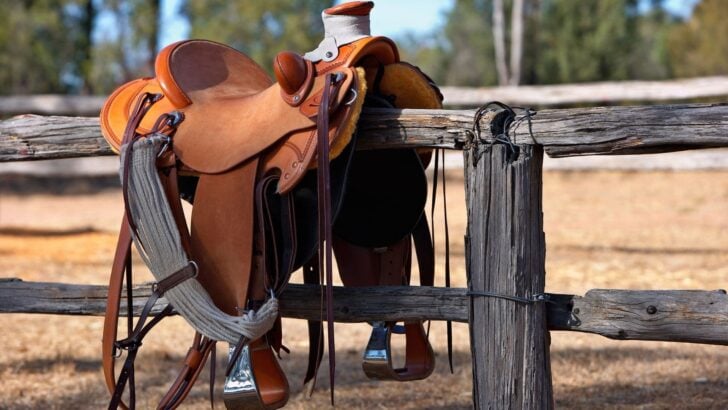
A Western saddle has a lot of parts, and knowing what each one is called makes it easier to spot wear, discuss repairs with a saddle maker, and explain a possible fit problem to your trainer. Whether you’re shopping for a saddle, checking out a used one, or simply curious how all those leather pieces work together, understanding saddle anatomy is useful.
What are the parts of a Western horse saddle? The tree is the saddle’s internal foundation. It supports the main structure, including the seat, horn, fork or swell, cantle, skirt, fenders, and stirrups. The cinch and rigging system secure the saddle to the horse, while the gullet, latigo, offside billet, strings, and conchos each have a specific job.
Below, I’ll walk through what each part does, how the pieces work together, and what I check when I’m looking over an older saddle or considering a used one.
Table of Contents

Parts of a Western Saddle
The easiest way to spot these on an actual saddle is front to back. Up front are the horn, fork, and gullet. In the middle are the seat and cantle. Underneath are the tree and skirt. Hanging down are the fenders and stirrups. Then there is the rigging system that holds the saddle securely on the horse.
Main Western Saddle Parts
| Part | Also Called | What It Does |
|---|---|---|
| Tree | – | The saddle’s internal foundation. It determines the saddle’s basic shape, influences fit and weight distribution, and provides the structure the rest of the saddle is built around. |
| Horn | Saddle horn | The knob on top of the fork. It was designed for rope work when handling cattle. Riders may rest a hand on it when mounting or during quiet work, but it isn’t a substitute for balanced riding or a grab handle in an emergency. |
| Fork | Swell, pommel | The raised front section of the saddle, positioned over the horse’s withers and forming the base for the horn. Western riders commonly call it the fork or swell. “Pommel” is a broader saddle term also used for the front of some Western saddles. |
| Gullet | Channel | The open channel along the underside of the saddle. It should provide clearance over the horse’s withers and spine so the saddle carries weight on the muscles beside the spine, not on bone. |
| Seat | – | Where the rider sits, between the fork and cantle. Western seats vary by discipline, but many are designed to provide a more substantial, supportive feel than a close-contact English saddle. |
| Cantle | – | The raised back edge of the seat. It supports the rider and helps prevent the rider from sliding backward. |
| Skirt | – | The broad leather section beneath and around the tree. It covers and protects the tree, supports the fleece or lining, and contributes to how the saddle contacts the horse’s back. |
| Fenders | – | The wide leather panels that cover the stirrup leathers and hang down the sides of the saddle. They help protect the rider’s leg from rubbing directly against the horse and rigging. |
| Stirrups | – | The frames that support the rider’s feet. They help with mounting, balance, and weight distribution while riding. |
Parts That Secure the Saddle
| Part | Also Called | What It Does |
|---|---|---|
| Cinch | – | The strap that runs beneath the horse’s belly and holds the saddle in place. Western riders call it a cinch; the comparable English-saddle strap is called a girth. |
| Rigging | Rigging D-rings, rigging plates | The attachment system connecting the saddle to the cinch. It may use D-rings, flat plates, or other hardware secured to the tree. Inspect the hardware, leather, and stitching regularly because the rigging carries the forces that hold the saddle on the horse. |
| Latigo | Near-side latigo | The long leather strap, usually on the horse’s left side, that threads through the cinch ring and rigging D-ring to tighten the cinch. Check it for cracks, dry rot, stretched holes, and thinning leather. |
| Offside billet | Off billet, offside | The shorter strap on the horse’s right side that connects the rigging to the cinch. Depending on the saddle, it may be fixed or adjustable, and it deserves the same close inspection as the latigo. |
| Rear cinch | Back cinch, flank cinch | A second cinch used on some double-rigged saddles, especially for ranch, roping, and certain working uses. It should be adjusted correctly and connected to the front cinch with a hobble strap so it can’t hang too far back. |
Other parts you may hear mentioned: Saddle strings are leather ties along the skirt used for securing gear such as a rope, rain slicker, or saddle bags. Conchos are decorative metal or leather discs, often used where saddle strings attach. Depending on the saddle, you may also hear terms such as stirrup leathers, fleece, jockeys, billets, and saddle rigging plates.
Miles’ Take: A saddle can look beautiful on the outside and still have a problem underneath. I never take a used saddle at face value – a few minutes checking the parts below tells you a lot more than the finish does.


Western Saddle Parts to Check Before You Ride
You don’t need to take a saddle apart before every ride, but I do give the working parts a quick look. The pieces that deserve the most attention are the ones holding the saddle on the horse and carrying your weight.
- Latigo and offside billet: Look for cracks, dry rot, stretched holes, thinning leather, and damage where the straps bend around the cinch ring and rigging.
- Cinch and rigging: Check webbing, buckles, D-rings, plates, and stitching for wear, loose hardware, sharp edges, or anything that could rub the horse.
- Fenders and stirrup leathers: Inspect the leather around the adjustment holes, buckles, stirrup neck, and fender edges for cracks or excessive stretching.
- Tree and skirt: A shifting fork or cantle, new squeaks or pops, or a saddle that suddenly sits differently on the horse are all worth a closer look – see which parts can be replaced below for what to do if you spot one.
- Rear cinch, if used: Make sure it’s adjusted correctly and connected to the front cinch with a hobble strap so it can’t hang too far back.
If you find a safety-critical problem, don’t try to get one more ride out of it. Repair or replace the worn part before you ride again.
Western Saddle Parts vs. English Saddle Parts
At a glance, all saddles can look similar, but Western and English saddles are built for different jobs, and the parts reflect that:
| Western saddle | English saddle |
|---|---|
| Horn for rope work and certain Western disciplines | No horn |
| Tree covered by a broad skirt, often with fleece or wool underneath | Tree with padded panels underneath |
| Rigging, latigo, offside billet, and cinch | Billets and girth |
| Fenders that cover the stirrup leathers | Exposed stirrup leathers |
| Often a larger bearing surface and a more substantial feel | Generally less bulk and closer rider-to-horse contact |
Western and English saddles are built for different jobs, so the parts are arranged differently. A Western saddle uses a horn, skirt, rigging, cinch, latigo, and fenders; an English saddle uses panels, billets, a girth, and exposed stirrup leathers. Neither style is automatically more comfortable or better for a horse – the right choice depends on the job, the rider, and, most importantly, how the saddle fits the individual horse.
Why Saddle Fit Matters
Choosing a saddle isn’t just about picking the prettiest or most affordable one. A poor fit on the horse can cause sores, pressure points, and behavioral issues as the horse starts associating riding with discomfort – and in bad cases, can affect the horse’s back or movement over time. A poor fit for the rider makes for an unstable seat, which raises the odds of falling and can lead to backaches on longer rides.
Every horse and rider is different, so treat saddle fit as something to reassess periodically, not a box you check once. If your horse starts pinning its ears during tacking up, resisting forward movement, bucking, changing stride, or acting differently under saddle than on the ground, don’t automatically assume it’s a training problem. Rule out pain and have the fit evaluated by an experienced saddle fitter when appropriate.
How Long Do Western Saddles Last?
There’s no fixed lifespan for a Western saddle. A well-made saddle that’s stored properly, kept clean, and repaired when needed can stay serviceable for decades. On the other hand, poor leather, weak hardware, a damaged tree, hard daily use, damp storage, and neglected maintenance can shorten the life of any saddle considerably. A horse that’s young, aging, changing weight, or developing muscle differently may also outgrow a saddle that’s still structurally sound.
Heavy-use competition saddles often need closer inspection, since their rigging, leather, fleece, stitching, and stirrup components see more stress. That doesn’t mean you automatically need a new saddle every few years – inspect the parts that carry weight and secure the saddle, reassess fit as your horse changes, use a properly chosen saddle pad, and repair or replace the component that’s worn or unsafe.
Miles’ Take: I get a lot more life out of my pleasure riding saddles than my competition saddles. The ones that see hard, regular use simply wear faster, no matter how well you care for them.

Which Parts Can Be Replaced?
When one of my saddles gets damaged, I have to decide whether it makes more sense to repair it or replace it. Replacing one worn part is usually less expensive than buying another saddle, but the answer depends on the saddle’s quality, the condition of the tree, the cost of labor, and how well the saddle still fits the horse.
Latigos, offside billets, cinches, stirrup leathers, fenders, strings, some rigging components, fleece, stitching, and certain seat or skirt repairs may be repairable or replaceable. The cost can climb quickly on a quality saddle, though, especially when the seat, rigging, or large leather sections need to be rebuilt.
The tree is different. It’s the saddle’s foundation, and a cracked, broken, or shifting tree should be inspected by a qualified saddle maker, repairer, or fitter before the saddle is ridden again. A new squeak or pop, a loose fork or cantle, uneven bars, a saddle that suddenly rocks, or a change in how it sits on the horse can all be warning signs, but none of them alone confirms a broken tree. Tree repair is sometimes possible, but it can be expensive enough that replacement is the better value.
A saddle pad can improve cushioning and help fine-tune a saddle that already fits reasonably well, but it can’t correct the wrong tree shape or width. If the saddle pinches, bridges, rocks, sits low at the withers, or creates soreness, ask a qualified saddle fitter to assess the fit instead of trying to solve the problem with a thicker pad.
Miles’ Take: We’re lucky to have a good saddle repairman nearby who charges fair rates, but he’s backed up enough that it takes at least six months to get a saddle back. Worth knowing before you commit to a repair over a replacement – factor the wait into your decision, not just the price. Before I send a saddle out, I take pictures of the problem areas and ask exactly what’s being repaired – costs can climb fast once the tree, seat, or rigging is involved.
My advice: weigh your options. Talk to a professional, get a real number on repair costs, and compare that against what a new saddle in similar quality actually costs before deciding.
Saddle Care and Maintenance
Most saddle problems come from small things left unaddressed, not one dramatic failure. Here’s where I see riders go wrong most often.
If you’d rather watch the process, this video shows the basic steps for cleaning and conditioning a Western saddle.

- Skimping on the saddle pad: A good pad does more than cushion – it helps distribute the rider’s weight and protects the horse’s back. A worn-out or missing pad can lead to discomfort or injury.
- Skipping fit checks: Horses change shape over time just like people do. Check the fit periodically rather than assuming it’s still right because it was right last year.
- Ignoring early wear: A minor crack or a loosening stitch is cheap to fix now and expensive to ignore. Small problems compound if you let them.
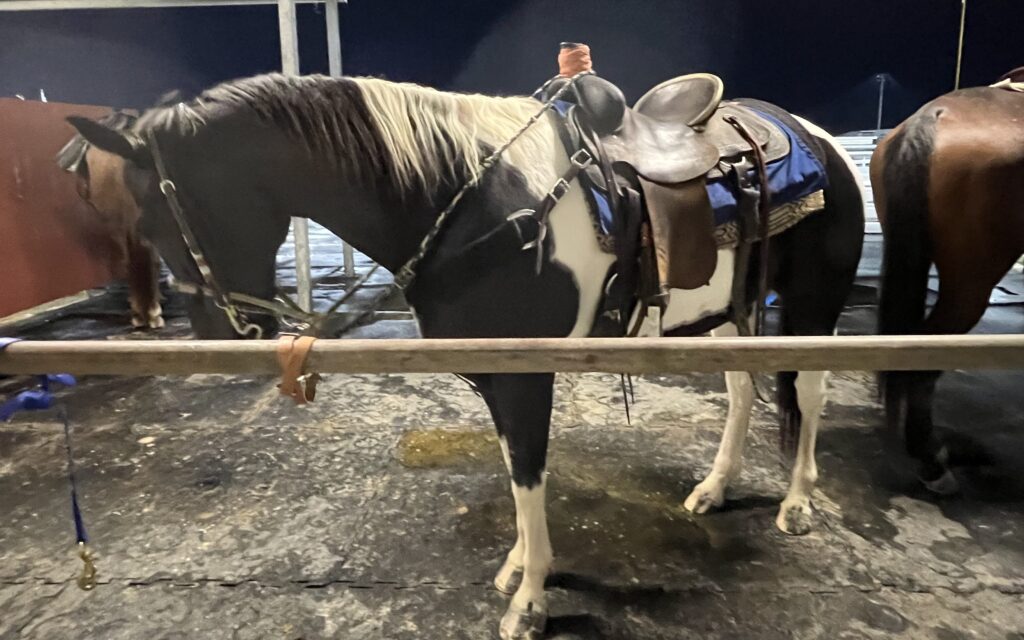
On the maintenance side, the routine is simple and doesn’t take long if you keep up with it:
- Wipe the saddle down and clean it with saddle soap.
- Apply leather conditioner for extra protection.
- Let the leather dry naturally – never force-dry it near heat.
- Store it in a cool, dry spot on a saddle rack. If your barn is dusty, cover it with a sheet or saddle cover.
That routine only takes a few minutes when you stay on top of it, and it can prevent dry, cracked leather and small repair issues from becoming expensive problems.
FAQ
What are the parts of a Western saddle called?
The main parts are the horn, fork (also called the swell), seat, cantle, tree, gullet, skirt, fenders, stirrups, cinch, latigo, offside billet, rigging, strings, and conchos. The tree forms the internal frame, and everything else attaches to it.
What is the horn of a saddle for?
The horn sits on top of the fork at the front of the saddle. It was designed for rope work when handling cattle. Riders may rest a hand on it when mounting or during quiet work, but it shouldn’t be used as a substitute for balance or as a grab handle in an emergency.
What is the fork or swell on a Western saddle?
The fork, also called the swell, is the raised front section of the saddle beneath the horn. It sits above the horse’s withers and forms the saddle’s front structure. Some riders also use “pommel” for this area, though that term is most closely associated with English saddles.
How long do Western saddles last?
A well-made Western saddle can last for decades when it’s stored properly, cleaned and conditioned as needed, and repaired before minor wear becomes a major problem. Its actual lifespan depends on construction quality, use, climate, storage, tree condition, leather care, and whether it still fits the horse.
How much do Western saddles weigh?
Most Western saddles weigh around twenty-five pounds, though this varies with the materials and design. Saddles with heavy metal decoration can weigh well over forty pounds.
What’s the difference between a saddle tree and a saddle pad?
The tree is the rigid internal frame of the saddle. It determines the saddle’s basic shape, supports the rider, and must match the horse’s back well enough to distribute pressure properly. A saddle pad sits between the saddle and the horse to provide cushioning, manage sweat, and protect the leather or fleece. A pad can help fine-tune a suitable fit, but it can’t make the wrong tree shape or width fit correctly.
Which Western saddle parts should I inspect most often?
Inspect the latigo, offside billet, cinch, rigging, stirrup leathers, fenders, stitching, and tree regularly. These parts either keep the saddle secured to the horse or carry the rider’s weight. Cracked leather, stretched holes, loose stitching, damaged hardware, or a saddle that shifts or rocks should be addressed before riding.
Once you know your saddle’s parts, fitting problems, wear, and repairs all get a lot easier to spot. Learn the anatomy, keep it clean and conditioned, and check the fit on a real schedule instead of waiting for a sore back to tell you something’s wrong. Written from the perspective of a lifelong horse owner and rider, this guide breaks down the parts I inspect when buying, maintaining, and riding Western saddles.
About Miles Henry
Racehorse Owner & Author | 30+ Years in Thoroughbred Racing
Miles Henry (legal name: William Bradley) is a professional horseman based in Folsom, Louisiana. He holds Louisiana Racing License #67012 and has spent over three decades managing Thoroughbreds at premier tracks including Fair Grounds, Delta Downs, and Evangeline Downs.
Expertise & Hands-On Experience: Beyond the track, Miles has decades of experience in specialized equine care, covering everything from hoof health and nutrition to training protocols for Quarter Horses, Friesians, and Paints. Every guide on Horse Racing Sense is rooted in this “boots-on-the-ground” perspective.
30 of their last 90 starts
Equibase Profile.

Connect with Miles: