

Last updated: August 1, 2026
In a handicap race, the better horse is asked to carry more weight and prove it. The idea is to keep the race honest, and any horseman knows a few pounds can matter a lot more than most people think.
Table of Contents
How a Handicap Race Works
In most horse races, horses carry weight determined by race conditions — a set amount for the class of race, with adjustments for age, sex, and apprentice jockeys. In a handicap race, the weight each horse carries is individually assigned by the track’s racing secretary based on that specific horse’s ability relative to the others in the field.
Think of weight like running with a backpack. A few extra pounds barely affects a short sprint — but over a mile or more, that burden compounds with every stride. The best horse in the field gets the heaviest backpack. Everyone else gets a little less.
The theory is straightforward: if Horse A is significantly better than Horse B, Horse A carries enough extra weight that the speed advantage is neutralized. In a perfectly handicapped race, every horse would finish in a dead heat. That never actually happens — but it’s the ideal the system is reaching for.
| Horse | Assigned Weight | Theoretical Outcome | What It Means |
|---|---|---|---|
| Top horse in field | 126 lbs (topweight) | Carries the most — ability burdened by weight | Better horse, bigger handicap |
| Mid-range horse | 118 lbs | Carries 8 lbs less than topweight — competitive advantage | 8 lb difference ~ several lengths per mile advantage |
| Lesser horse | 112 lbs | Carries 14 lbs less than topweight — significant advantage | 14 lb difference ~ significant lengths per mile advantage |
| Bottom of field | 108 lbs (bottom weight) | Minimum weight — lightest possible assignment | Maximum weight relief; horse must still earn it on the day |
Horse A: 126 lbs | Horse B: 114 lbs | Last race margin: Horse A by 1 length
Weight swing = 12 lbs ~ 2.5-3 lengths at a mile — the theoretical advantage flips to Horse B. If the public still bets Horse A as the favorite, you have an overlay on your hands.
The key distinction from other race types is that the weight differential is deliberate and individualized. In a claiming race, all horses typically carry similar weight adjusted only for sex and age. In a handicap race, the weight spread can be 20 pounds or more between the best and worst horse in the field — a substantial performance difference that shapes the entire race dynamic.
What a Handicap Race Looks Like on Race Day
When you look at a race program or past performances for a handicap race, the first thing you’ll notice is that every horse is carrying a different weight. One horse might be listed at 126 pounds, another at 118, and another at 112. Those numbers include the jockey, saddle, and any lead weights placed in the saddlecloth to reach the assigned total. The higher number signals the horse the racing secretary believes is the best in the field.
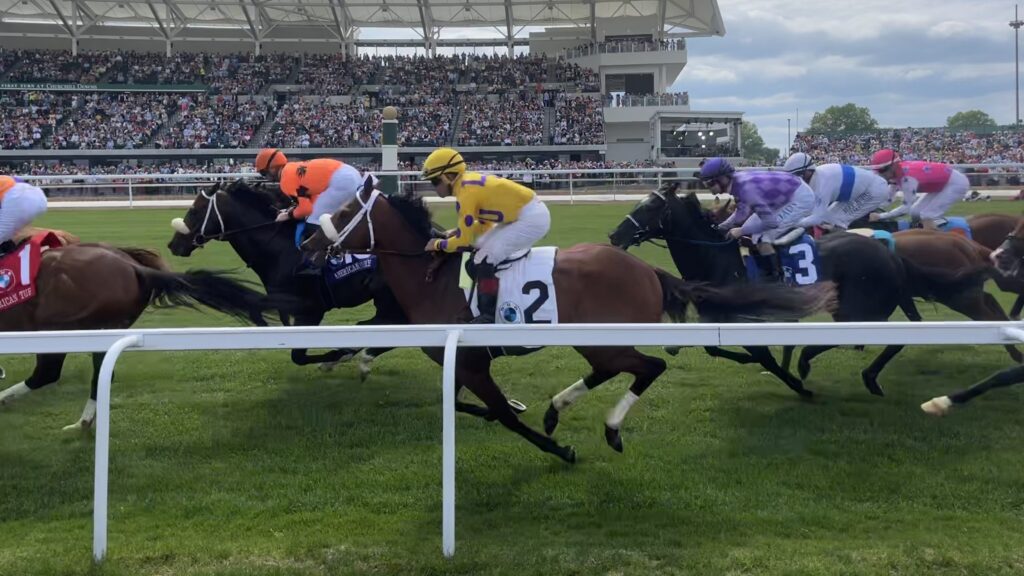
On the track, you won’t visually notice the difference — horses don’t look heavier or slower because of a few pounds. But over the course of the race, especially at longer distances, those weight differences affect how long a horse can sustain its speed. The topweight horse may look comfortable at the half-mile; by the final furlong, it may be feeling those extra pounds more than the lighter rivals closing from behind.
Why Do Handicap Races Exist?
Handicap races exist to solve a problem every racing secretary faces: the horses in a field are almost never equal in ability, which means without intervention, the best horse wins most of the time and betting becomes predictable. The handicap format addresses this in three practical ways.
First, it keeps betting markets competitive. When every horse in a field carries weight calibrated to its ability, the theoretical outcome is a dead heat — meaning the public can’t simply back the fastest horse and expect consistent returns. Second, it prevents domination by elite horses that would otherwise sweep through lighter company unopposed. A horse that has won five straight races in allowance company carries a weight burden in a handicap that reflects that winning streak. Third, it creates wagering interest across the full field rather than concentrating action on one or two prohibitive favorites — which matters both for the track’s handle and for the bettors who want a return on their investment.
In practice, the format has declined at the highest levels of American racing — most major stakes races have shifted to weight-for-age or conditions formats — but it remains central at regional tracks where starter handicaps are a staple of the weekly card.
Why Trainers and Owners Enter Handicap Races
Everything above explains handicap races from the track’s side of the fence. From the barn side, the decision to enter one looks different — and this is where owning horses for 30 years teaches you things a bettor never has to think about.
Catching a favorable weight assignment. If you think your horse is sitting on a good effort and might be underrated by the racing secretary, a handicap can work in your favor. Catch a light weight in a competitive field and you’re getting an advantage you won’t see in allowance races — the secretary has given you free ground before the gate even opens.
Avoiding a tougher allowance or stakes spot. Sometimes a handicap is simply the softer target on the condition book that week. A horse that would be overmatched stepping up to open allowance company might find a winnable spot in a handicap where the weight scale keeps things closer to even.
Building a horse’s confidence after improvement. A horse coming off a troubled trip or a step up in class that didn’t go well sometimes needs a race it can win to reset. A handicap where the secretary hasn’t yet caught up to recent improvement can be exactly that spot.
Using class and weight together, strategically. The sharpest move I’ve seen from other owners — and made myself a few times — is entering a horse in a handicap specifically because the weight break combines with a class edge the secretary hasn’t fully priced in yet. Neither factor alone is enough; together, they’re worth entering for.
How the Racing Secretary Assigns Weights
In American racing, weight assignments in handicap races are made by the track’s racing secretary — a track official who also writes the condition book and manages entries. The process is fundamentally different from the published numerical rating systems used in British and Irish racing, where horses receive a specific number (e.g., a rating of 105) that directly translates to a weight assignment.
American track handicappers use a more subjective, form-based approach. The secretary reviews each horse’s recent performances, class level, earnings, and current form to determine where they sit relative to the other horses in the field. The horse judged to be the best in the field is assigned the topweight — typically 126 pounds in graded stakes handicaps, per Equibase race condition data — and every other horse receives a weight scaled below that based on the handicapper’s assessment of how much ability separates them. Handicap assignment is just one of several ways American racing sets weight — for the full picture, including weight-for-age, sex allowances, and apprentice riders, see our guide to why racehorses carry different weights.
| Factor | How It Affects Weight | Notes |
|---|---|---|
| Recent race results | Wins and close finishes raise weight; poor finishes lower it | Most heavily weighted factor — current form matters more than past reputation |
| Class of recent races | Horses from higher-class races carry more | A horse coming off a Grade I win carries more than one coming off a claiming win |
| Earnings | Higher lifetime earnings typically mean higher weight | More relevant in graded handicaps than in local track handicaps |
| Sex allowance | Fillies and mares receive a 5-lb allowance vs. males | Applied automatically; a filly assigned “120” carries 115 against males assigned 120 |
| Age allowance | Younger horses (2 and 3 year olds) carry less than older horses | Weight-for-age scale adjusts for developmental difference — 3-year-olds carry 3-5 lbs less than older horses at most distances |
| Penalty weight | Added weight for horses that win after weights are assigned | Typically 3-5 lbs added; prevents a horse from entering as a lesser weight after a recent win |
Weights are typically assigned several days before the race and published for all connections and bettors to see. Once assigned, a horse’s weight can increase through a penalty (if it wins after the weights are drawn) but cannot decrease. A horse that wins a race after weights are set for a handicap it’s already entered in typically picks up 3-5 pounds of penalty weight.
How Weight Affects Performance
The relationship between weight and performance is one of the most studied questions in horse racing. The widely used rule of thumb — cited in handicapping literature from Daily Racing Form and elsewhere — is that one pound of extra weight costs approximately one length per mile, though it’s an industry rule of thumb rather than an exact formula, and pace, surface, and individual horse physiology all shape how much it actually costs on a given day. It’s a useful framework for comparison, not a precise formula.
| Weight Difference | Performance Cost (6 furlongs) | Performance Cost (1 mile) | Performance Cost (1 1/4 miles) |
|---|---|---|---|
| 3 lbs | ~1/2 length | ~3/4 length | ~1 length |
| 5 lbs | ~3/4 length | ~1 1/4 lengths | ~1 1/2 lengths |
| 10 lbs | ~1 1/2 lengths | ~2 1/2 lengths | ~3 lengths |
| 15 lbs | ~2 1/4 lengths | ~3 3/4 lengths | ~4 1/2 lengths |
| 20 lbs | ~3 lengths | ~5 lengths | ~6 lengths |
Why Weight Matters More at Longer Distances
The weight-to-performance relationship is stronger at longer distances than at sprints. A 10-pound weight difference in a six-furlong sprint costs roughly a length and a half — meaningful but not decisive. At a mile and a quarter, the same 10 pounds costs around three lengths — the difference between winning and finishing out of the money in a competitive field.
Some horses carry weight better than others. Larger, heavier horses — draft-built Thoroughbreds with big frames — tend to be less affected by a few extra pounds than lighter-bodied, speed-type horses. A small, quick 900-pound sprinter carrying 126 pounds is at a larger relative disadvantage than a 1,200-pound, deep-bodied router carrying the same weight. Weight also has a larger impact on horses involved in early pace battles — carrying extra pounds while setting or pressing the pace compounds fatigue earlier in the race, which is why pace-pressing topweights are particularly vulnerable to late closers carrying light weights in route races.
The practical difference shows up clearly in real races. At Fair Grounds, I’ve watched mid-level handicap fields where a horse carrying 112 pounds — 12 or more below the topweight — ran down the leader in the final furlong of a mile route, having saved just enough energy through the stretch to get up. The topweight horse had led comfortably for six furlongs. The weight caught it in the eighth pole to wire. The bettor who noticed the weight advantage and the lighter horse’s closing style had a significant edge over the public.
Types of Handicap Races in American Racing
Not all handicap races work exactly the same way. American racing has several distinct formats that use weight assignment to shape competition.
| Race Type | How Weights Are Set | Who Can Enter | Where You’ll See It |
|---|---|---|---|
| Straight handicap | Racing secretary assigns individual weights to each horse | Open — any horse meeting the conditions | Major stakes races; less common at regional tracks now |
| Starter handicap | Racing secretary assigns weights; restricted field | Only horses that have previously been entered for a claiming price at or below a specified amount | Common at regional tracks including Fair Grounds and Evangeline Downs |
| Optional claiming handicap | Weights assigned; horses can enter with or without a claiming tag | Open; horses with tags can be claimed, those without cannot | Increasingly common as tracks blend formats |
| Weight-for-age race | Weights set by published weight-for-age scale (not by secretary) | Open — weights vary only by age, not ability | Classic races; Breeders’ Cup events; international racing |
| Invitational handicap | Weights assigned by racing secretary; horses invited by track | Selected by track based on quality | Major festivals; marquee race days |
Starter handicaps deserve special attention because they’re what most owners and bettors at regional tracks actually encounter. A starter handicap is restricted to horses that have previously been entered for a claiming price at or below a specified amount — for example, “starter handicap for horses that have run for a claiming price of $20,000 or less.” This limits the field to horses that have been in the claiming ranks, making it a competitive but not elite format. For a full explanation of how claiming races work, see our complete claiming race guide.
Handicap vs. Allowance vs. Claiming: Key Differences
Understanding what makes a handicap race distinct from other race types helps clarify when and why trainers enter horses in them — and how to bet them effectively.
| Race Type | Who Determines Weight | Is Horse For Sale? | Who Can Enter | Class Level |
|---|---|---|---|---|
| Handicap | Racing secretary — individually assigned | No | Open (or restricted by conditions) | Varies — can be any level from local to Grade I |
| Allowance | Race conditions — set by eligibility | No | Horses meeting the stated conditions | Above claiming; below stakes |
| Claiming | Race conditions — set by sex and age | Yes — at the claiming price | Any horse at or below the claiming price | Varies by price; backbone of regional racing |
| Stakes | Weight-for-age scale or conditions | No | Horses nominated and eligible | Highest — Grade I, II, III |
The practical difference between a handicap and an allowance race from an owner’s perspective is primarily in the weight. In an allowance race, the conditions set a base weight with allowances for specific eligibility criteria — a horse that hasn’t won a certain type of race gets a few pounds off. In a handicap, the track handicapper looks at the whole field and sets weights to create competitive balance. A horse that has been dominating allowance company may find itself carrying topweight in a handicap as the secretary deliberately burdens its advantage.
Betting Handicap Races: How to Use Weight as an Edge
Handicap races offer some of the best betting opportunities in racing precisely because the weight assignments create a second layer of analysis that most casual bettors ignore. The public tends to bet on the horse’s name and reputation; sharp bettors look at whether the track handicapper has assigned weights accurately — and where the mismatches are. For a complete foundation on horse racing wagering, see our guide to betting on horse racing.
- Giving away 10+ lbs at a route distance (1 mile or longer)
- Facing pace pressure — another horse will challenge early
- Won last race easily and is now significantly overbet
- Competing against a lighter horse whose recent form has improved
- Has a light-framed build that handles extra weight poorly
The public often focuses on the horse’s reputation. Experienced handicappers pay closer attention to whether the weight assignment matches the horse’s true ability.
| Betting Situation | What to Look For | Why It Creates Value |
|---|---|---|
| Topweight at short odds | Public betting a topweight horse down to heavy favoritism | The public is backing the horse’s reputation; the weight is working against it. An overlay opportunity often exists on a well-weighted rival. |
| Horse carrying big weight at route distance | Topweight at 1 1/4 miles or longer | At long distances, every pound matters more. A horse giving away 12+ lbs at a mile and a quarter is fighting a real structural disadvantage. |
| Racing secretary underrates a horse | A horse assigned a low weight whose recent form is significantly better than the secretary’s assessment | Low weight + undervalued ability = overlay. If the public also underestimates the horse, odds can be excellent. |
| Penalty weight after a win | Horse won after weights were assigned; picked up a 3-5 lb penalty | A horse sharp enough to win a race is likely still in good form — the penalty is public, but the current fitness is real. May create a value play. |
| Bottom weight in a competitive field | Lightly weighted horse in a field where topweight is significantly better | If the bottom weight is competitive and the weight relief is meaningful, the odds may not fully reflect the class compression. |
Here’s a sharper take that most guides won’t say directly: if a handicap favorite is giving away 10 or more pounds at a route distance, treat it as overbet until proven otherwise. The public prices in the horse’s reputation; the weight is working against it on every stride after the half-mile. At 10-plus pounds and a mile or longer, the weight difference becomes significant enough that I want a very good reason to ignore it.
Setup:
Horse A (favorite): 126 lbs | Horse B (closer): 114 lbs
Last race result: Horse A beat Horse B by 1 length at a mile
Weight analysis:
Weight difference: 12 lbs | Distance: 1 1/8 miles
Using the one-pound framework: 12 lbs ~ 2.5-3 lengths at this distance
Conclusion:
The weight swing more than erases the 1-length margin from last race. Horse B now has the theoretical edge — yet the public still bets Horse A because it won last time. That gap between public perception and weight reality is where overlay opportunities live.
Weight Difference (lbs) / 4 ~ lengths at 1 mile
Example: 12 lbs / 4 = 3 lengths at a mile. At 1 1/4 miles, add ~25%. At 6 furlongs, subtract ~40%. Use as a quick in-field estimate, not a precise calculation.
- Compare last race margin between the two horses you’re evaluating
- Convert the weight difference into lengths using the one-pound rule as a guide (e.g., 8 lbs ~ 2 lengths at a mile)
- Adjust the expected outcome — if the weight swing is larger than the recent margin between the horses, the lighter horse becomes the logical play
Example: Horse A beat Horse B by 1 length last race but now gives 8 lbs (~2 lengths at a mile). The weight shift alone flips the expected result — and if the public hasn’t noticed, you have an overlay.
One important caveat for bettors: in many modern U.S. races, the weight spread between horses is smaller than in historical handicaps — often compressed to 6-10 pounds across the field rather than 15-20. When the weight differential is narrow, pace, trip, and current form become more decisive than the weight assignments alone. The framework above is most powerful when the weight swing is 10 pounds or more and the distance is a mile or longer.
3 Handicap Race Patterns That Win Races
After you’ve looked at enough handicap races, you start seeing the same setups over and over. Most casual bettors never notice them.
| Pattern | What’s Happening | Why It Wins |
|---|---|---|
| Lightweight closer + fast early pace | A lightly weighted horse sits off a pace set by topweights fighting for position | The topweights burn energy early while carrying maximum weight; the closer arrives fresh with minimum weight in the stretch. This combination is the most reliable upset pattern in route handicaps. |
| Topweight + pace pressure = vulnerable | The best-weighted horse in the field is also a front-runner facing speed rivals | Carrying maximum weight while fighting for the lead compounds fatigue at the worst possible time. A topweight pressed through fast fractions rarely lasts. Fade this horse in the exacta; don’t throw it out entirely. |
| Recent winner + small penalty = still live | A horse that won after weights were set picks up a 3-5 lb penalty — but was clearly sharp enough to win a race | The penalty is public information the market has seen. What the market underestimates is that the horse is still in winning form. Horses in peak condition often absorb a small penalty without losing competitive edge — the form cycle matters more than the extra weight. |
Famous American Handicap Races
Handicap races were once the prestige format of American racing — where the best horses were tested against each other with weight doing the equalizing. The Santa Anita Handicap, still run annually at Santa Anita Park, is one of the few major American races that retains this traditional format. Most others have converted to weight-for-age or conditions stakes.
| Race | Track | Distance | Notes |
|---|---|---|---|
| Santa Anita Handicap | Santa Anita Park | 1 1/4 miles | One of the oldest and most prestigious American handicaps; known as “The Big Cap.” Still run annually at Santa Anita Park — one of the few major American races retaining the traditional handicap format. |
| Whitney Handicap (now Whitney Stakes) | Saratoga | 1 1/8 miles | Originally run as a handicap; now a Grade I weight-for-age race |
| Suburban Handicap | Belmont Park | 1 1/4 miles | Historic New York handicap dating to 1884 |
| Jockey Club Gold Cup | Belmont Park / Saratoga | 1 1/4 miles | Run as a handicap for much of its history; now a weight-for-age stakes |
| Pimlico Special | Pimlico | 1 3/16 miles | Historic Maryland race; Seabiscuit carried 130 lbs to victory here in 1938 |
Seabiscuit’s 1938 Pimlico Special win — carrying 130 pounds at a mile and three-sixteenths — is the most famous weight-carrying performance in American racing history. He wasn’t just winning; he was overcoming roughly 6-8 lengths of theoretical disadvantage against the lighter horses in the field. That he won decisively makes the key point: at elite levels, class can transcend weight. But only up to a point — and knowing where that point is separates serious bettors from casual ones.
You don’t need to go back to 1938 to see this dynamic play out. At the regional level — Fair Grounds, Evangeline Downs, the tracks I’ve watched for decades — starter handicaps regularly produce the same pattern on a smaller scale. A horse that has won two or three straight at the claiming level gets assigned topweight in a starter handicap. The connections enter with confidence. A lightly weighted closer sitting 10 pounds below and coming off a hidden good effort — one the secretary didn’t fully account for — closes them down in the stretch. The crowd bet the form horse. The sharp money was on the weight.
Handicap Race Terms Explained
Handicap racing has its own vocabulary. These are the terms you’ll encounter in the racing form and the condition book when a handicap race is on the card. For a complete horse racing glossary, see our horse racing terms glossary.
| Term | Definition |
|---|---|
| Topweight | The highest weight assigned in a handicap — carried by the horse the racing secretary believes is the best in the field. Carrying topweight is a statement of quality, but also the biggest burden. |
| Bottom weight | The lowest weight assigned — carried by the horse judged the weakest in the field, or the minimum weight allowed by the race conditions. Also called the minimum weight. |
| Penalty weight | Additional weight added to a horse after it wins a race subsequent to the original weight assignment. Typically 3-5 pounds. Prevents a horse from benefiting from a favorable weight after improving its form. |
| Weight-for-age (WFA) | A standardized weight scale that adjusts carrying weight based only on a horse’s age — not individual ability. WFA races are not technically handicaps because all horses of the same age carry the same weight. The WFA scale gives older horses more weight than younger ones at the same distance. |
| Ahead of the handicapper | A horse whose actual current ability is better than the weight it is assigned — meaning it should theoretically be carrying more. A horse “ahead of the handicapper” is likely underrated and may represent a betting opportunity. |
| Long handicap / out of the handicap | When a horse’s assigned weight falls below the minimum weight for the race, it is “out of the handicap” or in a “long handicap.” The horse must carry the minimum weight regardless — meaning it effectively carries more than its theoretical assignment. |
| Sex allowance | The weight reduction given to fillies and mares competing against males — typically 5 pounds. Applied automatically as part of the weight assignment. |
| Conditions | The specific eligibility requirements of a handicap race — which horses can enter, what the purse is, what the distance is, and what the weight range is. Conditions are published in the condition book several weeks before the race. |
FAQs: What Is a Handicap Race?
What is a handicap race in horse racing?
A handicap race is a race in which the track’s racing secretary assigns a different weight to each horse based on ability — better horses carry more, lesser horses carry less. The goal is to equalize the field so any horse theoretically has a chance to win. Weight assignments are published before the race and can increase (through a penalty) if a horse wins after the weights are drawn. Handicap races range from local starter handicaps at regional tracks to Grade I events like the Santa Anita Handicap.
How is weight assigned in a handicap race?
In American racing, the track’s racing secretary assigns weights based on each horse’s recent performance, class of races, earnings, and current form. The horse judged best in the field is assigned the topweight (typically 126 lbs in major handicaps), and all other horses receive individually set weights below that based on how much ability the secretary believes separates them. The process is more subjective than the published numerical rating systems used in British and Irish racing.
How much does extra weight slow a horse?
The consensus estimate is one pound of weight costs approximately one length per mile — or about one-fifth of a second per mile. At six furlongs, a 10-pound weight difference costs roughly 1.5 lengths. At a mile and a quarter, the same 10 pounds costs about 3 lengths. The effect is larger at longer distances and for lighter, speed-type horses than for larger, heavier-framed horses.
What is the difference between a handicap race and an allowance race?
In an allowance race, weight is set by race conditions — a base weight with reductions (allowances) for specific eligibility criteria like not having won a certain type of race. All horses meeting the conditions carry similar weights with small adjustments. In a handicap race, the racing secretary individually assigns each horse a unique weight based on its ability relative to the whole field. The weight spread in a handicap can be 15-20 pounds between the best and worst horse; in an allowance race, the spread is typically 3-5 pounds.
What is a starter handicap in horse racing?
A starter handicap is a handicap race restricted to horses that have previously been entered for a claiming price at or below a specified amount — for example, ‘starter handicap for horses entered for $20,000 or less.’ It’s a common format at regional tracks and sits between claiming races and open allowances in the class hierarchy. Weights are assigned individually by the racing secretary, just like in any other handicap.
What does topweight mean in a handicap race?
Topweight is the highest weight assigned in a handicap — carried by the horse the racing secretary judges to be the best in the field. Carrying topweight is both a recognition of quality and a burden. At route distances, a topweight horse carrying 15+ lbs more than the bottom weight is giving away significant ground in theoretical performance.
When Weight Doesn’t Matter (or Matters Less)
Understanding when weight is decisive is only half the picture. Knowing when it isn’t matters just as much for betting and entry decisions.
Large class gaps. When one horse is substantially better than the rest of the field, weight can’t fully compensate. A Grade I winner carrying 128 pounds against $25,000 claimers is still going to win by daylight. The weight-levels-the-field theory only holds when ability differences are small. When they’re large, weight is slowing the inevitable — not changing the outcome.
Short sprints. Weight compounds over distance — but in a five-furlong sprint, the race is over before the burden fully registers. A 10-pound weight difference costs roughly one length at six furlongs; at five furlongs it’s less than that. In sprints, gate speed, post position, and pace tend to dominate. Weight is a factor, not the factor.
Lone speed scenarios. When one horse has a clear speed advantage and faces no pace pressure, it can often carry extra weight comfortably — because it’s not expending energy fighting for position. A lone front-runner in a handicap carrying topweight, with no rivals to press it, has an easier task than the table would suggest. Pace shapes how much the weight costs; an uncontested lead softens that cost considerably. See our guide to pace figures for how to identify these scenarios before the race.
Conclusion
A handicap race is not just a race format — it’s a puzzle. The racing secretary’s weight assignments are a published theory about how the horses in a field compare to each other. Your job as a bettor — or as an owner deciding whether to enter — is to evaluate whether that theory is correct. When the secretary has it right, the field is genuinely competitive and any horse can win. When the secretary has it wrong, there’s an overlay somewhere in the field.
Weight matters more at longer distances and in closer fields. A horse carrying topweight against rivals it’s clearly superior to will still win. A horse carrying topweight in a field of near-equals is fighting a real battle against the scale. Understanding the difference — and being able to quantify it using the one-pound-per-length framework — is one of the most practical handicapping tools available.
In handicap racing, the odds don’t just reflect the horses — they reflect whether the racing secretary got it right. And when they didn’t, that’s where the money is.
Have you ever watched a topweight collapse in the stretch after leading through fast fractions — or seen a lightly weighted closer pick them off at the wire? Drop the race and the weight spread in the comments. I’ll break down what happened.
Sources
- Equibase — Race conditions and weight assignments: equibase.com
- Daily Racing Form — Past performances and handicap weight data: drf.com
- BloodHorse — Thoroughbred racing coverage and historical handicap data: bloodhorse.com
- National Thoroughbred Racing Association: ntra.com

About Miles Henry
Racehorse Owner & Author | 30+ Years in Thoroughbred Racing
Miles Henry (legal name: William Bradley) is a professional horseman based in Folsom, Louisiana. He holds Louisiana Racing License #67012 and has spent over three decades managing Thoroughbreds at premier tracks including Fair Grounds, Delta Downs, and Evangeline Downs.
Expertise & Hands-On Experience: Beyond the track, Miles has decades of experience in specialized equine care, covering everything from hoof health and nutrition to training protocols for Quarter Horses, Friesians, and Paints. Every guide on Horse Racing Sense is rooted in this “boots-on-the-ground” perspective.
30 of their last 90 starts
Equibase Profile.

Connect with Miles: