Skip to Content

What Do Horses Eat? A Complete Feeding Guide From Hay to Grain

What Do Horses Eat? A Complete Feeding Guide From Hay to Grain

Last updated: April 2, 2026

By: Miles HenryFact Checked

What do horses eat? Most horses should get 80–100% of their diet from forage — hay and grass. Everything else is secondary. Get that balance wrong and problems show up fast: weight loss, colic, laminitis. I’m a licensed Louisiana racehorse owner (#67012) with over 30 years managing feed programs for Thoroughbreds in race training and pleasure horses — and the difference between getting it right and getting it wrong shows up faster than most new owners expect.

Quick Answer: Horses eat primarily forage — hay and grass — which should make up at least 1.5–2% of their body weight daily. A 1,100-pound horse needs roughly 16–22 pounds of forage per day. Grain and concentrates are added for horses in heavy work or with higher energy needs. Fresh water (8–12 gallons daily, more in heat or heavy work) is non-negotiable. What a horse eats changes significantly based on workload, age, body condition, and season.

What Do Horses Eat? (Simple Breakdown)

Horses eat primarily forage — grass and hay — which should make up at least 1.5–2% of their body weight daily, according to AAEP nutrition guidelines. Grain and supplements are added only when needed for energy, growth, or specific health conditions. For most pleasure horses, quality hay, fresh water, and free-choice salt is a complete diet.

  • Grass: The most natural food source — what horses evolved to eat. Available through pasture turnout.
  • Hay: Dried grass or legumes — the foundation of most diets year-round, especially when pasture is limited.
  • Grain and concentrates: Added energy for horses in hard work. Many pleasure horses need none at all.
  • Supplements: Salt is essential for all horses. Other supplements fill specific gaps — most horses on good hay need very little.
  • Fresh water: The single most critical nutrient. A horse without water is a horse at risk for colic.

Each of these is covered in depth below, including how much horses need, which types to choose, and how feeding changes with workload and age.

Horse Diet at a Glance

Forage (hay + grass): 80–100% of the diet by volume — 1.5–2.5% of body weight daily

Grain / concentrates: 0–20% — only for horses in moderate to hard work

Water: 8–20+ gallons daily depending on workload and temperature

Salt: Free-choice loose salt or block — all horses, every day

Supplements: Only to fill documented gaps — most horses on good hay need very few

I’ve managed feed programs for active Thoroughbreds in full race training and for the Quarter Horses and pleasure horses I’ve kept at my Folsom facility for over 30 years. Feeding a racehorse and feeding a backyard pleasure horse are not the same job — the biology is identical, but the quantities, timing, and composition are very different. This guide covers what horses eat at every level, why the digestive system shapes every feeding decision, and what the most common mistakes look like.

Medical disclaimer This guide provides general educational information based on 30+ years of personal experience (Louisiana owner license #67012) and published equine nutrition guidelines. Always consult a licensed veterinarian or equine nutritionist before making significant changes to your horse’s diet, especially for horses with metabolic conditions, laminitis risk, or significant weight issues.
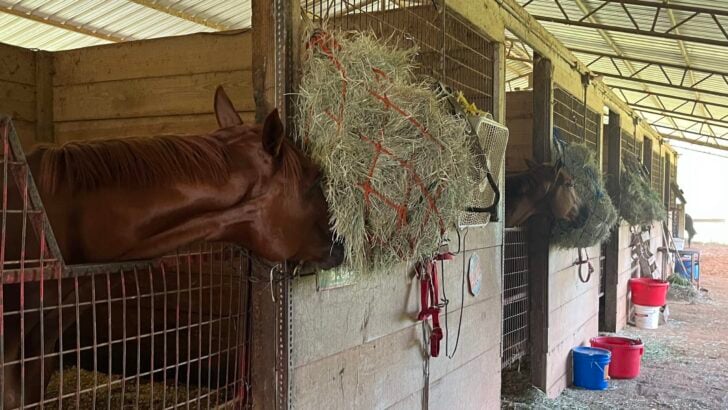
What do horses eat — horse eating hay from a hay net, the foundation of every equine diet.
Hay is the foundation of every horse’s diet regardless of workload — even horses receiving significant grain should get the majority of their daily calories from forage.

How a Horse’s Digestive System Shapes What It Eats

Everything about how horses should be fed follows directly from how their digestive system works. Horses are hindgut fermenters — meaning most of their fiber digestion happens in the cecum and large colon, not the stomach. This creates two important constraints every feeding decision has to respect. For a full explanation of equine digestive anatomy, see our horse digestion guide.

First, the horse’s stomach is small relative to its body size — roughly 2–4 gallons in a 1,100-pound animal. It empties quickly, which means large, infrequent grain meals create acid pooling in an empty stomach and dramatically increase ulcer risk. In simple terms: horses are designed to eat small amounts continuously, not large meals twice a day. For a deeper look at how this affects feeding decisions, see our horse digestion guide.

Second, the hindgut fermentation process depends on a stable microbial population. Sudden dietary changes — switching hay types abruptly, dramatically increasing grain, or giving access to lush spring pasture overnight — disrupt that microbial balance and can trigger colic or laminitis.

Miles’ Take — Why Feeding Order Matters I always feed hay before grain, and I’ve done it that way for 30 years. When hay goes in first, the horse has something to chew and digest before the grain hits — saliva production goes up, stomach acid gets buffered, and the grain passes through more slowly. When grain goes in first to a hungry horse, it hits an empty stomach and moves through fast. Over time, feeding grain first on an empty stomach is one of the clearest pathways to gastric ulcers I know. For more on recognizing and managing this problem, see our guide on horse ulcers. It’s a small habit that makes a real difference.

Hay: The Foundation of Every Horse’s Diet

Hay is what horses eat more than anything else, and choosing the right type matters. The two broad categories are grass hay and legume hay, and most horses do best on a combination or on grass hay alone.

Hay Type Protein % Energy Best For Notes
Timothy 8–11% Moderate Pleasure horses, maintenance Widely available; consistent quality; low sugar
Orchard grass 10–12% Moderate–high All-around; horses that need more energy Palatable; horses tend to prefer it over Timothy
Bermudagrass 8–10% Moderate Southern U.S. horses; maintenance Common in Louisiana; limit lush spring growth for metabolic horses
Alfalfa 15–22% High Hard-working horses, young horses, underweight horses Rich — use mixed or as supplement to grass hay, not sole diet for most horses
Mixed hay (grass + legume) 10–14% Moderate–high Most horses Good balance; reduces risk of overfeeding protein from pure alfalfa
Coastal Bermuda 7–9% Low–moderate Easy keepers; metabolic risk horses Lower protein and energy than alfalfa; common in Southeast
Hay types and nutritional profiles. Actual values vary by cutting, maturity at harvest, and growing conditions — hay testing is the only way to know exactly what you’re feeding. Source: AAEP nutrition guidelines.

The general rule is that horses should eat 1.5–2% of their body weight in forage daily. For a 1,100-pound horse, that’s 16–22 pounds of hay per day if the horse is not on pasture. Horses in hard work may need 2–2.5% to maintain condition alongside their grain ration. Horses with metabolic conditions or obesity risk may need to be restricted to 1.5% of their current weight while targeting a lower goal weight.

From the barn — How I feed hay to my racehorses vs. my pleasure horses: My Thoroughbreds in training get Timothy or mixed grass-alfalfa hay — high quality, tested, leafy. They get hay first thing in the morning before their grain, and again in the evening. Between those feedings, they have access to hay in a slow-feed net to keep something in their stomachs throughout the day. Ulcers are a real concern with hard-working horses, and a constantly empty stomach makes them worse. My pleasure horses at Livingston get Alica Bermuda or Coastal Bermuda — solid hay, nothing fancy — because they don’t need the energy density that a horse doing daily track work requires.

Can Horses Eat Only Hay?

Yes — many horses thrive on hay alone with no grain. A horse at maintenance or light work on quality hay is getting most of what it needs. The addition of a plain salt block and fresh water covers the essentials. What hay-only feeding doesn’t cover well: high-calorie demands (horses in heavy work need concentrated energy beyond what hay volume can realistically provide), specific mineral deficiencies in regional hay (a hay test reveals whether a ration balancer is needed), and horses that struggle to maintain weight on forage alone. For the majority of pleasure horses, however, good hay plus salt plus water is a complete program.

Always check hay before buying and before feeding. Good hay is green-ish (some browning is normal), smells clean, and has no visible mold or dust. Musty smell, white or black spots, and excessive dust are all reasons to reject a bale. Dusty hay significantly increases respiratory disease risk, and moldy hay can cause colic or toxicosis. For a complete guide to selecting and storing hay, see our articles on how to choose hay for your horse and feeding horses hay.

Grass and Pasture: Benefits and Risks

Fresh pasture is the most natural feed source for horses and, when managed well, one of the healthiest. The problem is that domestic pastures — especially in spring and after rain — don’t behave like the varied, sparse natural grazing that shaped equine digestion. Nutrient density and nonstructural carbohydrate content can spike dramatically, which is why pasture management matters as much as what’s in the feed bucket. Aim for at least 2–3 acres of good pasture per horse.

The main pasture risk situations to manage:

  • Lush spring grass and post-rain flush — highest risk. NSC levels spike, especially in April–June in the Gulf South. Limit metabolic and overweight horses to morning turnout when sugar is lower, or use a grazing muzzle.
  • Stressed or frost-damaged grass — plants concentrate sugars as a stress response. Remove at-risk horses from pasture and feed hay instead until conditions normalize.
  • Overgrazed pasture — increases weed and sand ingestion risk. Rotate pastures and supplement with hay when grass coverage is thin.
  • Sparse dry pasture (drought) — inadequate calories; supplement with hay. In sandy soils, consider psyllium supplementation to reduce sand colic risk.
  • Stable established pasture — low risk for most horses; monitor body condition in easy keepers who may gain weight even on modest grass.
Spring grass and laminitis — the highest-risk period of the year Laminitis triggered by high nonstructural carbohydrate intake from lush spring grass is one of the most common and most preventable serious conditions in horses. Horses that are overweight, have a history of laminitis, or show signs of insulin resistance (cresty neck, fat pads, easy weight gain) are at the highest risk. In Louisiana, the danger window is roughly April through June for Bermudagrass flush. Limit these horses to a few hours of morning turnout when sugar content is lower, use a grazing muzzle, or keep them on hay until the flush passes. For prevention and management, see our detailed guide to preventing laminitis in horses and managing high-risk pasture conditions.

Grain and Concentrates: When and How Much

Grain is an energy supplement for horses whose caloric needs exceed what forage can provide — horses in hard work, young growing horses, mares in late pregnancy or lactation, and horses that struggle to hold weight. Many pleasure horses, easy keepers, and horses on good pasture need none at all. Horses with insulin resistance or equine metabolic syndrome require particularly careful grain management — see our guide to managing equine metabolic syndrome for specifics.

Grain / Concentrate Type Energy Density Best Use Cautions
Oats Moderate Working horses; good fiber-to-starch ratio Whole oats are safe; still limit to what’s needed
Corn High High-energy needs; cold weather feeding Dense starch — feed cautiously; colic risk if overfed
Barley Moderate–high Working horses; European racing tradition Usually fed processed (crimped or rolled)
Commercial textured feed Varies Convenience; balanced formulation Read the label — many contain molasses; check NSC for metabolic horses
Commercial pelleted feed Varies Consistent nutrition; easier chewing for seniors Choose workload-appropriate formulation
Fat supplements (rice bran, flaxseed, oil) High Performance horses; weight gain without starch load Introduce slowly; balance omega-3 to omega-6 ratio
Beet pulp Moderate Fiber source; weight gain without sugar spike Soak before feeding; low starch — safe for metabolic horses
Common grains and concentrates. No single grain meal should exceed 4–5 pounds for an average-sized horse — large starch loads increase colic and laminitis risk.

Split daily grain across at least two meals — ideally three for horses in hard training. Never feed a hot, sweated horse a large grain meal immediately after work. Allow the horse to cool first, and offer water in small amounts frequently during the cooling process rather than a full bucket at once.

For horses in race training or high-performance programs, see our detailed guide to feeding racehorses for peak performance and our guide to feeding performance horses for competition and training. For underweight horses, see our guide on how to put weight on a horse.

One note on alfalfa-only feeding: a friend of mine feeds his performance Quarter Horses nothing but alfalfa cubes with free-choice access, and his horses competed well at a recent roping event in Fort Worth. It works for him — hard-working horses self-regulating on high-protein forage. I still wouldn’t recommend it for maintenance horses, where the excess protein adds metabolic load without benefit. But it’s a reminder that horses are more adaptable than the rules suggest when the basics are right.

Miles Henry's horse drinking water from a bucket after a hard work at the Fair Grounds.
Keeping my horse hydrated after a hard work at the track.

Water: The Most Critical Nutrient

Water is the most critical nutrient in any horse’s diet. Dehydration leads to impaction colic faster than almost any other single factor, and horses can become dangerously dehydrated more quickly than most owners expect — especially in hot weather or during hard work.

Daily water requirements for a 1,100-lb horse: maintenance in mild weather requires 8–10 gallons; light work raises that to 10–12 gallons; hard training or race work needs 12–15+ gallons; Gulf South summers can push requirements to 15–20 gallons or more. Hay-fed horses need roughly 20–30% more water than horses on pasture because dry forage contains almost no moisture. Lactating mares need 15–20+ gallons daily. Always provide free-choice access — never ration water.

Cold water in winter is one of the most underappreciated colic risk factors. Horses significantly reduce their water intake when water temperature drops below about 45°F. In cold climates — or during the occasional Louisiana cold snap — heated water buckets or tank heaters are a straightforward intervention that meaningfully reduces winter impaction colic rates. Salt supplementation (loose salt free-choice, or a plain salt block) encourages drinking by maintaining thirst drive, and it’s one of the simplest and most cost-effective things any horse owner can do. For a full guide to recognizing and responding to colic, see our article on what to do when your horse colics.

Miles’ Take — The Ashton Lesson The night before one of his races, my horse Ashton refused his feed. He was drinking, moving normally, and showed no signs of colic — he just didn’t want his grain. I reduced his grain and kept his hay available. He ran well the next day. What I learned is that horses often self-regulate in ways that make sense if you pay attention to the whole picture. A horse that stops eating grain but is still drinking and passing manure normally is usually telling you something minor. A horse that stops drinking is always a concern that needs investigation quickly.

Supplements: What’s Worth It and What Isn’t

The horse supplement market is large and aggressive. Most horses on a balanced diet of quality hay and appropriate concentrates don’t need additional supplementation beyond a plain salt block. The supplements that are genuinely worth considering for specific situations are a much shorter list than the industry would suggest.

Supplement Type Evidence Base Who Needs It Skip It If
Plain salt (loose or block) Strong All horses Never skip — essential for water intake and electrolyte balance
Electrolytes Strong (heavy work/heat) Horses in hard work, especially in hot weather Horses at maintenance with good salt access
Joint supplements (MSM, glucosamine) Moderate Older horses, horses in heavy joint-loading work Young, sound horses with no joint history
Omega-3 fatty acids (flaxseed, fish oil) Moderate Horses on hay-only diets (low in omega-3); inflammatory conditions Horses on good pasture already getting omega-3 from grass
Vitamin E Strong (deficiency situations) Horses with no pasture access; horses with neuro or muscle conditions Horses on good pasture (natural vitamin E source)
Probiotics / prebiotics Emerging Horses recovering from colic, antibiotic treatment, or dietary change Healthy horses with stable diet and routine
Biotin (hoof) Moderate Horses with documented poor hoof quality Horses with good hooves — won’t improve what isn’t broken
Supplement evidence and use cases. Have your hay tested before adding mineral supplements — many hay-based deficiencies vary by region and cutting, and supplementing without testing can create imbalances.
Miles’ Take — Keep It Simple I’ve tried a lot of supplements over 30 years. My honest view: quality forage, appropriate grain for the workload, free-choice salt, and clean water get you 95% of the way there for most horses. Joint supplements make a real difference for older horses in work — I’ve seen it. Electrolytes in Louisiana summer heat are non-negotiable for hard-working horses. Beyond that, I’m skeptical of most of it. The money spent on unnecessary supplements is usually better spent on better hay.

One area where nutrition shows up visibly is coat quality. A dull, rough coat is often one of the first signs of nutritional gaps — particularly omega-3 deficiency or insufficient protein. For more on the link between diet and coat condition, see our guide on horse coat nutrition.

What Do Horses Eat Daily? (Real Examples by Workload)

The easiest way to understand equine feeding is to see what a full day actually looks like. Here are three real daily feeding examples for a 1,100-pound horse at different workload levels — the same horse, three very different jobs:

Horse Type Morning Midday / Turnout Evening Daily Total
Pleasure horse (light work or pasture rest) 8–10 lbs grass hay Pasture access or slow-feed hay net 8–10 lbs grass hay 18–20 lbs hay, no grain, free-choice salt, water
Moderate work horse (arena, trail 4–5x/week) 8 lbs hay + 2–3 lbs grain Hay net or pasture 8 lbs hay + 2–3 lbs grain 18 lbs hay + 4–6 lbs grain split into 2 meals, salt, water
Racehorse in full training 6 lbs quality hay + 4–5 lbs performance feed Slow-feed hay net in stall 6 lbs hay + 4–5 lbs performance feed 15–18 lbs high-quality hay + 8–12 lbs performance feed across 2–3 meals, electrolytes in heat
Real daily feeding examples for a 1,100-lb horse. Adjust amounts based on individual body condition score — these are starting points, not fixed prescriptions.

These are starting points — adjust based on individual body condition score, season, and forage quality. A horse that’s losing condition on these amounts needs more; one that’s gaining weight on them needs less.

How Feeding Changes by Workload

The single most important variable in what a horse eats is what it does. A horse doing nothing needs far less than a horse in hard training. Getting this wrong in either direction — underfeeding a working horse or overfeeding an idle one — creates problems that show up in performance, soundness, and long-term health.

Workload Level Examples Forage Grain / Concentrate Key Consideration
Maintenance (no work) Retired, companion, pasture rest 1.5–2% body weight None or ration balancer only Obesity risk — monitor body condition score closely
Light work Trail riding 1–3x/week, light arena work 1.5–2% body weight 0–0.5% body weight Many horses need no grain at this level with good hay
Moderate work Regular riding, showing, lessons 4–5x/week 1.5–2% body weight 0.5–1% body weight Monitor condition; adjust grain up or down as needed
Heavy work Endurance, advanced dressage, jumping training 2–2.5% body weight 1–1.5% body weight Ulcer risk increases — consider buffering agents; never skip hay first
Race training Thoroughbreds in full track training 1.5–2% (quality hay) 1–1.5%+ body weight Multiple small grain meals; ulcer management critical; electrolytes in heat
Feeding guidelines by workload for an average 1,100-lb horse. These are starting points — adjust based on individual body condition score every 2–4 weeks.

Body condition scoring — assessing a horse’s fat cover on a 1–9 scale — is the most practical tool for knowing whether you’re feeding the right amount. A score of 4–5 is ideal for most horses. Below 4 means the horse needs more calories. Above 6 means it needs less, or more exercise, or both. Check body condition every two to four weeks and adjust feed before a problem becomes serious. For guidance on building feeding and care into a consistent routine, see our complete horse care schedule. For how feeding changes across seasons, see our guide to seasonal horse feeding strategies. For senior horses specifically, the feeding picture changes again after age 20 — see our complete guide to feeding senior horses.

Common Horse Feeding Mistakes

Most feeding-related health problems in horses come from a handful of recurring mistakes. None of them are complicated — but they’re common enough that every horse owner should know them by name. Several of these mistakes are among the leading causes of colic; if you’re not familiar with how to recognize and respond to colic, see our guide on what to do when your horse colics.

Mistake Why It Happens The Consequence The Fix
Feeding too much grain to horses that don’t need it Owners assume working horses equal grain; pleasure horses get the same ration Obesity, laminitis, metabolic syndrome Match grain to actual workload; most pleasure horses need none
Making sudden diet changes New hay arrives, pasture access changes overnight, grain switched without transition Colic, hindgut acidosis, laminitis All changes over 7–10 days minimum
Not providing enough forage Hay is expensive; owners cut back; grain fed as substitute Gastric ulcers, colic, wood chewing, weaving Forage should always be the base — never substitute grain for hay
Ignoring winter water intake Cold water is less appealing; horses reduce drinking; owners don’t notice Impaction colic — the leading preventable cause of equine death Heated water buckets; free-choice salt; check intake daily
Feeding grain before hay Convenience; grain is easier to portion; hay takes longer to prepare Grain hits empty stomach → ulcer risk, hindgut issues Always hay first, every feeding, no exceptions
Unrestricted spring pasture access Spring arrives, gate opens, horse grazes freely — seems natural Laminitis from high-NSC flush grass, especially in metabolic horses Gradual pasture introduction; limit hours; use grazing muzzle for at-risk horses
Feeding by volume instead of weight Owners count flakes, scoops, or cans rather than weighing Significant over- or under-feeding — a flake of alfalfa is not a flake of Timothy Use a scale; feed by weight not volume
Common feeding mistakes and how to avoid them. Most are preventable with consistent routines and basic knowledge of equine digestive physiology.

What Horses Should Never Eat (And Safe Treats)

Horses can safely eat a range of fruits and vegetables as occasional treats. The key word is occasional — treats are not a meaningful nutrition source and should not substitute for forage. The foods to avoid list is shorter but more important, because some common human foods are genuinely dangerous to horses.

Food Safe? Notes
Apples Yes (treats) Remove core and seeds; cut into pieces for safety
Carrots Yes (treats) Cut lengthwise to reduce choking risk
Bananas Yes (treats) Including the peel
Watermelon Yes (treats) Horses enjoy the rind; high water content
Peppermints / sugar cubes Yes (treats, limited) Limit for metabolic or insulin-resistant horses
Avocado NO — toxic All parts — fruit, leaves, bark, pit — are toxic to horses
Onions / garlic (large amounts) NO — toxic Small supplemental garlic amounts sometimes used; large amounts cause anemia
Chocolate / caffeine NO — toxic + prohibited Theobromine toxicity; prohibited substances for competing horses
Rhubarb NO — toxic Contains oxalic acid; causes kidney damage
Bread / baked goods (large amounts) Avoid Yeast can cause gas and digestive upset; no nutritional value
Lawn clippings NO Ferment rapidly in the bag; cause colic when eaten in quantity
Meat / animal products NO Horses are strict herbivores; digestive system cannot process animal protein
Safe treats and foods to avoid. When in doubt about a specific food, consult your veterinarian before offering it. Source: AAEP.
Large trailer load of horse hay, important to have plenty for horses kept in stalls.
Bulk hay delivery, it’s crucial to have plenty of hay on hand.

Core Feeding Rules Every Owner Should Know

These rules apply across all horses, all workloads, and all feed types. They’re not complicated — but consistently following them prevents the most common and most serious feeding-related health problems.

  1. Feed hay before grain at every feeding. Never offer grain to a horse that hasn’t had forage recently. Hay buffers stomach acid; grain on an empty stomach accelerates ulcer development.
  2. Change diets over 7–10 days minimum. This applies to every switch — hay type, grain brand, pasture introduction. The hindgut microbiome needs time to adjust. Abrupt changes cause colic.
  3. No single grain meal over 4–5 lbs. Large starch loads overwhelm the small intestine, reach the hindgut undigested, and trigger acidosis. Split large daily rations into multiple smaller meals.
  4. Fresh water available at all times. Never ration water. Horses that drink less than they need are at real risk for impaction colic — particularly in cold weather when water is less palatable.
  5. Feed by weight, not volume. A flake of alfalfa weighs nearly twice what a flake of Timothy weighs. The only accurate measure is a scale.
  6. Let a hot horse cool before feeding. After hard work, allow heart rate to normalize before offering grain. Offer water in small amounts frequently during the cooldown — not a full bucket at once.
  7. Check teeth annually. Horses with sharp points or hooks can’t chew properly, which means they can’t extract nutrition from feed efficiently. Dental problems cause weight loss that feed changes alone won’t fix.
  8. Feed horses individually when possible. In group feeding, dominant horses eat too much and submissive ones eat too little. The result is weight and health imbalances that compound over time.
  9. Check body condition every 2–4 weeks. Adjust feed before problems develop. A horse losing weight slowly is much easier to correct than one that has become significantly underweight.
  10. Never feed moldy or dusty hay. Mold causes colic and toxicosis. Dust causes heaves and other respiratory conditions. When in doubt, reject the bale — the cost of bad hay is always higher than the cost of replacing it.

For guidance on raised versus ground feeding, see our article on raised vs. ground feeding and our complete horse care schedule.

FAQs: What Do Horses Eat?

What do horses eat every day?

Horses eat primarily forage — hay, grass, or both — as the foundation of their daily diet. A 1,100-pound horse needs roughly 16–22 pounds of forage per day (1.5–2% of body weight). Horses in heavy work additionally receive grain or commercial concentrates, typically 5–10 pounds split across multiple meals. All horses need free access to fresh water and a salt source daily. Treats (apples, carrots) are supplemental and not a significant part of the diet.

Do horses eat hay or grass?

Horses eat both hay and grass — they are the same nutritional category (forage) in different forms. Hay is dried grass or legumes, fed when fresh pasture is unavailable or insufficient. Many horses receive hay year-round and have supplemental pasture access. The choice between hay types and pasture depends on the horse’s workload, metabolic health, and what’s available regionally. Horses with metabolic conditions (insulin resistance, laminitis history) need carefully managed grass access, particularly during spring flush growth.

Do horses need grain?

No — many horses do not need grain. Pleasure horses, easy keepers, and horses on good pasture can maintain excellent condition on quality forage alone, sometimes with a ration balancer to fill nutritional gaps. Grain is an energy supplement for horses whose caloric needs exceed what forage can provide: hard-working horses, growing horses, mares in late pregnancy or lactation, and horses that struggle to hold weight. Overfeeding grain to horses that don’t need it is a common cause of obesity, laminitis, and metabolic problems.

How much hay does a horse eat per day?

A horse should eat 1.5–2% of its body weight in forage daily. For a 1,000-pound horse, that’s 15–20 pounds of hay per day if not on pasture. For a 1,200-pound horse, it’s 18–24 pounds. Horses in hard work may need up to 2.5% to maintain condition alongside their grain. Horses with metabolic conditions may need to be restricted to 1.5% of their current body weight. Always feed by weight rather than by the number of flakes — hay density varies significantly between types and cuttings.

How much water does a horse drink per day?

A horse at maintenance in mild weather drinks 8–10 gallons of water per day. In hot weather or during hard work, that rises to 12–20 gallons or more. Lactating mares need 15–20+ gallons. Horses that suddenly reduce water intake are at risk for impaction colic — reduced drinking should always be investigated. Salt supplementation (free-choice loose salt or a plain salt block) encourages adequate water intake by maintaining thirst drive.

What foods are toxic to horses?

Foods that are toxic to horses include avocado (all parts), onions and garlic in large amounts (cause anemia), chocolate and caffeine (theobromine toxicity; also prohibited for competing horses), rhubarb (oxalic acid causes kidney damage), and lawn clippings in quantity (ferment rapidly and cause colic). Horses are strict herbivores and cannot safely process any meat or animal products. When in doubt about a specific food, consult a veterinarian before offering it.

How do I transition my horse to a new feed?

Any change to a horse’s diet should happen over at least 7–10 days. Start by replacing approximately 25% of the current feed with the new feed, then increase to 50% at day 3–4, 75% at day 6–7, and 100% by day 10. This applies to switching hay types, introducing new grain, increasing concentrate amounts, or transitioning from winter hay to spring pasture. The gradual change gives the hindgut’s microbial population time to adapt. Abrupt dietary changes are one of the most common causes of colic in otherwise well-managed horses.

What do racehorses eat compared to pleasure horses?

Racehorses in full training eat significantly more energy-dense food than pleasure horses. They receive high-quality hay (Timothy or grass-alfalfa mix) plus commercial concentrate feeds formulated for performance — typically 8–12 pounds of grain per day split across 2–3 meals. Fat supplementation (rice bran, oil) is common to add energy without large starch loads. Electrolytes are essential in hot weather. Pleasure horses at maintenance often need no grain at all, or just a ration balancer. The digestive principles are identical — forage first, small grain meals, gradual changes — but the quantities and formulations are very different.

Can horses eat only grass?

Yes — horses evolved to live on grass, and many do well on pasture alone when it is adequate in quantity and quality. A horse on good pasture year-round may not need hay or grain at all. However, most domestic situations require hay supplementation: pasture becomes insufficient in winter, drought, or when stocking density is too high. Horses with metabolic conditions (insulin resistance, laminitis history) cannot safely eat unlimited grass, particularly during spring flush growth when nonstructural carbohydrate levels are high. And horses in regular work typically need more energy than grass alone provides. So while grass-only is biologically possible and natural, it works reliably only under specific conditions.

Conclusion

According to guidelines from the American Association of Equine Practitioners, forage should make up the majority of a horse’s diet.

What horses eat is simpler than the supplement aisle suggests: hay and water first, grain only when the workload justifies it. The complexity is in the details — which hay, how much, when to add grain, how to manage seasonal pasture risk, and how to adjust as workload and age change. Getting those details right is what separates a horse that thrives for 30 years from one that develops chronic health problems in its teens.

The most useful thing any horse owner can do is learn to read body condition accurately and check it regularly. Feed the horse in front of you, not the horse you think you have. A horse that was at ideal weight in October may need significantly more feed by February, and a horse that gained through a lush spring pasture may need a real reduction heading into summer.

If you want to improve your horse’s feeding program, start with one step: weigh your hay and check body condition this week. That alone catches most problems early — before weight loss becomes significant, before a metabolic issue develops, before the vet bill arrives. If you get forage, water, and consistency right, you’ll prevent more problems than any supplement ever will.

For deeper guidance on specific aspects of equine nutrition, see our complete feeding library: how to choose hay for your horse, feeding horses hay, feeding senior horses, seasonal horse feeding strategies, feeding racehorses for peak performance, feeding performance horses for competition, and raised vs. ground feeding.

What does your horse eat — and has your feeding program changed as its workload or age shifted? Share your setup in the comments. I wrote every one, and it helps other horse owners avoid the same mistakes.

Sources

  • National Research Council — Nutrient Requirements of Horses (6th ed.): nap.edu
  • American Association of Equine Practitioners — Equine nutrition guidelines: aaep.org
  • University of Minnesota Extension — Hay in horse diets: extension.umn.edu
  • UC Davis School of Veterinary Medicine — Equine nutrition: vetmed.ucdavis.edu

This article provides general educational information about equine nutrition. Consult a licensed veterinarian or equine nutritionist for diet recommendations specific to your horse’s health status, workload, and regional conditions.