
Last updated: June 23, 2026
Any links on this page that lead to products on Amazon are affiliate links and I earn a commission if you make a purchase. Thanks in advance – I really appreciate it!
Tendon boots versus fetlock boots: which do you need — both or neither? This is a question I often get, especially from new show jumpers, because the two boots are frequently used together.
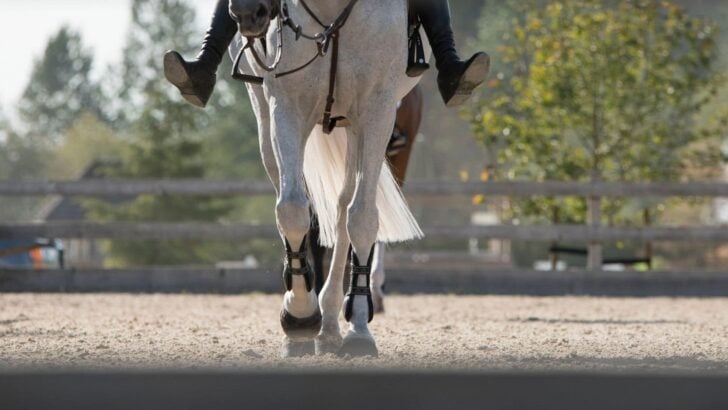
Tendon boots go on the front legs and protect the superficial digital flexor tendon from hind hoof strikes on landing. Fetlock boots go on the hind legs and protect the fetlock joint from brushing injuries between hind legs. They are used together in jumping because each protects a different leg and a different type of injury.
- Tendon boots: Front legs only — protect the back of the cannon bone from hind hoof strikes during landing
- Fetlock boots: Hind legs only — protect the fetlock joint from brushing interference between hind legs
- Used together: Standard jumping setup uses both because each covers a different risk area
- Open-front design: Preserves pole awareness so horses feel rail contact and learn careful jumping
- Key difference: Tendon boots protect a tendon; fetlock boots protect a joint
The rest of this guide breaks down how each boot type works, which legs they belong on, and when you need one set of boots rather than the other.
Table of Contents

Harrison Howard Horse Tendon Boots Open Front/Fetlock Boot
Check Price & Availability →What Tendon Boots Are and What They Do
Tendon boots protect the superficial digital flexor tendon — the SDFT — which runs along the back of a horse’s front lower leg from the knee to the fetlock. This tendon is the most vulnerable structure in a jumping horse’s front leg because it sits directly in the path of the hind hooves when a horse lands. On landing from a fence, especially at height, the hind feet frequently clip the back of the front lower legs. Without protection, even a glancing strike from a metal shoe at landing speed can cause significant tendon damage and put a horse out of work for months.
The hard protective shell of a tendon boot is positioned specifically along this rear surface of the cannon bone. It absorbs and deflects the impact energy from a hind hoof strike before it reaches the tendon tissue underneath. A quality tendon boot like the Professional’s Choice open-front design uses a dual-hardness shell with an air-cushion inner layer to distribute the force of a strike across a wider surface area rather than concentrating it on a single point of the tendon.
Why the Front of the Boot Is Open
The open front on a tendon boot is deliberate and functionally important. When the front of the leg is left exposed, a horse that clips a pole or rail feels it immediately. That sensation triggers the horse’s natural response — to snap the legs up more carefully — and over time reinforces careful jumping technique. A fully enclosed boot removes that feedback loop. In the show jumping world, riders and trainers rely on that feedback to develop an honest, clean jumper. Removing it by using a fully enclosed boot is considered counterproductive to good training.
The open front creates no meaningful protection gap for the intended use case because the front of the cannon bone is not where hind hoof strikes land. The risk is at the back of the leg, and that is precisely where the hard shell is. If a horse is striking its own front cannon bone — a different problem caused by gait irregularities — a brushing boot with full circumferential coverage is the right tool, not a tendon boot.
Tendon boots are front-leg only: Tendon boots are sized, shaped, and positioned for the front legs. The protective shell curves to the anatomy of the front cannon bone and the structure of the SDFT. They are not interchangeable with hind leg boots and should never be used on the hind legs as a substitute for fetlock or brushing boot protection.
What Fetlock Boots Are and What They Do
Fetlock boots protect the fetlock joint — the horse’s “ankle” — on the hind legs. The fetlock is the joint where the cannon bone meets the pastern, and on the hind legs it is directly exposed to a specific type of interference injury called brushing: when one hind leg swings through and strikes the inside of the opposite hind fetlock joint during movement. That contact can cause bruising, swelling, lameness, and soft tissue damage to the joint structures if it happens repeatedly at speed.
Because the fetlock joint is a smaller, more compact target than the full cannon bone, fetlock boots are shorter and less bulky than tendon boots. They are designed to wrap the joint with a hard outer shell and padded interior while leaving the front of the joint open — again to preserve pole awareness and jumping sensitivity. In a jumping horse, the hind legs are responsible for generating the push that clears the fence, and overly restricting hind leg movement with heavy boots can reduce that push. The compact design of a fetlock boot gives protection without sacrificing hind end performance.
All-Purpose vs Open-Front Fetlock Boots
Fetlock boots come in two main configurations. All-purpose fetlock boots have a hard outer shell and full circumferential padding — they wrap the entire joint and are used for schooling, trail riding with horses that brush on their hind legs, or training situations where maximum protection is the priority. Open-front fetlock boots leave the front of the joint uncovered, matching the philosophy of the tendon boot: the horse should feel rail contact and learn to jump carefully. Open-front fetlock boots are the standard for show jumping competition, while all-purpose designs are more common in everyday training contexts.
Both designs protect the inside of the fetlock joint from brushing strikes. The difference is in how much contact feedback the horse receives during work. For a horse with a significant brushing problem that causes injury even at slow gaits, an all-purpose fetlock boot provides more complete coverage. For a horse competing over fences that brushes only at speed, the open-front design is the correct choice.

Tendon Boots vs Fetlock Boots: Key Differences
The core structural difference comes down to this: tendon boots provide rear protection for the front legs, and fetlock boots provide joint protection for the hind legs. That single distinction explains every design decision that follows — why they are different sizes, why each has an open front, and why they are always used as a pair in jumping rather than one or the other.
The table below breaks down every relevant structural and functional difference. Understanding these distinctions before purchasing is how you avoid the most common mistake riders make with leg protection: buying the right product and putting it on the wrong legs.

HORZE Chicago Protective Horse Tendon Boots
Check Price & Availability →When to Use Tendon Boots
The primary scenario for tendon boots is any jumping discipline where the horse is working over fences at height. The higher the fence, the more forceful the landing, and the greater the speed and energy of the hind hoof as it follows through. At training heights of 2 feet, the risk is modest. At 3’6″ and above in competition, a hind hoof strike on an unprotected front tendon at landing speed can cause a bowed tendon — a severe injury that can end a competitive career or require a year or more of rehabilitation. That risk alone makes tendon boots non-negotiable for horses jumping at any serious height.
Cross-country and eventing are additional situations where tendon boots belong on the front legs. The footing on cross-country courses is variable — uneven terrain, wet grass, and hard ground all increase landing impact — and the fences are fixed and unforgiving. In eventing, specialist cross-country boots are designed with additional coverage and weather resistance compared to arena tendon boots, but the underlying protection principle is the same.
A third scenario is horses with a documented tendon injury history that are returning to work or in active maintenance. In these cases, a veterinarian may recommend tendon boots during flatwork sessions as an additional layer of protection against the minor hind leg contacts that happen during lateral movements, transitions, and collected work. This is different from the jumping use case — it is about managing a known vulnerability rather than protecting against a specific landing impact.
When tendon boots are the wrong choice: Do not use tendon boots as a substitute for brushing boots on a horse that strikes the inside of its own front legs during flatwork. Tendon boots leave the inside of the front cannon bone unprotected — the hard shell is positioned at the rear. A horse that brushes its own front legs needs a boot with inside coverage, which is a brushing boot, not a tendon boot.
When to Use Fetlock Boots
Fetlock boots belong on the hind legs of any jumping horse as part of the standard tendon-boot-and-fetlock-boot pairing. The hind fetlock is the contact point for brushing injuries that occur when a horse’s hind legs swing through the stride — the faster the work, the more likely the legs will come close enough to make contact. In a horse that moves efficiently and straight, brushing on the hinds may be rare. In a horse that is wide behind, slightly cow-hocked, or simply moves with a lot of energy, it happens regularly at anything above a slow trot.
Outside of jumping, fetlock boots are the right choice for any horse that shows evidence of hind leg brushing — marks, swelling, hair loss, or actual wounds on the inside of the hind fetlock joints. You do not need to be jumping or competing to need fetlock boots. A horse that brushes during dressage work, trail riding, or turnout needs protection for that joint regardless of discipline. The all-purpose design with full circumferential coverage is more practical than open-front for non-jumping contexts because pole awareness is not a factor.
Signs your horse may need fetlock boots on the hinds:
- Hair worn or missing on the inside of one or both hind fetlock joints
- Small cuts, scabs, or swelling on the medial (inside) surface of the hind fetlock
- You can hear the hind legs clicking during movement — that contact is brushing
- Your farrier or trainer has commented on the horse being wide behind or moving with interference

HORZE Chicago Fetlock Rear Boots
Check Price & Availability →Miles’s Take: I had a Quarter Horse mare with a wide hip that brushed her hind fetlocks every time she worked above a slow trot. We tried open-front fetlock boots first because that is what I had on hand from a jumping horse. The inside coverage was adequate for a light brushing hit, but this mare hit herself hard enough that she needed the full circumferential padding of an all-purpose design. Switching to a padded all-purpose fetlock boot on her hinds solved the problem completely. The lesson was that fetlock boot selection is not just about whether to use one — it is about matching the protection level to the severity and location of the contact. A horse that barely grazes itself may do fine with an open-front; a horse that genuinely clobbers its own fetlocks needs more material on the inside of the joint.
Do You Need Both?
For jumping, yes — you need both, and they need to go on the correct legs. Tendon boots on the fronts only leaves the hind fetlocks unprotected. Fetlock boots on the hinds only leaves the front tendons unprotected. Because the two boots address completely different injury types on completely different legs, using only one half of the pair means you have addressed one risk and ignored another.
The only legitimate reason to use one without the other is when your horse needs protection for only one of the two specific injury types. A flatwork horse with a documented tendon history that does not jump needs tendon boots on the fronts and has no particular use for fetlock boots — unless it also brushes on the hinds, in which case fetlock boots belong on the hinds regardless of whether any jumping is happening. Similarly, a trail horse or dressage horse that brushes on the hind legs needs fetlock boots on the hinds without any requirement for tendon boots on the fronts, because there is no landing impact to protect against.
Approach the decision by asking two separate questions. First: does this horse face a hind hoof landing impact risk on its front tendons? If yes — jumping, eventing, tendon history — tendon boots go on the fronts. Second: does this horse face brushing or interference risk on its hind fetlock joints? If yes — any discipline, any speed at which the hind legs make contact — fetlock boots or all-purpose brushing boots go on the hinds. For more guidance on matching the right boot type to specific disciplines and gait issues, the complete horse leg boots guide covers every common scenario.
Fit and Application for Both Boot Types
Both tendon boots and fetlock boots follow the same core fit principle: snug enough that you can slide one finger between the boot and the horse’s leg at the widest point of the cannon bone, with no slipping during movement. Too tight and you risk compression injury and heat buildup. Too loose and footing grit works beneath the boot during work, causing abrasion that can be worse than going bare-legged. For a complete walkthrough of correct leg protection application, review the leg wrap and boot fitting fundamentals before you start.
Fit mistakes that cause injury with both boot types:
- Straps too tight: Excessive compression on the suspensory branches causes bandage bows — ligament damage from sustained pressure — even from a single long session
- Straps too loose: Arena footing and sand work into the gap between boot and leg and abrade the skin; the boot may also rotate or ride up during movement and lose its protective position
- Skipping the trot test: Walk and trot the horse for 30 seconds immediately after booting; any boot that moves, rotates, or rides up needs adjustment before you proceed
- Leaving boots on after work: Remove both tendon and fetlock boots immediately after each session — press your palms flat against the cannon bone and the fetlock to check for residual heat, and address any findings before the next ride
- Heat in summer: In temperatures above 85 degrees, keep sessions shorter when using neoprene boots; ice legs after hard work regardless of boot type — ice boots after a jumping session in July are not optional for horses in the South
Applying Tendon and Fetlock Boots Together
When using both as a pair, apply tendon boots to the front legs first. Brush the front legs clean, removing any dirt or grit around the cannon bone and fetlock area. Slide the tendon boot down the leg — do not drag it back up if you miss the position — with the hard shell at the rear and the opening at the front. Fasten the top strap first, then work down. Repeat for the second front leg. Then move to the hind legs and apply the fetlock boots, brushing the hind pastern and fetlock area clean before fitting. The teardrop padding should sit at the rear of the fetlock joint, with the straps fastening on the outside of the leg.
After both pairs are on, do the trot test on a straight line. Watch for any boot that moves, slides, or changes position. Check all strap tension before the actual work session begins. After work, remove both pairs, run your hands over the cannon bones and fetlock joints on all four legs, and allow the legs to breathe before returning the horse to its stall.
FAQs: Tendon Boots vs Fetlock Boots
What are tendon boots used for?
Tendon boots protect the superficial digital flexor tendon on the back of a horse’s front lower legs from hind hoof strikes during jumping. When a horse lands from a fence, the hind hooves follow through and can clip the back of the front legs at significant speed and force. The hard protective shell on the rear of a tendon boot absorbs and deflects that impact energy before it reaches the tendon. Tendon boots are also used for horses with documented tendon injury history during flatwork as an extra layer of protection.
What do tendon boots do that regular boots do not?
Tendon boots position a hard protective shell specifically along the back of the front cannon bone, where hind hoof strikes land during jumping. They also leave the front of the leg open — intentionally — so the horse can feel contact with a pole and learn to jump carefully. A standard brushing boot wraps the full circumference of the leg and protects against brushing interference, but its padding is not concentrated at the rear for impact absorption the way a tendon boot is. The two boots solve different problems and are not interchangeable.
What is the difference between tendon boots and fetlock boots?
Tendon boots go on the front legs and protect the tendon at the back of the front leg from hind hoof strikes on landing. Fetlock boots go on the hind legs and protect the fetlock joint from brushing injuries — when one hind leg strikes the other during movement. They are different sizes, different shapes, go on different legs, and protect against different injury types. In show jumping they are paired together because each boot covers a vulnerability the other does not.
Do you need both tendon and fetlock boots for jumping?
Yes, for most jumping situations you need both. Tendon boots on the fronts protect the tendon from hind hoof landing strikes. Fetlock boots on the hinds protect the ankle joint from brushing during takeoff and landing. Using tendon boots alone leaves the hind fetlocks unprotected. Using fetlock boots alone leaves the front tendons unprotected. Because each boot addresses a completely different injury on a completely different leg, they are not substitutes for each other.
Can you use tendon boots on the hind legs?
No. Tendon boots are sized and shaped for the anatomy of the front legs. The protective shell is positioned for the SDFT tendon structure on the front cannon bone. Using them on the hind legs will not provide correct protective positioning, and they will not fit correctly on the different geometry of the hind cannon bone. For hind leg protection, use fetlock boots for the fetlock joint or brushing boots for full hind leg coverage.
What horses need tendon boots?
Any horse jumping at height where hind hoof landing strikes are a genuine risk, including show jumpers, eventers, and cross-country horses. Horses with a documented history of superficial digital flexor tendon injury that are returning to work or in maintenance training benefit from tendon boot protection even during flatwork. Horses with clean confirmation doing light flatwork without jumping generally do not need tendon boots.
Are open-front boots the same as tendon boots?
Yes, the terms are used interchangeably. Open-front boots and tendon boots refer to the same piece of equipment: a boot worn on the front legs with the front surface open to preserve rail awareness, and a hard protective shell at the rear to guard the superficial digital flexor tendon. Both names are correct — open-front describes the design, tendon boot describes the protected structure.
When should fetlock boots be used without tendon boots?
When a horse brushes on its hind legs but is not jumping. A dressage horse, trail horse, or flatwork horse that strikes the inside of its own hind fetlock joints during movement needs fetlock boot protection for that joint regardless of discipline. The absence of a jumping component means there is no landing impact on the front tendons, so tendon boots are not required. Fetlock boots — or all-purpose brushing boots for more complete hind leg coverage — address the brushing risk on their own.
Do tendon boots protect the fetlock?
Not directly. Tendon boots are designed to protect the superficial digital flexor tendon on the back of the front leg — not the fetlock joint itself. The hard shell on a tendon boot ends at approximately the level of the fetlock but is positioned at the rear of the leg, not wrapped around the joint. A horse that needs fetlock joint protection — for brushing injuries on the hind legs, or impact protection on the front fetlock — needs a different boot. Fetlock boots protect the hind fetlock joints. All-purpose brushing boots provide circumferential coverage that includes the front fetlock as part of their wider protection area.
Key Takeaways: Tendon Boots vs Fetlock Boots
- Different legs, different injuries — tendon boots go on the front legs to protect the SDFT tendon from hind hoof landing strikes; fetlock boots go on the hind legs to protect the fetlock joint from brushing interference
- Both are open-front by design — the open front preserves pole awareness so horses feel rail contact and learn to jump carefully; this is intentional, not a protection gap
- For jumping, use both — neither boot substitutes for the other because they address completely different vulnerabilities on completely different legs; using only one leaves one risk unmanaged
- Tendon boots without jumping are for tendon history — a horse that has had SDFT damage benefits from tendon boot protection during flatwork even without jumping involved
- Fetlock boots without jumping are for brushing — any horse that strikes the inside of its own hind fetlocks during regular work needs fetlock boot protection regardless of discipline
- Fit rules apply equally to both — one finger between boot and leg, always do a trot test after application, remove immediately after work and check for heat on all four legs
- Size tells you which is which — tendon boots are taller and cover from the mid-cannon to the fetlock; fetlock boots are smaller and wrap the joint only; if you pick up a boot and are unsure which it is, taller means tendon, shorter means fetlock
About Miles Henry
Racehorse Owner & Author | 30+ Years in Thoroughbred Racing
Miles Henry (legal name: William Bradley) is a professional horseman based in Folsom, Louisiana. He holds Louisiana Racing License #67012 and has spent over three decades managing Thoroughbreds at premier tracks including Fair Grounds, Delta Downs, and Evangeline Downs.
Expertise & Hands-On Experience: Beyond the track, Miles has decades of experience in specialized equine care, covering everything from hoof health and nutrition to training protocols for Quarter Horses, Friesians, and Paints. Every guide on Horse Racing Sense is rooted in this “boots-on-the-ground” perspective.
30 of their last 90 starts
Equibase Profile.

Connect with Miles: